



An AI detector that actually works.
New
Instantly know what's human and AI on Twitter, LinkedIn, Substack and more. Get our new Chrome extension.

en
Solutions
- AI Detector
- Chrome Extension
- API
- LMS Integrations
- Plagiarism Checker
- Multilingual AI Detection
- Pricing
- Contact Sales
Use Cases
Company
Blog
en
NEWTry our new chrome extension
An AI detector that actually works.
Detect AI-generated content with 99.98% accuracy. Trusted by universities, schools, and enterprises worldwide.
Try it for freePartner With Us

Reviewed as the proven, most reliable and most accurate AI detection tool in the market by third parties including University of Maryland and the University of Chicago.
Detect AI Assistance
99.98%+ Accuracy
3rd Party Verified
Free Checks
Try an example:HumanChatGPTAI + Human
UploadScan for AI
Trusted by Global Brands







What is an AI detector
and should you use one?AI writing has tells
01
01
AI writing has tells
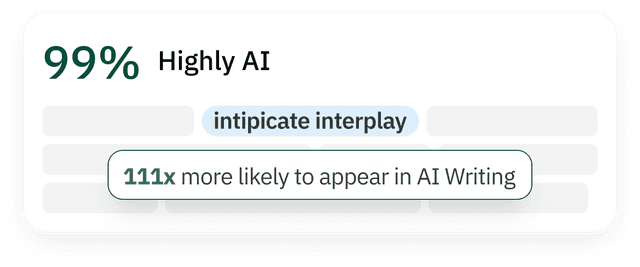
AI writing contains structural, stylistic, and semantic patterns that can all be detected by a trained eye or sufficiently sophisticated detection software. AI detection is not magic. It can actually work.
Next
Pangram detects them
02
02
Pangram detects them
Pangram's AI detector uses natural language processing and a massive data set of human and AI writing to analyze patterns in AI generated text created by popular models like ChatGPT, Gemini, Grok, Llama and Claude. Pangram's accuracy leads the industry and has been verified by researchers at the University of Chicago and University of Maryland.
Next
Content transparency is critical
03
03
Content transparency is critical
In an era where AI-generated content is increasingly prevalent in academia, media, and business, the ability to distinguish between human and machine-authored text is critical. In education, it creates trust between students and teachers. It's important in journalism where integrity is essential. AI generated text isn't inherently bad. However, society can benefit from being able to distinguish between AI and human text.
Next
01
AI writing has tells
AI writing has tells
AI writing contains structural, stylistic, and semantic patterns that can all be detected by a trained eye or sufficiently sophisticated detection software. AI detection is not magic. It can actually work.
02
Pangram detects them
Pangram detects them
Pangram's AI detector uses natural language processing and a massive data set of human and AI writing to analyze patterns in AI generated text created by popular models like ChatGPT, Gemini, Grok, Llama and Claude. Pangram's accuracy leads the industry and has been verified by researchers at the University of Chicago and University of Maryland.
03
Content transparency is critical
Content transparency is critical
In an era where AI-generated content is increasingly prevalent in academia, media, and business, the ability to distinguish between human and machine-authored text is critical. In education, it creates trust between students and teachers. It's important in journalism where integrity is essential. AI generated text isn't inherently bad. However, society can benefit from being able to distinguish between AI and human text.
Pangram combines cutting-edge AI and comprehensive plagiarism detection to give you the complete picture of text authenticity and get the information you need, all in one place.

AI Segment Analysis
Pangram won't just tell you how confident it is that the document is AI, but also how much of it is.

AI Assistance
Pangram will highlight segments that have been edited by AI rather than fully AI-generated.

Plagiarism Checker
Check for plagiarism and AI all at once. Perform an AI plagiarism check with one click.

Features
How is
Pangram different?There are many AI detectors available, but Pangram is different. It actually works. We also provide advanced features backed by peer-reviewed research that allow users to understand the origin of a piece of writing.


Years of research
Uses proprietary technology with years of research and development behind it, not an open source model or commercial LLMs covered with branding.

Trained on diverse data sets
Pangram relies on diverse datasets, hard negative mining, and active learning to achieve industry leading FPRs rather than perplexity and burstiness, which often fail in practice.

Detects all LLMs
Pangram can detect content from all major language models including ChatGPT, Claude, Gemini, Llama and more, making it a comprehensive solution for AI detection.
Supports 20+ languages
Our AI detection works across more than 20 languages, making it a truly global, multilingual solution for institutions and businesses worldwide.
Out-performed trained humans
Independent studies have shown that Pangram's AI detection outperforms trained human readers in identifying AI-generated content.

Detects humanized text
Pangram can detect AI-generated text even after it has been "humanized," or processed by tools that attempt to evade AI detection, ensuring reliable detection.

Verified accuracy
Our accuracy and reliability have been independently verified by third-party researchers and educational institutions.
Who we are
About
Pangram LabsAt Pangram, our mission is to rebuild trust amidst the increase in generative AI content. Founded in Brooklyn, NY, in 2024 by AI researchers from Tesla and Google, we continue to contribute to the research community to increase transparency. If you're interested, read more about our contributions and collaborations.
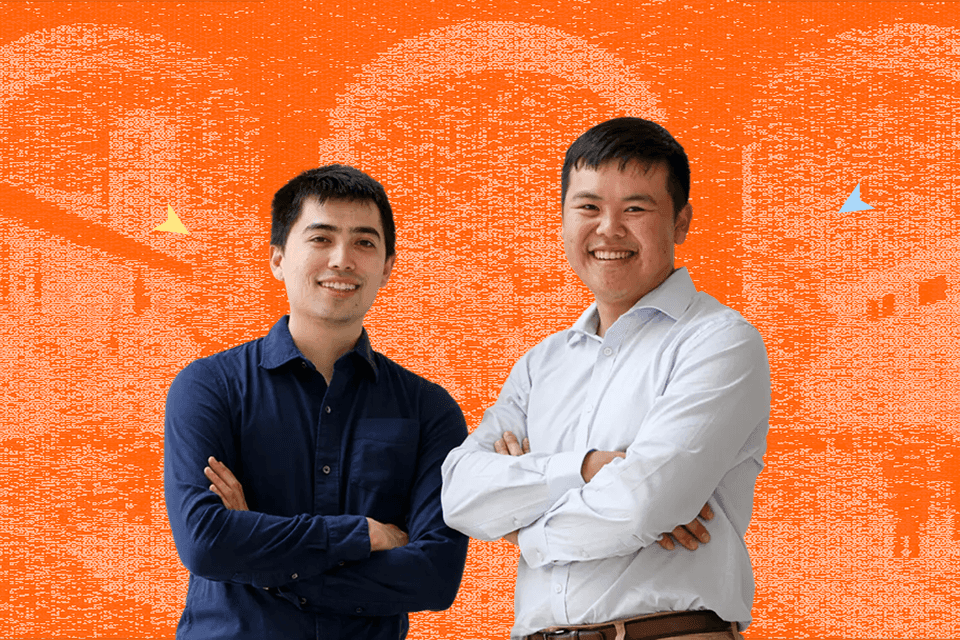
Max Spero, CEO
ex. Google ML EngineerStanford Computer Science
Bradley Emi, CTO
ex. Tesla Machine Learning ScientistStanford Computer Science | Physics
01
Input your text
Copy and paste your text into the field or upload files. Pangram supports PDF, DOCX, RTF files and up to 100 files at a time.

02
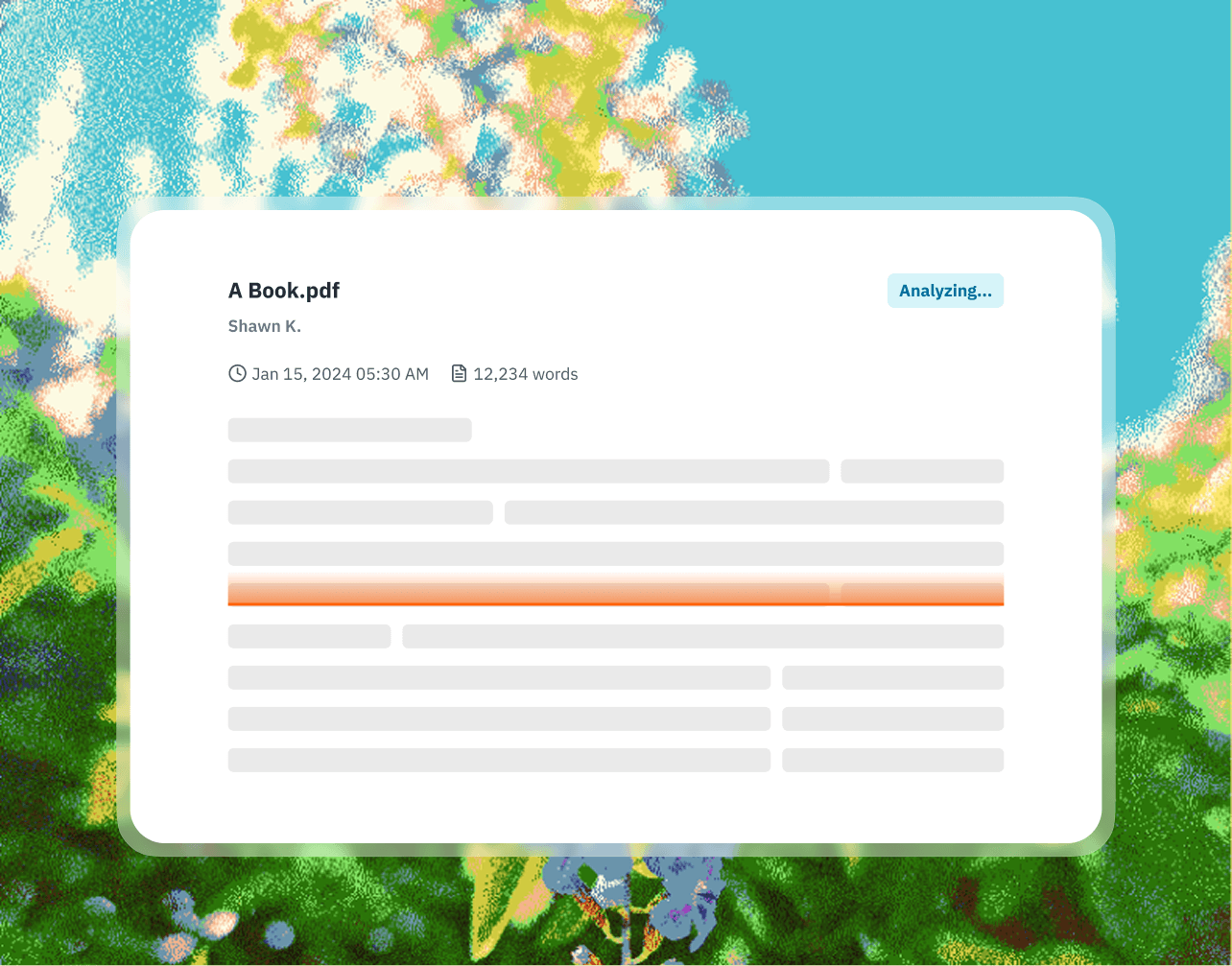
Scan for AI Content
Pangram analyzes your text using advanced AI detection algorithms to identify AI-generated content with high accuracy.
03
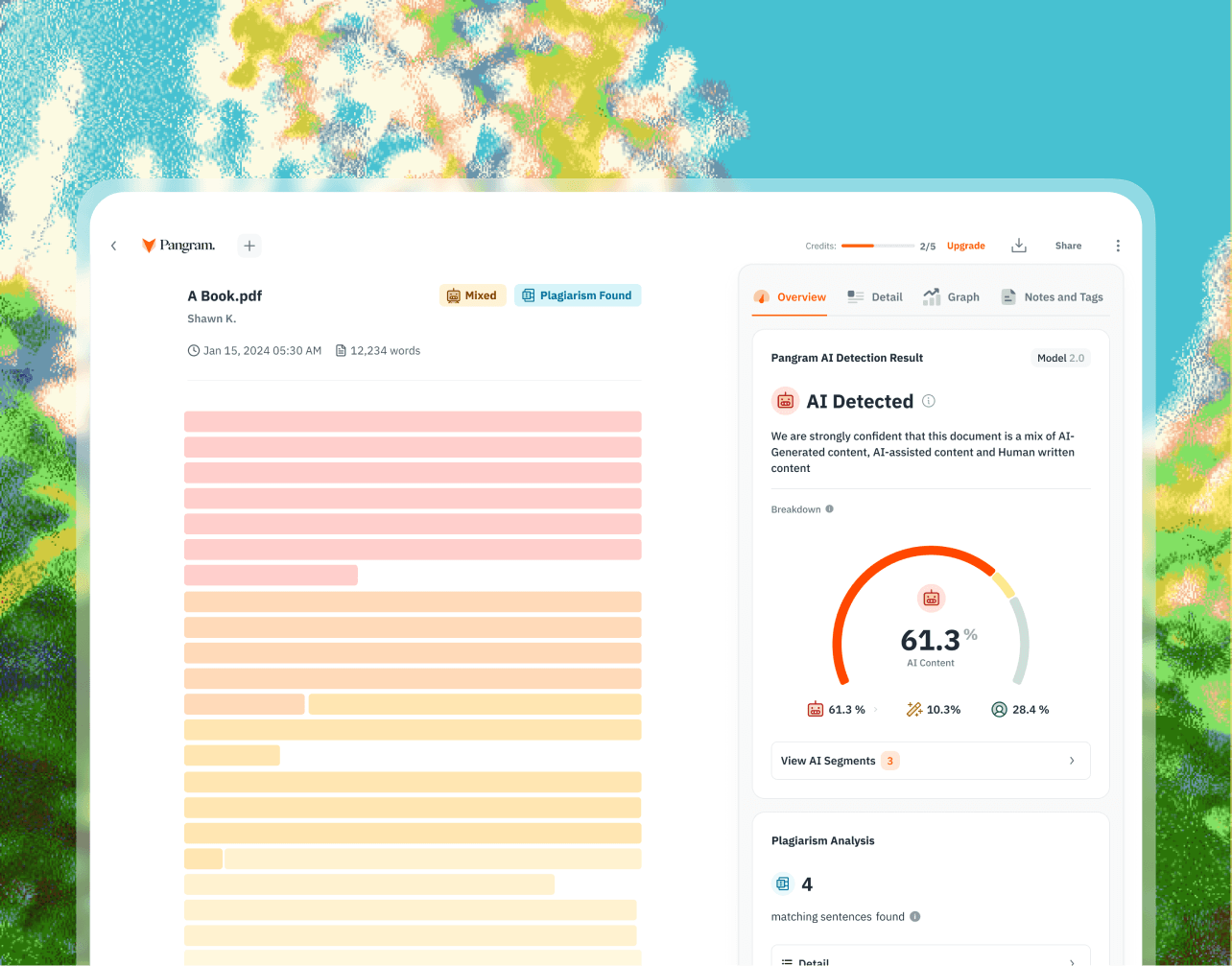
View results
Review detailed results showing AI detection scores, highlighted sections, and comprehensive analysis of your text.
04
Access past records
Access your complete history of scans, download reports, and manage your past detection records all in one place.
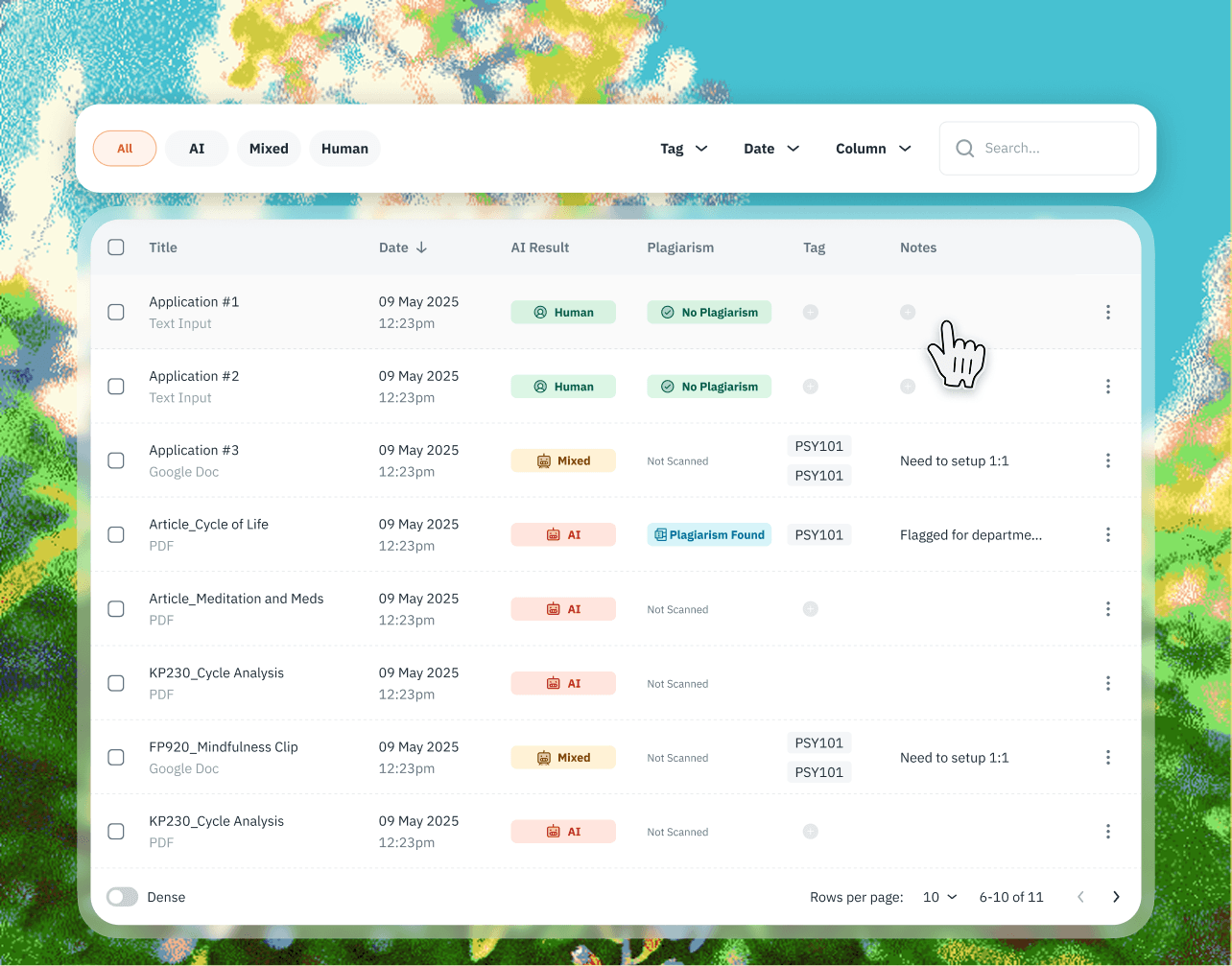


Pangram is also integrated into Chrome browser, Google Docs, and many learning management systems like Google Classroom and Canvas.
01
Input your text
Copy and paste your text into the field or upload files. Pangram supports PDF, DOCX, RTF files and up to 100 files at a time.
02
Scan for AI Content
Pangram analyzes your text using advanced AI detection algorithms to identify AI-generated content with high accuracy.
03
View results
Review detailed results showing AI detection scores, highlighted sections, and comprehensive analysis of your text.
04
Access past records
Access your complete history of scans, download reports, and manage your past detection records all in one place.
Pangram is also integrated into Chrome browser, Google Docs, and many learning management systems like Google Classroom and Canvas.
AI Detector for EducationAI Detector for Enterprise
 For teachersPangram's transparency tool reliably detects AI content and checks for plagiarism to help teachers understand the origin of written text and maintain integrity and fairness in assessment.
 For higher edPangram's LMS integrations allow universities to create informed AI policies. Our AI detector's tool accuracy gives them the peace of mind to implement those policies at scale.

01
LMS Integration
Our AI detector works with the most popular LMS systems making it easy to use across multiple platforms like Canvas, Moodle, Google Classroom, BrightSpace, and more.

03
API
Solution
Our API is perfect for high-volume projects with different pricing options to suit your needs. We have custom API solutions for educators, developers, and enterprise.
02
Google Doc &
Chrome Extension
Our Chrome Extension is a quick and convenient way to use our AI detection tool while browsing the web or within web-based applications such as Google Docs.


See what our customer says
Users love Pangram

Alex Imas, Professor

Pangram is pretty incredible. Much better than other AI detection tools (by a country mile). I've used it and tested it thoroughly and seen minimal false positives and negatives.
University of Chicago Booth School of Business
For me, Pangram Labs has become the most student-centered option I’ve found for my courses. Students see the same report I see, directly in our Canvas shell, and Pangram’s documented false-positive rate (1 in 10,000) allows me to comfortably treat a flag as an invitation to talk, never as a presumption of guilt.
— Susan Ray, Associate Professor Of English, Delaware County Community College
There's a lot of overhyped, me-too products flooding the AI space, but this detector is almost supernaturally good. I have yet to experience a single false positive or false negative.
Cloud Architect
— Ryan Nicolace, Cloud Architect

Jenna Russell, PhD
We compare human experts with five AI detectors, including Pangram and GPTZero. Among automatic detectors, Pangram significantly outperforms the rest.


Tuhin Chakrabarty, Professor
Pangram is really one of the best AI detectors we have, and y'all should use it.

Based on our experiences in the fall term, we have high confidence in Pangram as a detector of AI content in Wikipedia articles.
— LiAnna Davis, Chief Programs Officer and Deputy Director at Wiki Education
Pangram noticeably outperforms other LLM content detection services I've tried. It reduces our moderation workload enough to pay for itself many times over. If you run a platform with user-generated content, you should probably be using it.
— Robert Mushkatblat, CTO LessWrong

Dan Simon, CEO of Qwoted
The future of journalism depends on trust. This is why we're delighted to be partnering with Pangram, which has set the gold standard for Al detection and attribution

01
Initial training process for AI detection

Our classifier uses a traditional language model architecture. It receives input text and tokenizes it. Then, the model turns each token into an embedding, which is a vector of numbers representing the meaning of each token. The input is passed through the neural network, producing an output vector. A classifier head transforms the output vector into a prediction of human, AI, or AI-assisted. We train an initial model on a small but diverse dataset of approximately 1 million documents composed of publicly licensed human-written text. The dataset also includes AI-generated text produced by GPT-5 and other frontier language models. The result of training is a neural network capable of reliably predicting whether text was authored by human or AI.
02
Continued improvement through iteration

After the initial training, our model undergoes continuous improvement through iterative refinement. We collect feedback from real-world usage and incorporate new data patterns to enhance detection accuracy. This iterative process ensures our AI detection remains at the forefront of technology, adapting to new language models and writing styles as they emerge.
03
Consistent retraining of AI detector models

To maintain the highest level of accuracy, we consistently retrain our AI detector models with updated datasets that include the latest AI-generated content. This regular retraining process ensures our detection capabilities stay current with evolving AI technologies and can reliably identify content from the newest language models.
01
Initial training process for AI detection
02
Continued improvement through iteration
03
Consistent retraining of AI detector models
Our classifier uses a traditional language model architecture. It receives input text and tokenizes it. Then, the model turns each token into an embedding, which is a vector of numbers representing the meaning of each token. The input is passed through the neural network, producing an output vector. A classifier head transforms the output vector into a prediction of human, AI, or AI-assisted. We train an initial model on a small but diverse dataset of approximately 1 million documents composed of publicly licensed human-written text. The dataset also includes AI-generated text produced by GPT-5 and other frontier language models. The result of training is a neural network capable of reliably predicting whether text was authored by human or AI.
01
Product review
Pangram
0.5%
GPTZero
2.4%
Originality.ai
1.7%
RoBERTa
30.6%
False positive rate — Product review
02
Blog post
Pangram
0%
GPTZero
0.5%
Originality.ai
0%
RoBERTa
64.9%
False positive rate — Blog post
03
News article
Pangram
0.1%
GPTZero
1%
Originality.ai
0.3%
RoBERTa
77.8%
False positive rate — News article
04
Novel excerpt
Pangram
0%
GPTZero
0.5%
Originality.ai
0.3%
RoBERTa
53.2%
False positive rate — Novel excerpt
05
Restaurant review
Pangram
0.8%
GPTZero
1%
Originality.ai
2.2%
RoBERTa
51.7%
False positive rate — Restaurant review
06
Résumé
Pangram
0%
GPTZero
0%
Originality.ai
0.1%
RoBERTa
69.1%
False positive rate — Résumé
01
Product review
02
Blog post
03
News article
04
Novel excerpt
05
Restaurant review
06
Résumé
Pangram
0.5%
GPTZero
2.4%
Originality.ai
1.7%
RoBERTa
30.6%
False positive rate — Product review
FAQs
AI Detection FAQs
Looking for answers? Explore common questions and get the information you need, all in one place.
001
What is AI content detection?
AI content detection, like Pangram's AI checker tool, analyzes text for traces of AI writing. AI detectors return a prediction and a score based on the likelihood that the text is AI-generated.
002
How does Pangram work?
Pangram's AI detection tool analyzes text for traces of AI writing. If our system finds evidence that the content contains AI writing, it will return this observation along with how much of the document we believe is AI-generated or AI assisted. Otherwise, we consider the result human written.
003
How accurate is Pangram?
Pangram is over 99% accurate and has been third-party verified by researchers at the University of Chicago and The University of Maryland.
004
What is Pangram's false positive rate?
Pangram's false positive rate (the rate at which human documents are incorrectly flagged as AI) is currently 1 in 10,000. This number is calculated on an aggregate of public datasets containing tens of millions of written documents.
005
Is Pangram's AI detector free?
We offer four free checks a day after signing up for our free plan, including AI assistance detection. Additional credits and features like plagiarism detection are available with a subscription. For more information, check out our pricing plans.
006
Is my data safe if I check text with Pangram?
Yes, all user data is encrypted and stored securely on our servers to be displayed in your history. We never share or sell your data to any third parties.
007
What languages does Pangram detect AI content in?
Pangram's multilingual AI checker detects AI writing in English, Arabic, Chinese, Czech, Dutch, French, German, Greek, Hindi, Hungarian, Italian, Japanese, Korean, Persian, Polish, Portuguese, Romanian, Russian, Spanish, Swedish, Turkish, Ukrainian, Urdu, Vietnamese, and more.
008
What AI models does Pangram detect?
Pangram detects AI writing from the latest ChatGPT 5, Claude Sonnet by Anthropic, Google Gemini, Deepseek, Meta AI, Grok, Llama, Mistral, OpenAI's o1, o3, Perplexity and Deep Research. Pangram also detects AI suggestions from AI writing tools like Grammarly and Quillbot. Pangram even detects new and unreleased AI models.
009
What signals does Pangram use to detect AI text?
Pangram uses writing style, word choice, syntax choice, and grammatical structure to detect AI writing. Our AI writing detector only looks at the content of the text submitted. It does not compare the text to other submissions in a database or on the web like traditional plagiarism checkers, and it does not capture writing process data such as cut-and-paste. Pangram does not access OpenAI's database or analyze a user's browsing history.
010
How are schools using Pangram?
Schools incorporate AI detection tools from Pangram using LMS integrations like our Canvas integration or our Google Classroom integration. By bringing Pangram into the classroom, teachers can set boundaries around AI use and ensure students are improving their critical thinking skills through their schoolwork.
011
How are universities using Pangram?
Professors use Pangram to set boundaries on AI use and ensure that students properly learn the material by using our AI and plagiarism detectors directly in their LMS. Academic integrity departments use Pangram to provide evidence for cases that goes beyond the score - highlighting the most common phrases that LLMs use and comparing submissions to actual AI-generated responses.
012
Why do other AI detectors sometimes give false positives?
Many other AI detectors use metrics like perplexity to detect AI writing. Perplexity is how unexpected, or surprising, each word in a piece of text is, when looked at from the perspective of a particular language model or LLM. AI text is often low-perplexity, because of how AI models work. Unfortunately, other simple or unsurprising writing, like the Declaration of Independence, come up as a false positive, making perplexity-based detectors unreliable for scenarios like the classroom where false positives are undesirable. Pangram does not use perplexity or other metrics that correlate with AI writing, instead using a comprehensive deep learning approach that discovers patterns over millions of writing samples.
013
Why do other AI detectors fail to flag AI writing?
Many other AI detectors don't keep up-to-date with the latest AI models. Pangram is constantly collecting writing samples from the latest and most capable AI models to ensure that the software can detect writing from all AI services, even those from unreleased models or AI editing tools.
014
Why is Pangram the best AI detector?
Pangram is built by a team of seasoned machine learning engineers with extensive experience in AI. Pangram is the most advanced AI detection model and is built on millions of human and AI documents to ensure that it can pick up on even the most subtle nuances in AI writing.

The Pangram blog
More from our
AI experts Case StudiesAI is Writing Prize-Winning Fiction
 Jenna RussellMay 21, 2026One of the Commonwealth Short Story Prize finalists was accused of being AI-generated on Twitter.
 NewsThe Information Theory Behind Why AI Writing Sucks
 Joe StechMay 19, 2026Compared to the unique voices of human writers, AI writing sounds remarkably uniform. It turns out that there's a good reason for this, and it has to do with information theory.
 Case Studies67% of People Consuming Online Content Are Spotting Misleading Info from AI
 Max SperoMay 15, 2026As AI content gets better, it's harder than ever to tell what's human and what's ChatGPT. New Pangram data shows many people struggle to differentiate the two.
 Product UpdatesMeet Pangram 3.3!
 Katherine ThaiMay 13, 2026Introducing our latest AI detector, Pangram 3. 3, with improved recall on humanized texts and an even lower false positive rate on ESL writing.
 EducationDoes Google Classroom Have an AI Detector? What Teachers Actually Need
 Alex RoitmanMay 12, 2026Schools can add a Google Classroom AI detector by integrating third-party tools like Pangram into their Learning Management System.
 EducationWhat AI Detector Should Colleges Use? The 2026 Academic Standard
 EducationAI Cover Letter Checker - How HR Teams are Filtering Noise
 EducationAre AI Resume Builders Worth It? How Modern ATS Systems Work
 EducationAI Watermarking: Why Big Tech is Betting on AI Provenance, and Losing
Subscribe to our updates
Stay informed with our latest news and offers.
Join Us
Pangram.
Products
AI DetectorChrome ExtensionAPILMS IntegrationsPlagiarism CheckerMultilingual AI Detection
For Organizations
For TeachersFor Publishing & MediaFor Content ModerationFor DevelopersFor Law FirmsFor UniversitiesFor RecruitersFor ML Engineers
Research
How AI Detection WorksPangram Research PapersResearch InquiriesFeatured PressModels
Resources
AI educationProduct updatesNewsCase studiesBlogPricingTerms of ServicePrivacy PolicyData Privacy FAQStatus
Company
About UsContact UsCareersPress

SOC2 TYPE2
Verified by AssuranceLab
© 2025 Pangram. All rights reserved.
[](https://www.instagram.com/pangramlabs/ "Pangram Labs on Instagram")[](https://twitter.com/pangramlabs "Pangram Labs on X")[](https://www.linkedin.com/company/pangramlabs/ "Pangram Labs on LinkedIn")
© 2025 Pangram. All rights reserved.
pura: loading…