
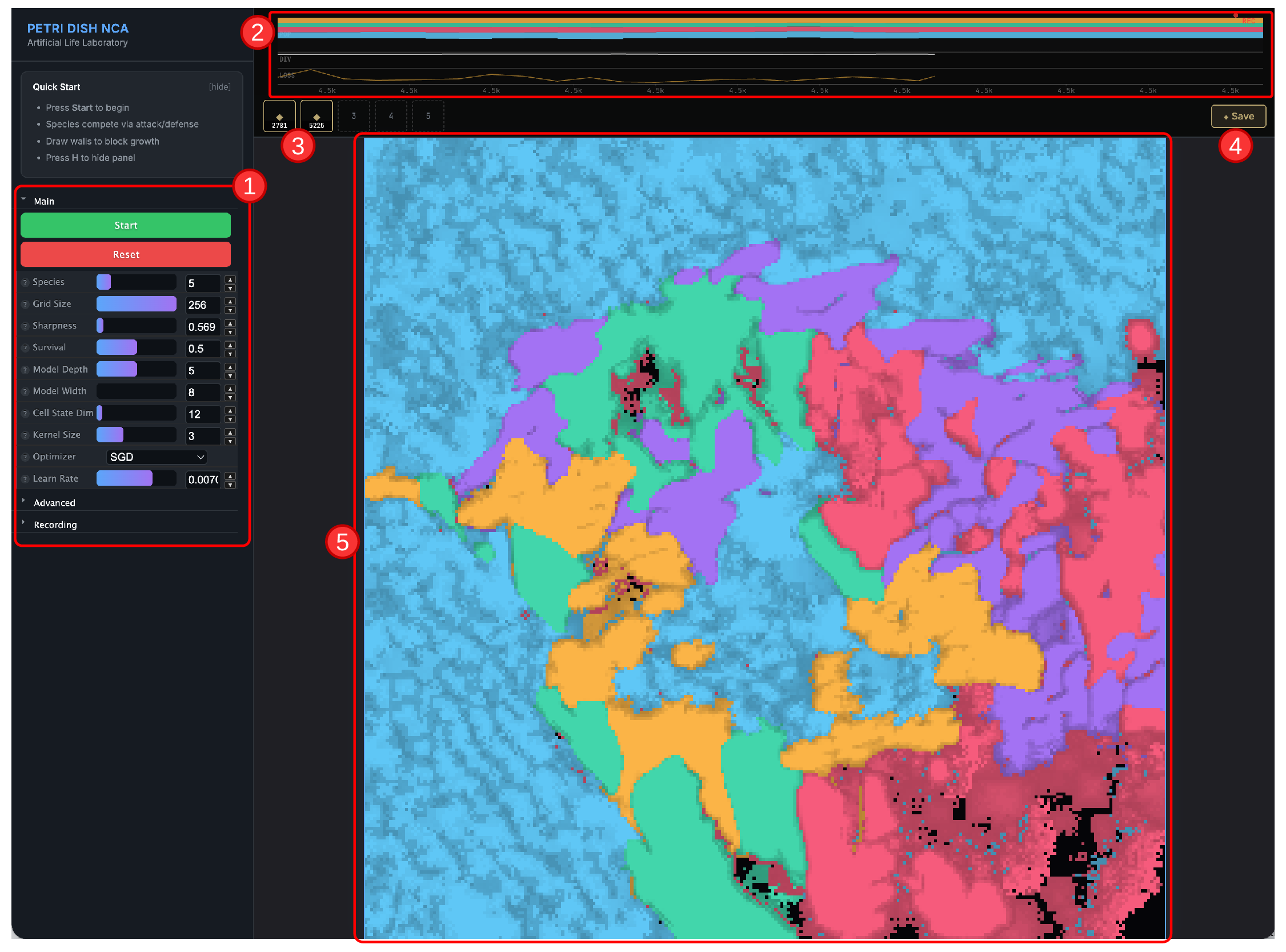
Digital Ecosystems
Most of our parameter changes affect how the species train — learning rates, loss weights, optimiser choices. The growth gate steepness is different: it changes the simulator itself, reshaping which cells are alive and which are dead on every step.
At kgate=17.5k\_{\\text{gate}}=17.5kgate\=17.5, the sigmoid is nearly a step function. Species territories are flat, bistable, and clean. Perturbations heal within a few steps — a stable, ordered regime .
Reduce steepness to kgate≈4.9k\_{\\text{gate}} \\approx 4.9kgate≈4.9 and the system crosses into the edge band (the critical regime). The sigmoid's transition zone widens, allowing stable intermediate aliveness values. Species develop distinct phenotypes: some churn aggressively at borders, others maintain stable cores with negotiating boundaries. Texture regenerates autonomously without any further parameter changes — confirming that edge dynamics are intrinsic, not transient.
Push further to kgate≈4.6k\_{\\text{gate}} \\approx 4.6kgate≈4.6 and coherent structure collapses into the chaotic regime — flickering pixels with no stable territories.
Ordered

kgate=17.5 step 350 α=0.90
Edge

kgate=4.9 step 3237 α=0.48
Chaotic

kgate=4.6 step 591 α=0.33
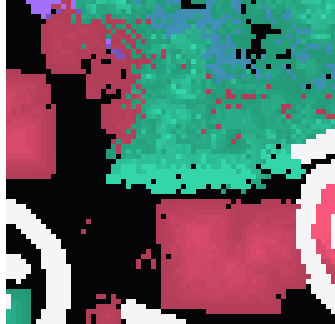
Succession at the edge (kgate=4.6, steps 733–757) →
 Step 733
 Step 735
 Step 739
 Step 741
 Step 743
 Step 747
 Step 749
 Step 751
 Step 755
 Step 757
Baseline Edge

kgate=4.8 τ=1.01 step 5181
\+ Temperature

kgate=4.8 τ=2.51 step 5424
\+ Gate Up

kgate=5.0 τ=1.01 step 1622
Re-Excite

kgate=4.9 τ=1.01 step 3575
Growth-gate steepness as an edge-of-chaos control. Top: three regimes along one trajectory — ordered (flat bistable territories), edge (grooves, cooperation fronts, expanding waves), chaotic (mid-collapse). Middle: real-time succession at $k\_{\\text{gate}}$=4.6; texture regenerates autonomously without parameter changes. Bottom: perturbations from a stable edge state — raising temperature erases texture, raising the gate restores coverage, re-lowering re-introduces grooves.
The growth gate steepness plays the role of Langton's λ\\lambdaλ parameter , but inside a learning system where species adapt to whatever value the user sets. A caveat: starting cold at kgate≲5k\_{\\text{gate}} \\lesssim 5kgate≲5 collapses immediately — the system must warm up at high steepness first, then ramp down. Path dependence matters.