Your AI agent forgets every session. PMB gives it memory, on your disk.
100% on your machineNo API keysNo cloud, no telemetryApache-2.0, open source
How it works
Memory that doesn't wait to be asked
Hooks inject the right memory before the model thinks, and journal the agent's work after, no LLM call on the read path, no tool the agent has to remember to call.
1 · Any agent records
\\_claude\\_Claude Code
\\_cursor\\_Cursor
\\_openai\\_Codex
writes to memory

PMB · one local memory
recalls what matters
2 · Surfaced before it answers
lesson0.94
file0.88
decision0.81
01 · Read4–16 ms
memoryagent
Auto-recall on every prompt
Every message is classified in sub-millisecond; the matching lessons, decisions and project overview are fetched for the agent before it reasons.
02 · Write< 1 ms
agentSQLiteLanceDB
Sub-millisecond async writes
The MCP tool returns instantly. SQLite first; the embed and LanceDB vector insert run on a background thread, never blocking the turn.
03 · Fuse94.5% recall@10
top-k
Hybrid recall, ranked
BM25 + dense vectors + entity graph + optional rerank, fused with Reciprocal-Rank-Fusion. One call returns the right thing, ranked.
04 · Learnhonest follow-rate
0.940.700.12
Lessons that earn their place
Every rule is scored by whether the agent actually follows it. Useful ones get starred; ignored ones are flagged dead, so you prune what doesn't help.
The Map · live entity graph
Your memory, as a graph you can explore
Every fact, decision, lesson, file and entity becomes a node, color-coded by type, sized by importance. Hover one to dim the rest, light up its neighbors, and read the full memory chunk.
MapTimelineOverviewLessons
By kindBy cluster
All edgesStrong
0 entities · 0 connections · 8 clusters
drag · scroll · hover
The Timeline · git-graph journal
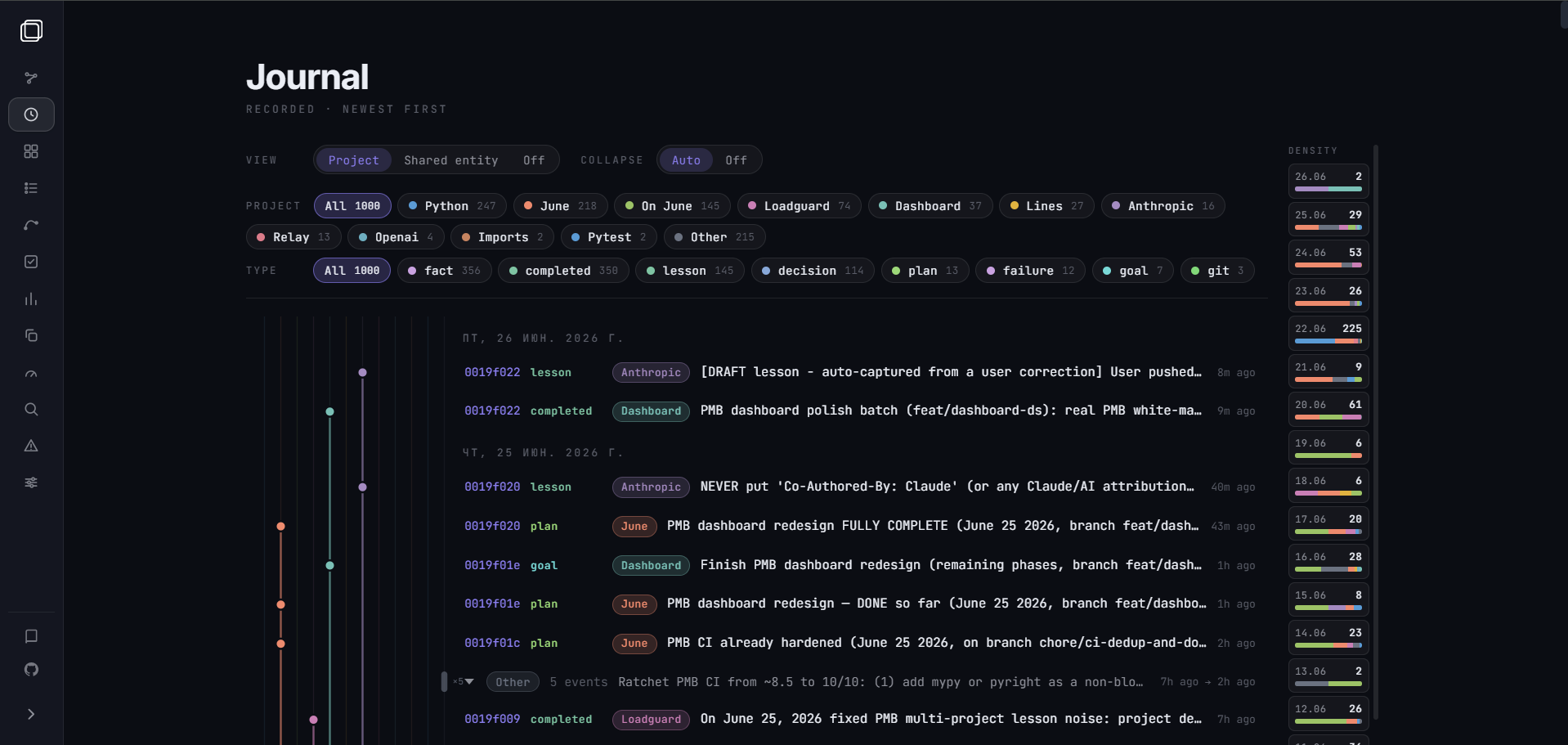
Every decision, lesson and commit, newest first
One lane per project, nodes color-coded by event type, connected by soft curves. The same journal that ships in the dashboard, written automatically as you work.
MapTimelineOverviewLessons
Type
Not a mockup
This is the actual dashboard
A local web app served from your machine. The Map and Timeline above are live recreations, here is the real thing, rendering one project's memory.
MapTimeline
5,229 entities
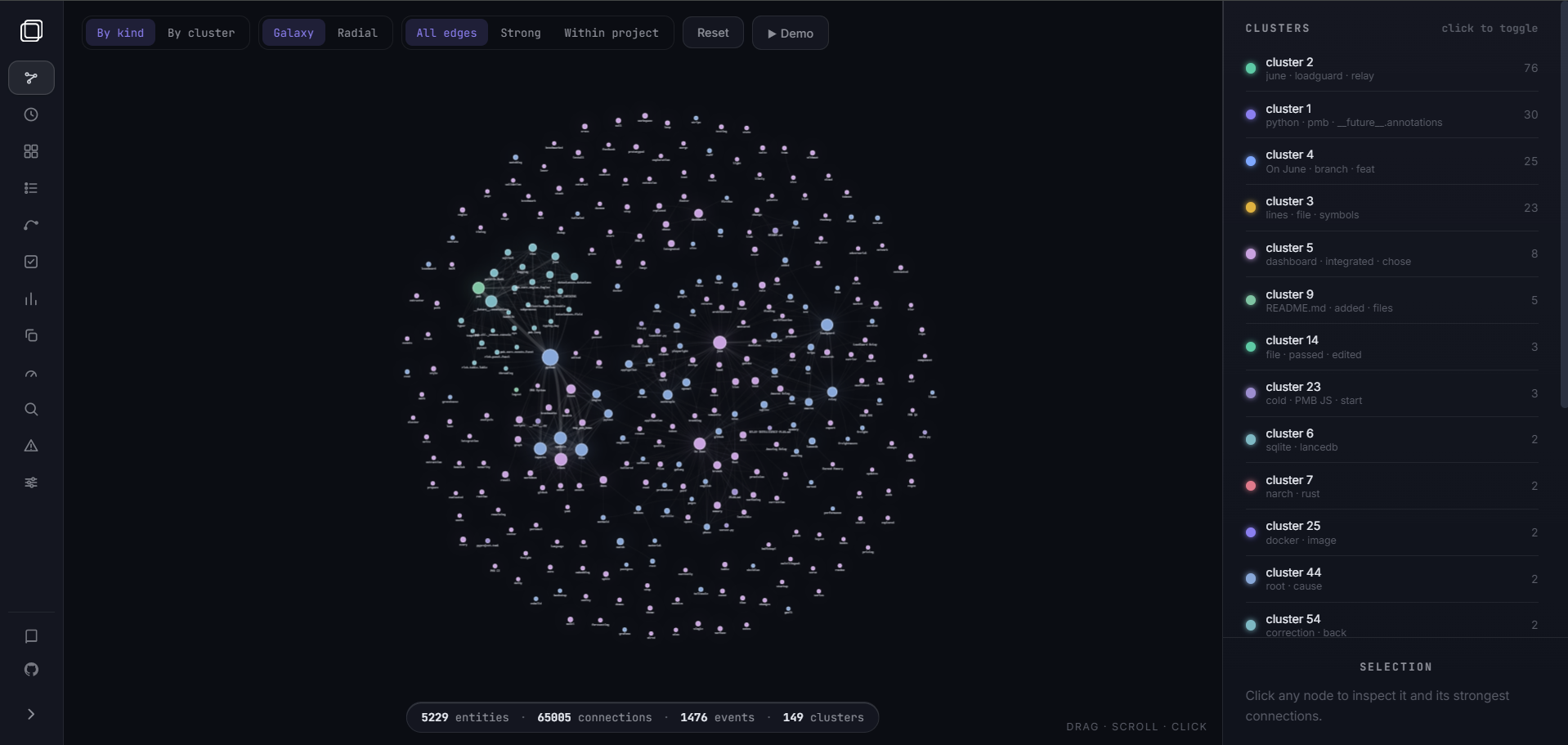
The Map · 65,005 connections across 149 clusters, color-coded by kind
Why it matters
What changes when your agent remembers
Not features, outcomes. This is what persistent memory actually does to your day.
Stop re-explaining your project
Every session starts already knowing your decisions, conventions and the bug you hit last Tuesday. No more pasting the same context into a fresh chat.
Switch tools without losing context
Claude Code, Cursor, Codex and Zed all read the same memory. Your context follows you, not your editor, so changing agents costs nothing.
Memory you can actually trust
PMB scores whether each lesson gets followed and flags the dead ones. It tells you when a memory isn't helping, so your context stays honest, not bloated.
Watch it compoundSession 1 of 5
Day one: a blank slate
The agent starts with nothing. You explain your project, your conventions, the bug you hit last Tuesday, and at the end of the session it all evaporates.
12
entities
1
lessons
·
recall hits
S1S2S3S4S5
Quickstart
Seven commands, then just talk to your agent
No account, no keys, nothing leaves your machine. Inspect everything from the terminal, or open the dashboard.
zsh · \~/pmb
pmb recall
fix the pricing bug in checkout⏎
L
never lower NEGOTIATE/SKIP under 25%
lesson · PMB
0.94
F
verdict-policy.ts · line 142
file · opened Tue 14:32
0.88
D
use RRF over a learned weight
decision · 4 days ago
0.81
3 of 41 memories · fused in 35 mshybrid recall
Integrate
One command wires your agent to MCP
Everything runs over stdio, the server is a child process of your agent. No network, no port, no token.
Claude Code
- Rules appended to your agent's config automatically
- Point several agents at one shared workspace
- Verify the wiring with pmb doctor
Any model · local or hosted
Bring your own model, or run it offline
PMB never calls an LLM on the read path. The optional summarize and graph-extract passes run on whatever you point them at, including a fully local Ollama. Your memory stays yours.
graph.extractor = llm:ollama·run extraction and summaries on a local model, 100% offline, zero API keys.
Quickstart
Running in 60 seconds
Three commands, no account, no config. Then just work the way you already do.
1
Install
One pip install. Pure Python, runs on macOS, Linux and Windows.
$`pip install pmb-ai`Copy
2
Connect your agent
Wires PMB into your agent over MCP. Swap in cursor, codex, zed, and more.
$`pmb connect claude-code`Copy
3
Just talk to it
Work as usual, PMB records and recalls automatically. Open the dashboard any time to explore.
$`pmb dashboard`Copy
Architecture
Files on your disk, all the way down
Every event lives in SQLite; vectors live in LanceDB next to it. Copy them anywhere with cp. No server to trust.
Your agentMCP · stdioMCP server29 tools · prepare()Enginehybrid routerHybrid recallBM25 + vector + graph · 35msAsync writeembed queue · sub-ms returnSQLiteLanceDBON YOUR DISK
Benchmarks
Fast, local, and honest about it
Every number here is measured on PMB's own engine and reproducible from the repo. No cloud, no LLM in the read path, no per-query cost.
94.6%recall@10 (LoCoMo)
88msp50 recall at 2k memories
<1msasync write, never blocks
$0per recall, fully local
73.1%answer accuracy (J-score, LoCoMo)
#### Retrieval quality (recall@k)
MRR 0.774 · nDCG@10 0.81668.485.089.494.6k=1k=3k=5k=10
LoCoMo-10 · 997 questions · no LLM grader · cache off
#### Recall latency vs memory size (p50 / p95)
p50p95
100 ms101005001k2k
Warm daemon, cache off, local CPU. Real \~100-memory workspace: p50 24 ms. Cached: \~0.15 ms.
Radically honest
It tells you when a memory isn't helping
Every lesson carries a surface\_id. PMB tracks whether the agent actually followed it, confirmed or auto-detected from activity. Rules that get ignored are flagged dead. The ones that earn their place are starred. No vanity metrics.
usefulnever lower NEGOTIATE/SKIP under 25%
usefulpmb warmup before first recall
unverifiedprefer tree-sitter for TS indexing
deadalways rerun the full suite on edit
Under the hood
Built on boring, durable pieces
No exotic infrastructure. Local files and well-worn libraries, the kind you can still open in five years.
Memory hygiene
It tends itself
A year in, recall is still sharp. Memory decays, archives, and dedupes on its own, and never deletes anything behind your back.
Speed up timePause
Write
Active
Read
Decay
Compact
Archived
You
Daemon
Memory flows left to right and tends itself. Hover a stage to follow the path.
one SQLite file
FAQ
Straight answers
Does my code or data ever leave my machine?
No. Everything lives in a local SQLite file with vectors in LanceDB right next to it. There are no network calls on the read path, no account and no telemetry, ever. Unplug the internet and it still works.
How is this different from RAG or a vector database?
Two ways. Recall is hybrid, BM25 plus dense vectors plus an entity graph, fused and ranked. And it's automatic: the right memory is injected before the model thinks. You don't build a pipeline or hope the agent remembers to call a tool.
Will it slow my agent down?
No. Recall lands in about 35 ms and writes return in under a millisecond, the embedding and vector insert happen on a background thread, so the turn is never blocked.
Which agents and operating systems are supported?
Any MCP-aware agent: Claude Code, Cursor, Codex, Zed, Windsurf and more, wired in with one command. PMB is pure Python and tested on macOS, Linux and Windows.
What if a memory is wrong or unhelpful?
PMB scores whether each lesson actually gets followed and flags the dead ones so you can prune them. It's the rare tool that tells you when its own memory isn't earning its place.
Is it really free?
Yes. Apache-2.0, open source, free forever. No paid tier, no seats, no telemetry. You own the file and the code.
Apache 2.0 · 100% offline
Give your agent a
memory it keeps.$`pip install pmb-ai`Copy
Free & open source forever·Star the repo·Open an issue·Contribute