


AI agents are only as good asthe context they can reach.
Stop hardcoding context
Why you need a context layer
This is how most agents get data today, and why it doesn't last. A context layer replaces the hand wired map with one that stays current.
Hardcoded today
- Schemas pasted into prompts that quietly go stale
- A new MCP server to wire up for every source
- No ownership, meaning or lineage, so the model guesses
- Every team rebuilds the same context plumbing
- One governed context layer across every asset
- One MCP endpoint every agent shares
- Ownership, definitions and lineage built in
- Always live, never a stale copy
With Marmot
You don't move your databases to Marmot. You stop hardcoding the context around them. See Marmot for agents
Context for AI and engineers
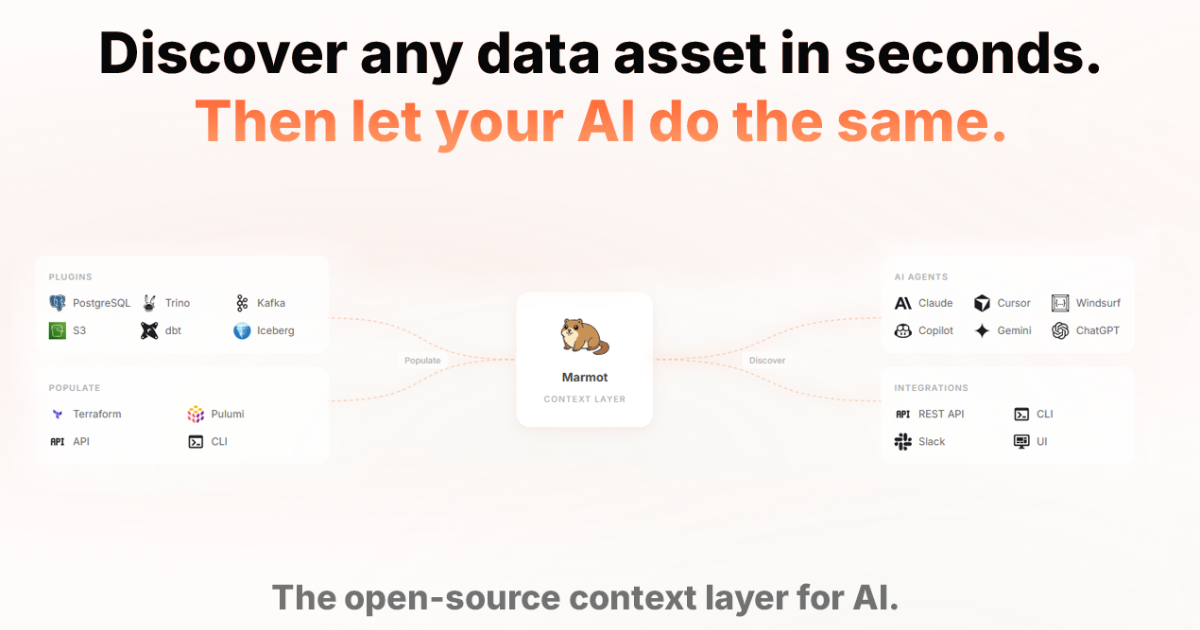
Catalog every data asset, enrich it with the context that matters and make it accessible to your team and your AI tools.
Discover
One place for agents and humans to find every service, API, queue, topic and database.
Understand
Trace how data flows and what depends on what with lineage.
Contextualize
Ownership, business definitions and custom fields that give AI the full picture.
Share
Expose certified context through MCP, the API and the UI.
Populate with
Built-in MCP server
Ask your AI assistant about your business and get answers backed by your actual catalog.
Works with any MCP-compatible client.
What tables do we have related to customer orders?
discover\_data
I found 3 assets matching "customer orders": the orders table in the warehouse, an orders\_raw Kafka topic, and a daily\_orders\_summary view.
Who owns the orders table?
find\_ownership
The orders table is owned by the Data Platform team. Sarah Chen is the primary contact.
What does "GMV" mean in the order\_gmv column?
lookup\_term
GMV stands for Gross Merchandise Value — the total sales revenue before deductions.
Traditional catalog
ElasticsearchSearch
KafkaEvents
FrontendUI
APIBackend
Neo4jGraph
MySQLMetadata
AirflowOrchestration
7+ servicesHours to deploy
Marmot

MarmotSingle binary
PostgreSQLSearch, storage & graphs
2 servicesMinutes to deploy
Less infrastructure, same power
Traditional data catalogs need an entire platform team. Marmot needs a database you probably already run.
Deploy in under five minutes
Marmot runs as a single binary backed by PostgreSQL - the only dependency you need to start cataloging your data.
\~ / marmot
$docker compose up -d
\[+\] Container postgres-1 Started
\[+\] Container marmot-1 Started
Marmot is running at http://localhost:8080
Connect to your data sources
Growing ecosystem of plugins
PostgreSQLMySQLMongoDBClickHouseBigQueryKafkaAirflowdbtS3DuckDBSQSOpenAPI
Don't see your data source? Open an issue to request a plugin.
Built to scale
Simple architecture doesn't mean limited. Marmot handles real workloads on modest infrastructure.
Load tested on real infrastructure
500k+
Assets
100+
Concurrent users
<50ms
Avg response time
Only metadata. Your data stays put.
A context layer needs to know about your assets, not to hold their contents. Marmot is built so the data itself never leaves your systems.
Metadata, not your data
Marmot catalogs schemas, ownership, descriptions, lineage and statistics. The rows, messages and payloads inside your systems never enter Marmot.
Deploy it your way
Use managed Cloud, or run the open source build yourself. Run it yourself and even the metadata stays inside your own VPC and under your own controls.
Open source and auditable
MIT licensed and built in the open. Read exactly what Marmot collects, how it connects to a source, and what it stores, line by line.
Ready to give your AI the context it needs?
Try the live demo or explore the open source, self-hostable solution. MIT licensed with a flexible API.
Have questions? Get in touch