



Fuel Insights
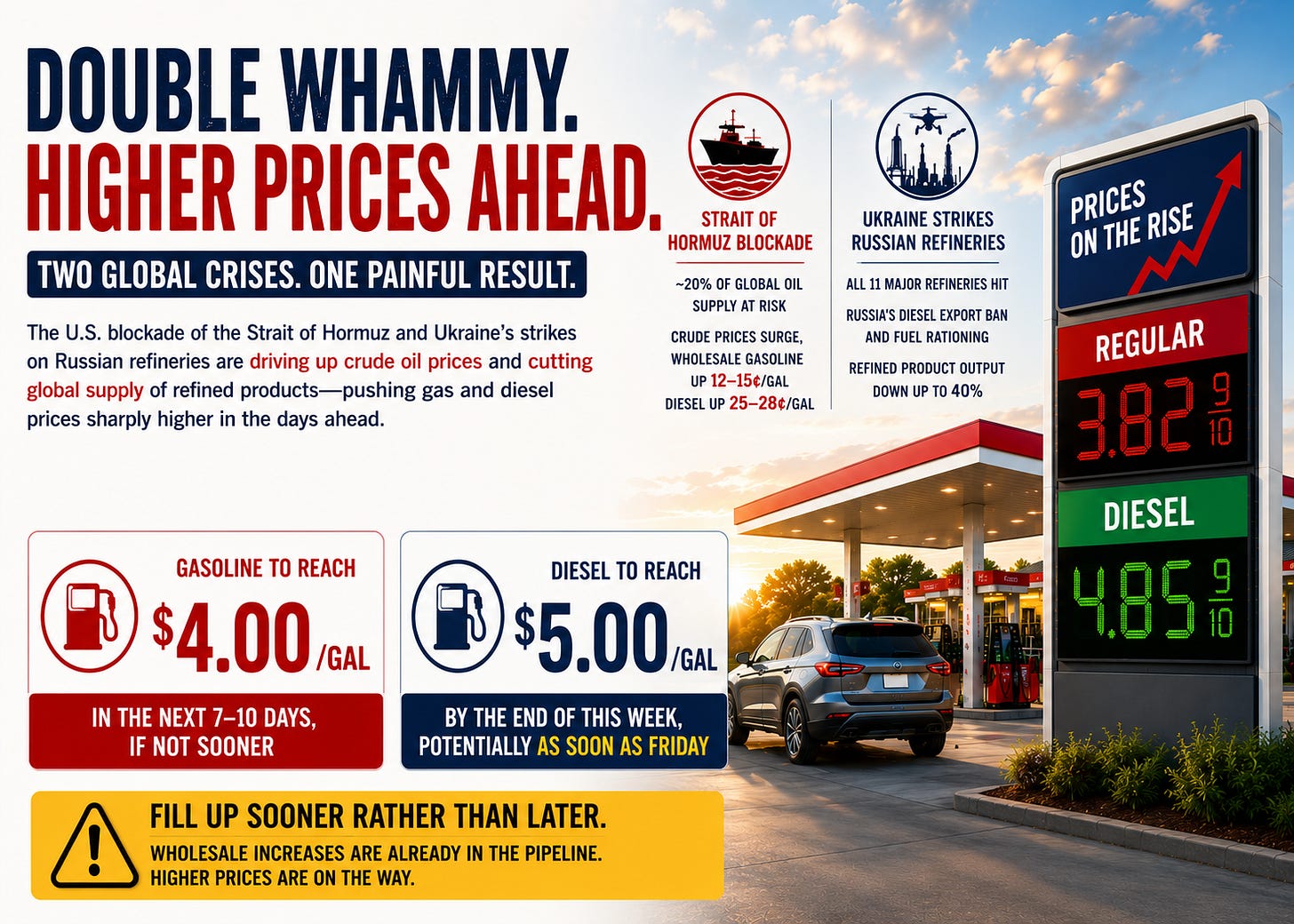
You’re reading my second article today, and the situation warrants it. The pain at the pump is about to intensify, and this time it’s not one story driving it, it’s two. With the U.S. resuming its blockade of the Strait of Hormuz and Ukraine systematically knocking out Russian refining capacity thousands of miles away, motorists are facing a rare double whammy: rising crude oil prices and shrinking global supply of refined products at the same time. I now expect the national average price of gasoline to reach $4 per gallon in the next 7-10 days, if not sooner, while the U.S. average diesel price is likely to again reach $5 per gallon by the end of this week, potentially as soon as Friday.

The most visible driver is the renewed escalation between the U.S. and Iran. With the blockade of the Strait of Hormuz resuming, WTI crude jumped to $75 per barrel, up nearly 10%, as markets priced in the risk to the roughly one-fifth of global oil supply that transits the Strait. Wholesale markets wasted no time reacting: gasoline spot prices are up 14-23 cents per gallon, while spot diesel prices have surged 24-27 cents per gallon.
Those increases haven’t even hit the pump yet, but they will. Retailers will begin passing these costs along in the next 24-48 hours, and I’d expect increases of 15-45 cents per gallon over the next week or so, with price cycling states like Michigan, Ohio, Indiana and Florida likely to see the sharpest and fastest moves. Ohio is already up 27 cents per gallon versus a week ago, with Delaware and New Mexico up 20 cents, and the jumps are just getting started.
While the Strait dominates headlines, a second supply shock has been building with far less attention. Ukraine has dramatically escalated its long-range drone campaign against Russian oil refineries, and the results are staggering. In just the past two weeks, Ukrainian strikes have hit the Omsk refinery in western Siberia, Russia’s largest, along with facilities in Saratov, Syzran, Yaroslavl, Ufa and Krasnodar. Ukraine says it has now struck all eleven of Russia’s largest gasoline-producing refineries.
The damage is severe enough that Russia has banned diesel exports through at least the end of the month and imposed fuel rationing in some regions. Some Western officials estimate Russia’s ability to produce and export refined products has been cut by as much as 40%.
Why does that matter for American drivers? Russia remains one of the world’s largest exporters of diesel and other refined products. When that supply disappears from the global market, buyers in Europe, Latin America and elsewhere compete harder for everyone else’s barrels, including ours. That’s a big reason diesel is leading this rally, with average prices up 38 cents per gallon in Florida and 30 cents in Texas versus a week ago. With wholesale diesel up 25-28 cents per gallon, the national average diesel price is on track to hit $5 per gallon by week’s end, and it could happen by Friday. Diesel strength eventually bleeds into gasoline as refiners chase the most profitable products.
What makes this moment particularly precarious is how little slack remains in the system. The Strategic Petroleum Reserve declined again to 316.5 million barrels, down 3 million from a week ago, as releases continue. Those releases may slow given lower oil prices earlier this year, and could wrap up by August, meaning one of the few tools for offsetting supply shocks is being drawn down at exactly the wrong time.
Put simply: crude oil is more expensive because of the Strait, and refined products are scarcer because of Russia’s crippled refining sector. Either one alone would push prices higher. Together, they could produce one of the sharpest sustained increases we’ve seen this year.
Filling up sooner rather than later may save you some cash. The wholesale increases already in the pipeline virtually guarantee higher street prices in the days ahead, and if escalations continue on either front, today’s prices may look like a bargain in two weeks.
There are wildcards that could soften the blow. A de-escalation in the Strait, progress in ceasefire talks between Russia and Ukraine, or a faster-than-expected demand response could all take pressure off. But for now, the momentum is clearly pointed higher, and $4 gas looks less like a possibility and more like a near certainty.
For now, higher gasoline and diesel prices are on their way, larger jumps in price cycling states and smaller but more often increases in non-cycling areas. I'll continue sharing updates on trajectory as this next chapter unfolds- you can follow on X, Substack, Threads, Facebook and more. Please consider sharing and liking this content- it helps more people see it- thank you!