



The Atlas
There’s a scene that repeats itself every four years. A country from the periphery walks onto the pitch against a power far richer than itself. On the other side there is more money, better stadiums, stronger leagues, modern training centres with data analysts, sports psychologists, doctors, nutritionists. Before the ball is even kicked, the field already looks tilted.
Then the ball starts rolling, and something comes loose. The country that sits mid-table in almost every global ranking suddenly plays as if it had some invisible machinery behind it. Its players press, dribble, thread a pass nobody else saw, find space where there seemed to be none. A kid who grew up kicking a ball around a dirt lot or a neighbourhood club in a small provincial town, and who left home as a teenager to live in a club academy residence, competes on equal terms with footballers born into the most expensive sporting structures on the planet. And, often enough, beats them.
South America has been producing that anomaly for decades. Far from being a wealthy region or a populous one, in men’s football it has always been near the top: Argentina, Brazil and Uruguay have spent a century among the best in the world, and the region as a whole performs as if it were much bigger and richer than it is. There is no World Cup broadcast where the rundown of contenders leaves out Argentina and Brazil; and no tournament where Uruguay or Colombia are not among the sides with a real chance of sending a favourite home.
That is what we will try to understand here: why South America produces such good national teams, where it got that edge, and whether it can hold on to it. Let’s take a look.

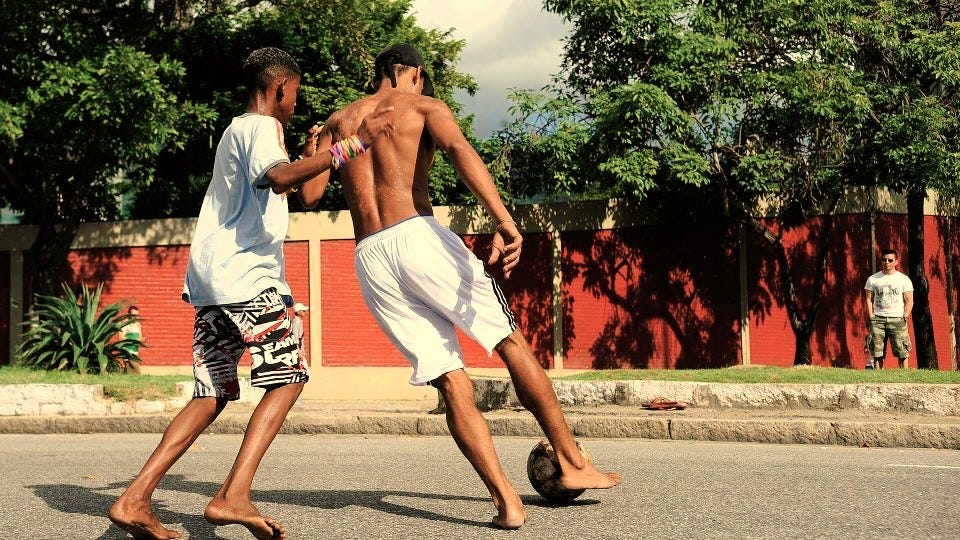
Beach football, Boipeba, Brazil. Photo: Daniel Schteingart.
The chart is simple. On the horizontal axis, the size of each economy. (Unlike previous issues of The Atlas, where we used GDP per capita, here we use total GDP: a country’s economic mass, wealth and population combined.) On the vertical axis, the strength of its national team, measured by the Elo index, named after its creator, the Hungarian-American physicist and chess player Árpád Élő. Borrowed from chess, it scores each team by its results, weighting the quality of the opponent and the importance of the match (a World Cup final and a friendly do not count the same). Each dot is a country, coloured by its confederation. We take the average for the twenty-first century so far. As with every Atlas chart, it is interactive: you can slide the window back to 1980 and watch the dots redraw themselves.
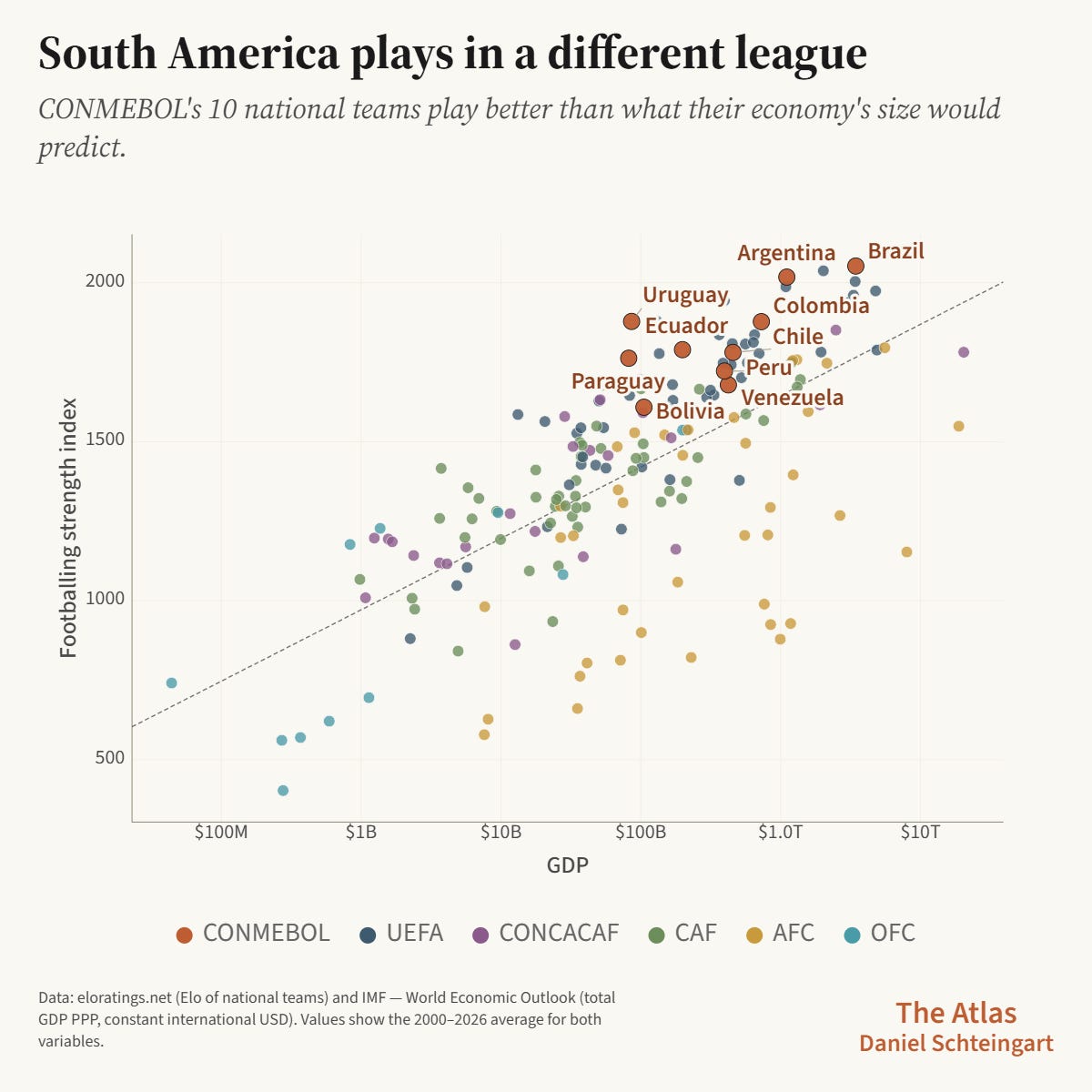
As we have seen in other issues, these charts have a line (the “regression line”) that marks what is expected: here, the football performance predicted by the size of an economy. The relationship is positive: in general, the bigger an economy (because it is richer, more populous, or both), the higher the Elo. But what matters is not the line so much as what departs from it. That distance between what we observe and what we would predict is what we have been calling, since the first issue, “the residual.” And in football, the South American residual is enormous.
South America performs 18% above what its economy would predict (273 Elo points). And it is not just Argentina, Brazil and Uruguay: all ten members of CONMEBOL (the South American confederation), without exception, sit above the line, even the ones nobody would associate with footballing greatness, like Venezuela or Bolivia. The pattern extends, though much more faintly, north into Latin America: Central America and Mexico also post a positive residual (Nicaragua aside), only at a far shorter distance from the line than their neighbours to the south.
The most extreme case in the world, the dot furthest from the line in the entire chart, is Uruguay: a positive residual of 34%. The Uruguayan economy ranks 91st in the world; in footballing strength, the country climbs to 11th. And that is with the analysis starting in 2000, leaving out the golden Uruguayan eras, when a country of some two million people won two World Cups (1930 and 1950) and two Olympic golds (1924 and 1928, which at the time counted as world titles). A second figure confirms the oddity from another angle. Pantheon, an MIT project, measures how globally remembered a public figure is (by how many languages their Wikipedia article appears in and how often it is visited from around the world). Among the 1,000 most-remembered footballers in history, Uruguay has nearly 11 memorable figures per million inhabitants, more than any other country. Behind that number stand reference points from different generations (Obdulio Varela, Enzo Francescoli, Luis Suárez), which show that Uruguayan talent was a constant across the decades rather than the product of a single golden age.
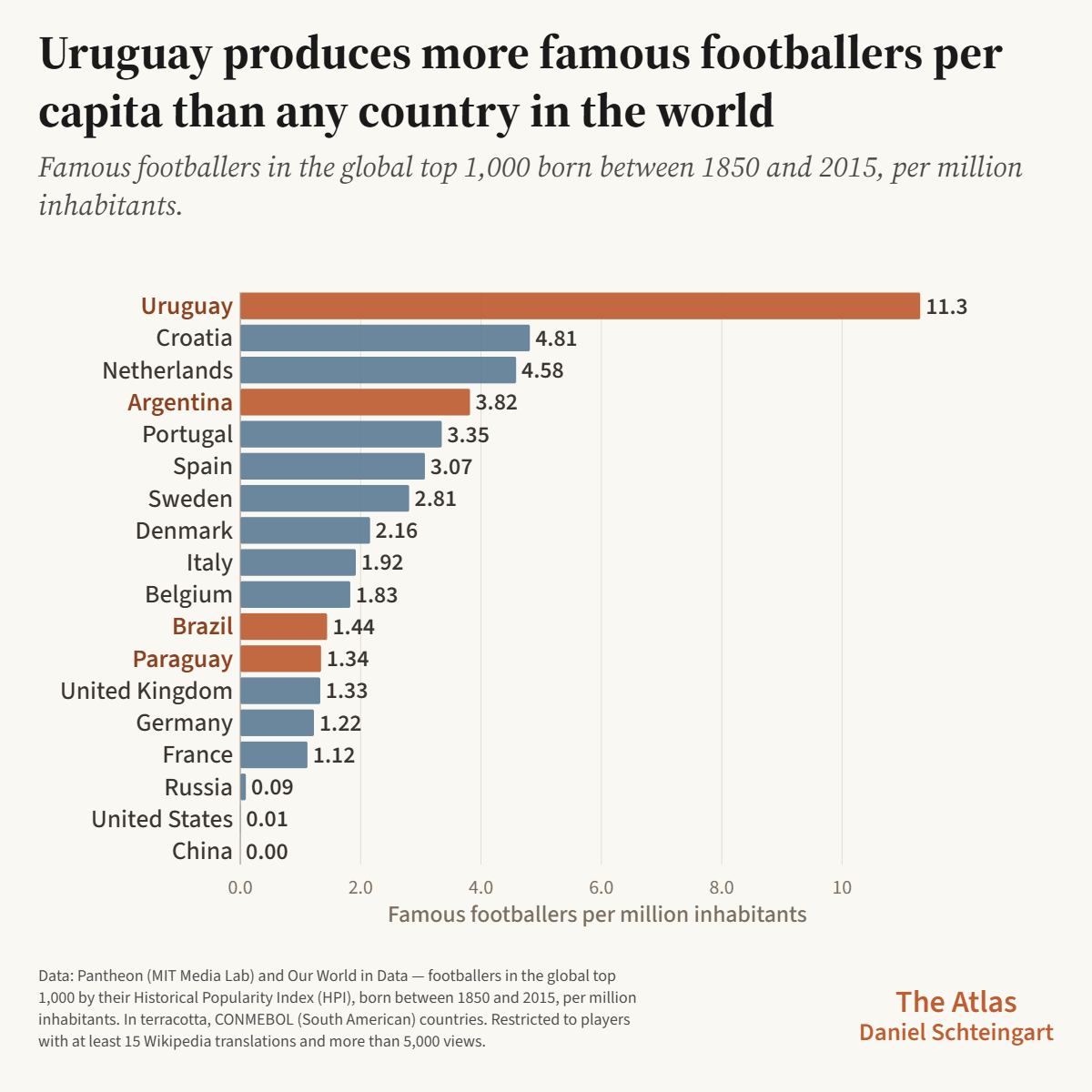
Brazil also sits above the predictable, though its residual is more moderate (16%). Its greatness comes less from overperforming than from sheer scale: it produces stars in enormous quantities, but because it is a giant country; adjusted per head, the feat dilutes. Uruguay is the inverse case: it does not produce that many in total, but an astonishing number for its size. With a positive residual of 22%, Argentina lands between its two neighbours.
CONMEBOL is not the only confederation above the line. UEFA (Europe) also plays better than its GDP predicts, though by a considerably smaller margin (10% more, around 145 Elo points) and with far more internal spread. Most European sides overperform their economic size, but some fall below it (Luxembourg, say, or Azerbaijan). Among the most outlying Europeans there is a sharp regional pattern: the Balkan nations of the former Yugoslavia behave like South Americans. Croatia, whose Elo is 30% higher than its GDP would suggest, is almost a Uruguay: fewer than four million people, World Cup runners-up in 2018 and semi-finalists at two other tournaments (1998 and 2022). Portugal and Spain show up as positive outliers too, a little less extreme but just as clear.
Now to the ones below the line, the countries that underperform their economic weight. The first thing that jumps out is the planet’s two largest powers: the United States and China, both comfortably below. But the clearest pattern is regional: Asia is the continent with the most negative residual of all (−19%).
The chart lays the South American puzzle bare. But before tackling it, let’s start with the basics: what does the size of an economy have to do with footballing performance?
Before chasing the South American anomaly, it is worth understanding the least mysterious part of the chart: why the size of an economy is tied to playing better. Total GDP blends two distinct advantages. The first is wealth: richer countries have more resources to invest in sporting infrastructure, to hire elite coaches and specialists, and to keep children healthier. The second is population: more people means more chances that exceptional talent appears. In a country of 100,000 it is very unlikely a star emerges; in one of 200 million, the pool is vastly larger.
That said, wealth and population, important as they are, do not go all the way: together they explain barely 44% of footballing strength. The other 56% is where the residual lives. South American exceptionalism cannot be explained by money and people: it sits in that 56%. Let’s go looking for it.
Football reached South America very early. It began in the River Plate region through the British who, at the end of the nineteenth century, ran the railways, banks and ports of Buenos Aires and Montevideo. From there it soon passed to the local population, who began to make the game their own and to found their own clubs. One of the first football leagues outside the British Isles was played in Buenos Aires in 1891; the association that is today the AFA dates to 1893 and ranks among the five oldest in the world. This early start spread across the rest of the region: by 1925, almost every South American country had its own football association and a growing infrastructure of clubs.
The map that follows captures this. Each country is coloured by the median founding year of its current clubs: in Argentina that year is 1911, in Paraguay 1916, in Uruguay 1920, which means half the clubs active today in those countries were founded before then. The index weights clubs by relevance (measured by how many Wikipedia languages they appear in), so River, Olimpia and Peñarol count for more than little-known clubs. South America and Europe come out in dark brown, signalling long-standing club infrastructure. Asia, Africa, the United States, Canada and Australia, in blues, are countries with young clubs, where football arrived recently.
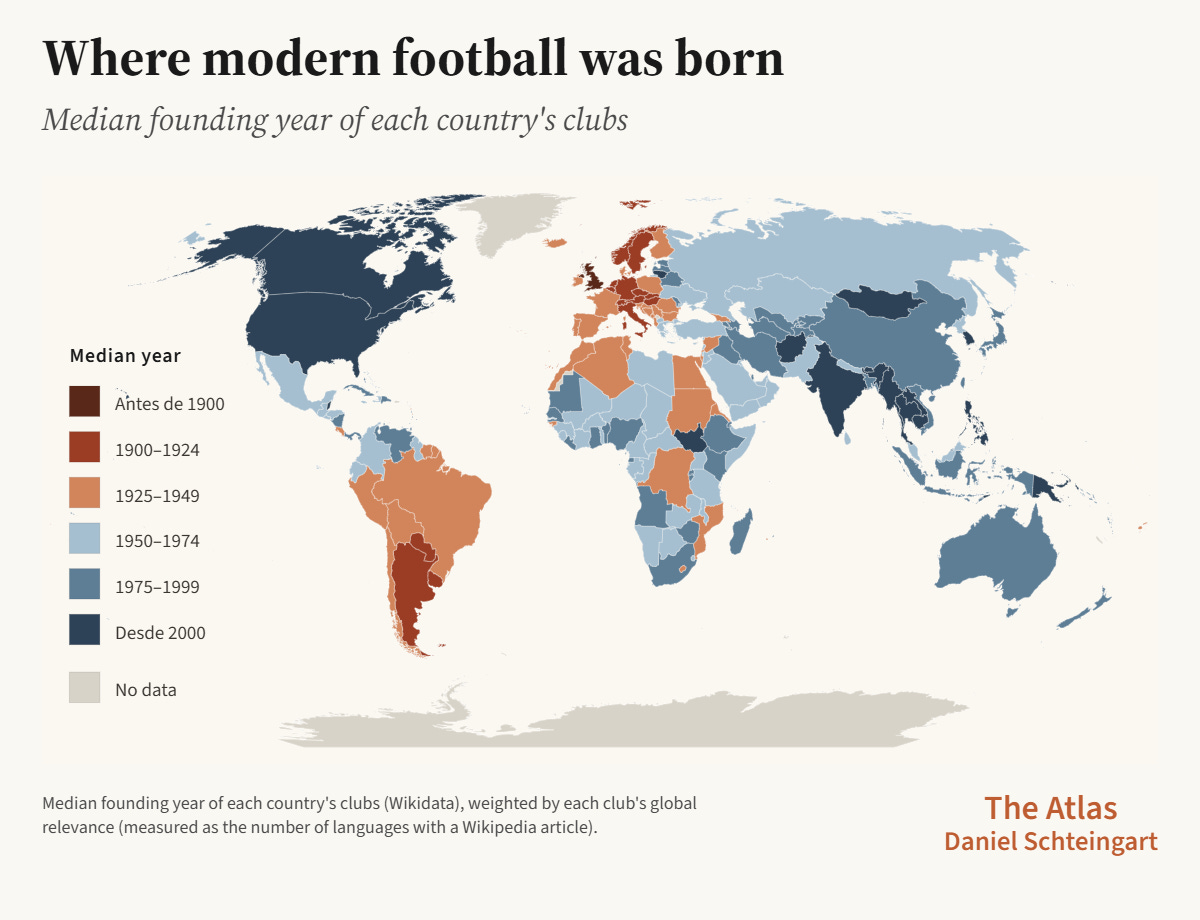
Alongside the size of the economy, the depth of its football tradition is one of the strongest predictors of current performance. It makes sense: the older the tradition, the more time football had to lay down three things you cannot buy overnight. First, institutions: clubs, leagues, neighbourhood tournaments, scouting networks, administrators, coaches. Second, know-how: ways of training, of watching players, of correcting technique, of competing from a young age, of passing the craft between generations. Third, social desire: families who take their children to the club, kids who dream of becoming their idols, whole neighbourhoods that recognise talent before a scout ever does. In a country where football arrived a hundred years ago, each generation does not start from scratch: it inherits a network. Precarious, unequal and messy, but a network that multiplies the chances that a talent appears, is seen, is pushed, is shaped, and makes it to the top.
But here an apparent paradox appears. If the British brought football, why did it not catch on just as strongly in the countries with the deepest historical ties to the United Kingdom, like the United States, Canada or Australia? The reasons are several, but different studies converge on one point. In those countries, by the time football began to spread around the world, other sports of the Anglophone world had already taken the centre of national sporting life: baseball and American football in the United States, ice hockey in Canada, cricket, rugby and Australian rules football in Australia. Each had its clubs, leagues, calendars, heroes, rivalries and rituals. Football arrived in societies where the symbolic, institutional and commercial space of “national sport” was already largely taken.
The paradox of the former British colonies points to something more general: a country’s footballing strength depends on how much competition football meets for its talent. When another sport has already taken that centre, football is left as a supporting actor and never fully takes off. When it arrives and finds no rival, it takes everything: the fans, the institutions, the kids who dream.
But antiquity alone does not close the puzzle. Europe also has old clubs and also performs above expectations, though considerably less than South America. Why, if both have long traditions, is the South American residual nearly double? Here the second factor comes in: competition between sports comes in degrees, and the South American monopoly runs deeper than the European one. In Europe football is the king of sports, but it reigns surrounded by powerful satellites (tennis, basketball, cycling, rugby, the winter sports) that draw off their share of the talent. A European kid with an exceptional physique might end up in any of those channels. In South America there are almost no satellites: that kid plays football, full stop.
The chart that follows crosses those two dimensions. On the horizontal axis, what share of each country’s most-remembered athletes (per Pantheon) are footballers: the further right, the more talent concentrated in football. On the vertical axis, the antiquity of the clubs: the lower down, the deeper the footballing tradition. The four quadrants tell different stories.
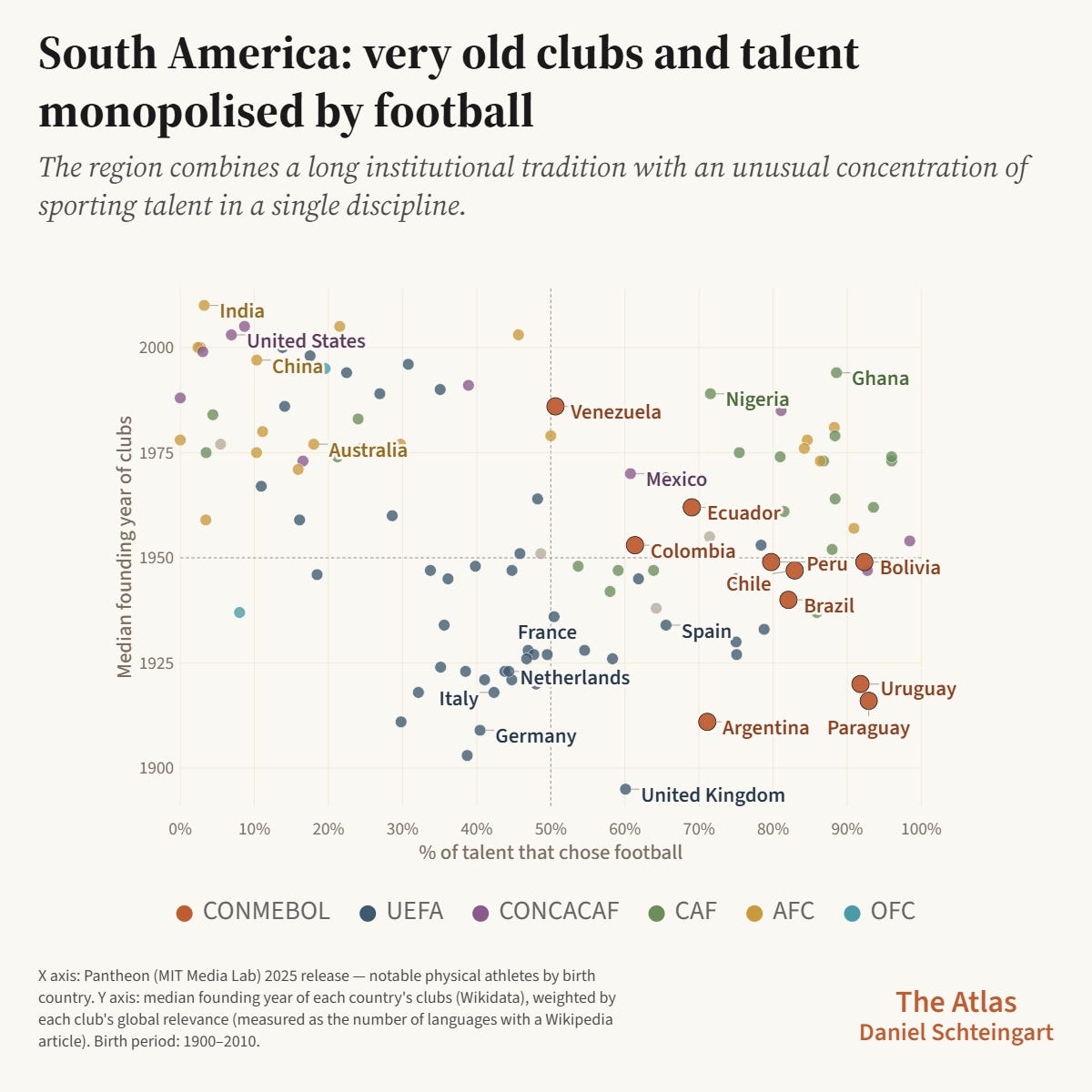
The bottom-right is the South American quadrant par excellence: old clubs and talent channelled almost entirely into football. Paraguay and Uruguay are the most extreme cases on the chart. The bottom-left is European: long tradition, but diversified talent; that is where most UEFA countries sit. The top-right gathers mostly African countries with recent club infrastructure and a high degree of specialisation in football, like Nigeria, Ghana, Senegal or Côte d’Ivoire. And the top-left holds those with young clubs and sporting talent heavily absorbed by other disciplines, like the United States, Canada, Australia and India. In that quadrant a peculiar Latin American appears: the Dominican Republic, famous for its baseball players and not its footballers.
South American exceptionalism, then, is not just about antiquity: it is antiquity plus monopoly. Football arrived early and took everything.
That combination (arriving early and taking everything) explains much of the residual, but it also begs to be explained: why did it happen right here, and not somewhere else in the world? The answer lies in the moment the ball came ashore. At the end of the nineteenth century, the River Plate was living through one of the fastest, earliest urbanisations in the developing world: Buenos Aires and Montevideo were filling with immigrants and growing at a dizzying pace. Football landed in that social mix at exactly the right time: a new game, urban, cheap, asking for nothing more than a ball and an open patch of ground, that could belong to everyone at once, and that in time ended up giving that newly arrived mass something in common. And it landed on an empty pitch, with no earlier sport already holding the place.
Europe had the antiquity but never the monopoly: many of its great sports (tennis, cycling, rugby, the winter sports) are European in origin and were organised in the same nineteenth century as football, so football was born competing with local traditions of its own age. The United States, Canada and Australia urbanised early, but the spot was already taken. Africa has been building its footballing passion, but far later. South America, and above all the River Plate, had all three at once: it arrived early, it arrived in cities that were exploding, and it arrived to an empty pitch.

Boy playing football on stone steps, Mar del Plata, Argentina. Photo: Alex Dos Santos.
Football’s early arrival and its monopoly over talent explain a good part of South American exceptionalism. But it is worth measuring how much. When we looked at GDP alone, South America came out 273 Elo points above expectation. Once we add club antiquity and the concentration of talent in a single sport, that surplus falls to 75 points. It is a huge drop: those two variables explain most of the oddity. But not all of it. And so the question returns: what pieces are missing to finish explaining the South American anomaly?
In academia, several hypotheses are floating around. A meat-rich diet, which would favour the physical and cognitive development of children. Inequality and poverty, which would turn football into one of the few visible routes upward and push the most talented to chase it rather than another career. A temperate climate, which allows outdoor play almost year-round. Less structured forms of street play (the dirt-lot kickabout, the pickup game), able to train improvisation, guile and flexibility. None is far-fetched and all are plausible. But so far the evidence on their real impact is fairly thin.
That is why part of South American exceptionalism still has no name: a murmur you can hear but cannot quite catch. And maybe that is where, deep down, part of its charm lies: however much we turn the numbers over, a remainder is left that no explanation fully exhausts. That stubborn oddity is, perhaps, part of what makes South American football mythical.

Street football in Brazil. Photo: Agência Brasil / Wikimedia Commons, CC BY 3.0.
\ \ \*
Every four years, the question will not be whether South America keeps producing good footballers. It would be strange if it stopped: there are too many clubs, too much memory, too many families who recognise a different kind of dribble before anyone else. The question is whether that edge will keep being enough. And the answer pulls both ways.
Working against it is the technification of football: the more that player development depends on science, data, nutrition and money, the better positioned rich countries are to turn resources into sporting advantage. And the globalisation of football threatens to drain talent, as already happens to Africa and the Caribbean, who watch their best players, born in the diaspora, pull on European shirts. But those same forces also push the other way. South American footballers now move to European leagues more than ever, and there they soak up all that sophistication, which they later give back to their national teams. And as long as those national teams stay powerful, the kid with two passports will keep choosing the shirt of his birth country over the European one, just as Argentines of Italian descent who could play for Italy choose Argentina.
That is the key: the South American advantage protects itself. As long as it wins, it keeps its own and even attracts those of divided origin; the day it starts losing, it will start losing them too. Perhaps the next great match will not be against a European power at a World Cup, but against an entire world bent on manufacturing, with method and budget, what South America learned to multiply with history, desire and a ball that has been rolling for over a century.
---
Visual. Football Around the World, by Magnum Photos, one of the world’s leading documentary photography cooperatives. Stunning images of footballing scenes from every corner of the planet.
Data to play with. World Trade Cup, from the Observatory of Economic Complexity, a World Cup trivia game for guessing, match by match, which country exports more to the other across different products.
Academic 1. A recent paper analyses the Messi–Ronaldo rivalry to show that even an apparently footballing preference can express deeper values: across 26 countries, the more progressive tend to prefer Messi, and the more conservative, authoritarian and short-video-consuming, Ronaldo.
Academic 2. Another recent paper measures football’s “leg drain,” the dual-nationality version of brain drain, and finds it flows much like the real thing: wealthy European nations soak up the player value while Africa and the Caribbean bear the heaviest losses.
---
Explore the interactive charts
- Chart 1 \- Footballing strength vs. economic size
- Chart 2 \- Memorable footballers per million inhabitants
- Chart 3 \- The antiquity of football clubs around the world
- Chart 4 \- Club antiquity versus football’s monopoly
Explore more charts
This article features only a selection. On the interactive site, you can browse all the charts from this edition, explore different countries and years, and find additional visualizations on the history of national teams, migration, and the geography of world football.
Explore all the interactive charts
The Atlas — Mapping development from Latin America, issue 3 — June 10th 2026.
If you enjoyed this issue, suscribe and share
Subscribe