UK Tokenization Roadmap Puts £33 Billion on the Table and a Clock on the Wall
UK Tokenization Roadmap Puts £33 Billion on the Table and a Clock on the Wall
- Ayanfe Fakunle
- July 14, 2026
- Digital Assets, News
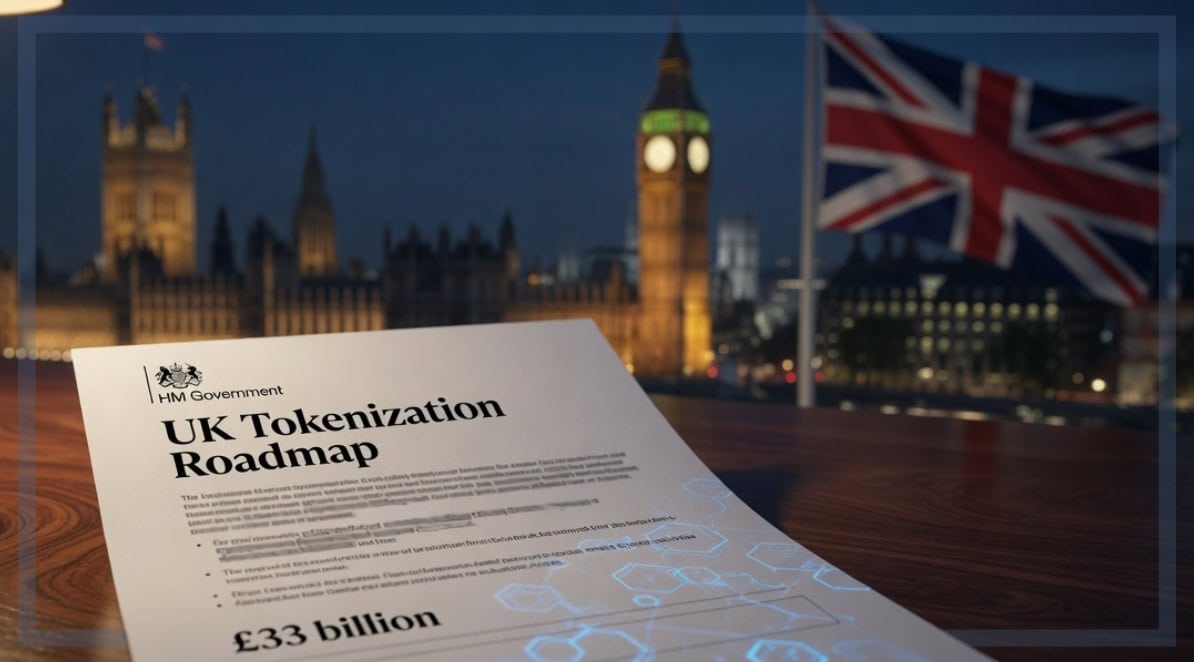
The UK government now has a written plan for moving its wholesale financial markets onto blockchain rails. On July 13, Chris Woolard, HM Treasury’s Wholesale Digital Markets Champion, delivered his first report to the Chancellor. The headline numbers are up to £33 billion in additional annual economic output and £14 billion in yearly tax revenue by 2035, if the UK builds the infrastructure fast enough.
The report, backed by the City of London Corporation, cites estimates from Barclays, PwC, and Boston Consulting Group that tokenized real-world assets could hit $88 trillion globally by 2035. Today’s market sits somewhere between $23 billion and $36 billion, depending on who is counting. The gap between those figures explains both the ambition and the risk.
🚨 JUST IN: The United Kingdom just made its move on tokenization. And #Ripple is inside the room. 🇬🇧
HM Treasury appointed a Wholesale Digital Markets Champion to build a tokenized wholesale financial markets system for the UK. The inaugural report was published today, July 13,… <https://t.co/OqYclFXmIq> pic.twitter.com/Lt7x5Wrryh>
— RippleXity (@RippleXity) July 13, 2026
DIGIT Targets First Issuance by Q1 2027
The roadmap sets hard deadlines. The Digital Gilt Instrument (DIGIT), the pilot that would make the UK the first G7 country to issue a blockchain\-native government bond, is expected to have its first issuance in Q1 2027.
HSBC was appointed as platform provider in February, running the pilot on its Orion platform inside the Bank of England’s Digital Securities Sandbox. That sandbox, which comprises 16 firms, including Euroclear and the London Stock Exchange Group, has been approved to test tokenized issuance, trading, and settlement under regulatory supervision.
54 Firms, Nine Action Groups, One Repo Trade to Prove It Works
A cross-industry taskforce of 54 firms: BlackRock, Goldman Sachs, JPMorgan, HSBC, Coinbase, Circle, and Ripple, among them, will spend the next 12 months organized into nine action groups covering primary issuance, tokenized collateral, tokenized funds, payment rails, legal certainty, and financial crime compliance. Their first target is a live, end-to-end tokenized repo transaction by spring 2027. Woolard is due to hand the Chancellor a second report on DLT interoperability standards by July 2027, so the taskforce has one year to show a working trade rather than another set of working groups.
Woolard frames the stakes bluntly: tokenization is a network game, and the UK cannot afford to sit on the sidelines. The UK’s dominance in FX, OTC derivatives, and repo markets is what’s on the line. Ripple’s UK policy head Matthew Osborne backed the plan, noting that onchain funds, bonds, and repo are already proving more liquid than their legacy versions.
Settlement Is Still the Weak Link
Tokenized assets mean little if the cash side can’t keep up. The report pushes for settlement using stablecoins, tokenized bank deposits, and central bank money, a point industry executives keep hammering. Banking Circle’s Kirit Bhatia warned that without modern payment rails, digital assets stay “constrained by the legacy plumbing underneath.”
The good news is that this part is no longer theoretical. In January, Lloyds completed the UK’s first gilt purchase settled with tokenized deposits, issued on the public Canton Network, buying a tokenized gilt from FCA-regulated exchange Archax. The deposits kept earning interest and stayed covered by the Financial Services Compensation Scheme, proof that blockchain settlement and ordinary banking protections can coexist. Six major UK banks, including Barclays, Lloyds, and NatWest, are also running the Great British Tokenized Deposits pilot through mid-2026, and the project has confirmed it will support DIGIT bidders as an onchain payment supplier.
Disruption Banking tracked the UK’s tokenization momentum in January, when the strategy was still a collection of separate pilots. The Woolard report is the first attempt to stitch them into one national program with dates attached.
The test now is execution. Working groups and sandboxes generate headlines. Liquidity is harder. A digital gilt that settles instantly but rarely trades is a science project, not a market. Whether 54 firms can turn a priority list into a production repo trade within a year will show whether the £33 billion projection is a forecast or a wish.
Author: Ayanfe Fakunle
The editorial team at #DisruptionBanking has taken all precautions to ensure that no persons or organizations have been adversely affected or offered any sort of financial advice in this article. This article is most definitely not financial advice.
See Also:
Leave a Reply Cancel reply
Your email address will not be published. Required fields are marked \*
Comment \*
Name \*
Email \*
Website
Save my name, email, and website in this browser for the next time I comment.
The reCAPTCHA verification period has expired. Please reload the page.
Related Posts
Tokenization’s Real Problem: Who Will Actually Buy?
UK’s Tokenization Momentum: Leading the Charge into 2026?
How the Wyoming Stable Token Wanted to Beat Biden’s SEC but Became a Potential Government Surveillance Tool Instead
NEWSLETTER
I would like to receive future communications
I agree to the GDPR & CCPA Terms & Conditions
SUBMIT
Trending
BIS report on Big Tech in Finance
Supply Chain Disruptions and Credit Risk Dependencies
Revolut Has a New Office, But it’s Hybrid Work for Employees
How Is The “Trump Trade” Impacting Crypto Markets?
SNIB invests £7.5 million in firm run by employee’s brother
Understanding the Risks and Rewards of Investing in Digital Assets In 2025 And Beyond
UK Tokenization Roadmap Puts £33 Billion on the Table and a Clock on the Wall
Strait of Hormuz Tensions Weigh on Chinese Stocks as Oil Surges
The easyJet Takeover: Can Apollo Actually Own a European Airline?
Write your email to verify subscription
Verify
Loading...
#### Sign up for our free newsletter and receive the latest banking and fintech stories, straight to your inbox - every week
We use cookies to ensure that we give you the best experience on our website. If you continue to use this site we will assume that you are happy with it.OkPrivacy policy