





Kave Rennedy
People’s lives might be getting better as we get richer: folks can afford children’s shoes and live longer. Or their lives might be getting worse: lonelier and doing work they feel no part of. Who could possibly say?
Econometricians.

Real GDP measures how much of everything people get in a year, including goods like food and services like haircuts. This is a good start, but how should we compare a year with 3 apples and 5 haircuts to one with 10 apples and 4 haircuts? Apples went up, and haircuts went down.
If we give up here, we’ll be giving up on most years, because rarely do people get more of literally everything. But we can tell that some years have more stuff. Imagine we were comparing 3 apples and 5 haircuts in the first year to a billion apples and 4 haircuts in the second year. That looks like an improvement to me!
Dollars are a measure of how much people value stuff. Statisticians use prices to convert each good into dollars, and then sum them up to get a total GDP. But this approach can mislead. If apples become too cheap to meter, almost no dollars get spent on them, even when people are eating more apples than ever. So, when calculating real GDP, statisticians pick a benchmark year, and then convert the goods using that year’s prices.
But pricing things this way runs into trouble when you try to use the result as a welfare measure.
Imagine that there are only two goods: food and string quartets. People like both, but each additional bit of food or string quartet performance is valued less than the last.
Over time, the inhabitants of this world get better at making both food and music. But, they improve at making food faster than at making string quartets.
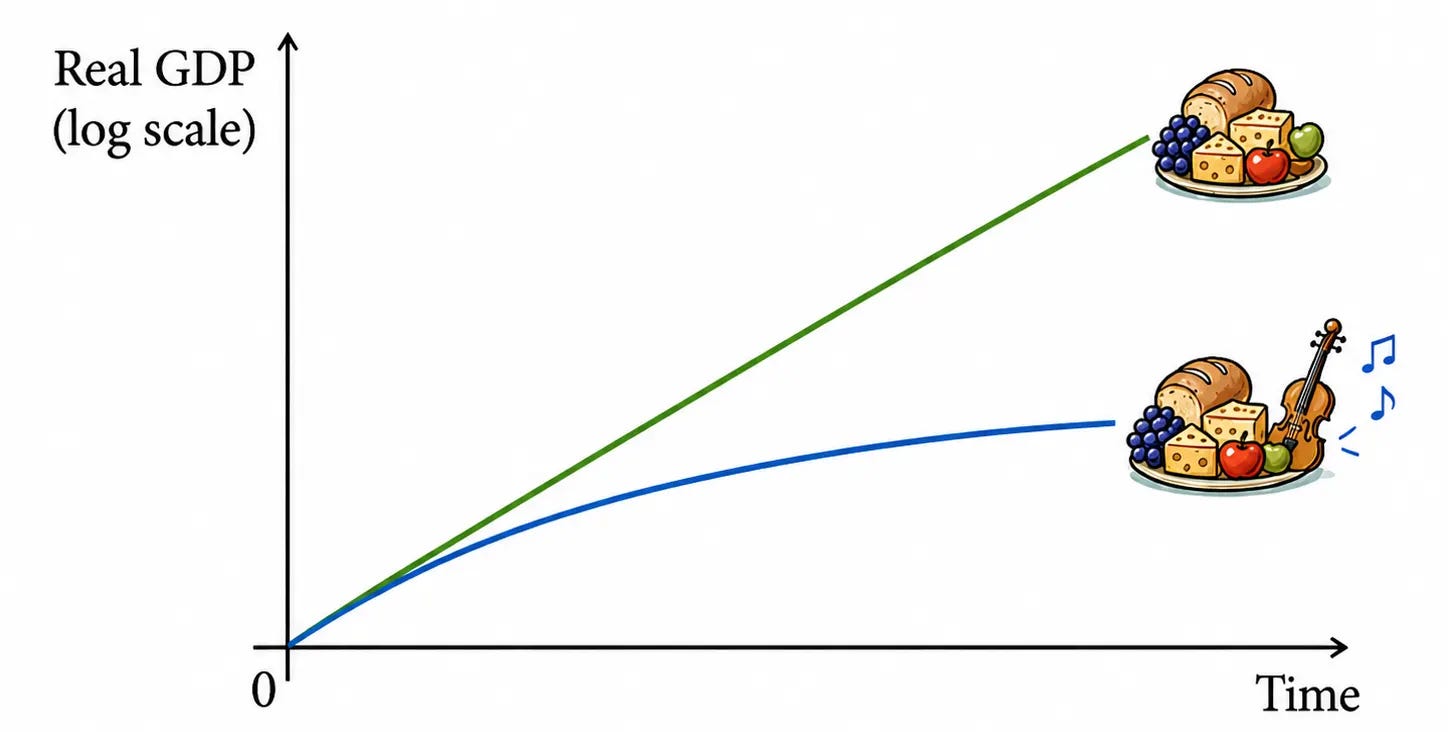
As food gets cheaper and cheaper, satisfying your needs costs almost nothing. People move almost all their spending to string quartets. String quartets get cheaper, but not nearly as much as food does. Because almost all spending is now on quartets, real GDP basically tracks how fast the quartet sector grows.

GDP growing with and without string quartets
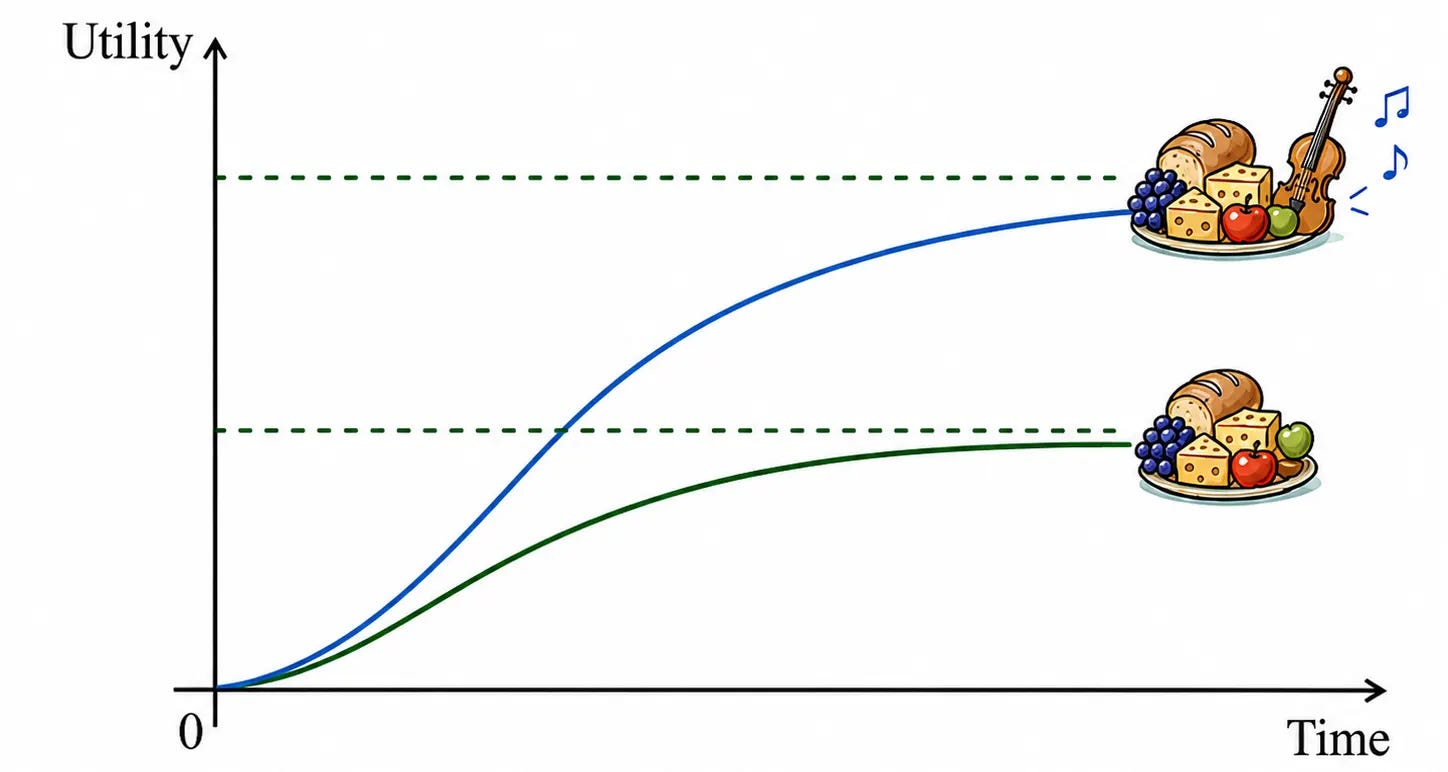
Delete string quartets from the world, and real GDP would, confusingly, grow faster. People would spend all their money on food, and they get better at making food very quickly. So real GDP grows faster without string quartets, but the utility of that world is lower!

Utility is higher with string quartets. Peep how the ordering switches between the two graphs!
Not the best measure. As John Wentworth put it in 2021, real GDP mainly measures the goods which are revolutionized least.
Philip Trammell and Charles Jones have a new paper that suggests a better measure. It’s also the source of the above example. I recommend reading it; it’s shockingly clear
Rationality equilibrates
The paper assumes that folks are rational, then leans on a corollary: people get the same bang for their buck everywhere. Spending an extra cent today is just as good as saving it for tomorrow. You might as well spend it on lowering your risk of death or buying more of your favourite tea.
Why does rationality imply this? Cos if it were better to buy tea than save money, you’d already save less and spend more on tea. People keep adjusting their budgets until there are no more wins to be had with that money.
I’ll call this the “rationality equilibrates” argument.
1% of your money or 0.01% of your life
People are actually quantifying the value of their life all the time. The world abounds with options to trade a little danger of dying for a little bit of money. Both working in an oil refinery and buying a cheaper car are a little more dangerous than the alternative, and both make or save you money.
These choices put a price on avoiding death. You could live to see tomorrow, or you could get to spend a bunch more money today. There’s a price at which that equals out. The name for that price is value of statistical life (VSL). I’ll call it “value of life”.
The dollars in that price are not just any dollars. They have the magic property that each dollar is as good as the last. If your value of life is $1 billion, those are dollars that each feel as welcome as a dollar does right now, not dulled by the jaded disgust of a person richer than they can stomach.

Homer experiencing non-diminishing marginal utility in donuts
This is an example of a “rationality equilibrates” argument: if you take a 1 in a million chance of dying for $20 today, you think the rest of your life is less than a million times as good as that extra $20. To find out how good your life is, in the face of a fickle dollar, we need to know: how good is that extra $20?
To say it another way, the utility of your life, according to you, is its value in dollars, multiplied by the utility of a dollar.
That just leaves finding out how much the next dollar is worth to you. As the authors wryly note, the utility of the next dollar is “rarely observed”. In fact, we can’t observe it!
What you can see instead
As we all know from 2008 MIRI hiring posts, utility functions are unique up to affine transformation. For me, that phrase remained catechistic for years. “Utility functions are unique up to affine transformations, Brother Kave,” I would intone to myself as I waited for my toast. “They preserve relative intervals, frater,” I’d respond.
What does this mean? First, your choices don’t change if we bump up your utility in all situations. If apples are a bit better and bananas are just as much better, you’ll take the same odds when betting my apple against your banana. Second, your choices don’t change if we scale your utilities by some factor. Liking apples more intensely only makes a difference if you don’t like everything else more intensely as well.
We can get rid of the “bump” by asking: how good is a bit more stuff? The difference between four apples and three apples stays the same even as we bump your utility. We can get rid of the “stretch” by looking at how your utility grows. A 3% increase is a 3% increase even if the numbers are all doubled.
The paper looks at how the value of a bit more stuff grows over time: the combination of looking at growth rates and the next bit of stuff means that we’re talking about something objective. Its value is pinned down by folks’ choices.

Growth mindset
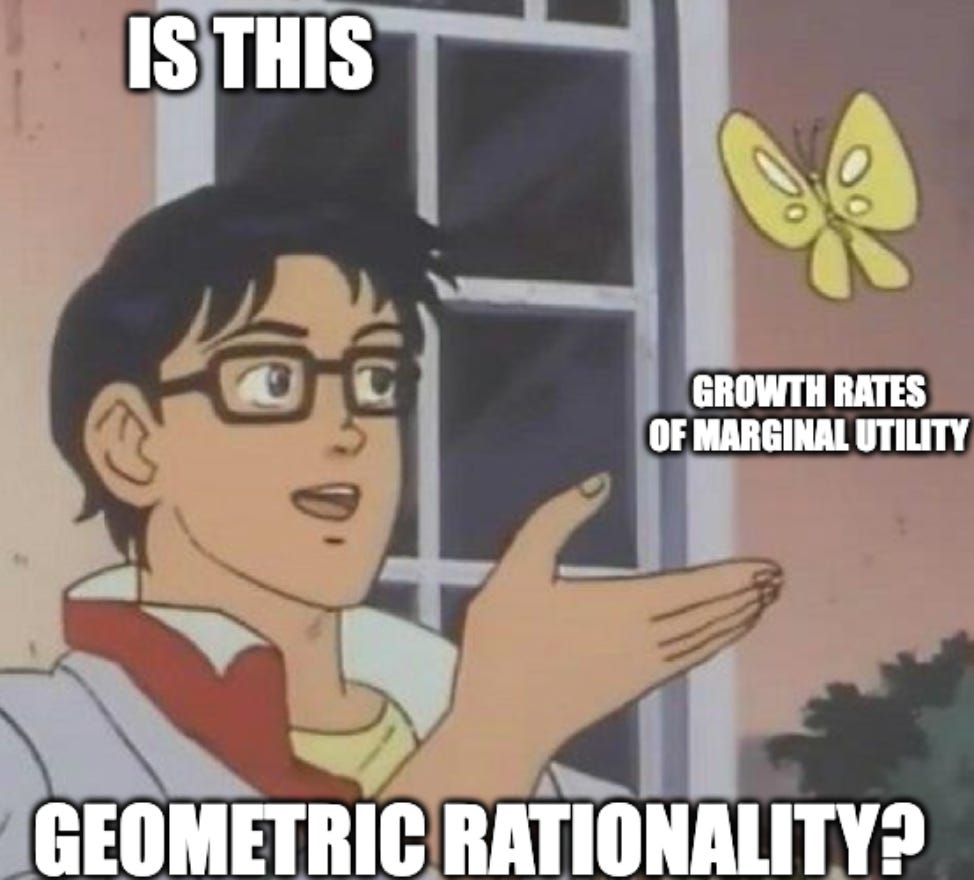
Lifetime utility grows for two reasons. The dollar value of your life can rise. And the value of an extra dollar can rise. Add those two growth rates together and you get the rate at which your lifetime utility grows.
We can use a “rationality equilibrates” argument to find out.
You could spend a dollar today. Or, you could save it for a little later. If you save it for later, you’ll get a bit more money back the next day (because you’ve voted for society to make tomorrow richer at the expense of today). But it’s later, and maybe you’re a bit impatient, and care about later less than now. And also, the opportunity to spend your next dollar might be better or worse later than it is now.
All of these effects matter. But the “rationality equilibrates” argument says it all washes out. You save more money until you’re indifferent between saving the next dollar and spending it today.
We can solve this for a growth rate, and we find it’s remarkably simple. It’s just how quickly you stop caring about the future, minus how fast your money grows when you wait.
To get your growth in lifetime utility, all we have to do is add in the growth in the value of life!
In math:
\\(\\textrm{Growth}(U) = \\textrm{Growth}(\\textrm{VSL}) + \\rho + i\\)
Where U is lifetime utility, ρ is how fast you stop caring and i is how much interest you get.
Here’s the first paragraph.
The richest person in the world in the 1830s was Nathan Rothschild, whose personal net worth was around 0.6% of British national income (Ferguson, 2008, p.82). Despite this vast fortune, Rothschild died at age 58 in 1836 of an infection that $10 of antibiotics could likely cure today (Economist, 2004). Similarly, the richest people in the world today, such as Bill Gates or Jeff Bezos, presumably have a marginal utility from additional consumption spending that is zero. Nevertheless, their utility still increases when new goods (smartphones or LLMs) are invented. These examples suggest that more consumption of a fixed set of goods eventually hits a marginal utility of zero while the invention of new goods or higher quality goods continues to increase wellbeing.
Good, right?