


Beyond's Substack


Join Beyond Horizon for one original intelligence report each week exploring where frontier space companies are heading—and why.
Subscribe
Text only version:
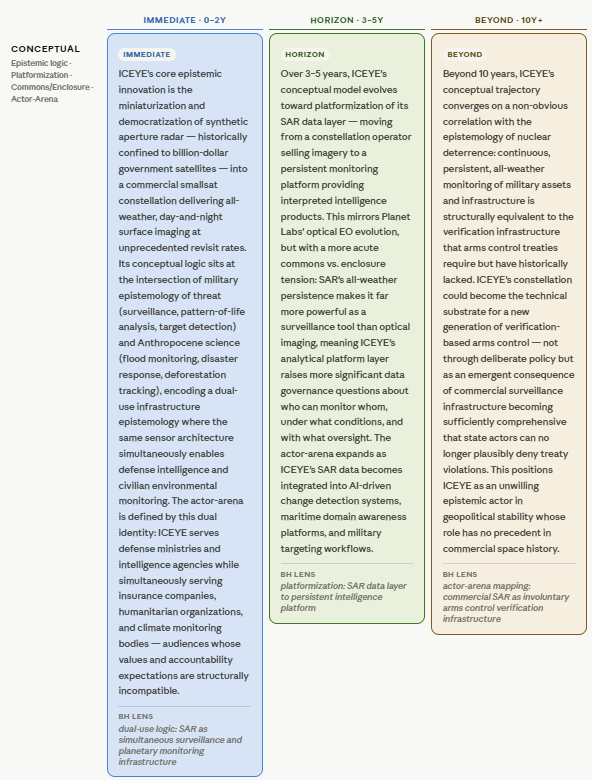
Immediate · 0–2y
Horizon · 3–5y
Beyond · 10y+
Conceptual
Epistemic logic · Platformization · Commons/Enclosure · Actor-Arena
Immediate
ICEYE’s core epistemic innovation is the miniaturization and democratization of synthetic aperture radar — historically confined to billion-dollar government satellites — into a commercial smallsat constellation delivering all-weather, day-and-night surface imaging at unprecedented revisit rates. Its conceptual logic sits at the intersection of military epistemology of threat (surveillance, pattern-of-life analysis, target detection) and Anthropocene science (flood monitoring, disaster response, deforestation tracking), encoding a dual-use infrastructure epistemology where the same sensor architecture simultaneously enables defense intelligence and civilian environmental monitoring. The actor-arena is defined by this dual identity: ICEYE serves defense ministries and intelligence agencies while simultaneously serving insurance companies, humanitarian organizations, and climate monitoring bodies — audiences whose values and accountability expectations are structurally incompatible.
BH lens
dual-use logic: SAR as simultaneous surveillance and planetary monitoring infrastructure
Horizon
Over 3–5 years, ICEYE’s conceptual model evolves toward platformization of its SAR data layer — moving from a constellation operator selling imagery to a persistent monitoring platform providing interpreted intelligence products. This mirrors Planet Labs’ optical EO evolution, but with a more acute commons vs. enclosure tension: SAR’s all-weather persistence makes it far more powerful as a surveillance tool than optical imaging, meaning ICEYE’s analytical platform layer raises more significant data governance questions about who can monitor whom, under what conditions, and with what oversight. The actor-arena expands as ICEYE’s SAR data becomes integrated into AI-driven change detection systems, maritime domain awareness platforms, and military targeting workflows.
BH lens
platformization: SAR data layer to persistent intelligence platform
Beyond
Beyond 10 years, ICEYE’s conceptual trajectory converges on a non-obvious correlation with the epistemology of nuclear deterrence: continuous, persistent, all-weather monitoring of military assets and infrastructure is structurally equivalent to the verification infrastructure that arms control treaties require but have historically lacked. ICEYE’s constellation could become the technical substrate for a new generation of verification-based arms control — not through deliberate policy but as an emergent consequence of commercial surveillance infrastructure becoming sufficiently comprehensive that state actors can no longer plausibly deny treaty violations. This positions ICEYE as an unwilling epistemic actor in geopolitical stability whose role has no precedent in commercial space history.
BH lens
actor-arena mapping: commercial SAR as involuntary arms control verification infrastructure
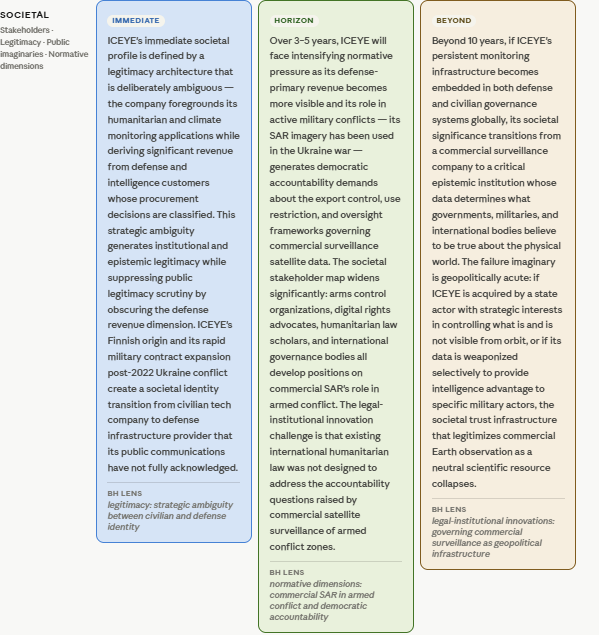
Societal
Stakeholders · Legitimacy · Public imaginaries · Normative dimensions
Immediate
ICEYE’s immediate societal profile is defined by a legitimacy architecture that is deliberately ambiguous — the company foregrounds its humanitarian and climate monitoring applications while deriving significant revenue from defense and intelligence customers whose procurement decisions are classified. This strategic ambiguity generates institutional and epistemic legitimacy while suppressing public legitimacy scrutiny by obscuring the defense revenue dimension. ICEYE’s Finnish origin and its rapid military contract expansion post-2022 Ukraine conflict create a societal identity transition from civilian tech company to defense infrastructure provider that its public communications have not fully acknowledged.
BH lens
legitimacy: strategic ambiguity between civilian and defense identity
Horizon
Over 3–5 years, ICEYE will face intensifying normative pressure as its defense-primary revenue becomes more visible and its role in active military conflicts — its SAR imagery has been used in the Ukraine war — generates democratic accountability demands about the export control, use restriction, and oversight frameworks governing commercial surveillance satellite data. The societal stakeholder map widens significantly: arms control organizations, digital rights advocates, humanitarian law scholars, and international governance bodies all develop positions on commercial SAR’s role in armed conflict. The legal-institutional innovation challenge is that existing international humanitarian law was not designed to address the accountability questions raised by commercial satellite surveillance of armed conflict zones.
BH lens
normative dimensions: commercial SAR in armed conflict and democratic accountability
Beyond
Beyond 10 years, if ICEYE’s persistent monitoring infrastructure becomes embedded in both defense and civilian governance systems globally, its societal significance transitions from a commercial surveillance company to a critical epistemic institution whose data determines what governments, militaries, and international bodies believe to be true about the physical world. The failure imaginary is geopolitically acute: if ICEYE is acquired by a state actor with strategic interests in controlling what is and is not visible from orbit, or if its data is weaponized selectively to provide intelligence advantage to specific military actors, the societal trust infrastructure that legitimizes commercial Earth observation as a neutral scientific resource collapses.
BH lens
legal-institutional innovations: governing commercial surveillance as geopolitical infrastructure
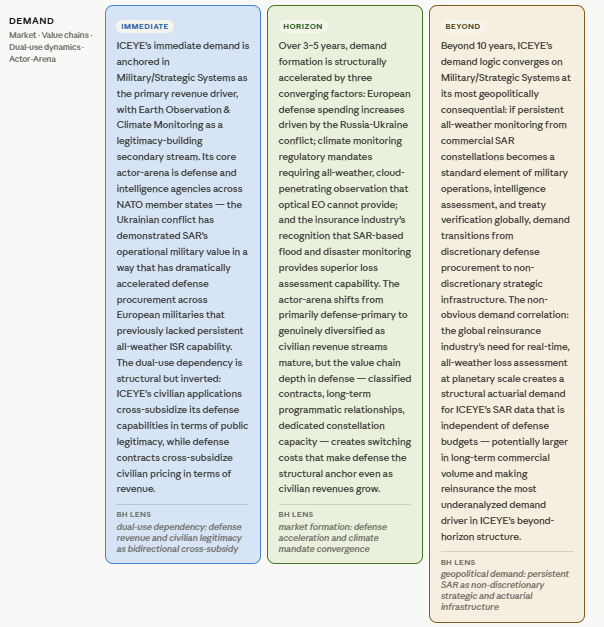
Demand
Market · Value chains · Dual-use dynamics · Actor-Arena
Immediate
ICEYE’s immediate demand is anchored in Military/Strategic Systems as the primary revenue driver, with Earth Observation & Climate Monitoring as a legitimacy-building secondary stream. Its core actor-arena is defense and intelligence agencies across NATO member states — the Ukrainian conflict has demonstrated SAR’s operational military value in a way that has dramatically accelerated defense procurement across European militaries that previously lacked persistent all-weather ISR capability. The dual-use dependency is structural but inverted: ICEYE’s civilian applications cross-subsidize its defense capabilities in terms of public legitimacy, while defense contracts cross-subsidize civilian pricing in terms of revenue.
BH lens
dual-use dependency: defense revenue and civilian legitimacy as bidirectional cross-subsidy
Horizon
Over 3–5 years, demand formation is structurally accelerated by three converging factors: European defense spending increases driven by the Russia-Ukraine conflict; climate monitoring regulatory mandates requiring all-weather, cloud-penetrating observation that optical EO cannot provide; and the insurance industry’s recognition that SAR-based flood and disaster monitoring provides superior loss assessment capability. The actor-arena shifts from primarily defense-primary to genuinely diversified as civilian revenue streams mature, but the value chain depth in defense — classified contracts, long-term programmatic relationships, dedicated constellation capacity — creates switching costs that make defense the structural anchor even as civilian revenues grow.
BH lens
market formation: defense acceleration and climate mandate convergence
Beyond
Beyond 10 years, ICEYE’s demand logic converges on Military/Strategic Systems at its most geopolitically consequential: if persistent all-weather monitoring from commercial SAR constellations becomes a standard element of military operations, intelligence assessment, and treaty verification globally, demand transitions from discretionary defense procurement to non-discretionary strategic infrastructure. The non-obvious demand correlation: the global reinsurance industry’s need for real-time, all-weather loss assessment at planetary scale creates a structural actuarial demand for ICEYE’s SAR data that is independent of defense budgets — potentially larger in long-term commercial volume and making reinsurance the most underanalyzed demand driver in ICEYE’s beyond-horizon structure.
BH lens
geopolitical demand: persistent SAR as non-discretionary strategic and actuarial infrastructure
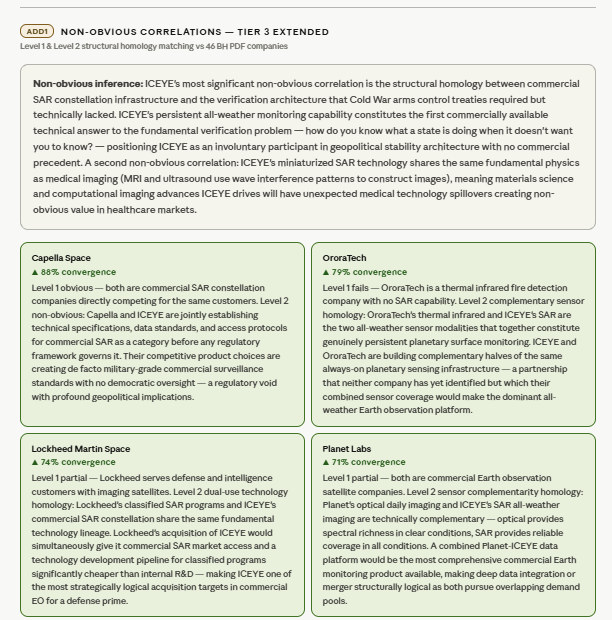
ADD1Non-Obvious Correlations — Tier 3 Extended
Level 1 & Level 2 structural homology matching vs 46 BH PDF companies
Non-obvious inference: ICEYE’s most significant non-obvious correlation is the structural homology between commercial SAR constellation infrastructure and the verification architecture that Cold War arms control treaties required but technically lacked. ICEYE’s persistent all-weather monitoring capability constitutes the first commercially available technical answer to the fundamental verification problem — how do you know what a state is doing when it doesn’t want you to know? — positioning ICEYE as an involuntary participant in geopolitical stability architecture with no commercial precedent. A second non-obvious correlation: ICEYE’s miniaturized SAR technology shares the same fundamental physics as medical imaging (MRI and ultrasound use wave interference patterns to construct images), meaning materials science and computational imaging advances ICEYE drives will have unexpected medical technology spillovers creating non-obvious value in healthcare markets.
Capella Space
▲ 88% convergence
Level 1 obvious — both are commercial SAR constellation companies directly competing for the same customers. Level 2 non-obvious: Capella and ICEYE are jointly establishing technical specifications, data standards, and access protocols for commercial SAR as a category before any regulatory framework governs it. Their competitive product choices are creating de facto military-grade commercial surveillance standards with no democratic oversight — a regulatory void with profound geopolitical implications.
OroraTech
▲ 79% convergence
Level 1 fails — OroraTech is a thermal infrared fire detection company with no SAR capability. Level 2 complementary sensor homology: OroraTech’s thermal infrared and ICEYE’s SAR are the two all-weather sensor modalities that together constitute genuinely persistent planetary surface monitoring. ICEYE and OroraTech are building complementary halves of the same always-on planetary sensing infrastructure — a partnership that neither company has yet identified but which their combined sensor coverage would make the dominant all-weather Earth observation platform.
Lockheed Martin Space
▲ 74% convergence
Level 1 partial — Lockheed serves defense and intelligence customers with imaging satellites. Level 2 dual-use technology homology: Lockheed’s classified SAR programs and ICEYE’s commercial SAR constellation share the same fundamental technology lineage. Lockheed’s acquisition of ICEYE would simultaneously give it commercial SAR market access and a technology development pipeline for classified programs significantly cheaper than internal R&D — making ICEYE one of the most strategically logical acquisition targets in commercial EO for a defense prime.
Planet Labs
▲ 71% convergence
Level 1 partial — both are commercial Earth observation satellite companies. Level 2 sensor complementarity homology: Planet’s optical daily imaging and ICEYE’s SAR all-weather imaging are technically complementary — optical provides spectral richness in clear conditions, SAR provides reliable coverage in all conditions. A combined Planet-ICEYE data platform would be the most comprehensive commercial Earth monitoring product available, making deep data integration or merger structurally logical as both pursue overlapping demand pools.
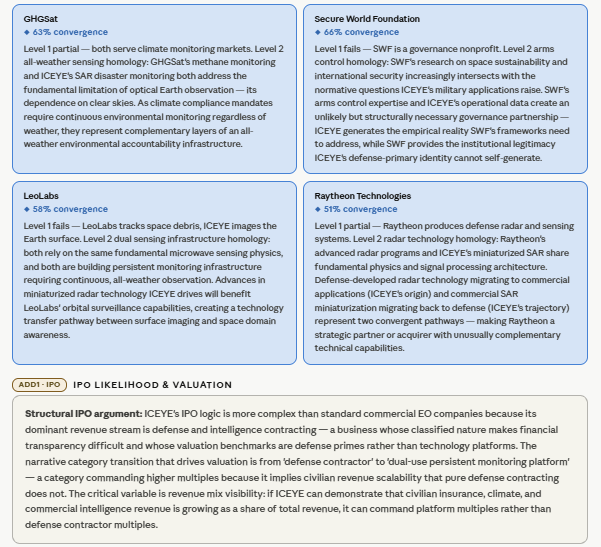
GHGSat
◆ 63% convergence
Level 1 partial — both serve climate monitoring markets. Level 2 all-weather sensing homology: GHGSat’s methane monitoring and ICEYE’s SAR disaster monitoring both address the fundamental limitation of optical Earth observation — its dependence on clear skies. As climate compliance mandates require continuous environmental monitoring regardless of weather, they represent complementary layers of an all-weather environmental accountability infrastructure.
Secure World Foundation
◆ 66% convergence
Level 1 fails — SWF is a governance nonprofit. Level 2 arms control homology: SWF’s research on space sustainability and international security increasingly intersects with the normative questions ICEYE’s military applications raise. SWF’s arms control expertise and ICEYE’s operational data create an unlikely but structurally necessary governance partnership — ICEYE generates the empirical reality SWF’s frameworks need to address, while SWF provides the institutional legitimacy ICEYE’s defense-primary identity cannot self-generate.
LeoLabs
◆ 58% convergence
Level 1 fails — LeoLabs tracks space debris, ICEYE images the Earth surface. Level 2 dual sensing infrastructure homology: both rely on the same fundamental microwave sensing physics, and both are building persistent monitoring infrastructure requiring continuous, all-weather observation. Advances in miniaturized radar technology ICEYE drives will benefit LeoLabs’ orbital surveillance capabilities, creating a technology transfer pathway between surface imaging and space domain awareness.
Raytheon Technologies
◆ 51% convergence
Level 1 partial — Raytheon produces defense radar and sensing systems. Level 2 radar technology homology: Raytheon’s advanced radar programs and ICEYE’s miniaturized SAR share fundamental physics and signal processing architecture. Defense-developed radar technology migrating to commercial applications (ICEYE’s origin) and commercial SAR miniaturization migrating back to defense (ICEYE’s trajectory) represent two convergent pathways — making Raytheon a strategic partner or acquirer with unusually complementary technical capabilities.
ADD1 · IPOIPO Likelihood & Valuation
Structural IPO argument: ICEYE’s IPO logic is more complex than standard commercial EO companies because its dominant revenue stream is defense and intelligence contracting — a business whose classified nature makes financial transparency difficult and whose valuation benchmarks are defense primes rather than technology platforms. The narrative category transition that drives valuation is from ‘defense contractor’ to ‘dual-use persistent monitoring platform’ — a category commanding higher multiples because it implies civilian revenue scalability that pure defense contracting does not. The critical variable is revenue mix visibility: if ICEYE can demonstrate that civilian insurance, climate, and commercial intelligence revenue is growing as a share of total revenue, it can command platform multiples rather than defense contractor multiples.
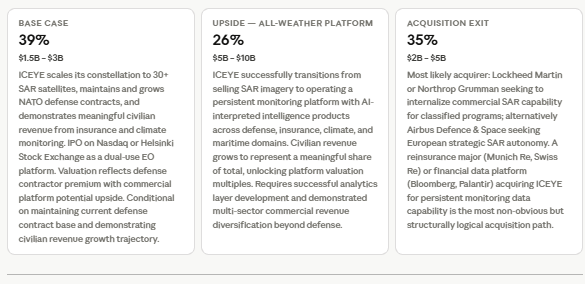
Base Case
39%
$1.5B – $3B
ICEYE scales its constellation to 30+ SAR satellites, maintains and grows NATO defense contracts, and demonstrates meaningful civilian revenue from insurance and climate monitoring. IPO on Nasdaq or Helsinki Stock Exchange as a dual-use EO platform. Valuation reflects defense contractor premium with commercial platform potential upside. Conditional on maintaining current defense contract base and demonstrating civilian revenue growth trajectory.
Upside — All-Weather Platform
26%
$5B – $10B
ICEYE successfully transitions from selling SAR imagery to operating a persistent monitoring platform with AI-interpreted intelligence products across defense, insurance, climate, and maritime domains. Civilian revenue grows to represent a meaningful share of total, unlocking platform valuation multiples. Requires successful analytics layer development and demonstrated multi-sector commercial revenue diversification beyond defense.
Acquisition Exit
35%
$2B – $5B
Most likely acquirer: Lockheed Martin or Northrop Grumman seeking to internalize commercial SAR capability for classified programs; alternatively Airbus Defence & Space seeking European strategic SAR autonomy. A reinsurance major (Munich Re, Swiss Re) or financial data platform (Bloomberg, Palantir) acquiring ICEYE for persistent monitoring data capability is the most non-obvious but structurally logical acquisition path.
ADD2Index of Similarity — IS-Path & IS-Position
0–25 Highly Unique · 26–50 Moderately Unique · 51–75 Convergent Field · 76–100 Non-Unique
IS-Path
27
Moderately Unique
ICEYE’s developmental pathway is moderately unique — it pioneered the miniaturization of commercial SAR satellites to the point where constellation economics became viable, requiring specific Finnish academic radar research heritage, early ESA and government backing, and the timing of smallsat launch economics reaching a feasibility threshold. The pathway is less singular than ClearSpace or Tesserae because Capella Space has pursued a very similar technical and commercial pathway nearly simultaneously. ICEYE’s pathway uniqueness lies in its European origin, first-mover advantage in commercial SAR constellation deployment, and its specific decision to prioritize constellation scale over individual satellite capability.
IS-Position
43
Moderately Unique
The beyond-horizon destination — a persistent all-weather surface monitoring platform embedded in both defense and civilian governance infrastructure globally — is moderately unique but faces intensifying competition as Capella Space, Umbra, Synspective, and national SAR constellation programs (European, Japanese, Indian) all pursue structurally similar positions. ICEYE’s IS-Position of 43 reflects a destination recognized as strategically valuable across defense, insurance, and climate sectors, but whose convergent field is becoming more crowded rapidly. Durable advantage depends on archive depth, constellation scale, and established defense customer relationships rather than a conceptually unique destination.
ADD3Social Alignment Index — IA
0–25 High Friction · 26–50 Moderate Friction · 51–75 Moderate Alignment · 76–100 High Alignment
IA · Social Alignment
49
Moderate Friction
ICEYE faces moderate social friction — specifically the friction pattern of a company whose genuinely valuable civilian applications are increasingly overshadowed by defense and surveillance applications in the public consciousness. Key alignment drivers exist but are narrowing: disaster response and flood monitoring generate genuine humanitarian legitimacy, climate compliance mandates create structural demand, and the post-2022 European security environment has generated unusual public acceptance of defense-relevant commercial space capabilities. Key friction points are intensifying: ICEYE’s role in providing SAR imagery used in the Ukraine conflict has made it impossible to maintain a civilian-primary public identity, and as military applications become more operationally significant, democratic accountability demands for oversight of commercial surveillance satellite data in armed conflict will intensify. The IA of 49 reflects a company at a societal inflection point — its defense applications generate revenue and strategic legitimacy simultaneously, but normative backlash from civil society, arms control advocates, and digital rights organizations is building toward a threshold requiring explicit governance commitments ICEYE has so far avoided.