

Mathematics formula found on Maya wall rivals insights of ancient masters
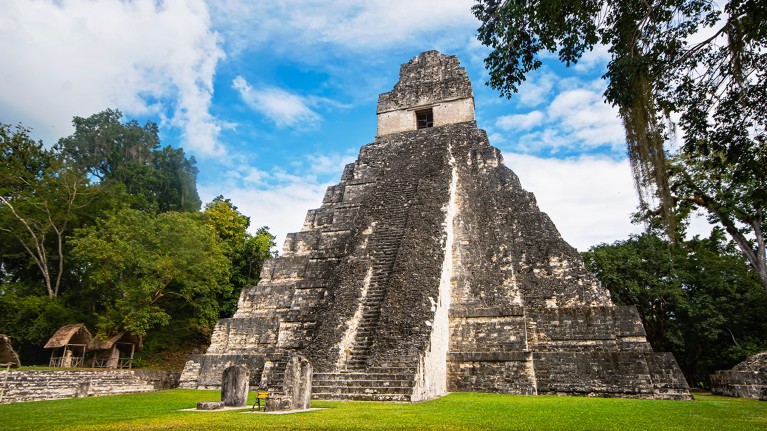
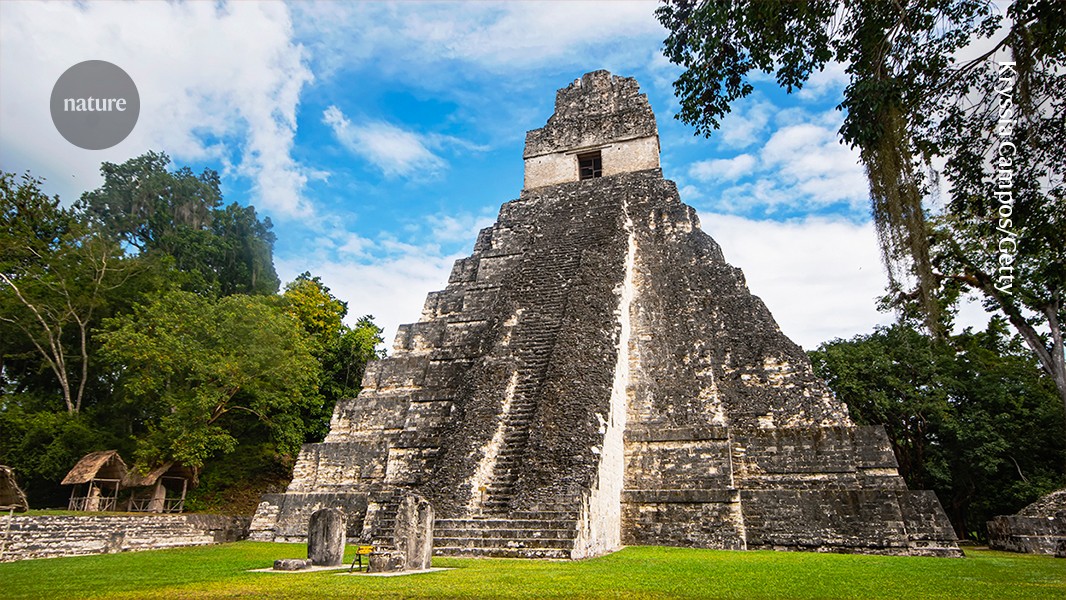
The Maya temple Tikal in Guatemala is about one day's walk from Xultun, where researchers discovered mathematical formula scribbled on the walls.Credit: Kryssia Campos/Getty
A mathematical formula inscribed on a wall at the Maya site of Xultun in Guatemala has revealed the name of an important Maya mathematician-astronomer for the first time. Researchers suggest Sak Tahn Waax, or ‘White-Chested Fox’, was a scholar comparable with mathematical giants of the past.
In a study published 14 July in the journal Antiquity1, Heather Hurst, an archaeologist at Skidmore College in Saratoga Springs, New York, and her colleagues describe their analysis of a mathematical text from a chamber in Xultun that was originally excavated in 20112.
The chamber’s walls are painted with human figures and hieroglyphic texts. These include mathematical calculations based on astronomical calendars, which were used by the Maya people to decide the timing of events such as the inaugurations of kings. Hurst and her colleagues suggest that the chamber was a workspace for scribes making codices in the mid-eighth century ad.
The authors analysed one set of hieroglyphs in particular, referred to as Text 19. Hurst says that this set of mathematical calculations expresses the relationships between several calendar systems in a playful manner that hasn’t been seen before in Mayan texts. “I think it was a mathematical flex. Somebody was saying ‘I’ve got this amazing pattern, and it’s so good it needs to be written down’. It was like, ‘Boom! Mic drop!’,” says Hurst.
“The discovery shows people that the Maya were very clever, creative, intellectually curious people who taught and learnt and sometimes did math for the sake of it,” says Eric Heller, an archaeologist at the University of Southern California Dornsife.
Identity revealed
Text 19 is a small, L-shaped group of eleven hieroglyphs with a combined height of about 10 centimetres. Hurst and her colleagues found that the first nine hieroglyphs of the set encode the Maya calendar and astronomical cycles.
The formula shows how one 2,920-day cycle could be divided up into the calendar units used by the Maya people. This 2,920-day cycle was important because it tied together key astronomical cycles, corresponding to both five Venus cycles (584 days each) and eight solar years (365 days each). However, the Text 19 calculations also relate the 2,920 days to Uinal (months with 20 days), Tzolkin (_the 260-day sacred calendar), _Tun (a year with 360 days) and Mars years of 780 days.
“It’s just super nerdy math,” says Hurst. The hieroglyphs also show only partial dates, which made them hard to decipher. “They’re doing this abbreviated shorthand, so they give you the first half of a notation and the second half is implied.”
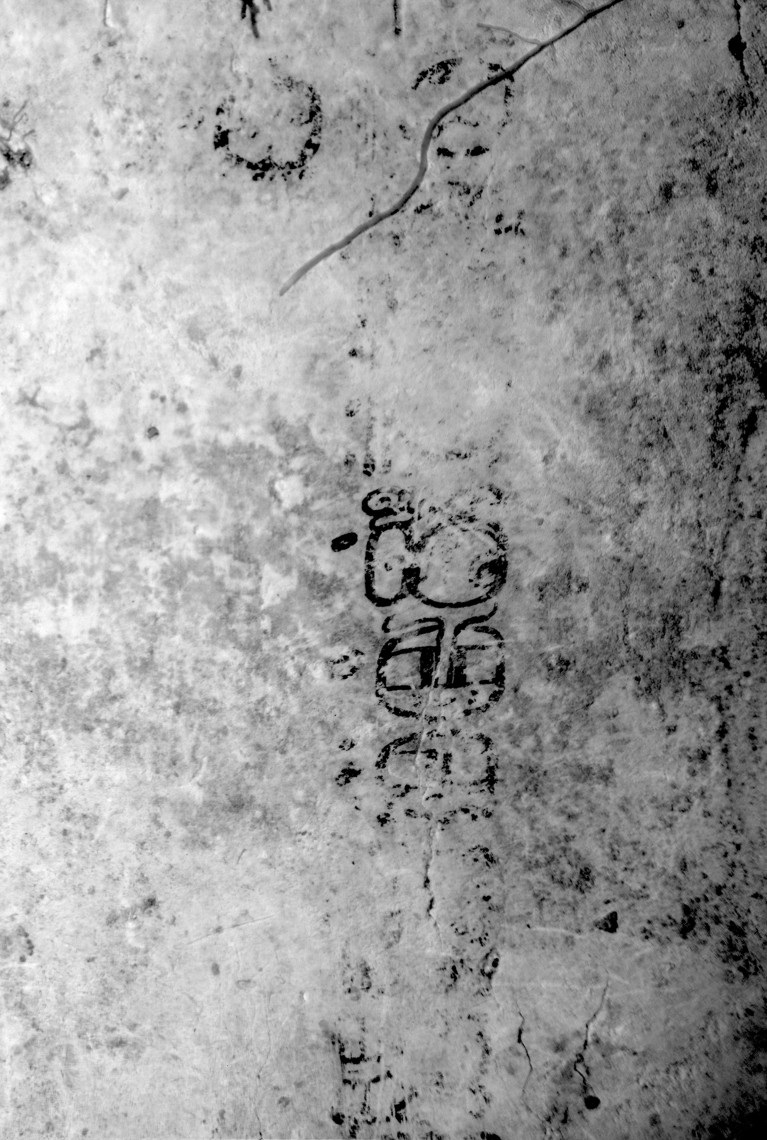
The mathematical formula on Text 19 appear as glyphs.Credit: Photograph by G. Ware, courtesy of the San Bartolo-Xultun Regional Archaeological Project
Until now, the identities of the mathematician-astronomers behind such calculations had remained mysterious. Hurst and her colleagues found a phrase in the penultimate hieroglyph in Text 19 meaning “so says”. This was followed by the name Sak Tahn Waax, in the final hieroglyph, suggesting that the writer was taking or giving credit for the calculation. “We know it’s a male name because it’s missing a prefix,” she says.
The fact that the writer is named is significant, because it suggests that mathematicians were recognized in Maya society as much as artists were, says Gerardo Aldana, an anthropologist at the University of California, Santa Barbara.
Equalling the greats
Enjoying our latest content?
Log in or create an account to continue- Access the most recent journalism from Nature's award-winning team
- Explore the latest features & opinion covering groundbreaking research
-
 Ancient DNA from Maya ruins tells story of ritual human sacrifices
-
 Large-scale early Maya sites in Mexico revealed by lidar mapping technology
-
 Maya bones bring a lost civilization to life
- Astronomy and astrophysics
- Mathematics and computing
- History
- Astronomy and astrophysics
- Mathematics and computing
- History
-
 How the calendar came to be News & Views 14 JUL 26
-
 First ‘true sugar’ molecule found in space — offering hints to life’s origins News 13 JUL 26
-
 LARES-2 satellite measures frame-dragging effect around the Earth Article 08 JUL 26
- AI models: one country’s fears become everyone’s constraint Correspondence 14 JUL 26
-
 Universal cell embedding provides a foundation model for cell biology Article 08 JUL 26
- AI can cause harm: safeguards must catch up Correspondence 07 JUL 26
- How the calendar came to be News & Views 14 JUL 26
-
 ‘This time, it’s the other way around’: how Indonesia is reclaiming the science of human history Career Feature 09 JUL 26
-
 Say hello to hard helium News & Views 07 JUL 26
- #### Ohio Eminent Scholar in Structural Biology - Open Rank The Dept. of Chemistry & Biochemistry at Miami University seeks an Ohio Eminent Scholar in Structural Biology at the Asst./Assoc./Full Prof. level. Oxford, Ohio (US) Miami University
- #### Junior Professor Chair in AI for Precision Medicine and Chronic Inflammatory Diseases Junior Professor Chair in AI for Precision Medicine and Chronic Inflammatory Diseases The Inria Centre at the University of Lille invites outstand... Lille (Arrondissement), Nord (FR) Inria
- #### Strategic Scientist, Outstanding Youg Investigator, and Postdoctoral Positions at CIBCAS CIB invites distinguished Strategic Scientist, Outstanding Young Investigator, and Postdoctoral Research Fellow. Chengdu, Sichuan (CN) Chengdu Institute of Biology, Chinese Academy of Sciences
- #### Assistant Professor of Medical Sciences (in Medicine), Tenure Track The Division of Nephrology in the Department of Medicine at Columbia University Irving Medical Center seeks applications for a tenure-track appointmen New York City, New York Columbia University Irving Medical Center, Division of Nephrology
- #### Tenure-Track Faculty Position In Molecular and Systems Biology
Access through your institution
or
doi: https://doi.org/10.1038/d41586-026-02170-8
References
1. Rossi, F. D., Stuart, D. & Hurst, H. Antiquity https://doi.org/10.15184/aqy.2026.10378 (2026). Article Google Scholar 2. Saturno, W. A., Stuart, D., Aveni, A. F. & Rossi, F. Science 336, 714–717 (2012). Article Google Scholar
Related Articles
Subjects
Latest on:

Jobs
Close banner Close

Sign up for the Nature Briefing newsletter — what matters in science, free to your inbox daily.
Email address
Sign up
I agree my information will be processed in accordance with the Nature and Springer Nature Limited Privacy Policy.
Close banner Close
Get the most important science stories of the day, free in your inbox. Sign up for Nature Briefing