



Artificial Rhetoric
When asked about Meta’s attempts to poach his people with nine-figure offers last year, Dario Amodei said that Mark Zuckerberg was “trying to buy something that cannot be bought, and that is alignment with the mission.” It was a good line, not least because it was plausibly true. There’s probably no check large enough to make someone believe in what you are doing, even if there is a sum of money that will make most people pretend to.
This essay is about things you can buy with a high enough salary, or at least that people believe can be purchased that way. In particular, it’s about Anthropic and the specific way they go about making their most visible hires, their goals, and what their money buys. It’s not a condemning article, for the record; like most subjects, this one is complex. Not having an ax to grind with Anthropic means I’m much more curious about this than I am condemning,
Thanks for reading! Subscribe for free to receive new posts and support my work.
Subscribe
Of all the more ordinary hires Anthropic makes in a year, the vast majority are mundane, if still elite among the masses potential SV teammates. They are engineers and product people and an endless stream of machine learning experts. They are not usually announced, at least not in highly visible ways.
Others are more distinct. They include a psychologist known for approachable scientific debunking, a public sector commentator read by members of Congress and white house staffers, and the AI safety philosopher who set out perhaps the most careful public case on AI dangers. Among them is also perhaps the most credible independent voice in the field, a man who seven months before he joined was on podcasts calling the AI industry’s hype fundraising.
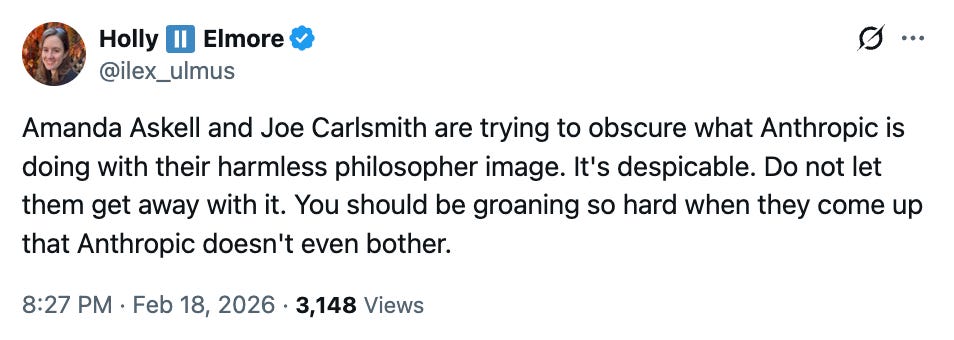
Some people, perhaps predictably, react to these kinds of hires in a more negative way:

That’s Holly Elmore, the executive director of Pause AI. You wouldn’t expect her to be neutral or positive about anything related to AI in the same way you wouldn’t expect glowing reviews of a steak from the head of PETA. At the same time, she’s not alone in her worries. A simple search of the kind of people who tend to care about this kind of thing brings up plenty of reactions to the hires ranging from celebration to concern, and that concern has grown as Anthropic has captured-slash-recruited more and more voices.
None of these are legitimacy hires in the sense that a room full of executives schemed to purchase credibility. I have no idea what was said in those rooms, and for the argument that follows, it does not matter. They are legitimacy hires in a plainer and more unsettling sense: whatever else each person was brought on to do, the effect of hiring them was to transfer some portion of their hard-won public trust onto Anthropic — automatically, mechanically, whether or not anyone willed it, and in at least one case despite the person’s explicit, written effort to stop it.
The natural rebuttal is Dario’s, that these are mission-aligned people joining a mission they believe in. Under that framing, if it’s correct, treating their sincerity as an asset is a cynical, unfair approach not just because it miscasts both the hirers and hirees as evil, but because it dyes an effort to staff conscientious true believers as a sellout’s endeavor.
The point of this article isn’t to make a decision, but to draw a series of profiles about who these kinds of hires are, what they do at Anthropic, and how that affects the public-facing side of the organization. In other words, it’s looking at what Anthropic gets out of a celebrity outside of what they’d get from an unknown with identical work output.
What follows is four people, arranged from the case that most embarrasses the Anthropic Absorbs It’s Critics thesis to much more ambiguous cases that at least superficially look more like prestige-based hires.
---
As foreshadowed, let’s start with the hire that fits the worst with the idea that Anthropic is willing to spend money to gain legitimacy by ruining someone else’s. That’s Andrej Karpathy, perhaps the most qualified person for the role he’s filling on this list, and maybe among the top at Anthropic in general.
Andrej Karpathy is not a comms team hire, but he is still a well-known, large-audience voice. He is one of perhaps the best people living at explaining the theory of large language models and the complex engineering of actually training one at scale. He’s a founding member of OpenAI and the man most responsible for building Tesla’s autopilot stack. He’s an educator whose work has trained a meaningful percentage of everyone else who works at Anthropic, and he did it from a distance.
When Anthropic hired him in May 2026 to lead a team using Claude to accelerate its own pretraining, it was as defensible a hire as could be; if Karpathy was being captured, he was being captured to do exactly what Karpathy does. If he brought prestige with him, and he did, it was secondary to a list of qualifications as long as your arm. If his hire was a cynical prestige capture, then so arguably is any hire by anyone at any time.
And yet his hire still has an effect on the discourse, and not a small one.
Seven months before he joined, Karpathy was the most credible deflationary voice in artificial intelligence. In an incredibly bullish market for AI discourse, he was on Dwarkesh Patel’s podcast saying the models were “not there,” and labeling hype as “fundraising,”. He was calling frontier code output slop and saying Claude Code was net-unhelpful in his own work.
If AGI was on the way, it was still a decade out, he said. His timelines were five to ten times more pessimistic than the industry’s. The overall reaction to what he said was to ask if an OpenAI co-founder had finally popped the AI bubble.
He wasn’t anti-lab or anti-AI. But he was, in a very visible way, bearish. Karpathy, who worked at no lab, thought the hype was overdone. Once he was hired, he was inside the tent, explicitly using Claude to build more Claude. He didn’t have to say a word about the product for that to be a change. Anthropic’s legitimacy was improved as a result of having him there, and his own, the part connected to independence, was just a little diminished.
Even so, the sheer man-to-job fit in play here meant that there was very little to criticize, and if Karpathy was working for Anthropic, that’s very much where he’s in a lot of ways best utilized. Again, he was so clearly the kind of person that labs should be hiring that not doing it would mean Anthropic was shooting themselves in the foot for no clear gain. If any talent acquisition was ever justified, his was.
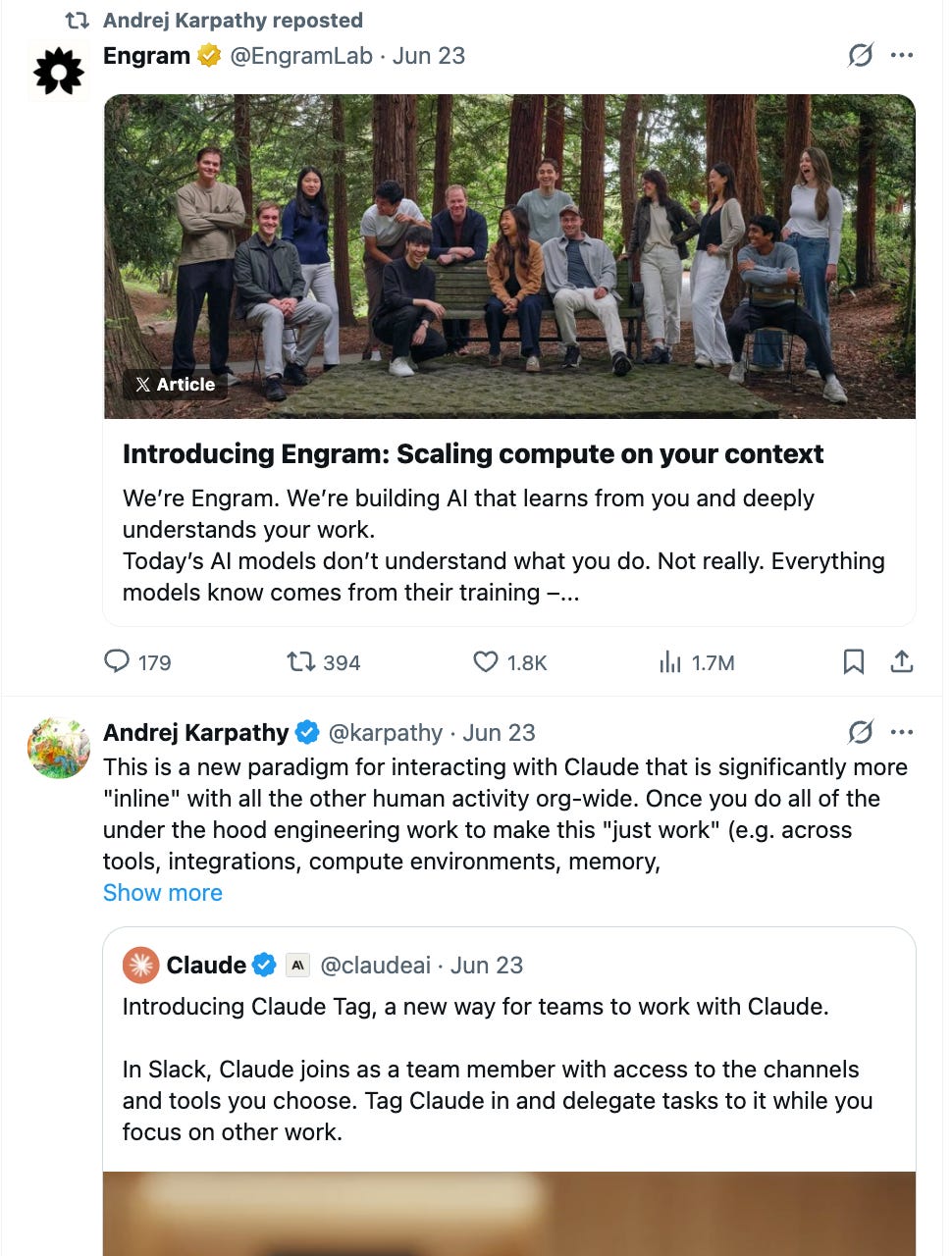
That’s legitimacy is why Karpathy’s X feed is so weird now, frankly. In the interim, he’s doubtless done great work at Anthropic. There’s no indication that he’s participated in a single dark conspiracy. And yet:

By June, Karpathy’s X, once a reasonably interesting resource for LLM-related thought, was indistinguishable from a normal B2B promotional account. Again, not wrong. But having purchased Karpathy’s services, Anthropic also got his reach, and the purpose of that reach fundamentally changed in the process.
---
Karpathy was one thing: legitimacy in the form of job-applicable skills. Stuart Ritchie is a step removed from that. His is the case where the legitimacy is the job.
Before Anthropic, Ritchie was a working scientist whose public brand was based on doubt. He wrote Science Fictions, a book about the ways science fools itself and the public through hype, bias, publication games, and (rarely) outright fraud. He co-hosted The Studies Show, a podcast that consists of taking down a fashionable claims that won’t stand scientific pressure testing.
If you want an in-house skeptic who works well in front of a camera and mic, Ritchie is the guy to call. And so Anthropic did.
In September 2023, four months before he took the Anthropic job, Ritchie addressed the AI apocalypse debate directly. The setup, in his show’s own words, was that Ritchie played the role of an AI apocalypse sceptic, and grilled his co-host on the usual arguments for catastrophe. Ritchie isn’t hostile to the arguments, but he’s definitely cast on the side of the person who thinks that the largest claims regarding AI’s capabilities are perhaps at least a little overblown.
Then he joined a company whose founding premise is that the grand AI claims are true, that even if an apocalypse isn’t coming the world shall certainly be changed in unprecedented ways. His job became promoting the idea that those coming changes will be as big and dramatic as can be imagined.
In that context, it’s important to note what Karpathy is that Ritchie isn’t. Ritchie is not an AI researcher, has no background in machine learning, publishes no papers on transformers, and otherwise provides nothing that cleanly corresponds to the technical work of a frontier lab. He’s a communicator, and that’s most of what he brought to the table.
Within that framework, his own identity as a communicator is a more emphasized part of what he brings to the table. His comfort and skills acting as an entertainer and educator are half of the puzzle, and the other half is brand; Ritchie’s brand is credible skeptic before anything else.
Anthropic deployed the credibility exactly where you would expect. In April 2025, Anthropic announced it was taking “model welfare” seriously, addressing the question of whether its AIs might have internal, morally significant experiences. This is, to non-AI-aligned laymen, the single most ridicule-vulnerable thing a frontier lab could say out loud, something like “the computers have hearts”.
Still, it’s the kind of thing that Anthropic finds important to talk about (and, honestly, is probably the kind of thing a conscientious lab can’t ignore). This is exactly the situation in which you need a credible skeptic present, to adjust the tone from “crazy people say crazy things” to “We’ve considered this, and we are the serious folks in the conversation”. The resulting announcement took the form of a filmed conversation between Anthropic’s welfare researcher and its Research Communications Lead, Stuart Ritchie himself.
Ritchie’s first line, at the twenty-four-second mark, is this: “I suppose the first thing people will say when they’re seeing this is, ‘Have they gone completely mad?”. It’s effective. It changes the tone on a dime, and in that moment Stuart’s pay is justified, whatever else he may be doing at comms in his less visible hours.
The move recurs in the interpretability explainer he hosts months later, which opens by disarmingly conceding that nobody really understands what happens inside these models. And his name sits in the author list of Anthropic’s own post measuring how persuasive its models are. In all cases, they make use of the hype-and-persuasion skeptic well.
Again, there’s nothing clearly wrong here. Stuart Ritchie announced the Anthropic job openly on the same Substack that made his name. He kept the newsletter running and the podcast running, complete with a standing note that he speaks for himself and not his employer. There’s no obvious reason to doubt that, either. His skepticism is still credible and operational in that context; the output hasn’t suffered.
He almost certainly believes every word he says about model welfare and interpretability in the same way he believes every word he says about the dangers of p-hacking. There’s no need to think he’s lying here, and in fact very little of his job at comms involves him being the guy that makes statements. The difference he makes is one of presence and reputation.
---
Karpathy brings credibility by way of expertise, and Ritchie brings it via a skeptic’s reputation. Santi Ruiz is a third thing, someone who brings established skills but also reach.
Ruiz is a real writer. He ran the editorial team at the Institute for Progress, and ran it well. He built the policy newsletter Statecraft, which has tens of thousands of subscribers, obtained with good old-fashioned organic quality. Nothing that follows is a knock on the quality of his work.
It is still true that the quality of his work is not what makes him valuable to a frontier AI lab, at least by itself. The larger part of what makes Santi Ruiz valuable is what that quality got him. By his own description, he writes for an audience that runs from the general public all the way to the warren of offices that houses the White House’s policy staff. His network encompasses Obama-era alumni of the Office of Science and Technology Policy, who, as he puts it, have a big Rolodex. His entire professional life has been the study and cultivation of access to the people who actually run the government.
Now consider what Anthropic hired him to do. He is the economics and policy lead on the editorial team, working closely with the Anthropic Institute. His out put is good, among the best. But it also comes with a byline that makes the people who run the government take notice. Statecraft is a newsletter about how to move the levers of government. Santi Ruiz’s expertise is knowing how policymakers get things done, and being one of the influential names in that sphere of thought. None of it was done in the dark, but he now puts that influence and reach to work for Anthropic, who gets both the excellent prose and Ruiz’s powerful audience reach.
---
Joe Carlsmith is the hardest (or at least the most complex) of the four to write about fairly, which is why I saved him for last. He saw precisely what his hiring would do to Anthropic’s (and his) reputation and addressed it in writing at length and in advance.
Joe Carlsmith is a philosopher, formerly of Open Philanthropy, and is a public AI safety expert. His report on power-seeking AI and his work on machines that fake alignment are among the most cited, most careful, and least hysterical statements of AI-related concern you can find. He doesn’t overclaim, he writes reasonably well, and is respected as a result.
In the fall of 2025, Carlsmith joined Anthropic to help refine the design of Claude’s character, constitution, and specs. His name is now on Claude’s Constitution, the document that, at least in theory, defines what the model is at a fundamental level.
Carlsmith is unique in the sense that he took the job and, in doing so, also published a six-thousand-word essay whose explicit subject was the legitimate concerns of getting co-opted by one of the labs he would normally be known for watchdogging. He himself brings up the conflict of a safety person joining an AI company, saying that doing so might “signal an inaccurate degree of endorsement” and promote “wrongful amounts of trust” in the company.
He admits, explicitly and honestly, that there’s some actual signal there. His conclusions about that signal are obvious, since he took the job; he believes that he can do his best, highest-impact work from the inside, and that this outweighs any negatives of assigning his tacit endorsement to Anthropic’s work. He still holds that the companies may present a double-digit percentage risk of destroying the whole of mankind, but reasonably (by some lights) concludes that’s why it’s important he’s there, lowering that percentage.
He spends a fair amount of that article explaining that his endorsement, such as it is, is limited. I think that for some people, specifically those that pay very close attention to this kind of thing, that’s true. But some large percentage of people are not that in-depth; they see Carlsmith has joined Anthropic, and likely conclude Anthropic is better for it.
That may very well be true, too. Carlsmith is very unlikely to work against AI safety while at Anthropic, in any case. But he’s one man, and it’s an open question whether his contributions as a worker can possibly outweigh his amplification of Anthropic’s legitimacy.
---
Again, please note what this article is not trying to prove. If it seems like I think that Anthropic is purposefully evil in its hiring - that its leaders sit in darkened rooms plotting the fall of mankind via the absorption of human hurdles to their dominance - I’ve overplayed my hand. I think, in most ways, that Anthropic is doing something very normal. It’s hiring the best people it can, both in terms of capability and in bonus legitimacy, fame, and reach that those best people tend to drag with them.
Indeed, it’s not clear to me what else they could do. Cream, they say, tends to rise to the top, and top-quality people tend to make themselves known by amassing followings and audiences. You’ve heard of Carlsmith, Ritchie, Ruiz, and Karpathy because of that effect. They are known because they are exceptional, and Anthropic can’t be faulted for wanting to hire the exceptional.
At the same time, it’s also true that every one of those hires does absorb legitimacy, and does to some extent or another neutralize a skeptic, ML expert, policy wonk, or AI safety proponent who might otherwise be in a more secure position to criticize them. By hiring them, they flip a potential negative to an ensured positive, whether the goal is hiring the best or not.
In today’s market, it’s obvious that those already don’t represent the entire resistance to Anthropic’s goals; even without them in play, the US government has thrown multiple wrenches into Claude’s game plan all by itself, on the counsel of other voices and via interactions with Dario rather than any of the communications people below him.
Even so, it’s worth talking about what the market looks like after another year of hiring, or another after that. Salaries, after all, are cheap compared to metric tons of semiconductor wafers; nothing is keeping Anthropic from hiring away the cream of the relevantly independent crop besides this all seeming normal.
This is likely the first post in a series talking about Anthropic hiring; soon I’ll post a second installment focusing on why Anthropic feels it needs the legitimacy these hires grant.
Thanks for reading! Subscribe for free to receive new posts and support my work.
Subscribe