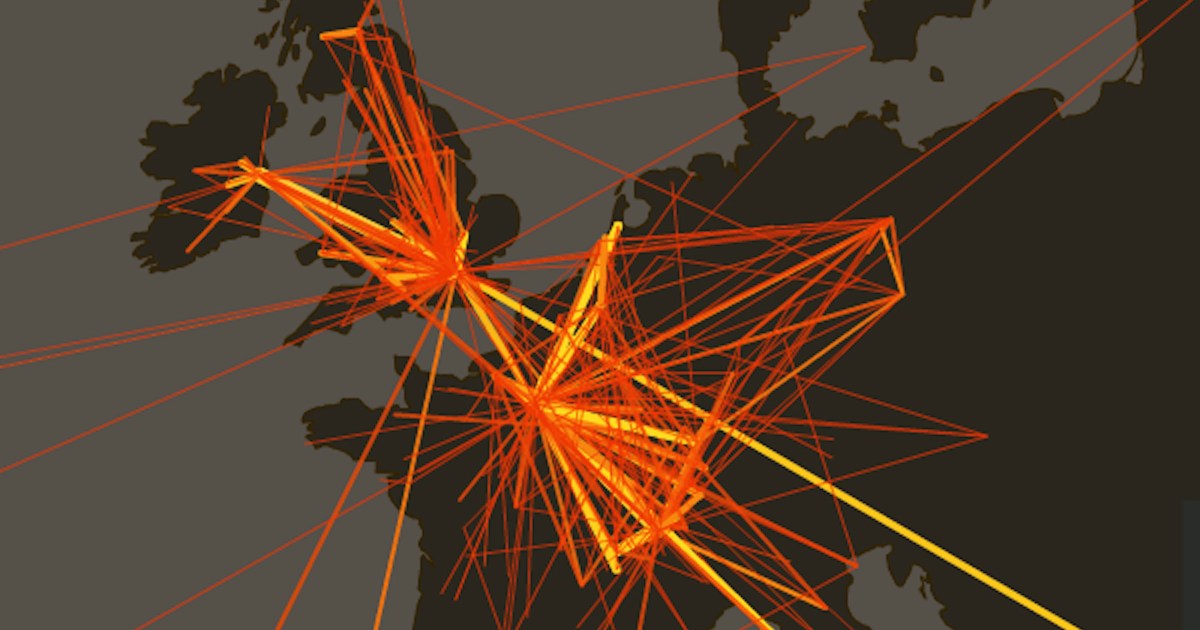
The Enlightenment had its own internet: The Republic of Letters
Open search
Open main menu
- My account
- Membership
- Latest
- Topics Back
- Videos Back Latest Videos See all videos
- Columns Back Columns
- Classes Back Featured Classes See all classes
- Store
- My Account Back
- More Back
- Sign In
- Membership
* My Classes * My Account
* My List * BT+ for my Business
Philosophy
* Ethics * Religion * Flourishing * Knowledge * Philosophy of Science * Philosophy of Art * Language * Political Theory * Identity * Meaning & Purpose
Science & Tech
* Physics * Biology * Aerospace * Health * Geology * Computing * Engineering * Energy * Biotechnology * Astronomy
Mind & Behavior
* Psychology * Neuroscience * Decision-Making * Mental Health * Consciousness * Emotional Intelligence * Personality * Relationships * Parenting
Business
* Entrepreneurship * Leadership * Finance * Marketing * Innovation * Strategy * Management * Artificial Intelligence * Startups * Economics
History & Society
* History * Literature * Art * Music * Film * Progress * Culture * Sociology * Policy * Geopolitics
 Objective reality only exists because other people do We experience only one small slice of the ruliad. What’s the ruliad? Stephen Wolfram explains.
 The psychology of perversion, revenge, and AI companionship Psychologist Paul Bloom examines why loneliness feels like starvation, why people are drawn to behaving poorly, and why revenge feels...
 Physics doesn’t explain the universe. Computation does. What do the laws of physics, biological evolution, and your free will have in common? The same mathematical principle runs...
 The full story of the dinosaurs, from extinction to extinction Steve Brusatte, the paleontologist behind Jurassic World's science and author of The Rise and Fall of the Dinosaurs and The...
 The myth of genius, and who it intentionally leaves out Zena Hitz argues that the real philosophers are taxi drivers, office clerks, and prisoners: Everyday people who exist outside the...
 The myth of a shared reality In conversation with Kmele Foster, Dan Carlin unpacks the myth of shared reality, the erosion of society, and the history...
 Mary Beard: Why no film has ever cracked The Odyssey Classicist Mary Beard explains why you should read The Odyssey before going to see Christopher Nolan's adaptation of the epic.
 The universe can’t be predicted, even if you know all its rules Most ‘theories of everything’ make the universe feel smaller. Physicist Stephen Wolfram's does the opposite.
 Mini Philosophy A philosophy column for personal reflection.
 Starts With A Bang An astrophysics column on big questions and our universe.
 Books A literature column to feed your curiosity.
 The Long Game A business column on long-term thinking.
 Strange Maps A geography column on history and society.
 The Well A collection of essays and videos on life’s biggest questions.
 13.8 A column at the intersection of science and culture.
 Members 12 videos Radical Respect at Work Kim Scott Co-Founder, Radical Candor, and Author, Radical Respect: How to Work Together Better
 Members 7 videos How to Rewire Your Brain for Learning Barbara Oakley Professor of engineering
 Members 10 videos How to Outsmart Misinformation Alex Edmans Professor of Finance, London Business School, and Author, May Contain Lies
 Members 7 videos Fostering Mutual Understanding Valerie Purdie (Vaughns) Greenaway, PhD Assistant Professor of Social Psychology at Columbia University
 Members 7 videos Understanding Trauma Bessel van der Kolk Psychiatrist and neuroscientist
 Members 10 videos Sustaining Excellence with Emotional Intelligence Daniel Goleman Psychologist and Author, Optimal: How to Sustain Personal and Organizational Excellence Every Day
* My Classes * My Account
* My List * BT+ for my Business
* Newsletters * Special Issues * Events
* Big Think+ Learning * Creative Studio * Advertise with Us
* About * Careers * View our Twitter (X) feed View our Youtube channel View our Instagram feed View our Substack feed View our Spotify feed
View our Twitter (X) feed View our Youtube channel View our Instagram feed View our Substack feed View our Spotify feed
Search
What are you curious about?
Popular Searches
Critical thinkingPhilosophyEmotional IntelligenceFree Will

A geography column on history and society.
Science and TechPhilosophyCommunicationHistoryDigital Culture
There was no internet during the Enlightenment, but something surprisingly similar did exist in the 17th and 18th centuries. This was the Republic of Letters: a virtual, global community of scientists and intellectuals who exchanged information using the fastest technology available at the time — the postal service.
15,000 letters
The clue is in the name: letters tied this self-proclaimed, transnational society together. Lots of letters. What this “metaphysical republic” lacked in speed, it made up for in volume. Take Leibniz and Voltaire, for example. In their lifetimes, these great minds wrote close to 15,000 letters each, sending them to hundreds of correspondents across all of Europe.
Ignatius Loyola managed only 9,000 letters, but the founder of the Jesuit order cast his intellectual net much wider. While Leibniz and Voltaire largely limited their correspondence to Europe, Loyola had pen pals from Mexico to Macau, thanks to a global network of Catholic missionaries and other like-minded co-religionists.
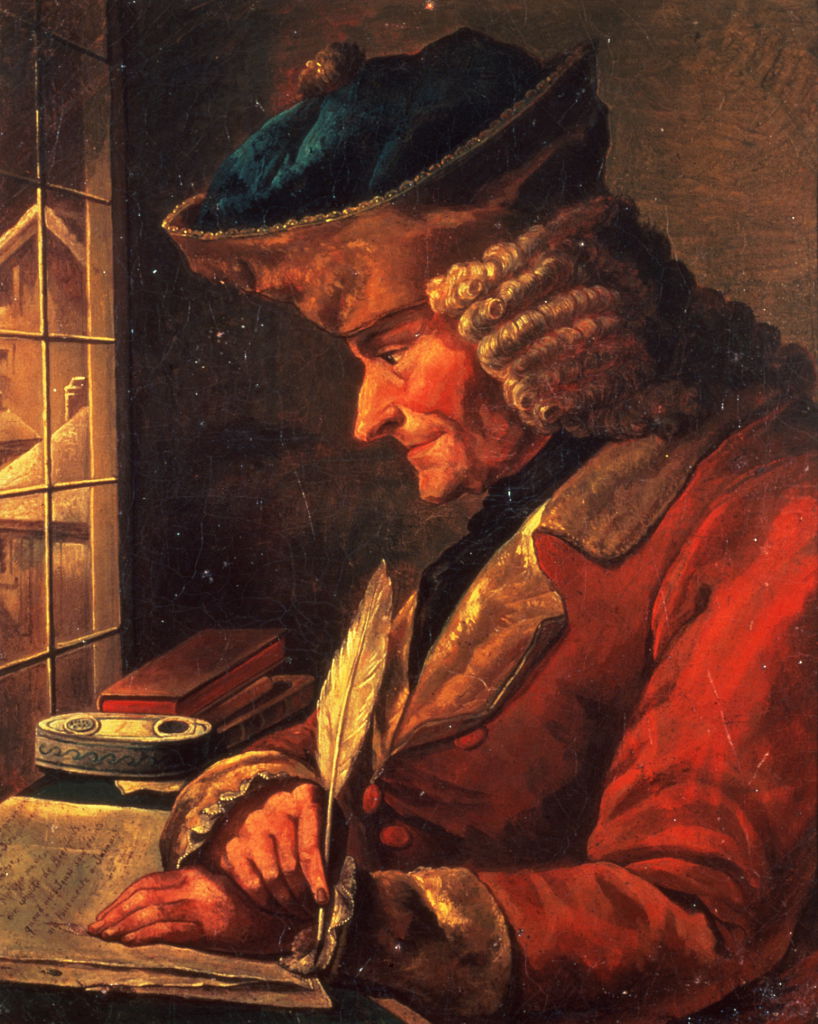
Voltaire penning one of his 15,000 letters, wearing what must be his writing cap. (Credit: Art Images via Getty Images)
Voltaire (1694-1778) in his Study (oil on canvas) (Photo by Art Images via Getty Images)
This network linking thousands of scientific and philosophical letter writers had a universal protocol: Experiment — not authority — should be the basis for factual knowledge. The network not only spread this ideal but also its fruits: Biological, geological, and astronomical observations from all around the world made their way back to the studies of Europe’s most learned men (and the occasional woman), and eventually into their pamphlets and books.
Of course, all that is now past. Not the experimental method — at least, not yet — but the hand-written letter is as good as dead, killed by almost two centuries of innovations in communication, from social media all the way back to the telegraph.
Sifting through the remains
As one door closes, another opens. Our digital paradigm offers fresh methods of sifting through the remains of the Republic of Letters. With increasing amounts of centuries-old sources digitized, it becomes easier to do quantitative analyses, and to “scrape, mine, curate, analyze, and visualize data.”

That quote is from an article in the AHR Forum about Mapping the Republic of Letters, a collaborative project based at Stanford University that builds case studies based on the metadata of the Republic’s letters. Among the project’s various results are some fascinating maps, some with new insights into the development of the intellectual climate in Enlightenment Europe and beyond.
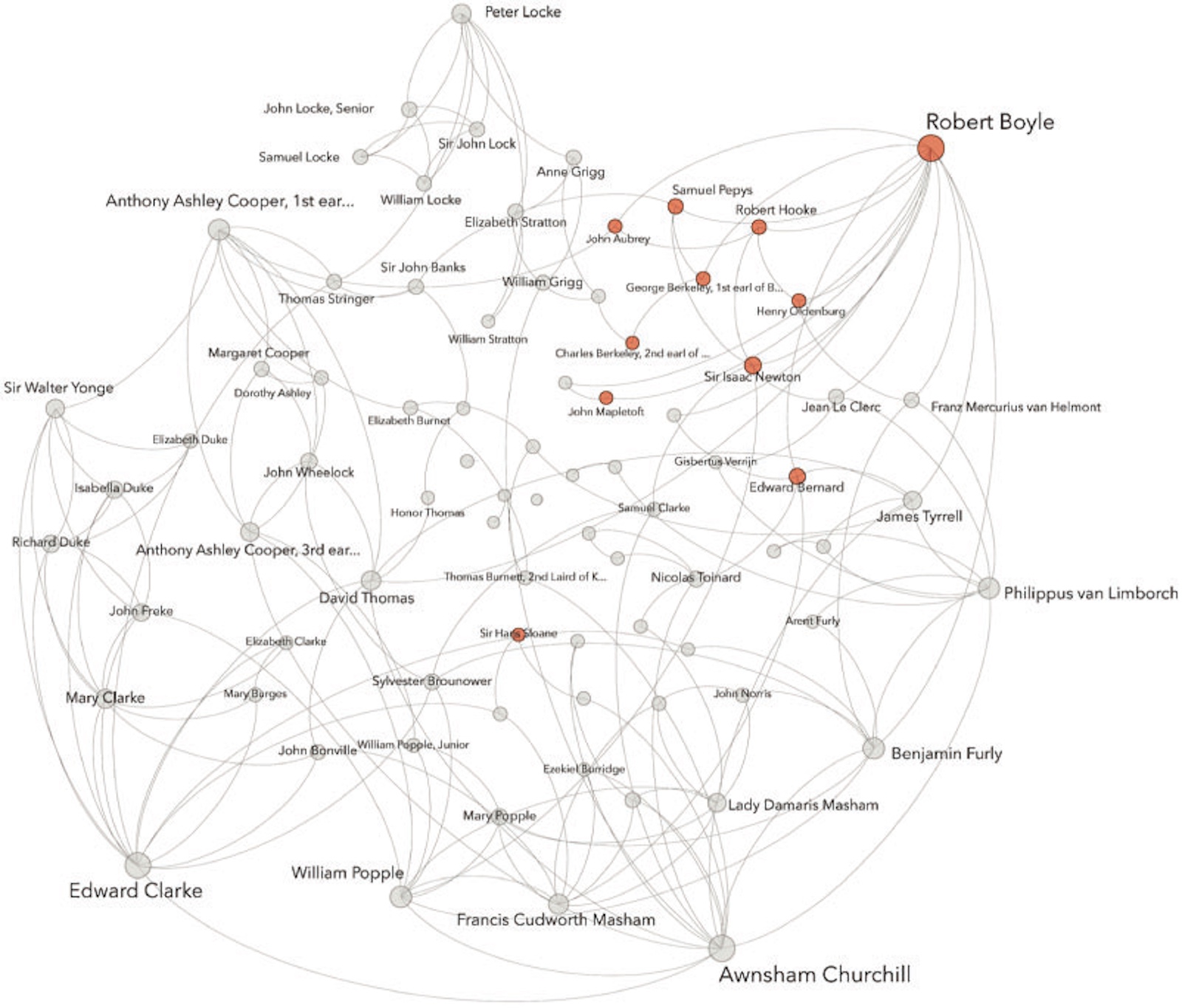
There was not one Republic of Letters, but many smaller intellectual fiefdoms hiding within the larger whole. (Credit: Mapping the Republic of Letters/Stanford University)
Many of those insights provide a more nuanced picture of the Republic of Letters than we had before. For example, the graph above shows that the Republic of Letters could be better described as a collection of small intellectual fiefdoms rather than as one large whole.
The graph maps the correspondence network of the English philosopher John Locke. It shows just how disconnected the various social and national subgroups in his network were from each other.
A multitude of communities
Rather than everyone writing to everyone, this visual representation clearly shows that several letter writers were the center of their own little epistolary universe, sending and receiving most of their letters to and from a small part of Locke’s total group of correspondents. (Awnsham Churchill, Robert Boyle, Philippus van Limborch — we’re looking at you!)
By demonstrating that there was “a multitude of communities within, or rather underneath, the surface of the Republic of Letters,” this graph offers a valuable corrective to the history of information. Rather than a network, the Republic of Letters was more like a patchwork.
While Enlightenment thinkers liked to style themselves “men of the world,” a meta analysis of their correspondence also calls into question the global nature of the Republic of Letters. Case in point: Benjamin Franklin, arguably the most famous North American of the 18th century, and certainly among the most traveled and best connected.
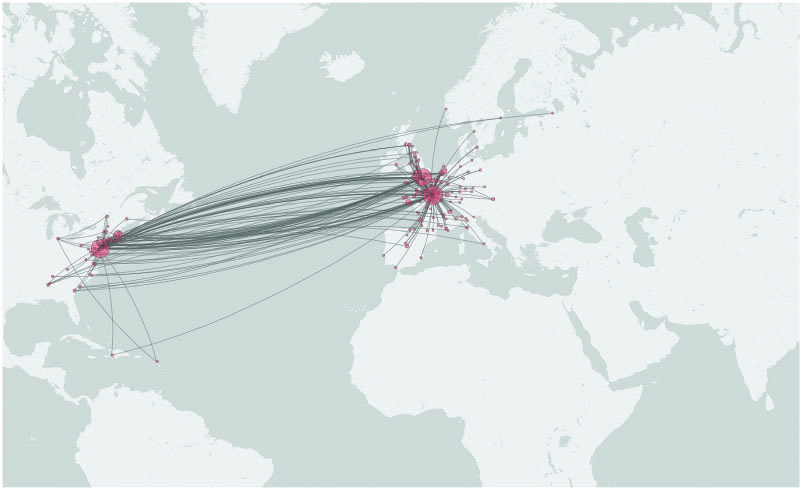
Most of the letters sent and received by Ben Franklin, the most famous North American of the 18th century, revolved on the London-Philadelphia axis. (Credit: Mapping the Republic of Letters/Stanford University)
Yet, despite having spent nearly 20 years in London and traveling on the continent, “Franklin’s correspondents were overwhelmingly found at either end of the London-Philadelphia axis,” as this graph demonstrates. Some small forays aside, Franklin’s correspondence doesn’t venture deep into the continent. To be fair, though, the map also clearly shows that Paris was as important a destination for Franklin’s letters as London.
From massive popularity to relative obscurity
It is somewhat ironic that Voltaire, who has been called “the most alive of dead white males,” is remembered these days mainly for a quote misattributed to him. No, he did not say, “I disapprove of what you say, but I will defend to the death your right to say it” (not even in French). The phrase is from a Voltaire biography published in 1906 and was meant to be a summary of his attitude, not a direct quote.
This map highlights the places where Voltaire’s works were published between 1712 and 1800, illustrating his significant popularity during that time, in stark contrast to his relative obscurity today. The total number of publications of Voltaire’s work stands at 1,973, of which 1,370 mention a place of publication. Most of those locations are accurate, but for whatever reason — perhaps to evade censorship — 162 are false…and 10 are made-up “fantasy places.”
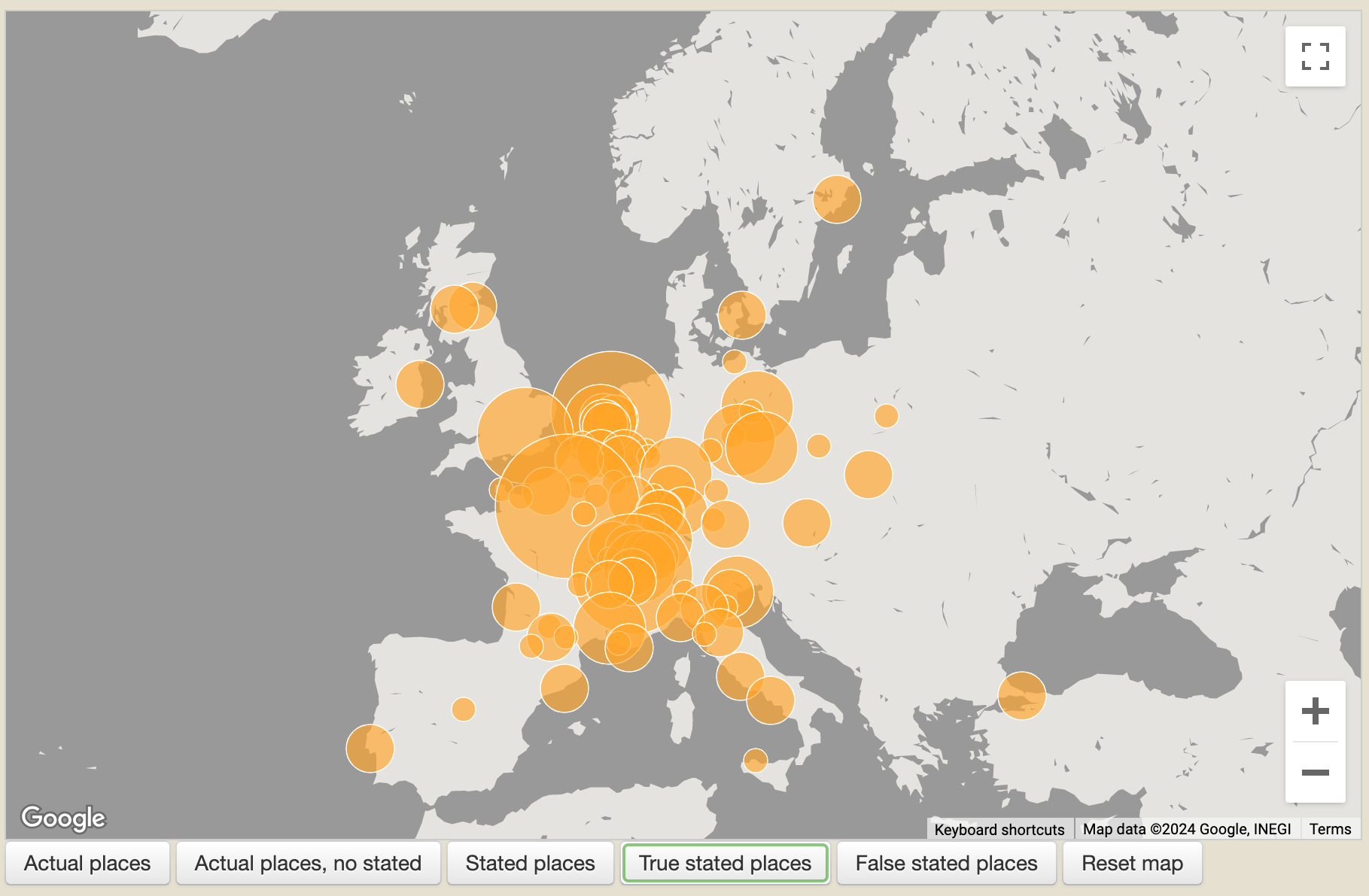
This map shows the ‘true’ places of publication for Voltaire’s work. The main ones are Paris (333), Amsterdam (169), and Geneva (157), with London (130) not far behind. But Voltaire was popular across the whole of Europe, and was printed as far away as Lisbon (9 publications), Istanbul (5) and Stockholm (4). (Credit: Mapping the Republic of Letters/Stanford University)
This map shows the true places. The main ones are Paris (333), Amsterdam (169), and Geneva (157), with London (130) not far behind. But Voltaire’s work was popular across the continent, and was printed as far away as Lisbon (9 publications), Istanbul (5) and Stockholm (4). In the Republic of Voltaire’s Letters, London is just an insignificant country town. (Credit: Mapping the Republic of Letters/Stanford University)
Above is another Voltaire-inspired map, this time showing the locations of his correspondents. Paris and Geneva — and to a lesser extent, Berlin, Brussels, and Amsterdam — feature heavily. What’s striking is the near-total absence of addresses in Britain. It’s even more striking when you consider the canonical story of the spread of Enlightenment ideas: from England via Voltaire to the Continent.
Page not found
As this map shows, the absence of correspondence to and from England points to a different story. The mapmakers suggest that Voltaire’s fascination was not with the England of his day but with the reign of Charles II, who had close ties to the court of Louis XIV at Versailles.
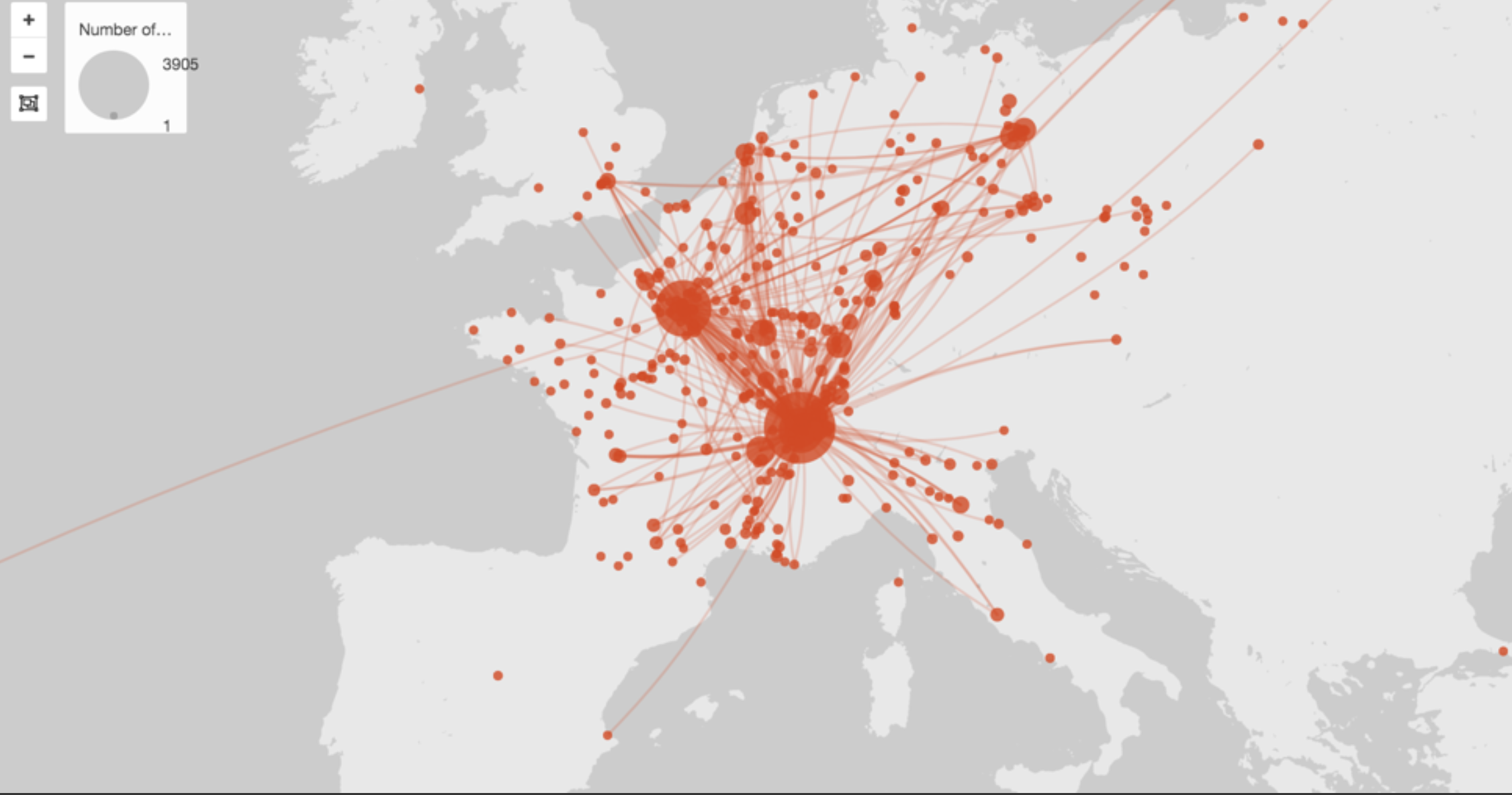
In the Republic of Voltaire’s Letters, London is just an insignificant country town. ((Credit: Mapping the Republic of Letters/Stanford University)
In the Republic of Voltaire’s Letters, London is just an insignificant country town. (Credit: Mapping the Republic of Letters/Stanford University)
Stanford’s project offers tantalizing summaries of other interesting maps and visualizations from the Republic of Letters, but the project’s web page has the distinct look and feel of something that was last updated 10 years ago. Click on something and you’re likely to see “page not found,” or “Adobe Flash player is no longer supported.” Leibniz never had this problem. Perhaps there’s another lesson here for the meta-Enlightenment.
For more on this, check out the full article about Historical Research in a Digital Age: Reflections from the Mapping the Republic of Letters Project, in the American Historical Review.
For the Mapping the Republic of Letters Project itself, what’s left of it, check its page at Stanford University.
Strange Maps #1241
Got a strange map? Let me know at [\[email protected\]](https://bigthink.com/cdn-cgi/l/email-protection#a0d3d4d2c1cec7c5cdc1d0d3e0c7cdc1c9cc8ec3cfcd).
Follow Strange Maps on X and Facebook
Science and TechPhilosophyCommunicationHistoryDigital Culture
Frank Jacobs has been writing about strange maps since 2006, published a book on the subject in 2009, and joined Big Think in 2010.

Special Issue Summer 2026
##### The Opt-Out Nation
This Big Think issue is a collection of stories about the American instinct to opt out, to pack up and go, to tell the boss, “I’d prefer not to.”
1 video 16 articles

 Feed your curiosityUnlock every video, every lesson, and every insight Big Think has to offer. Join today and start learning without limits.
Already a member? Click to sign in
Go deeper with Big Think Classes
 Members 9 videos Using AI to Create Amazing Things “King” Willonius Hatcher Comedian and AI Storyteller
 Members 9 videos The Power of Mindful Awareness Jon Kabat-Zinn Founder, The Center for Mindfulness, and Author, “Meditation is Not What You Think”, and “Falling Awake”
 Members 8 videos Cultivating the Conditions for Innovation Martin Gonzalez
 Members 6 videos Transform Your Organization with AI Daphne Koller Founder and CEO of insitro.
 Members 8 videos Productivity for Mortals Oliver Burkeman Author, “Meditations for Mortals”
##
Related Content
How a “flying circus” gave us the first aerial maps of Earth
Thomas Baldwin's Airopaidia (1786) includes the earliest sketches of the earth from a balloon.
by Frank Jacobs

Newton’s apple tree has descendants and clones all over the world
Its apples taste bad, but institutions all over the world want a descendant or clone of the tree, anyway.
by Frank Jacobs

Lemuria, the weirdest continent that never existed
To this day, one cult believes that Lemuria was real, and that its people left us the sacred wisdom to revive their advanced civilization.
by Frank Jacobs

Waving to the Great Mapmaker in the Sky
Some intriguing examples of people grooming the land for the unseen observer above.
by Frank Jacobs
