


Millions of California-bought cars can be hijacked via Bluetooth
At least 2.2 million vehicles fitted with dealer-installed KARR and SWDS security systems are vulnerable to nearby Bluetooth attacks that can unlock doors or prevent a stopped vehicle from starting, according to researchers at the University of California San Diego.
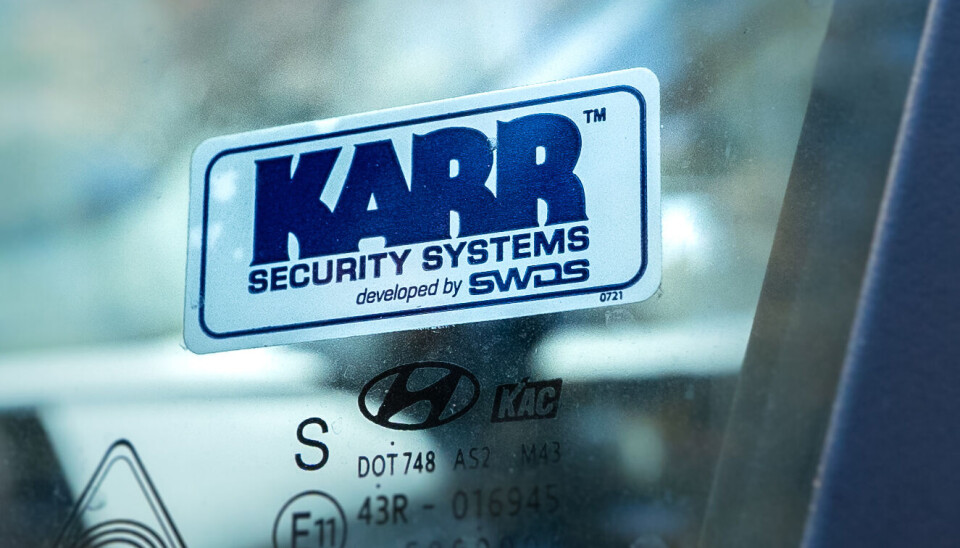
A KARR security system sticker in a vehicle window
David Baillot/UC San Diego Jacobs School of Engineering
An advance look at the research published by UCSD this week (the full writeup won’t be available until August 12) reveals that KARR and SWDS security devices manufactured by Acrisure contain a serious flaw: They “all … rely on the same secure key,” the researchers found.
What that means, according to the researchers, is that anyone who knows the key, has a device with a Bluetooth connection, and can get within five yards of an affected vehicle can unlock it, make the horn honk, flash the headlights, or even prevent it from starting.
REG AD
“Instead of smashing a window to get access to a vehicle, thieves could simply connect remotely via Bluetooth to the device inside the vehicle, and make it unlock car doors,” Jerry Yu, coauthor on the research and UCSD compsci graduate, said in the release.
REG AD
KARR/SWDS devices are installed by dealerships. Along with providing key fob-like functions, they also serve as an antitheft device, allowing dealers and buyers to track cars with the devices installed in the case of theft.
According to UCSD, the devices are typically sold as a paid upgrade at dealerships around the US. KARR says its products are available through more than 3,000 dealerships nationwide. Per the researchers, however, those devices remain active even if a buyer declines the service, meaning those who don’t have an active KARR/SWDS contract are still at risk.
“Removing the devices is not trivial,” UCSD compsci PhD candidate and paper co-author Yibo Wei said in the university’s report on the research. “You have to open up the dashboard and cut and reconnect the wires that are deeply intertwined with the car’s computers and ignition system.”
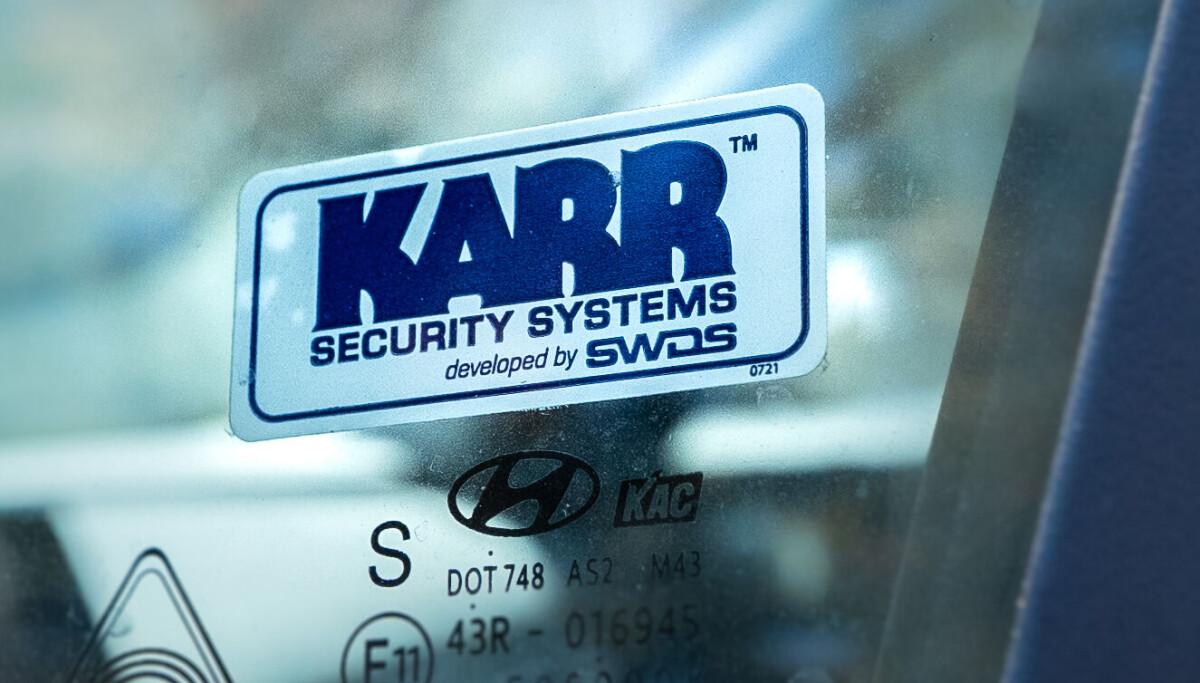
In other words, there are likely a lot of cars on the road with one of these units installed, and for many owners, a KARR or SWDS window sticker may be the only obvious indication.
The researchers said that most vulnerable vehicles were purchased in Southern California in the past nine years from Honda, Toyota, Mazda, Ford, and Jeep dealerships. Secondary market resales, however, mean affected vehicles can be found throughout the US and even as far away as Japan, the team noted. They also discovered a public database that stores information about equipped vehicles, according to UCSD.
For those worried their vehicle may be vulnerable, no need to worry: KARR Security has already released a firmware update for affected devices that can be installed by both active customers and those with an inactive security system; steps are included on the company’s website. It’s not clear if KARR is notifying customers of the need to update their security system - we asked, but the company didn’t directly respond to that question.
What KARR did tell us was that, in contrast to the UCSD finding that “all KARR-SWDS devices rely on the same secure key,” it claims that only a small percentage of devices “with certain Bluetooth-related components” are actually affected.
MORE CONTEXT
- Pwn2Own Automotive 2026 uncovers 76 zero-days, pays out more than $1M
- CAN do attitude: How thieves steal cars using network bus
- Porsche panic in Russia as pricey status symbols forget how to car
- Your next car might need 300 GB of RAM, and so will autonomous robots
-
 columnists Airbus takes flight from AWS. What happens next is critical
-
 off-prem Anyone with a shed, an extension cord, a couple of GPUs and an overdraft is building datacenters. Fujitsu just offloaded five
-
 security Linux kernel team publishes 432 CVEs in two days
-
 AI AND ML OpenAI admits it was the source of the agent swarm that attacked Hugging Face
-
 off-prem AWS customer learns the hard way how even the smallest oversight can be mission-critical
- AI and ML Codeberg gives vibe-coded projects the toss, promotes human FLOSS AI no longer welcome in human-focused community
- Systems AMD attacks the rack with Helios systems that rival Nvidia's Spec for spec, the House of Zen's first rack-scale AI compute platform is bigger and faster than Nvidia's Vera Rubin by nearly every metric, but that's only on paper
- DEVOPS Model Context Protocol prepares to break with its stateful past Biggest overhaul since launch ditches sessions, guts little-used features, and leaves homebrew implementations facing a slog
- Offbeat Tesla burns through a billion as Musk bets the farm on chips and bots Optimus remains 'very complex' and Robotaxis will try not to flatten your cat
- software IBM insists AI didn't kill software deals, just delayed them Big Blue says customers postponed rather than abandoned major purchases as hardware soaked up enterprise budgets
- Security Russians are posing as Signal support to launch phishing attacks PLUS: US takes down Iranian propaganda sites; Marketing company asks 'Why Do We Have Your Information?' And more!
- Security Microsoft patches failed to fix on-prem SharePoint, which is now under zero-day attack PLUS: China upgrades smartphone surveillance tools; Ring eases anti-snooping stance; and more
- Black Hat and DEF CON DEF CON Franklin project enlists hackers to harden critical infrastructure Voting village reports have been so successful, says Jeff Moss, that the whole of DEF CON will now be included
- Security EQT buys majority share in Swiss cybersecurity biz Acronis Went at equivalent of $3.5B+ valuation for entire firm, though portion sold not specified
- Malware Month Ten years since the first corp ransomware, Mikko Hyppönen sees no end in sight On the plus side, infosec's a good bet for a long, stable career
- GNOME can look like Windows – and Flashback can do it without extensions New 'Simple-taskbar' is an option, but there's a simpler, stabler way
- A moment of silence, please, for the final release of Debian on x86-32 New Debian versions hit FOSSland in the form of 13.6 and 12.15
- Baddies caught exploiting extensions bugs with perfect 10 scores on vulnerable Joomla websites Flaws in iCagenda, Balbooa Forms extensions can impact open source CMS that powers a million sites worldwide
- Frame: A new X11 server – implemented directly in assembly Joins yserver, Phoenix, and of course XLibre – and outlier Arcan
- Cinnamon 6.8 will support Wayland – if you want it Next version of Linux Mint’s desktop has both kinds of display server
- KDE Plasma users face a dire omen of change: 6.6.6 arrives 6.7 is now current, and in 6.8 you're getting Wayland whether you like it or not
“The vulnerability described in the research is highly complex and presents a low risk to customers under real-world conditions,” a KARR spokesperson told us. “Nevertheless, we responded promptly and developed a firmware update to address the issue.”
REG AD
The vulnerability was discovered serendipitously by the UCSD researchers years ago when they were doing research on credit card skimmers and spotted Bluetooth fingerprints they couldn’t identify. After figuring out they had spotted car security systems, the team started digging into the devices, and here we are.
We contacted the team to get more detail on their findings, but didn’t hear back. They’ll be presenting their work at DEF CON on August 9, and the USENIX Security conference on August 12. ®
[](https://www.facebook.com/sharer.php?u=https%3A%2F%2Fwww.theregister.com%2Fsecurity%2F2026%2F07%2F23%2Fmillions-of-california-bought-cars-can-be-hijacked-via-bluetooth%2F5277315) [](https://twitter.com/intent/tweet?url=https%3A%2F%2Fwww.theregister.com%2Fsecurity%2F2026%2F07%2F23%2Fmillions-of-california-bought-cars-can-be-hijacked-via-bluetooth%2F5277315) [](https://www.linkedin.com/sharing/share-offsite/?url=https%3A%2F%2Fwww.theregister.com%2Fsecurity%2F2026%2F07%2F23%2Fmillions-of-california-bought-cars-can-be-hijacked-via-bluetooth%2F5277315) [](https://bsky.app/intent/compose?text=Millions%20of%20California-bought%20cars%20can%20be%20hijacked%20via%20Bluetooth%0Ahttps%3A%2F%2Fwww.theregister.com%2Fsecurity%2F2026%2F07%2F23%2Fmillions-of-california-bought-cars-can-be-hijacked-via-bluetooth%2F5277315) [](https://www.reddit.com/submit?url=https%3A%2F%2Fwww.theregister.com%2Fsecurity%2F2026%2F07%2F23%2Fmillions-of-california-bought-cars-can-be-hijacked-via-bluetooth%2F5277315&title=Millions%20of%20California-bought%20cars%20can%20be%20hijacked%20via%20Bluetooth) [](https://api.whatsapp.com/send?text=Millions%20of%20California-bought%20cars%20can%20be%20hijacked%20via%20Bluetooth%0Ahttps%3A%2F%2Fwww.theregister.com%2Fsecurity%2F2026%2F07%2F23%2Fmillions-of-california-bought-cars-can-be-hijacked-via-bluetooth%2F5277315)
REG AD
Patches Year-long Russian attacks infect users as soon as they look at an email Phishing for dummies