Traces tell you what happened.AgentPulse shows you where to investigate.
Traces tell you what happened.
AgentPulse shows you where to investigate.Open-source drift investigation for multi-agent systems: which agent drifted, why, and what to check next.
Get started free → Chat with our engineers
Works with OpenAI SDKAnthropic SDKAutoGenLangChainLangGraphClaude Code (MCP)
How it works
Two lines in, an investigation out
1
Instrument
Add two lines at startup. AgentPulse automatically instruments OpenAI, Anthropic, LangChain, and AutoGen.
from sdk import instrument instrument(task\_type='my-system')
2
Capture
LLM calls, agent turns, tool calls, and handoffs are stored locally in one SQLite file per project. Core tracing works without an AgentPulse cloud account or hosted backend.
3
Detect drift
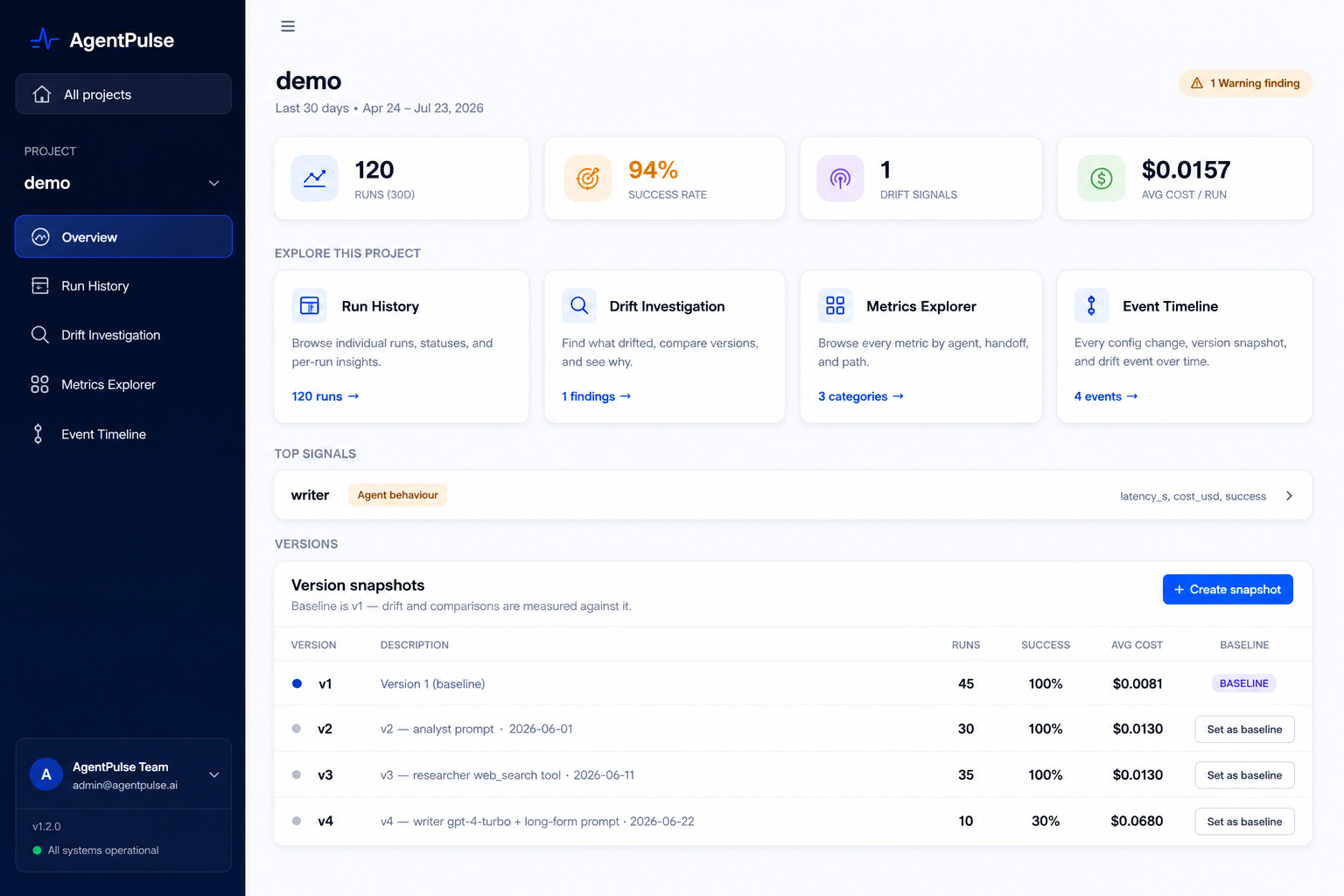
AgentPulse compares behavior across runs and versions, then flags agent, handoff, and route drift when signals leave their expected range.
4
Investigate
Follow the drift upstream to its likely source, with supporting signals, related changes, confidence, and suggested next checks.
What you get
Built around the investigation, not the trace viewer
When an outcome degrades, AgentPulse does not hand you a dashboard of symptoms. It compares every component against your baseline and walks the agent graph to the point where the drift originated.
The investigation path
investigation walks upstream from the symptom
researcherinput stable · cleared
analystinput stable · cleared
Root causewriteroutput drifted · input stable
Symptomcriticsuccess −70 pp vs baseline
Change log: writer prompt + model changed at run 18 · flagged as the likely cause
Drift Investigation
Four rules turn a baseline breach into a root-cause finding:
1. Baseline every metric, per agent, handoff, and route 2. Open an investigation only on a sustained outcome breach, never a single noisy spike 3. Walk the graph upstream and stop where inputs are stable but output drifted 4. Correlate prompt, model, and tool changes that could actually have caused it
 Likely cause identified Related change detected
See the run, not the logs
See every run as an execution timeline and interactive agent graph, not a wall of log lines.
- Tokens, latency, and cost for every turn
- Parallel branches, bottlenecks, and join time
- Handoff payloads and downstream outcomes on hover
 6.7s bottleneck branch
Claude integration
Let Claude run the investigation
AgentPulse ships an MCP server, so Claude Code and Claude Desktop can triage drift, compare releases, and propose next checks conversationally. Three ready-made skills are bundled.
\> what drifted today?
1 drift finding across 3 projects
● writer · Agent behaviour · demo
Severity: Critical Confidence: High
Why: a change in writer propagated downstream
to critic, whose success worsened. The fix
belongs in writer, not critic.
Trigger: writer prompt changed near run 110
`get_todays_finding`Active drift findings as root-cause-led investigation cards
`get_version_comparison`Which release introduced the change that broke an outcome
`get_next_check_steps`Recommended next investigation steps per finding
See it on your own agents
Book a 30-minute walkthrough of a real drift investigation, or ask how to wire AgentPulse into your stack.
Get started free Chat with our engineers
Open experiment
AgentPulse is a reference implementation, and we want to learn how your team investigates agent failures. Tell us what works, what's missing, or how you do it differently.