ai.2it.onl
Testing LLM Concurrency on Consumer Hardware
2026-08-02 · \~14 min read · benchmark 15 models 360 runs
I recently watched a YouTube video of someone testing a server-grade LLM hardware setup, pushing it to see just how much concurrency it could actually handle. It got me thinking: what can your own — perhaps a bit above-average — “gaming” / “workstation” PC really do? Especially within the limits of my RTX 5060 and its fast but limited 8GB of VRAM. I’ve been thinking about building a game or simulation driven by a high agent count, and I wanted to know what the feasible limit really is. That question brought me to these tests — and the results you’ll find below: the rig, the method, and every number and chart for all 15 models, individually and side by side. A note on authorship: that opening paragraph is my own words — the rest of this post is mostly AI-generated, though I have carefully gone over all of it, and every number has been checked against the raw benchmark data before publishing. And the dataset isn’t done yet — I plan to keep testing more models and will add them to the list as I do, so keep a lookout for new entries in the sidebar.
TL;DR
Concurrency scales on consumer hardware — pooled agents multiplied throughput 8.7x at best. The top all-in result was MiniCPM5 1B at 983 tok/s(433% of its solo speed). The worst was a flatline: Qwen3.5 0.8B with MTP enabled never scaled at all (\~180 tok/s at any concurrency) because multi-token prediction serializes requests — with MTP off the same model hit 787 tok/s. Thinking models hide a huge share of their budget in `reasoning_content` (up to 100%), and time-to-first-token degrades from milliseconds to tens of seconds under load. Errors across all 360 runs: zero.
Test rig
One desktop, fully loaded while every run executed. This is a dirty daily-driver environment — not a clean lab bench — and that was the point: the results are what real consumer hardware actually does.
CPU · compute
Ryzen 9 9950X3D
Zen 5 V-Cache flagship. Core affinity is hard-locked to CCD0 so every LLM loop stays on the 3D V-Cache cores — zero cross-CCD thread-hopping on the Infinity Fabric.
RAM · bandwidth
32GB DDR5 6400
UCLK locked 1:1 with the memory controller for the lowest possible system↔GPU transfer latency during CPU-side MoE offload and high-concurrency prefill pooling.
GPU · acceleration
RTX 5060 8GB GDDR7
Core + VRAM overclocked to squeeze maximum raw bandwidth out of the 128-bit bus. Every model was fully offloaded — the GPU is the engine room.
Environment · dirty load
3 monitors, always on
2x ultrawide + 1x 4K primary, with a hardware-accelerated multi-tab Chrome profile running through every single benchmark run.
LM Studio configuration
Identical server settings for every model — differences (MTP, KV cache quant, context caps) are called out per model on its page.
⚒ Decode & scheduling
- GPU offloadMax for model
- CPU threads8 · CCD0
- Eval batch size2048
- Physical batch size512
- Max concurrency24
- Flash attention_On_
- Context length34304 · max
- Unified KV cache_On_
- Offload KV to GPU_On_
- Keep model in memory_On_
- Try mmap()On
- KV cache quantF16 · Q8\_0 · Q4\_0
- Speculative decoding_Off_
- MTP exceptionQwen3.5 0.8B
- KV quant rulesF16 ≤1.5B · Q8\_0 2B · Q4\_0 3B+
- Context cap32k or 8k · per model
- Bigger models — climbing to roughly 9B parameters, about the max I can fit in 8GB of VRAM, to see how the concurrency curve changes as models outgrow the card.
- MoE models with offloaded experts — sparse models that push expert weights out to system RAM; the 9950X3D’s CCD0 affinity and 32GB of 1:1 DDR5 were built for exactly this. The question: does expert offloading serialize under load, or does MoE’s sparsity actually hold up better under concurrency than dense models?
- Agentic task mixes — multi-turn tool calling, structured JSON/action output, and code-editing loops, measuring parse success and instruction-following while 8–24 agents are in flight.
- Long-context drift — whether models stay coherent when agents hold full 32k contexts under compaction pressure, not just 60-second sprints.
- Quality vs token budget — the reasoning-share question made concrete: does the hidden thinking actually buy better task outcomes, or just slower answers?
- Latency budgets — which models stay inside interactive TTFT budgets at realistic concurrency, and which are batch-only.
- data/ directory (per-model sweep summaries)
● Memory & context
⚡ Decoding strategy
Methodology
The harness is a zero-dependency Node agent loop (`benchmark/benchmark.js`) plus a sweep driver (`benchmark/sweep.js`) streaming against LM Studio’s local OpenAI-compatible endpoint. Each model got 24 sequential runs — one per concurrency level 1–24 — of 60 seconds wall time. Each agent holds a 12,000-token budget, runs a multi-turn loop until budget or timeout, and samples `temperature 0.9`.
Token-level timing captures TTFT (time to first token), per-stream token gaps, content vs reasoning tokens, and per-agent/combined throughput. Reasoning is counted differently per model family: `reasoning_content` streams (MiniCPM5, Qwen-DeepSeek, Chronos, Qwen3.5), inline `<think>...</think>` tags stripped from content (Gemma Heretic), or not at all (the clean non-thinking models). Per-model pages note which.
One honesty flag: some per-agent numbers carry `*` — agents that sat queued for \~11–16s and then generated in a short burst report inflated per-agent tok/s. Those are timing artifacts; combined throughput and TTFT are the trusted columns.
Leaderboard — side by side
983
best combined tok/s (MiniCPM5 1B)
872%
best scaling (Unsloth Ministral 3 3B (2512))
7/15
thinking models
0
errors in 360 runs
best in column worst in column podium (top 3) lower is better · TTFT
| # | Model | Solo tok/s | Peak tok/s | @ agents | Scaling | TTFT solo | TTFT @ peak | Content @24 | Reasoning @24 | Errors | | -- | ---------------------------------------------------------------------------------------------------------------------------------------------- | ---------- | ---------- | -------- | ------- | --------- | ----------- | ----------- | ------------- | ------ | | 1 | MiniCPM5 1B MiniCPM · 1B · KV F16 · thinking | 227 | 983 | 24 | 433% | 1.5s | 7.0s | 48% | 52% | 0 | | 2 | Falcon3 1B Instruct Falcon · 1B · KV F16 | 187 | 839 | 13 | 449% | 1.0s | 677ms | 100% | 0% | 0 | | 3 | Qwen-DeepSeek 1.5B Agentic Distill Qwen · 1.5B · KV F16 · thinking | 165 | 829 | 21 | 502% | 4.2s | 23.4s | 32% | 68% | 0 | | 4 | Qwen3.5 0.8B — MTP Disabled Qwen · 0.8B · KV F16 · thinking | 239 | 787 | 22 | 329% | 12.0s | — | 0% | 100% | 0 | | 5 | Gemma3 1B IT (Heretic thinking) Gemma · 1B · KV F16 · thinking | 171 | 719 | 24 | 420% | 86ms | 2.9s | 53% | 47% | 0 | | 6 | Llama 3.2 1B Mini-Agent Llama · 1B · KV F16 | 196 | 652 | 24 | 333% | 880ms | 674ms | 100% | 0% | 0 | | 7 | Qwen2.5 1.5B Qwen · 1.5B · KV F16 | 173 | 577 | 20 | 334% | 108ms | 626ms | 100% | 0% | 0 | | 8 | Gemma 2B IT (smashed) Gemma · 2B · KV Q8\_0 | 121 | 538 | 17 | 445% | 94ms | 609ms | 100% | 0% | 0 | | 9 | Chronos 1.5B Chronos · 1.5B · KV F16 · thinking | 88 | 458 | 23 | 520% | 226ms | 17.3s | 6% | 94% | 0 | | 10 | Unsloth Ministral 3 3B (2512) Ministral · 3B · KV Q4\_0 | 47 | 410 | 23 | 872% | 115ms | 15.0s | 100% | 0% | 0 | | 11 | Mistralai Ministral 3 3B (2512) Ministral · 3B · KV Q4\_0 | 71 | 404 | 22 | 569% | 92ms | 15.6s | 100% | 0% | 0 | | 12 | Llama 3.2 3B Instruct Llama · 3B · KV Q4\_0 | 95 | 404 | 24 | 425% | 117ms | 16.1s | 100% | 0% | 0 | | 13 | Granite 4.1 3B IBM Granite · 3B · KV Q4\_0 | 79 | 362 | 16 | 458% | 191ms | 19.1s | 100% | 0% | 0 | | 14 | Qwen3 4B Qwen · 4B · KV Q4\_0 · thinking | 60 | 340 | 24 | 567% | 11.8s | 51.6s | 5% | 95% | 0 | | 15 | Qwen3.5 0.8B — MTP Enabled Qwen · 0.8B · KV F16 · thinking | 202 | 202 | 1 | 100% | 21.8s | 21.8s | 0% | 100% | 0 |
Podium rows mark the top 3 by peak combined throughput. Solo = concurrency 1 · Peak = highest combined all-token tok/s across 1–24 · Scaling = peak as % of solo · Content/Reasoning @24 = token mix at 24 agents · Every model page has the full 24-row table and raw data.
Side-by-side charts
All charts below are generated from the sweep JSON in the site’s dark theme; original matplotlib exports are downloadable per model.
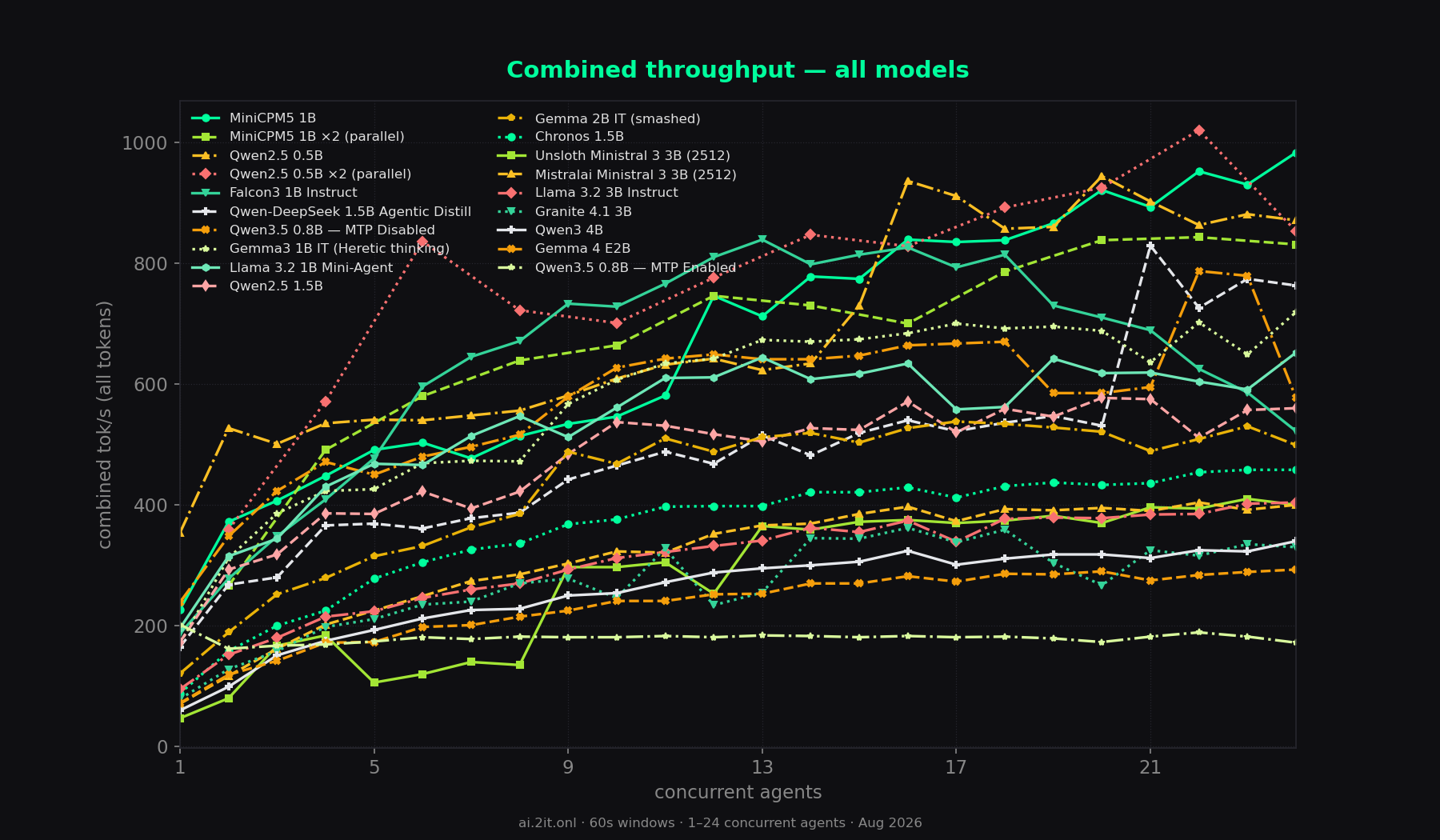
The headline chart. MiniCPM5 leads at 983 tok/s; Falcon3 and Qwen-DeepSeek climb hard past 15 agents; the MTP-enabled Qwen3.5 line is the tell — flat at \~180 tok/s from 2 to 24 agents. Most non-thinking models plateau between 400 and 650.
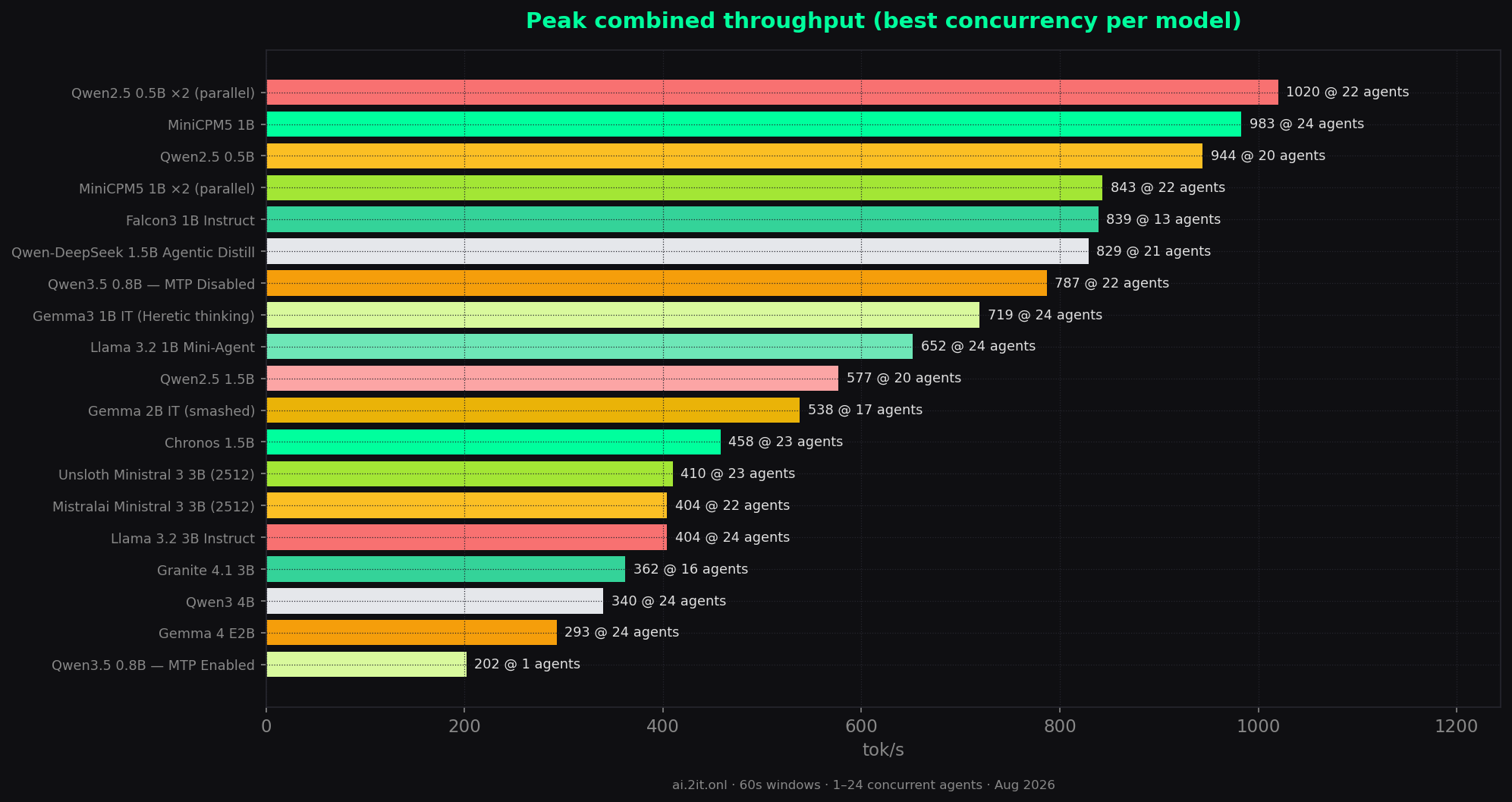
Peak combined throughput and the concurrency level where it happened. The spread is nearly 5x (983 ↔ 202 tok/s) on the same hardware — model choice matters more than GPU class here.
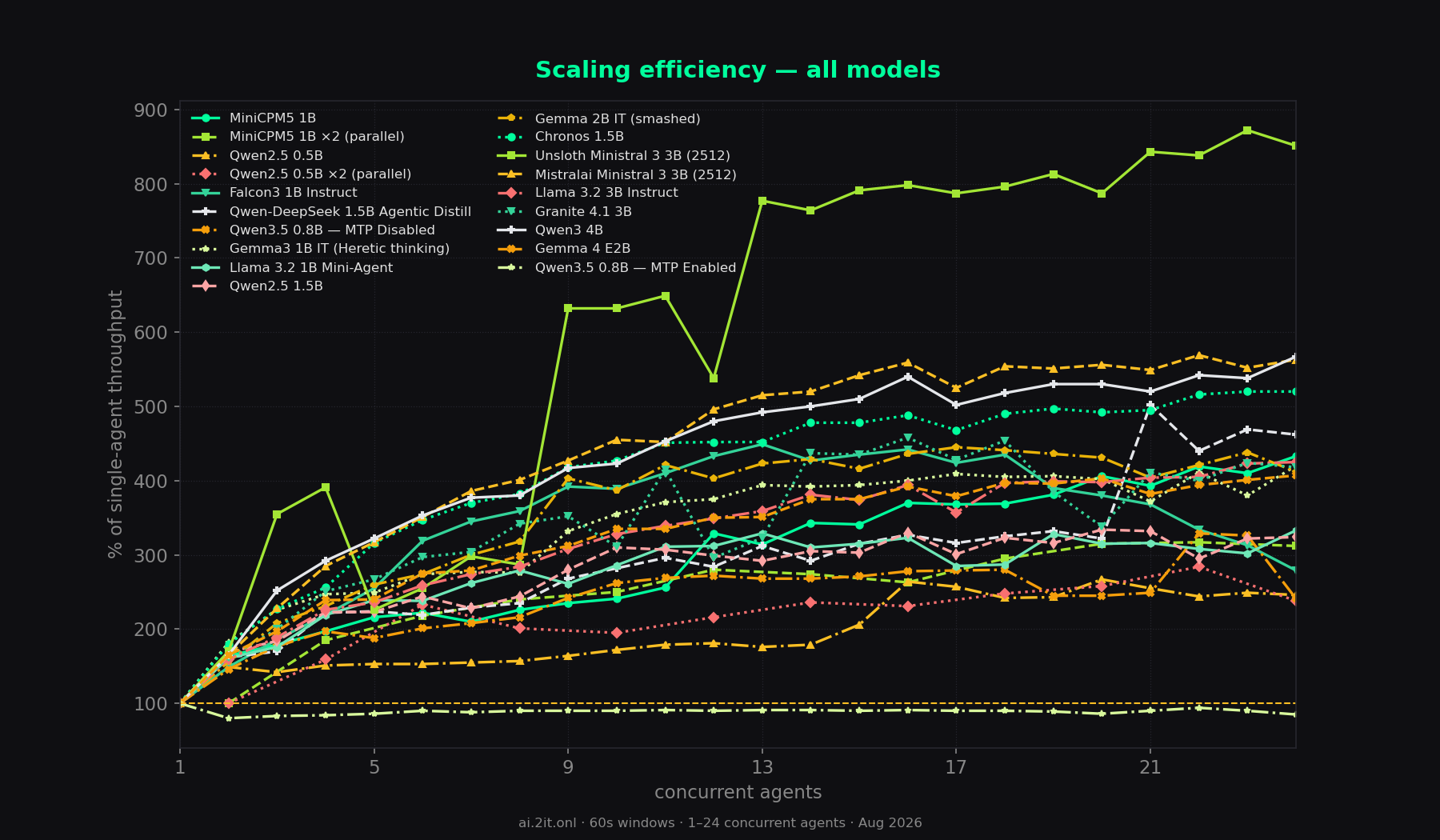
Scaling efficiency (peak vs solo). Unsloth Ministral 3 3B holds the record at 8.7x — followed by Chronos & Qwen-DeepSeek at 5x+ — because their solo baselines are tiny. Llama 3.2 3B and Gemma 2B trade raw speed for the most linear curves.
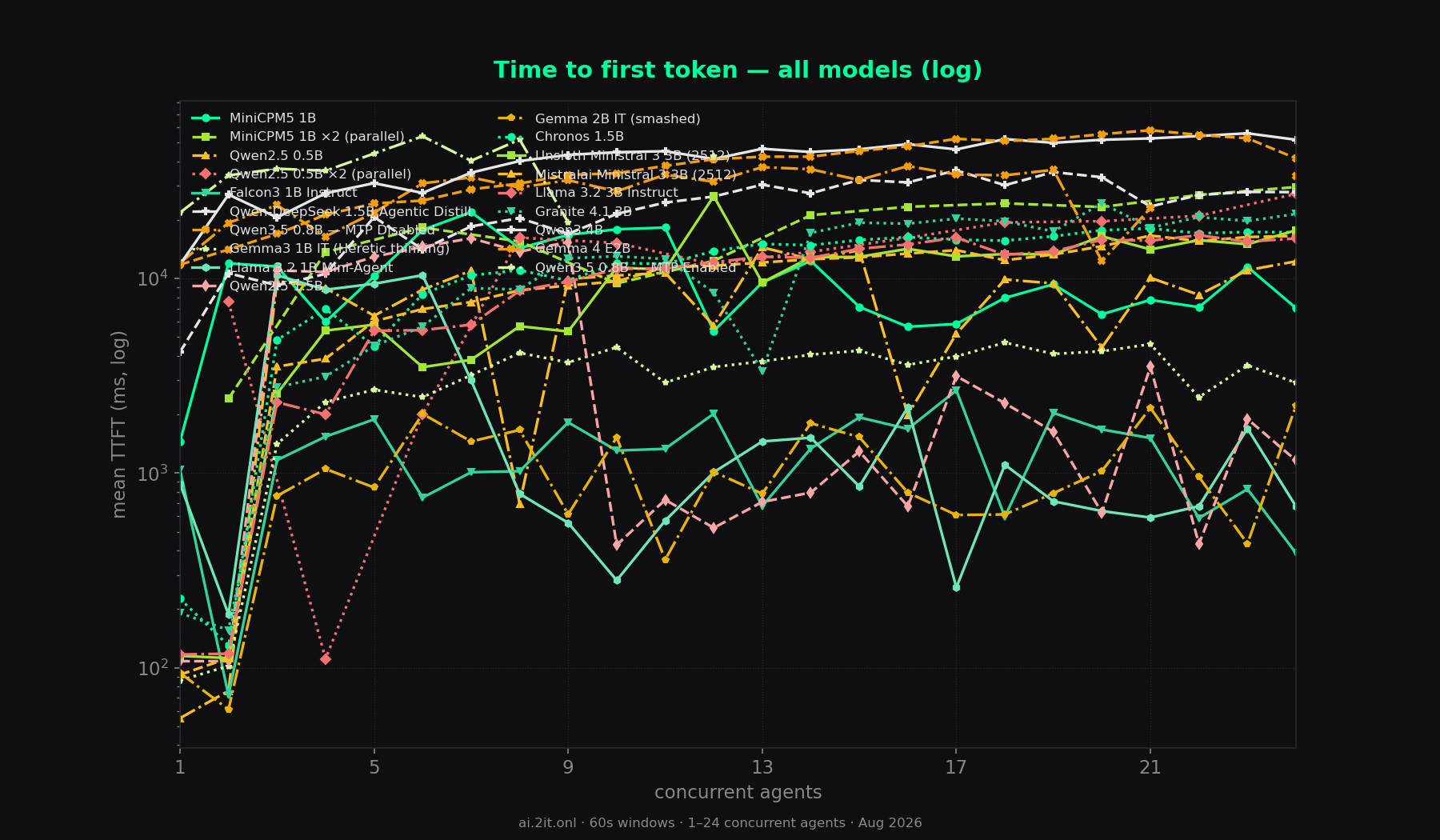
Mean TTFT (log). The thinking models live in the seconds-to-tens-of-seconds band; Qwen3 4B is the worst of the lot — 11.8s solo and 40–56s under load, with max values touching the full 60s window. Qwen-DeepSeek is close behind at up to 58s. Gemma 2B and Llama 3.2 1B stay sub-second until \~8 agents. For latency-critical controllers, this is the chart to read.
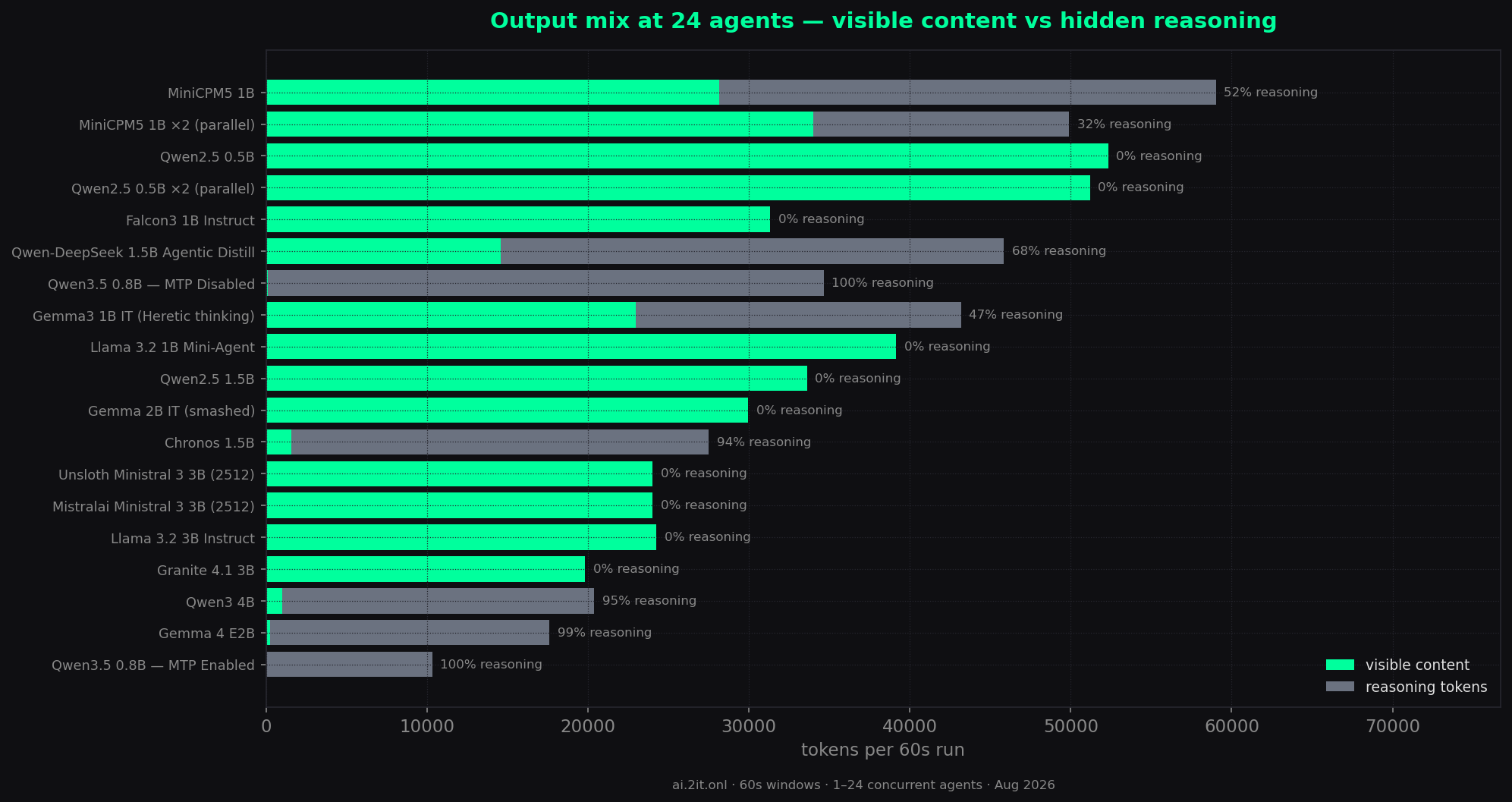
Output mix at 24 agents: green is visible content, grey is hidden `reasoning_content`. MTP-enabled Qwen3.5 emits 100% reasoning — nothing visible ever arrives. Qwen3 4B (\~95%) and Chronos (94%) barely show any content under load either. A “983 tok/s” headline is half story when 50% of it never reaches the agent.
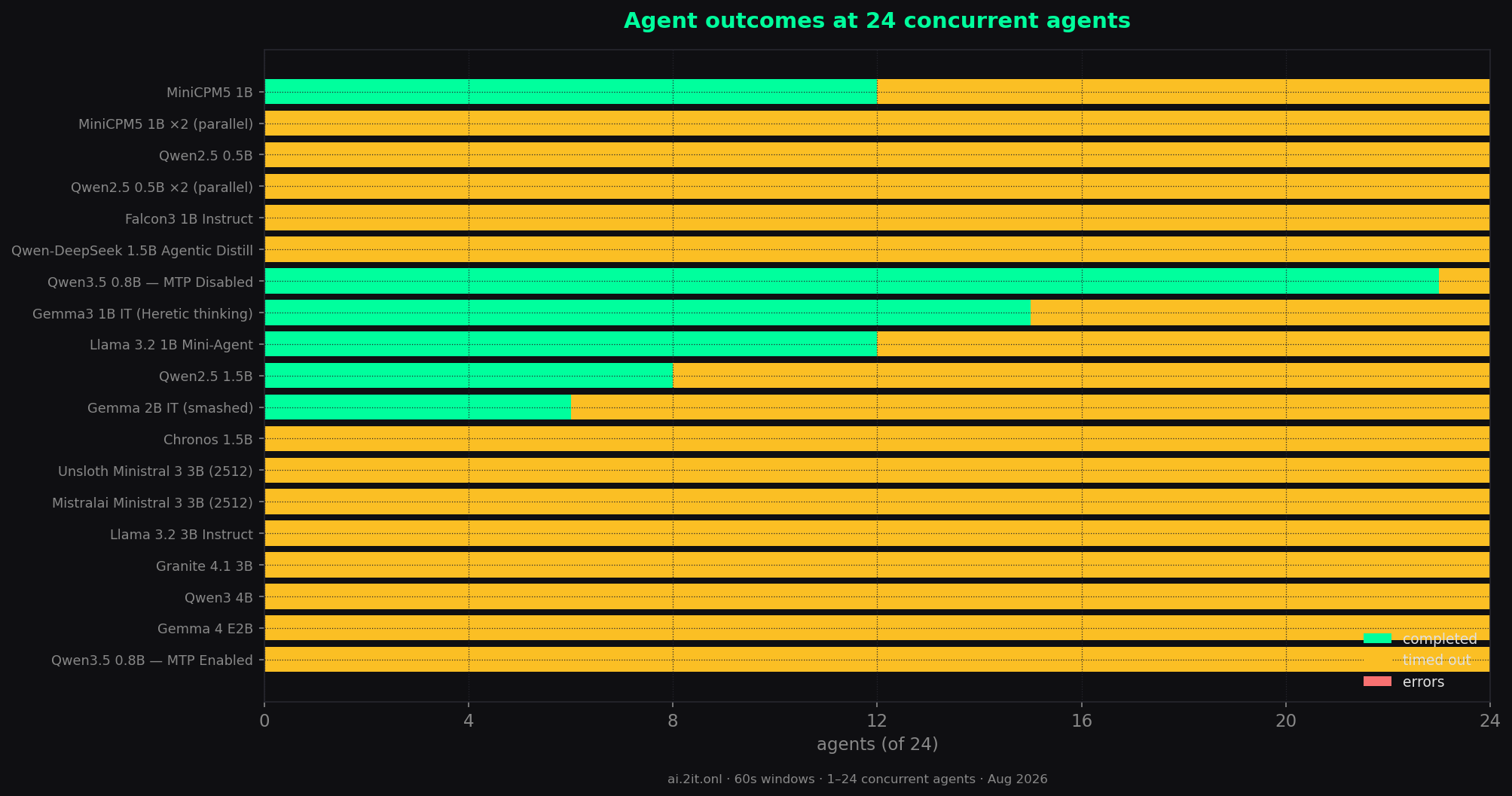
How the 24-agent runs actually ended: green = completed their turn, amber = hit the 60s timeout. Llama 3.2 3B never “completes” at high concurrency — every agent runs the full window and still produces tokens (that’s fine for throughput, bad for interactive agents). Errors everywhere: 0.
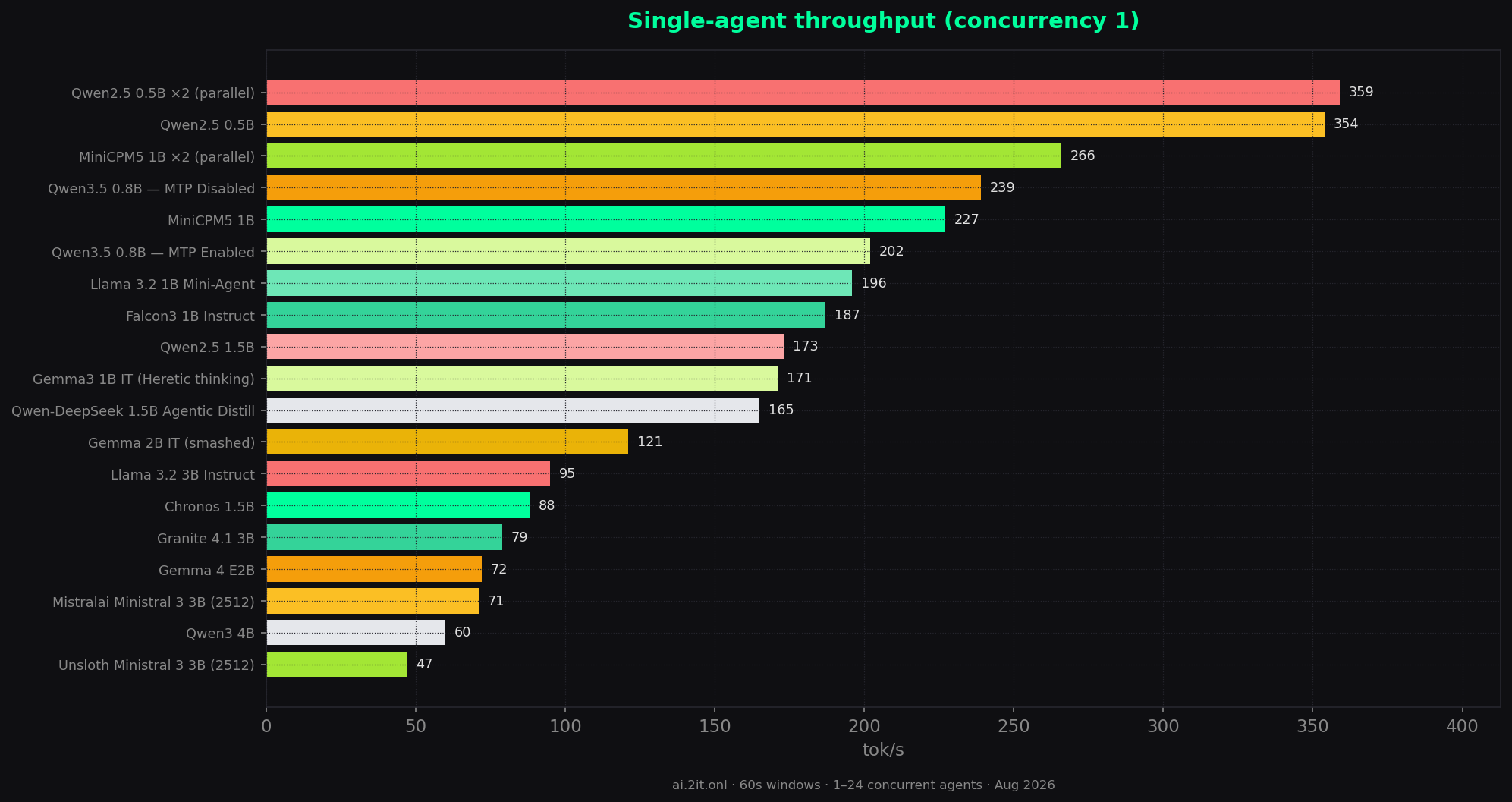
Single-agent throughput — the quality of one fast stream. MTP-off Qwen3.5 leads at 239 tok/s; Unsloth Ministral 3 3B is the slowest solo of all (47 tok/s on Q4\_0 KV) and the 3B class generally pays for its params. Everything here fits in 8GB VRAM.
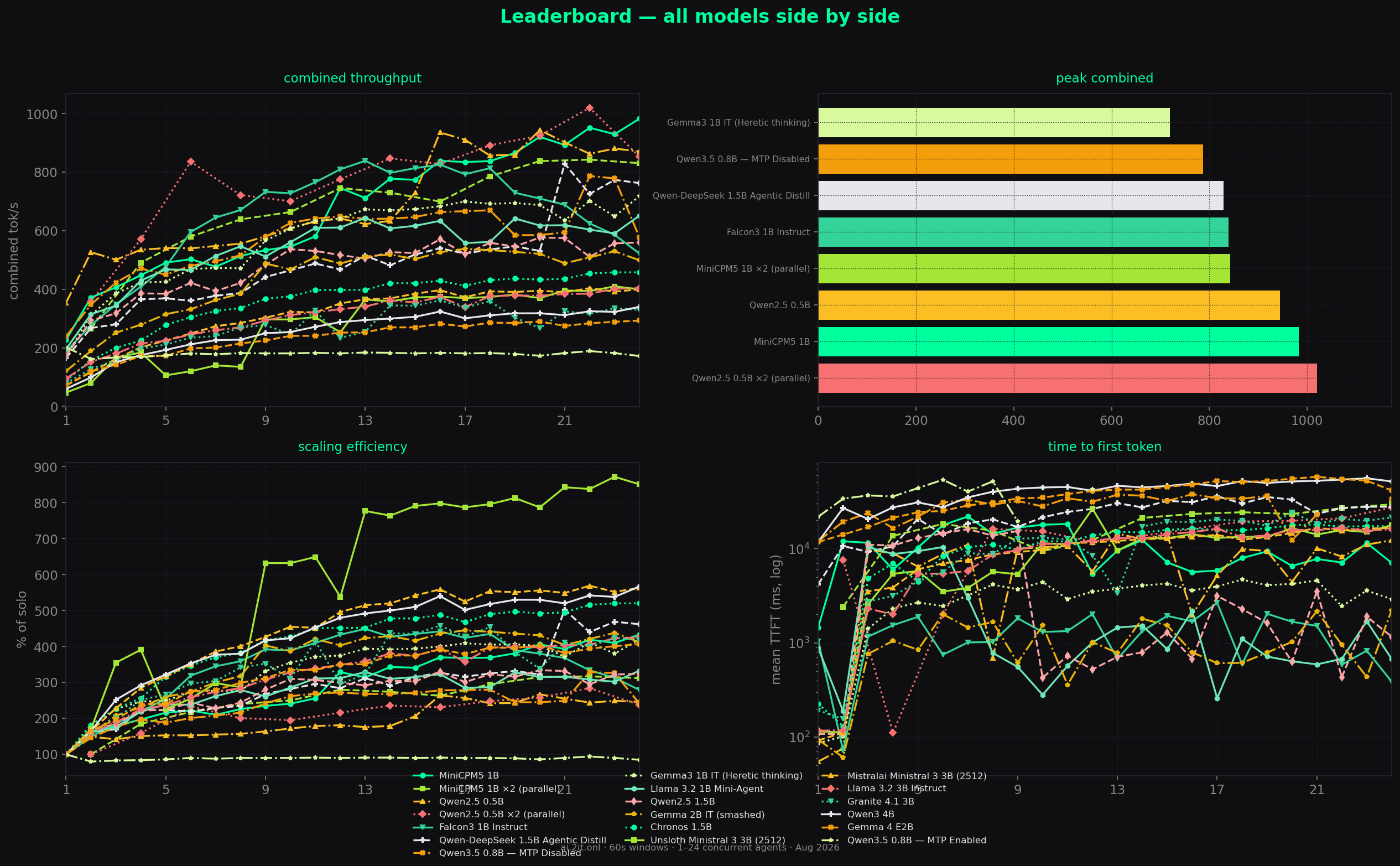
The full picture on one figure: combined throughput, peak bars, scaling, and TTFT for all 15 models.
Models — individually
Every model gets its own page: the complete 24-row table, key findings, all 8–9 charts, and raw CSV/JSON downloads.
01 · MiniCPM · 1B MiniCPM5 1B All-in throughput king (983 tok/s) but half its output is hidden reasoning and TTFT climbs to 52s. 983 tok/s · 433% scaling 02 · Falcon · 1B Falcon3 1B Instruct Fastest pure-content scorer — 839 tok/s at 13 agents, then rolls off as the 8k context saturates. 839 tok/s · 449% scaling 03 · Qwen · 1.5B Qwen-DeepSeek 1.5B Agentic Distill Best scaling efficiency (5.0x) but the worst TTFT profile — 20–58s to first token under load. 829 tok/s · 502% scaling 04 · Qwen · 0.8B Qwen3.5 0.8B — MTP Disabled The MTP experiment: with multi-token prediction off, throughput scales 3.3x instead of flatlining at \~180 tok/s. 787 tok/s · 329% scaling 05 · Gemma · 1B Gemma3 1B IT (Heretic thinking) Friendliest thinking profile — 86ms solo TTFT, 719 tok/s all-in, and it just thinks harder under load. 719 tok/s · 420% scaling 06 · Llama · 1B Llama 3.2 1B Mini-Agent The first agentic-tuned model tested — clean 196 tok/s solo, plateau of \~600–650 tok/s from 13 agents on. 652 tok/s · 333% scaling 07 · Qwen · 1.5B Qwen2.5 1.5B Best latency at low concurrency (108ms TTFT) and 3.3x scaling — but an erratic mid-range TTFT curve. 577 tok/s · 334% scaling 08 · Gemma · 2B Gemma 2B IT (smashed) Middle of the pack and steady — 538 tok/s peak, and the best latency of the smaller models (61ms–2.4s). 538 tok/s · 445% scaling 09 · Chronos · 1.5B Chronos 1.5B Slowest solo (88 tok/s) but scales 5.2x — 94% of its output at high concurrency is hidden reasoning. 458 tok/s · 520% scaling 10 · Ministral · 3B Unsloth Ministral 3 3B (2512) Slowest solo of any model tested (47 tok/s on Q4\_0 KV) but the highest relative scaling on record — 8.7x to 410 tok/s at 23 agents. 410 tok/s · 872% scaling 11 · Ministral · 3B Mistralai Ministral 3 3B (2512) The official build vs the unsloth sibling at the same Q4\_0 KV: 71 tok/s solo, smooth monotonic scaling to 404 tok/s at 22 agents — faster at every concurrency below the top end. 404 tok/s · 569% scaling 12 · Llama · 3B Llama 3.2 3B Instruct The 3B anchor — only 95 tok/s solo, but the smoothest, most predictable scaling curve in the sweep (4.25x). 404 tok/s · 425% scaling 13 · IBM Granite · 3B Granite 4.1 3B Slowest solo of all (79 tok/s) and the noisiest scaling curve, but TTFT is the real weak point — 20–24s at 20+ agents. 362 tok/s · 458% scaling 14 · Qwen · 4B Qwen3 4B The worst latency profile of any model tested — 11.8s TTFT solo, 40–56s under load — and \~95% of its output is hidden reasoning at high concurrency. Peak: 340 tok/s. 340 tok/s · 567% scaling 15 · Qwen · 0.8B Qwen3.5 0.8B — MTP Enabled The cautionary tale: MTP serializes requests — flat \~180 tok/s at any concurrency and zero visible content from 10 agents up. 202 tok/s · 100% scaling
Key takeaways
1. Concurrency pays, up to a wall. Every model except MTP-on Qwen3.5 scaled 3.3–8.7x. Diminishing returns beyond \~13–16 agents for most; a few (MiniCPM5, Falcon3) kept climbing to 24. 2. MTP serializes — it is not a throughput win for concurrency. The cleanest result of the whole sweep: same model, same box, MTP off = 3.3x scaling; MTP on = flatline. The decode path cannot batch. 3. Thinking tokens are overhead, not content. At 24 agents, reasoning share ran 45–100%. If your agents need visible answers, count content-only throughput. 4. TTFT is the agent-latency wall. Prefill-heavy thinking models push first-token latency to 20–60s under load — Qwen3 4B waits up to the full 60s window — unusable for interactive orchestration, fine for batch pipelines. 5. Reliability is not the bottleneck. 288 runs, zero hard errors. Timeouts (budget exhaustion) are the only non-OK outcome. 6. A 9950X3D + 32GB + 8GB VRAM can host the whole swarm. 24 concurrent 1B–3B agents ran with KV on GPU and no OOMs — this is genuinely consumer-hardware territory.
What’s next — bigger models & real-world use
This sweep is a living dataset — it’s not done yet. I plan to keep testing and adding models to the list as they land, so keep a lookout for new entries in the sidebar. Next up on the bench:
And throughput only answers how fast a model can go — not how well it works. The strongest performers from this sweep also head onto real-world use datasetsunder the same harness and the same dirty rig:
Data & downloads
Every number above is reproducible: each model page links its `sweep-summary.csv`, `sweep-summary.json`, the full report markdown, and the original white-background matplotlib chart exports. The generation pipeline lives in `build/` (dark-theme chart generator + model page builder) and is re-runnable as the dataset grows.