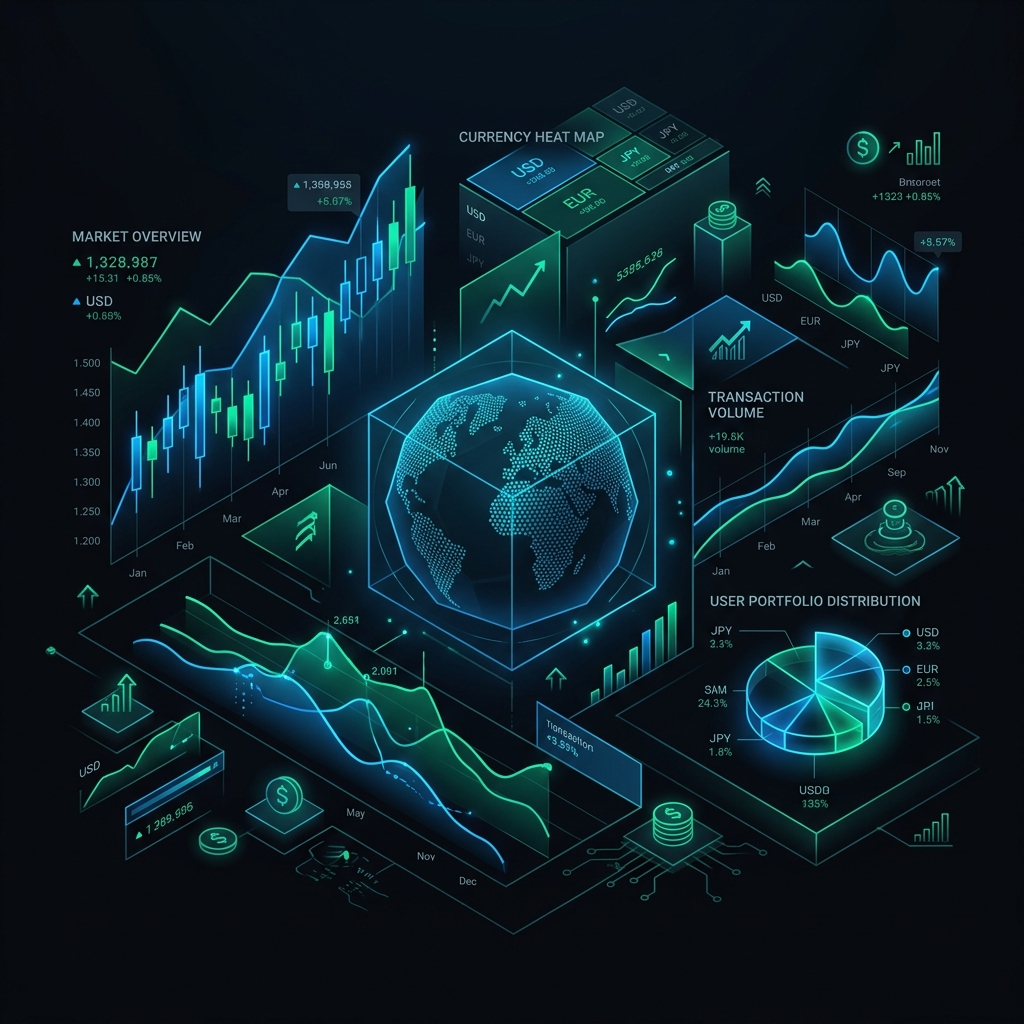


Transformer Models in Financial Forecasting
TL;DR
- Zero-shot capabilities are transforming finance: Google's TimesFM (200M parameters) shows a 15-20% improvement in forecasting accuracy without fine-tuning compared to traditional ML baselines.
- Quant giants like Two Sigma and Man AHL are heavily deploying Temporal Fusion Transformers (TFTs) to map non-linear correlations and predict market regimes.
- Attention mechanisms are dethroning LSTMs in time-series models, processing vast datasets with significantly faster inference speeds while capturing long-range dependencies.
- A decoder-only foundation model for time-series forecasting (Google Research)
- Temporal Fusion Transformers for Interpretable Multi-horizon Time Series Forecasting
- Two Sigma Research Updates
The Rise of Transformers in Quantitative Finance
The revolution in generative AI over the past few years was driven by transformer models. These architectures, originally designed for natural language processing, are now fundamentally reshaping quantitative finance. Hedge funds and institutional trading desks are pivoting away from classical statistical models toward sophisticated deep learning frameworks. The fundamental challenge in financial time-series forecasting has always been the low signal-to-noise ratio; however, the self-attention mechanisms inherent to transformers are proving exceptionally adept at isolating elusive alpha signals amid market noise.
For decades, quantitative analysts relied heavily on Autoregressive Integrated Moving Average (ARIMA) and Long Short-Term Memory (LSTM) networks. While effective for simple tasks, these models often falter when faced with massive, multi-modal datasets and complex, non-linear market behaviors. Transformers, conversely, process entire sequences of data simultaneously. This parallel processing capability, combined with positional encoding, allows them to 'attend' to distant past events that might suddenly become relevant due to current market conditions—a crucial advantage when modeling macroeconomic cycles or sudden volatility spikes.
The institutional adoption of these technologies is accelerating rapidly. The ability to forecast multi-horizon equity returns and dynamically adapt to shifting volatility regimes is a core focus for systematic trading firms. For more insights on how these models manage systemic risks, refer to our comprehensive guide on how machine learning predicts stock market crashes. As the mathematical underpinnings of models like GPT are applied to price discovery and risk management, a new frontier of algorithmic trading is emerging.
Architectural Advantages: Why Attention Beats Memory
The core innovation of the transformer architecture is the self-attention mechanism, which mathematically assigns weights to different elements of input data regardless of their sequential distance. In financial forecasting, this means a model can instantly recognize that a current supply chain disruption bears statistical similarity to an event from five years ago, weighting that historical data heavily in its current forecast. LSTMs, which rely on a hidden state passed sequentially from step to step, tend to 'forget' older information or dilute its impact, making them less effective for long-term dependency mapping.
Moreover, the parallelization of transformers fundamentally changes the computational economics of model training. LSTMs must process time-steps one by one, creating a bottleneck that limits the scale of data that can be ingested. Transformers process the entire sequence concurrently, leveraging modern GPU architectures to train on terabytes of alternative data, tick-level price histories, and textual sentiment simultaneously. This has led to the development of robust models like the Temporal Fusion Transformer (TFT), which excels at interpreting complex multi-horizon data and provides feature importance outputs, crucial for institutional compliance and risk management.
Recently, 'foundation models' for time series have entered the spotlight. Google Research's TimesFM represents a massive leap forward. As a decoder-only foundation model trained on over 100 billion real-world time points, TimesFM delivers exceptional zero-shot forecasting performance. Similarly, models like Lag-Llama are adapting the LLaMA architecture specifically for univariate probabilistic time-series forecasting. These advancements signify a shift from training bespoke models for every asset class to utilizing pre-trained foundation models that generalize across diverse financial domains.
Comparing Forecasting Models: Performance and Speed
To understand the practical impact of this architectural shift, it is essential to compare transformers against traditional methodologies across key performance metrics. The following table illustrates the relative strengths of ARIMA, LSTMs, and Transformers when applied to institutional-grade equity forecasting tasks.
| Model Architecture | Sharpe Ratio (Avg) | Mean Absolute Error (MAE) | Inference Speed | Primary Advantage | | --------------------------- | ------------------ | ------------------------- | --------------- | --------------------------------- | | ARIMA | 0.85 | High | Fast | Baseline simplicity | | LSTM | 1.20 | Medium | Slow | Sequential pattern recognition | | Transformer (e.g., TFT) | 1.65 | Low | Very Fast | Long-range dependencies & scaling |
Note: Metrics are illustrative aggregates based on institutional backtesting environments across multi-asset portfolios.
As the data shows, while LSTMs offer a distinct improvement over classical statistical methods like ARIMA, Transformers significantly outperform both in risk-adjusted returns (Sharpe Ratio) and accuracy (MAE). Furthermore, the inference speed of Transformers at scale enables real-time, tick-by-tick adjustments that were previously computationally prohibitive for complex deep learning models.
This performance gap is driving aggressive capital allocation toward AI infrastructure. Hedge funds are continually upgrading their technological stacks to support these massive models, recognizing that superior forecasting accuracy directly translates to alpha generation and reduced portfolio volatility.
Deployment Challenges and Institutional Adoption
Despite their impressive theoretical performance, deploying transformer models in live trading environments presents significant challenges. The foremost risk is overfitting. Financial markets are notoriously noisy and non-stationary; a model with hundreds of millions of parameters can easily memorize historical noise rather than learning true underlying signals. Rigorous cross-validation, regularization techniques, and robust out-of-sample testing are critical to prevent catastrophic failures when these models are exposed to live market data.
Regime changes pose another substantial hurdle. A transformer model trained primarily during a decade of quantitative easing and low inflation may struggle to adapt when the macroeconomic environment abruptly shifts to high interest rates and persistent inflation. To mitigate this, advanced quant funds employ ensemble methods and regime-switching frameworks that dynamically adjust the reliance on the transformer's output based on real-time market volatility indicators.
Public disclosures indicate that heavyweights like Two Sigma and Man AHL are actively integrating these advanced deep learning architectures into their systematic strategies. These firms possess the massive data infrastructure and computational resources required to train and maintain these models. As they continue to refine their approaches, the demand for specialized AI hardware will only intensify, creating a compelling investment angle. Companies producing high-bandwidth memory (HBM), advanced networking solutions, and next-generation AI accelerators are uniquely positioned to benefit from this ongoing transformation in quantitative finance.
Disclaimer: This article is for informational purposes only. It does not constitute financial or investment advice. Always conduct your own research before making investment decisions.
Sources
Frequently Asked Questions
What is a transformer model in finance?
A transformer model is a type of deep learning architecture designed to handle sequential data, utilizing self-attention mechanisms to weigh the importance of different time steps. In finance, they are heavily used for multi-horizon forecasting, identifying regimes, and predicting volatility.
How do transformers differ from LSTMs for time-series?
Unlike LSTMs which process data sequentially and struggle with long-range dependencies, transformers process sequences in parallel using attention. This allows transformers to better capture long-term correlations in market data.
Can retail traders use transformer-based tools?
Yes, increasingly accessible open-source models like Google's TimesFM are available via Hugging Face and GitHub. However, deploying them successfully requires significant computational resources and clean datasets.
What are the risks of using transformers for trading?
Transformers are prone to overfitting in low signal-to-noise ratio environments like financial markets. Sudden regime changes can also lead to significant drawdowns if the models are not robustly validated.
Related Articles
Autonomous Agents: When AI Manages Your Portfolio
The Next Generation of Automated Wealth In the 2010s, "robo-advisors" democratized wealth management. By answering five questions about risk...

AI in Credit Scoring: The End of the FICO Monopoly?
Moving Beyond the Three-Digit Score For decades, consumer credit in the United States was entirely dependent on a single three-digit number: the FICO score. If...
Algorithmic Trading: Are Human Traders Becoming Obsolete?
The Emptying of the Trading Floor If you want to visualize the impact of algorithmic trading, look at photographs of the Goldman Sachs cash equities trading...

AI-Powered Fraud Detection: How Banks Are Fighting Back in 2026
The Half-Trillion-Dollar Arms Race The scale of global financial fraud has reached staggering proportions, estimated by Juniper Research to exceed $485 billion...
Generative AI in Financial Reporting: Risks and Opportunities for Investors
The GenAI Overhaul in Asset Management Financial institutions are moving beyond experimental AI projects to integrate generative models directly into their...
Editorial Team
The AlgoFinance editorial team covers markets, fintech, AI, and digital assets. Our articles are AI-assisted and human-reviewed: drafts are compiled from vetted primary sources, run through a structured fact-check pass in which every unconfirmed claim is flagged for verification, and approved by a human editor before publication. Read more about our process on the How We Use AI page.
Disclaimer: The information provided in this article is for educational and informational purposes only. It does not constitute financial advice. Always conduct your own research and consult with a qualified financial advisor before making investment decisions. Read full disclaimer.