




Europe's summer heat has broken the Bell curve, as record El Niño builds
Search
Europe's summer heat has broken the Bell curve, as record El Niño builds

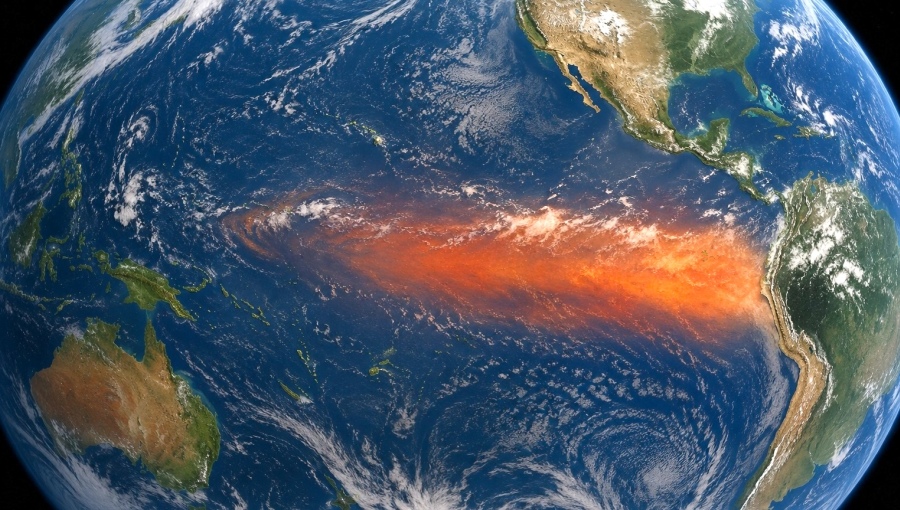
Western Europe's temperature distribution has shifted so far right that events once considered statistically near-impossible are now happening one year in seven, while the fastest-developing El Niño on record pushes ocean heat to new highs beneath it. / bne IntelliNews
[](https://www.facebook.com/bneIntelliNews) [](https://twitter.com/bneintellinews) [](https://www.linkedin.com/company/bneintellinews) [](https://t.me/bneintellinews) [](https://flipboard.com/@bneIntelliNews?utm%5Fcampaign=tools&utm%5Fmedium=follow&action=follow) [](https://feedly.com/i/subscription/feed/https://intellinews.com/feed)
By Ben Aris in Berlin July 27, 2026
This summer’s extreme temperatures have broken the normal “Bell curve” distribution of temperature variations and pushed it sharply to the right into record breaking highs. This is not normal – literally. That is the other name for the Bell curve: “the normal distribution.”
First you’ll need a quick maths lesson to understand why this news is so shocking. Bear with me. It’s not hard maths.
Originally developed by the famous German mathematician Carl Friedrich Gauss, who studied mortality, what the curve describes is a normal but random distribution around some event, like a person’s age at death. There is some average age, described by the peak at the middle of the curve, and likelihood of longer and shorter life spans are described by the shoulders of the curve left and right. At the extremes, the curve shows it's very unlikely to live a very short or long time before a person dies.
The key measurement for understanding what the shape of the curve means is to measure the “standard deviation”, how the numbers spread out from the middle.
Put simply, one standard deviation (known as a “sigma” in the trade) is nothing unusual at all. The curve is fat in the middle and around two thirds of all the results are in this part of the curve, so straying for the exact mean is no surprise at all. Moving out to two standard deviations and you capture 95% of all the results as the curve is still pretty fat, so that should not raise any eyebrows. But when you get to three sigmas from the middle, then you are into the territory where the curve has fallen by a lot. The number of results in that part of the curve only make up 4.3% of the results in a normal distribution.
And there is the rub: average temperatures this summer are six sigmas away from the historical middle of the curve. That is not only not normal, or even unlikely, it is an extraordinary crisis. In other words, this is the climatic equivalent of having a granny that just celebrated her 121st birthday.
Indeed, it is worse than that as it has never happened before. Scientists say this summer’s temperature range is now outside the range of historically recorded variants and the fast-developing super El Niño pushing global ocean heat to fresh records beneath it is to blame. This is the longest living granny in history.
Spilling out of the bell curve
"The summer that spilled out of the Bell curve: ancient climate statistics said it was impossible," wrote Spanish climate scientist Juan Jesus Gonzalez-Aleman, presenting standardised temperature anomaly data for Western Europe between May 15 and July 15.
Comparing three periods – the 1951-1980 baseline, the 1991-2020 climatology already shifted to the right, and 2026 – he found the entire distribution for this year has moved to around three standard deviations, with a tail extending beyond six sigmas.
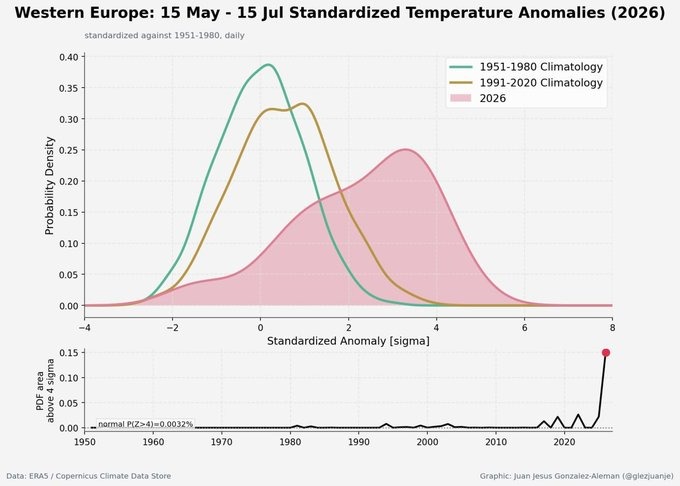
Western Europe standardised temperature anomalies, 15 May-15 Jul, 2026 vs historical climatology. Source: ERA5/Copernicus Climate Data Store, graphic by Juan Jesus Gonzalez-Aleman.
The most striking figure concerns the tail of the distribution. It’s much fatter than the front of the curve. One sure sign that a distribution is random is the left and right sides of the curve look the same. If the body of the curve is pushed to the left or right that is not random; something is driving it off base. In this case: the rapidly accelerating Climate Crisis.
Gonzalez-Aleman's data shows the share of readings exceeding four sigmas – a threshold that in a stable climate should occur with a probability of just 0.0032%, or roughly 1 in 30,000 – has historically been "practically zero" over 70 years of records. In 2026, around 15% of readings exceeded that threshold.
"We're no longer talking about a warmer-than-normal year," he said. "The climate has shifted to a range that the old statistics said shouldn't happen."
Oceans hit record heat as El Niño builds fast
As IntelliNews reported, this year is witnessing a historically hot El Niño, a climatic phenomenon that heats the seas in the Pacific Ocean up roughly every four years.
Underpinning the atmospheric extremes is an unusually rapid build-up of ocean heat. The Nino 3.4 index – the key measure of El Niño strength in the tropical Pacific – has now set a new record daily high for 55 consecutive days through July 23, running 0.74°C above any previous reading for that date, climate scientist Eliot Jacobson said.
"The Climate Casino is taking the Over on 3.6°C \[Zeke Hausfather's forecast\] and the Under on 4.3°C \[the CFSv2 model's forecast\]," he added, referring to competing predictions for how high the anomaly will peak.
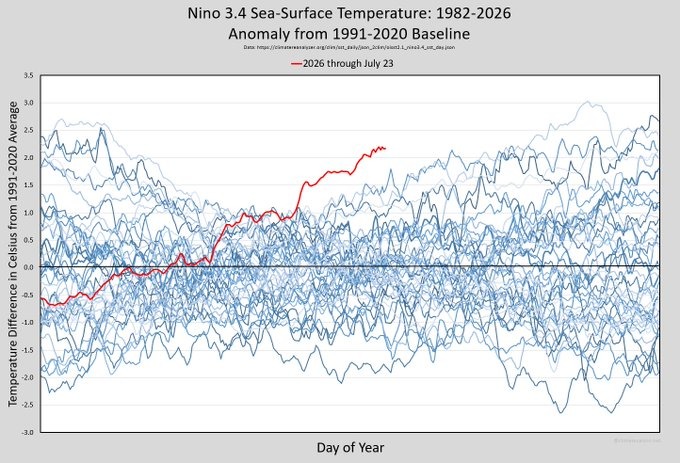
Nino 3.4 sea-surface temperature anomaly, 1982-2026, with 2026 shown in red through July 23.
After the Nino 3.4 index crossed the El Niño threshold of 0.5°C in April, it reached 1°C in May, 1.6°C in June and pushed above 2°C in early July – one of the fastest onsets on record. That is why this year’s El Niño has been dubbed “super.”
The world's oceans were already the hottest on record for June, according to independent European climate-monitoring services, even before the current acceleration. Model ensembles now put the event on track to become the strongest El Niño on record, with a median forecast of the Nino 3.4 anomaly peaking near 3.6°C later this year and some models pointing as high as 3.9-4.3°C – comfortably above the previous record El Niño of 2015-16.
The economic toll: grain losses top €2bn
Why is all this important? One of the things El Niño does is disrupt the weather. Hot ocean water causes air to rise and that is wind that then affects everything. It can cause storms and tornados in one part of the world, flooding deluges in another, and droughts somewhere else.
Crops are in the firing line, and the extraordinary heat is already showing up in Europe's harvest. A June heatwave wiped out more than €2bn worth of grain crops, with France and Hungary hit hardest, according to former NBU governor turned analyst Kyrylo Shevchenko. And this degradation of crops was before massive wildfires broke out in France and Spain that continue to rage out of control. Last year a record of more than one million hectares of land was burnt by wildfires; this year that record looks very likely to be broken again.
In the four weeks following the heatwave, EU and UK grain production forecasts were cut by nearly 9mn tonnes, as scorching temperatures struck wheat during its critical grain-filling stage across central and southern France, southern Germany, Austria, Poland and Hungary, with spring barley suffering even more damage than winter varieties.
That crop damage adds a fresh source of food-price inflation risk to an already strained European economy, layering an agricultural shock on top of the energy-market disruption caused by the wars in the Middle East and Ukraine. The closure of the Strait of Hormuz choked off one of the world’s major suppliers of fertiliser just as the planting season got underway that will reduce yields by as much as a third. And the escalating tit-for-tat missile war in Ukraine saw both Russian and Ukrainian ports shut down this week just ahead of the harvest season; between them the two warring countries account for a third of the world’s tradable grain.
And the disaster is not over. In fact it's only just getting underway as El Niño is expected to peak this autumn or spill over in to the beginning of next year when its temperature rises will reach their highest level.
Don’t just follow the news—understand it.
The IntelliNews PRO service includes access to reports, exclusive market data, and more news that decision-makers care about. Stay ahead of the market with IntelliNews PRO.
#REM #renewables #climatecrisis #ESG #bneGreen #BRICS #G7
Related Content

China's stalling car market masks a record global EV surge - IEA
Emerging-market ratings have absorbed the Iran war so far, but the buffers are thinning - Fitch
Number of people living in each city - OWID
China's stalling car market masks a record global EV surge - IEA
Emerging-market ratings have absorbed the Iran war so far, but the buffers are thinning - Fitch
Number of people living in each city - OWID
bneGREEN
Water shortages leave 40 villages in Iraq's Diyala facing severe drought
More than 40 villages south of Bahraz in Iraq's Diyala province face acute water shortages, forcing residents to rely on wells, as authorities push to dredge the Khrisan river before the next irrigation season.
Sunken Nazi warships resurface on Danube as Serbia's drought deepens
Dozens of Nazi-era warships, deliberately sunk in the Danube in 1944 to stop them falling into Red Army hands, have resurfaced near Prahovo in eastern Serbia as a summer drought pushes the river to some of its lowest levels on record.
China's stalling car market masks a record global EV surge - IEA
Global electric car sales rebounded sharply in the second quarter of 2026, rising 35% quarter-on-quarter to record levels in 50 countries, even as overall car sales fell around 5% y/y in the first half of the year on weaker demand in China and the US
Europe's worst wildfire season in years flags a global El Nino already moving commodity markets
Several European countries are having their worst wildfire year in more than a decade and worst than last year’s record wildfires that burnt over one million hectares, according to data from the EU's Global Wildfire Information System.
Wind and solar overtake fossil fuels in Germany for the first time ever
##
Water shortages leave 40 villages in Iraq's Diyala facing severe drought 4 hours ago
Sunken Nazi warships resurface on Danube as Serbia's drought deepens 8 hours ago
China's stalling car market masks a record global EV surge - IEA 8 hours ago
Wind and solar overtake fossil fuels in Germany for the first time ever 2 days ago
Cookies on the bne IntelliNews website
This site uses cookies - small text files that are placed on your machine to help the site provide a better user experience. In general, cookies are used to retain user preferences, store information for things like shopping carts, and provide anonymised tracking data to third party applications like Google Analytics. As a rule, cookies will make your browsing experience better. However, you may prefer to disable cookies on this site and on others. The most effective way to do this is to disable cookies in your browser. We suggest consulting the Help section of your browser or taking a look at the About Cookies website which offers guidance for all modern browsers.
- Close
- Full access to the bne daily content on the bne website
- Digital subscription to our monthly bne IntelliNews flagship magazine, delivered to your inbox
- Digital subscription to the "editor's picks" emails three times a week highlighting our best articles
- Full access to 10 years of bne archived articles
We use cookies to ensure that we give you the best experience on our website. If you continue we'll assume that you are happy to receive all cookies from this website. Accept View Cookie Policy

Dismiss
Register here to continue reading this article and 8 more for free or purchase 12 months full website access
Register to read the bne monthly magazine for free:
Subscribe to e-magazine
Subscribe to podcasts
Already registered
Google Captcha Failed!
Password could contain only a-z0-9\\+\*?\[^\]$(){}=!<>|:-\_ characters and have 8-20 symbols length.
Please complete your registration by confirming your email address.
A confirmation email has been sent to the email address you provided.
Remember me
Email field can't be empty.
No user with this email address.
A confirmation email has been sent to the email address you provided.
Access recovery request has expired, or you are using the wrong recovery token. Please, try again.
Access recover request has expired. Please, try again.
To continue viewing our content you need to complete the registration process.
Please look for an email that was sent to with the subject line "Confirmation bne IntelliNews access". This email will have instructions on how to complete registration process. Please check in your "Junk" folder in case this communication was misdirected in your email system.
If you have any questions please contact us at [\[email protected\]](https://www.intellinews.com/cdn-cgi/l/email-protection#b7c4d6dbd2c4f7ded9c3d2dbdbded9d2c0c499d4d8da)
Sorry, but you have used all your free articles fro this month for bne IntelliNews. Subscribe to continue reading for only $119 per year.
Your subscription includes:
bne IntelliNews
$119 per yearFor the meantime we are also offering a free subscription to bne's digital weekly newspaper to subscribers to the online package.
Click here for more subscription options, including to the print version of our flagship monthly magazine:
Take a trial to our premium daily news service aimed at professional investors that covers the 30 countries of emerging Europe:
For any other enquiries about our products or corporate discounts please contact us at [\[email protected\]](https://www.intellinews.com/cdn-cgi/l/email-protection#6a190b060f192a03041e0f060603040f1d1944090507)
If you no longer wish to receive our emails, unsubscribe here.
Magazine annual electronic subscription
Website & Archive annual subscription
Take a trial to our premium daily news service aimed at professional investors that covers the 30 countries of emerging Europe:
For any other enquiries about our products or corporate discounts please contact us at [\[email protected\]](https://www.intellinews.com/cdn-cgi/l/email-protection#addeccc1c8deedc4c3d9c8c1c1c4c3c8dade83cec2c0)