One shared memory layer for every AI tool you use
Loading
We’re LIVE on Product Hunt— support us with an upvote
One shared memory layer for every AI tool you use
Stop re-explaining yourself. Tell it once in Claude Code — it’s already there in Cursor, Codex, and every tool you connect. Automatically.
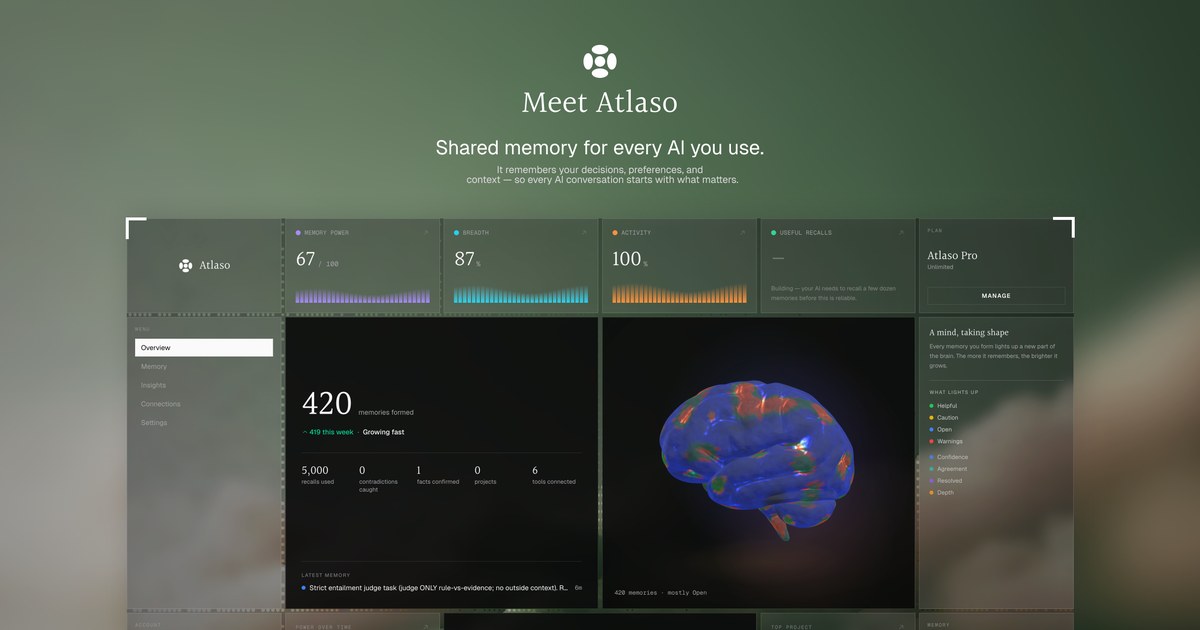
Atlaso is an AI memory layer: one persistent, shared memory that Claude Code, Cursor, Codex, Claude Desktop, OpenCode, and Antigravity read from and write to automatically.
macOSLinuxWindows
TerminalCopy
`$ curl -fsSL https://atlaso.ai/install.sh | bash`
Read the ResearchStart for Free

454567memories formed
Claude Code
›Team call — the launch moves from January to March.
Cursor
›When's the launch again?
CautionLaunch moved from January to March Claude Code
HelpfulSarah prefers async standups Cursor
HelpfulQ3 budget approved at $40k ChatGPT
OpenTwo suppliers still in the running Codex
WarningsOld pricing deck still in circulation Claude
HelpfulDemo day is the first Friday monthly Antigravity
Helpful
439%
Caution
26658%
Open
12427%
Warnings
245%
OverviewMemoryInsightsConnections
Memory maturity
Earlystage 1 / 4
84% agreement · 28 repeated facts · 2/5 conflicts resolved
Atlaso
Memory Power
81/100
Breadth
89%
Plan
Atlaso Pro
Manage
Menu
OverviewMemoryInsightsConnectionsSettings
457memories formed
↑ 101 this week · Growing fast
374 recalls · 27 contradictions · 28 facts confirmed
Latest memory
Launch moved from January to Marchjust now
457 memories · mostly Caution
A mind, taking shape
What lights up
Helpful
Caution
Open
Warnings
AAda Lovelace
Ambient MemoryExperimentalOff
81power
Search⌘K
Workbecomesmemory.
Anothertool.Samememory.
Everydetail,kept.
Sorted.Weighed.Structured.
Itknowswhat'ssettled.
Onememory.Everytool.

Works with your AI tools · + more coming
- Claude Code
- Cursor
- Codex
- Claude Desktop
 OpenCode
- Antigravity
- ChatGPTSoon
 Meta AISoon
- Claude Code
- Cursor
- Codex
- Claude Desktop
- OpenCode
- Antigravity
- ChatGPTSoon
- Meta AISoon
- Claude Code
- Cursor
- Codex
- Claude Desktop
- OpenCode
- Antigravity
- ChatGPTSoon
- Meta AISoon
- Claude Code
- Cursor
- Codex
- Claude Desktop
- OpenCode
- Antigravity
- ChatGPTSoon
- Meta AISoon
- Automatic capture as you work
- Decisions, watch-outs, and open threads
- Secrets scrubbed before anything is stored
- Automatic recall before each turn
- Picks up where you left off
- Zero setup, no pasting context
- One memory across every AI tool
- Personal and per-project memory
- Nothing trapped inside one app
- Every recall carries a verdict — settled, contested, or thin
- Contradictions flagged, superseded facts retired
- Grows more confident the more your work confirms it
The Problem
Today's AI starts from zero, forgets across tools, and trusts outdated facts.
Every session starts from zero, over and over
Close the tab and the context is gone. You re-explain your project, your preferences, and your decisions to the same tools, over and over.
What one tool learns, the next never sees
The context you build in one AI tool stays trapped there. Switch to another and you start over — every tool an island, blind to the rest.
Memory that piles up and goes stale
Systems that do remember tend to hoard everything — duplicates, dead tasks, facts you've long since changed — until recall is buried in noise and old answers resurface as if they were still true.
The Solution
Every AI tool you open already knows your context and picks up where you left off.
Capture
Your work quietly becomes memory
Monday, working with your AI, you settle a real decision: the launch moves to March — and the shortcut that burned you last quarter is a trap to avoid. You write nothing down. Atlaso captures both as you work — decisions, watch-outs, open questions — with secrets scrubbed before anything is stored.
Claude CodeChatGPTCursor
›Team call — the launch moves from January to March.
›For the client portal: password \= Zk4mQ92vvB\[REDACTED\]
›ok thanks, sounds good!
›Never invoice Acme before the PO clears.
Worth keeping ✓Secrets scrubbed ✓Saved ✓
Chatter — not worth keeping ✗
CautionLaunch moved from January to MarchClaude Code
HelpfulClient portal password = \[REDACTED\]ChatGPT
CautionNever invoice Acme before the PO clearsCursor
Synced in background ✓ — never blocks your turn
Work becomes memory.
Recall
Your AI walks in already knowing your context
Tuesday, a fresh session. Before your first prompt reaches the model, Atlaso has already recalled what matters — yesterday's launch decision, the trap you flagged, the question you left open — and placed it in context. No re-explaining, no cold starts.
Codex
›When's the launch again?
March — you moved it from January on Monday.
Searching memory — keyword + semantic
2 relevant · ranked
Injected — before the model sees your prompt
Launch moved from January to March0.86
Demo day is the first Friday monthly0.58
Old pricing deck still in circulation0.41Below floor 0.5 — not injected
\=== ATLASO MEMORY ===
Recalled notes from prior sessions.
\- Launch moved from January to March \[project\]
\- Demo day is the first Friday monthly \[personal\]
\=== END ATLASO MEMORY ===
Another tool. Same memory.
One Memory
What one tool learns, every tool remembers
Thursday, you open a different AI tool. It already knows — the decision travelled with you, because memory lives with your account, not inside any single app. Personal memory follows you everywhere; each project's memory stays cleanly isolated.
Claude Code
project · website
Launch → March\[personal\]
Portal password = \[REDACTED\]\[project\]
Session end — syncingSession start — pulling
Cursor
project · website
Launch → March\[personal\]
Portal password = \[REDACTED\]\[project\]
Session end — syncingSession start — pulling
OpenCode
project · mobile-app
Launch → March\[personal\]
Different project — not visible ✗
Session end — syncingSession start — pulling
Your memoryone store per account
sync · seq 1042 → 1043sync · seq 1043 → 1044
One memory. Every tool.
Confidence
It knows what it knows — and what's changed
Months later, plans change — the launch moves again. Atlaso doesn't let the two versions quietly coexist: the contradiction is flagged, the outdated decision retired, and every memory graded by the evidence behind it — so your AI acts on what's settled today, never on what used to be true.
Memory check · the launch date
CautionLaunch moves to May — decided with the team×1
CautionLaunch moves to MarchSuperseded×1×2
\+ confirmed again in a later session
May
March
freshness weight · half-life 14 days · supersede line 0.5day 0day 9day 16
Verdict — carried with every recall
·Thin — one note. Treat as a lead, not a settled finding.
✓Settled — memories agree. Safe to act on.
⚠Contested — memories disagree. Read both sides before using.
✓Settled — launch moves to May. Superseded memory retired.
It knows what’s settled.
Free plan — pick one tool
Claude Code
Claude Desktop
Codex
Cursor
OpenCode
Antigravity
TerminalClaude Code
$curl \-fsSL https://atlaso.ai/install.sh | bash
Atlaso — authorize this device:
https://app.atlaso.ai/connect
Waiting for approval…
Atlaso connected ✓
›Where did we leave off?
\=== ATLASO MEMORY ===
\- Launch moved from January to March \[project\]
\=== END ATLASO MEMORY ===
Picking up the March launch — pricing page was next.
app.atlaso.ai/connect
Claude Code wants to connect
Connect Claude Code on this device to your Atlaso account:
MacBook Pro — this device
Installs into Claude Code
HooksMCP serverSkill
CancelAuthorize
Device connected — returning to your terminal
Session start — sync runs in background ✓
Every prompt — recall before the model sees it
Every turn — captured · scrubbed · saved ✓
Where should memory live?
One paste. One click.
Atlaso is remembering for you now.
How It Works
Up and running in three simple steps
Pick your tool01
Choose where your memory should live — Claude Code, Cursor, Codex, Claude Desktop, and more.
Connect it02
Run the install command below and click authorize — or paste the connector URL if your tool has no terminal. About a minute — no config, no API keys to wrangle.
Just work03
That's it. Atlaso captures as you work and recalls what matters before every turn — automatically, across every tool you connected. Nothing to manage.
macOSLinuxWindows
TerminalCopy
`$ curl -fsSL https://atlaso.ai/install.sh | bash`
Benchmarks
Strong numbers. But benchmarks don't tell the whole story.
92%
Evidence recall on LongMemEval-S
67%
QA accuracy, full-haystack
6%No memory56%Keyword search69%Atlaso semantic
A score can't feel like your AI finally remembering you
We test the real shipped engine on LongMemEval-S — 115k-token haystacks, all six question types, an independent judge. The numbers are strong. But a benchmark is a checkpoint, not the point. The real proof shows up in your everyday work, when the right context is just there.
Read the four-judge benchmark: Atlaso vs mem0 on LongMemEval-S
95%
Hit@k — the right memory surfaced
LongMemEval-S · n=100 · full-haystack · judge: Claude Haiku 4.5 · reader: Qwen 3.5-9B. Headline stats measured through the shipped product path; the chart is our retrieval ablation in the research harness (55.9% → 69.2% with semantic retrieval on).
Capabilities
A complete memory layer — organized, private, and always improving.
Personal
web/
api/
mobile/
personal follows you · project stays home
Two kinds of memory
A personal memory that follows you across every tool, plus per-project memory that stays locked to its repo — no context bleeding between projects.
The back of your mind · session start
•Circling launch scope all week
•NEXT — wire the Stripe webhook
•RECENT — 3 notes since Tuesday
•OPEN — pricing — monthly vs annual
›
Ambient Memory
Pro
Start every session already oriented: where you were heading, what's new, and what's still unsettled — before you type a word.
Raw
“we switched to bun”
Uses bun, not npm
HelpfulSeen#tooling
npm is the package managerSuperseded
runs nightly · while you sleep
Background enrichment
Pro
Overnight, a background worker distills raw captures into clean, structured memories — tagged, graded, deduped — so recall keeps getting sharper.
Memory Power
81/ 100Strong, and compounding
Prefers TypeScript strictNotedSeenConfirmedVerified
2 contradictions caught · 28 facts confirmed
Power over time
every session compounds
Your memory, visible
See, search, and manage every memory in one dashboard — with a live Memory Power score, contradictions caught, and a clear next move.
DATABASE\_PASSWORD=hunter2
DATABASE\_PASSWORD=\[REDACTED\]
AKIA2F4WXKPLQ9TR8MDN
\[REDACTED:aws\_access\_key\]
scrubbed before anything is saved ✓
Yours to control
Export JSONProForget any memory
never trained on · never sold
Private by design
Secrets scrubbed before anything is saved, never trained on or sold — and you can delete any memory whenever you want.
Industry
These tools aren't just for code anymore. Neither is your memory.
Claude Code, Codex, and the rest started as coding tools — but people now run whole working lives through them: analysis, marketing, research, operations. Whatever you use them for, Atlaso remembers it.
Software & Engineering
Your AI remembers the codebase, the decisions, and the conventions across every tool — so it never re-learns your project from scratch.
Finance
Your models, positions, and past analysis stay in the AI you plan with — so it reasons from your real numbers, not a fresh guess each session.
Healthcare & Life Sciences
Clinicians and researchers keep protocols, guidelines, and prior findings intact — privacy-first, with secrets scrubbed before anything is stored.
Legal
Case facts, precedents, and client history stay in memory — so your AI can advise the next step with the whole matter in view.
Research & Education
Sources, experiments, and coursework build up over time — turning every new session into a continuation, not a restart.
Sales & Support
Every account, deal, and past conversation is remembered — so your AI walks into each one already knowing the customer.
Privacy & Security
Private by design, not by promise.
Your memory is some of the most sensitive data you have. We treat it that way — with sensible defaults, real controls, and no fine print.
Encrypted in transit & at rest
TLS everywhere, and your data is encrypted at rest by our infrastructure providers. Access tokens are stored only as hashes.
Never trained on, never sold
We don't train AI models on your memory or sell it. On the free plan, your memory is never sent to any LLM at all.
Yours to control
Secrets are scrubbed before storage, each project's memory stays isolated, and you can delete any memory — or your whole account — whenever you want.
FAQs
Have questions? Find answers.
Have more questions?
Reach out to our friendly support team
What is Atlaso?
Atlaso is an AI memory layer for the tools you already use. Connect it once. Atlaso then recalls the context that matters before each turn and captures the durable facts after — so your AI remembers your decisions, your preferences, and where you left off, in every tool.
Which AI tools does Atlaso work with?
Atlaso works with Claude Code, Cursor, Codex, Claude Desktop, OpenCode, and Antigravity, with more on the way. Anything else that speaks MCP can connect too. Your memory is shared across all of them, so what one tool learns, the others already know.
How do I install Atlaso?
One command. Paste it into your terminal and Atlaso installs, then opens your browser to link the machine — creating your account if you don't have one. Atlaso then sets up each AI tool you pick. No config files, no API keys. No terminal? Add Atlaso as a connector instead.
How is Atlaso different from the memory built into ChatGPT or Cursor?
Built-in memory lives inside a single app, is usually a black box, and doesn't travel. Atlaso is one memory across all your tools that you can see, search, and manage. Every recall also carries a verdict on whether a memory is settled or contested, so your AI isn't acting on shaky context.
Do I have to change how I work?
No. Once a tool is connected, Atlaso works automatically in the background — recall before each turn, capture after — with no new commands to learn. If Atlaso ever hits an error it fails silently, and your tool keeps working as normal.
Is my data private with Atlaso?
Yes. Atlaso scrubs secrets before anything is stored, and encrypts your data in transit and at rest. We never train AI models on your memory and never sell it. On the free plan your memory is never sent to any LLM. Delete any memory, or your whole account, whenever you want.
How much does Atlaso cost?
Atlaso is free for one device and one tool. Pro is $10 a month and unlocks unlimited devices and tools sharing one memory, plus Ambient Memory, background enrichment, Ask your memory, and JSON export. Build is $25 a month and adds a developer memory API. Cancel anytime.
Give your AI a memory today.
Connect Atlaso to the AI tools you already use and stop starting from zero. Free to start — no credit card required.