


The Untapped Potential of the Amazon’s Plastic-Eating Mushroom
The Untapped Potential of the Amazon’s Plastic-Eating Mushroom
by Trevor Greene Americas Sep 7th 20226 mins
Donate
Earth.Org is powered by over 150 contributing writers
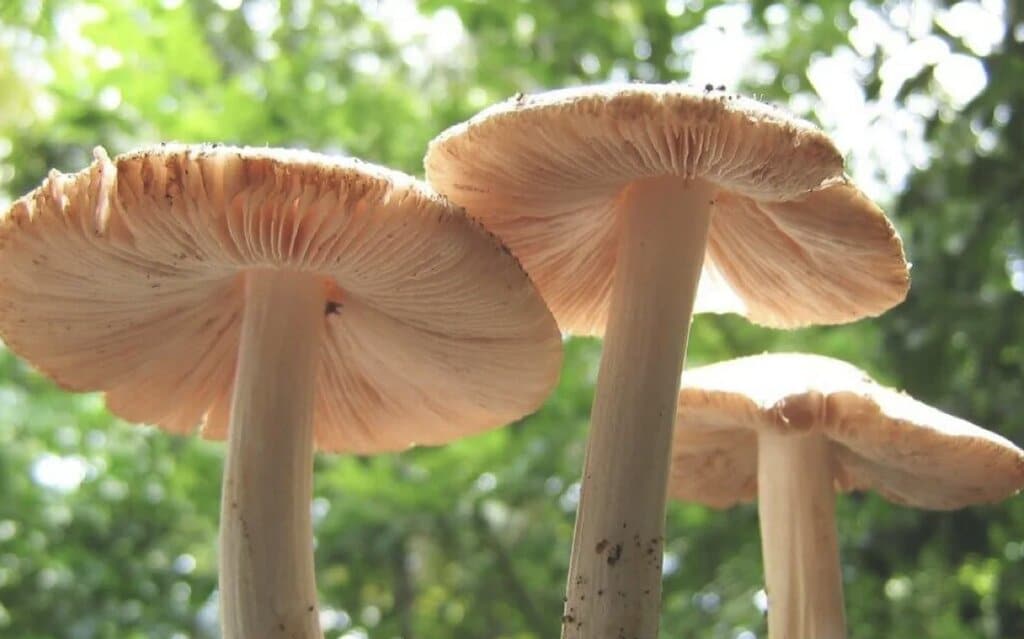
Long before there were trees, the Earth was overrun by giant mushrooms. Fungi first showed up over a billion years ago as three-metre-tall fungus fingers that dominated the landscape, while plants have been around for a paltry 700 million years debuting as scruffy shrubs. A billion or so years on, the humble ‘shroom is an unlikely champion in the war against plastic waste thanks to the discovery of a plastic-eating mushroom.
—
The Marvellous Plastic-Eating Mushroom
In the 100 years since it was invented, plastic has gone from being a wondrous time-saving material to a modern-day scourge, clogging our landfills, killing marine life and swirling around our oceans in massive garbage gyres the size of countries. When Yale University students found Pestalotiopsis in the rainforests of Ecuador in 2011, they discovered the first fungus that not only has a voracious appetite for plastic but can thrive in oxygen-starved environments like landfills. They taste good too.
Austrian designer Katharina Unger teamed up with scientists from Holland’s Utrecht University to develop the Fungi Mutarium, which uses pods of agar gelatine that nourish the fungus with sugars and starch until UV-treated plastic is stuffed into the middle. It takes a few months for the fungus to fully digest the plastic, leaving a puffy, mushroom-like cup with a sweet taste and a liquorice smell_._ Scientists foresee households owning a smaller-scale version to recycle their plastic waste and community recycling centres with larger systems.
The root system of mushrooms, mycelia, is intricate and can extend for kilometres. The largest living thing on Earth is the mycelial network of a honey mushroom fungus in Oregon in the US that covers 8.8 square kilometres just inches below the forest floor and estimated to be around 2,400 years old. Every autumn, the ‘Humongous Fungus’ pops hundreds of clusters of beautiful honey-yellow mushrooms from the forest floor. Over 90% of plants are intertwined with mycelial networks that are intimately woven into their whole lifecycle. Symbiotic fungi can even link plants into an intricate network known as the “wood-wide web,” which shares water and nutrients. Plants in turn ‘feed’ carbohydrates to fungi.
Using Mushroom as a Plastic Alternative
In the 1967 smash hit The Graduate, Dustin Hoffman’s 21-year old college grad Benjamin is cornered at his graduation party by a well-meaning friend of his parents who offers advice on a future career with just one word: plastics. Ironically, nowadays, that word could well be mushrooms. In March 2021, British fashion designer Stella McCartney debuted a black ‘leather’ bustier top and trousers made with mycelium. But McCartney isn’t the only designer making clothes from mushroom fibre. Big brands like Adidas, Lululemon and Hermés have announced that they will be debuting clothing lines made from mycelium, a more palatable leather alternative than the infamous ‘pleather’ derived from plastic.
Mushrooms are also being grown as alternative building materials in Seattle. The duo Eben Bayer and Gavin McIntyre are making mushroom material a multi-purpose, mainstream product. After earning degrees in mechanical engineering and product design in 2007, the pair came up with a new process for binding particles using mushrooms. That year, they founded a company called Evocative Design, and soon after the then-26-year olds brought out flip-flops that are 100% biodegradable. They followed with Greensulate, an organic, fire-resistant board made of water, flour, oyster mushroom spores and a mineral called Perlite. Bayer and McIntyre say the product will be as good as most insulation brands out there because it is as fire-resistant as commercial fibreglass insulation. The company calls its growth process ‘programmable biology.’ In a week to 10 days, miles of thin, super-grippy mushroom fibre are grown that can be moulded into nearly any shape. “The products literally grow themselves. In the dark. With little to no human contact,” says McIntyre. Evocative Design has even taken a new turn on meat substitutes by growing slabs of mycelium, which can be cut into bacon.
You might also like: Plastic Eating Bacteria: A Viable Solution to the Plastic Problem?
The Untapped Potentials of Mushrooms
Mushrooms can even replace nasty herbicides. Irish botanist Brian Murphy discovered in 2015 that growing little-known fungi called endophytes inside plants helps defend them against disease but doesn’t damage the plants. Instead of buying seeds coated in an insecticide containing neonicotinoids, which decimates bee colonies, farmers would buy seeds containing endophyte spores, which would then make their way inside the crop and bolster tolerance to drought, insects and pathogens, a technique called ‘bio-priming’. The discovery is a boon to farmers who are battling herbicide-resistant pathogens. Endophytes also help plants grow in inhospitable conditions where few organisms can survive. The endophytes have been tested at the Athabasca oil sands, Antarctica and at 21,000 feet on Mount Everest.
The original mushroom entrepreneur, Paul Stamets, is an unlikely expert. He started his career in the forest as a logger, not a scientist. In his ground-breaking book Mycelium Running, Stamets writes lyrically about his passion, describing mycelium as “the neurological network of nature,” a “sentient membrane” that has “the long-term health of the host environment in mind.” In 1980, he founded a company called Fungi Perfecti that sells mushroom products and develops applications of mushrooms for environmental remediation. In 1997, Stamets had a hunch that mushrooms could soak up oil, so he teamed up with Washington state researchers to conduct experiments using mushrooms to break down diesel-contaminated soil. They found that after two months, the mushrooms had removed 97% of a heavy chemical that other methods had consistently failed to break down. After the 1986 Chernobyl accident, researchers were astounded to discover some species of fungi that thrive on radioactive particles. “It’s damaging to plant and animal tissues but these fungi somehow capture it \[uranium\] like plants capture sunlight and use it to power their metabolism,” wrote Jim Wells in Sound Consumer. When the Deepwater Horizon oil spill coated the Gulf of Mexico, Stamets designed fully biodegradable ‘mycobooms’ made of hemp, a rot-resistant natural fibre in seawater environments. The booms were filled with straw and mycelium to absorb and digest oil on the ocean surface.
You might also like: Top Sustainable Food Packaging Companies to Support
Plastic-Eating Mushroom and Ecuador’s Development Dilemma
Back in Ecuador, the plastic-eating mushroom defines that country’s development dilemma. Caught between the Scylla of wholesale rainforest destruction for oil wealth and the Charybdis of endless generations of grinding poverty for preserving the rainforest for free, Ecuador’s leaders have only been able to look on impotently as wealthy Western corporations, especially pharmaceuticals, make billions from products derived from the Amazon. In 2007, then-President Rafael Correa tried to monetise Amazon preservation with a unique and ambitious plan to persuade rich countries to pay Ecuador for a moratorium on oil exploration in the remote Yasuni National Park, which was declared a world biosphere reserve by the UN in 1989. Correa had sought USD$3.6 billion in contributions, half the estimated $7.2 billion in proven reserves in the park. But he lifted the moratorium in 2013 after Ecuador had raised just $13 million.
The lure of oil wealth in Ecuador divided two sisters who were inseparable as children in the remote community of Sana Isla on Ecuador’s Napo River. Three generations ago, the Kishwa tribe of Sana Isla were still using blowpipes and had only recently made contact with the outside world. The tiny community is in one of the most biodiverse places on Earth. Scientists say a single hectare in this part of the Amazon at the intersection of the Andes, Equator and the Amazon basin contains a wider variety of life than in all of North America, including the plastic-eating mushroom Pestalotiopsis microspor. But underneath all that life lies close to a billion barrels of oil. When Ecuador’s biggest oil company, Petroamazonas, made an offer in 2011 to start seismic surveys in their homeland, Blanca Tapuy and her sister Innes were at loggerheads over the offer, with Blanca saying she is willing to die to stop its progress and Innes passionately asserting that petrodollars are vital for the future of the community. The company eventually backed down in the face of bitter opposition.
American oil giant Texaco arrived in Ecuador in 1964. When it left nearly 30 years later after being bought by Chevron, it had pumped 1.5 billion barrels of oil from Ecuador but left behind what came to be known as the ‘Amazon Chernobyl’, a 1,700-square-mile environmental disaster zone where it admitted to dumping 72 billion litres of toxic water which invariably ended up in the water supply, and gouging 1,000 unlined waste pits out of the jungle floor. Incredibly, Chevron lost the inevitable lawsuit and assembled a team of 2,000 lawyers to ferociously appeal the $9.5 billion penalty, vowing “…to fight until hell freezes over, and then we’re going to fight it out on the ice.”
While the legal combat raged, cancer rates skyrocketed and thousands of hectares of unspoiled ground have been poisoned, threatening the nearly 4,000 kinds of plants documented around Sana Isla, including Ecuador’s wondrous plastic-eating mushroom.
You might also like: 10 Scientific Solutions to Plastic Pollution
Tagged: Fungi
About the Author
#### Trevor Greene
Trevor Greene is a journalist, best-selling author and Afghan War veteran. He was serving with the Canadian Army in Kandahar in 2006 when he suffered a severe brain injury in an axe attack. He has written six books, starting in 2001 with Bad Date; The Lost Girls of Vancouver’s Low Track, the story of the missing prostitutes of the Downtown Eastside. His bestselling memoir, March Forth, was published in 2010 by HarperCollins. He is working on a second edition of his most recent book, There is no Planet B; Promise and Peril on Our Warming World, covers the good and bad aspects of the climate crisis. Greene lives in British Columbia with his wife, son and daughter. [](mailto:)
You Might Also Like
Climate Change Guides Solutions
12 Pros & Cons of Hydroponic Farming
Feb 12th 20237 mins
Top 7 Smart Cities in the World in 2024
Mar 5th 20245 mins
Unleashing the Power of Cloud Seeding: Navigating Potentials and Pitfalls
Apr 18th 20246 mins
163063
Subscribe to our newsletters
The best environmental stories of the week and month, handpicked by our Editor. Make sure you're on top of what's new in the climate.
Donate to Earth.Org If you like what we do – and what we stand for – please support us with a donation so we can grow our impact.
- Donate $5 Now and help keep EO alive
- Donate $5 every month – makes a real difference
Donate $5 NowDonate $5 Every Month
X
Keep freshly informed
Get the best of Earth.Org Get focused newsletters especially designed to be concise and easy to digest. Subscribe
X
Cookie Consent
We use cookies to improve your experience on our site. By using our site, you consent to cookies.
Powered by (opens in a new window)
Manage your cookie preferences below:
Essential cookies enable basic functions and are necessary for the proper function of the website.
Cookie Preferences
This cookie is used to store the user's cookie consent preferences.
30 days
Google Tag Manager simplifies the management of marketing tags on your website without code changes.
cookiePreferences
Registers cookie preferences of a user
2 years
td
Registers statistical data on users' behaviour on the website. Used for internal analytics by the website operator.
session
Statistics cookies collect information anonymously. This information helps us understand how visitors use our website.
Google Analytics is a powerful tool that tracks and analyzes website traffic for informed marketing decisions.
Service URL: policies.google.com (opens in a new window)
\_\_utmx
Used to determine whether a user is included in an A / B or Multivariate test.
18 months
\_ga
ID used to identify users
2 years
\_gali
Used by Google Analytics to determine which links on a page are being clicked
30 seconds
\ga\
ID used to identify users
2 years
\_gid
ID used to identify users for 24 hours after last activity
24 hours
\_gat
Used to monitor number of Google Analytics server requests when using Google Tag Manager
1 minute
\gac\
Contains information related to marketing campaigns of the user. These are shared with Google AdWords / Google Ads when the Google Ads and Google Analytics accounts are linked together.
90 days
\_\_utma
ID used to identify users and sessions
2 years after last activity
\_\_utmt
Used to monitor number of Google Analytics server requests
10 minutes
\_\_utmb
Used to distinguish new sessions and visits. This cookie is set when the GA.js javascript library is loaded and there is no existing \_\_utmb cookie. The cookie is updated every time data is sent to the Google Analytics server.
30 minutes after last activity
\_\_utmc
Used only with old Urchin versions of Google Analytics and not with GA.js. Was used to distinguish between new sessions and visits at the end of a session.
End of session (browser)
\_\_utmz
Contains information about the traffic source or campaign that directed user to the website. The cookie is set when the GA.js javascript is loaded and updated when data is sent to the Google Anaytics server
6 months after last activity
\_\_utmv
Contains custom information set by the web developer via the \_setCustomVar method in Google Analytics. This cookie is updated every time new data is sent to the Google Analytics server.
2 years after last activity
You can find more information in our Cookie Policy and .
AcceptClose
Save and Close