Spotlight
Spotlight
One page per addition that a line on the releases page does not carry: what it is, screenshots of it running, and the video if there is one.
Written for someone who has not read the source. The running list of every change is releases; every video is the video log.
August 2026
Newest first.
Browser
My latest experiment
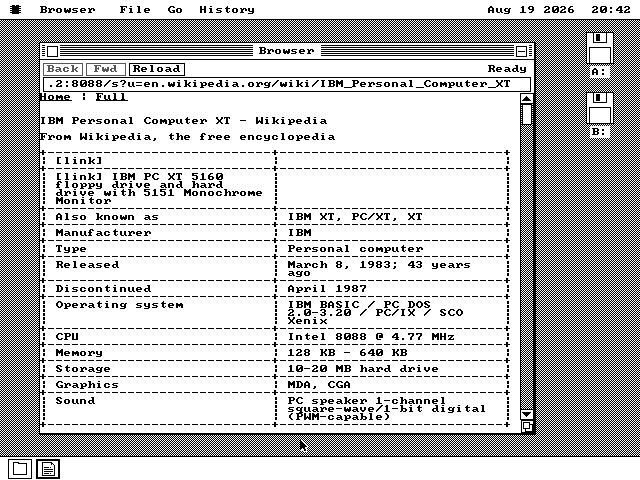
A web browser for the IBM PC XT
os8088 now fetches real web pages and lays them out as text and tables, over an Ethernet card or a parallel cable to a DOS machine standing next to it. The network is not the slow part: drawing a window full of text takes longer than fetching the page.
the browser13,889 bytes
the stackARP to TCP
machine4.77 MHz 8088
RunCPM
CP/M, in a window
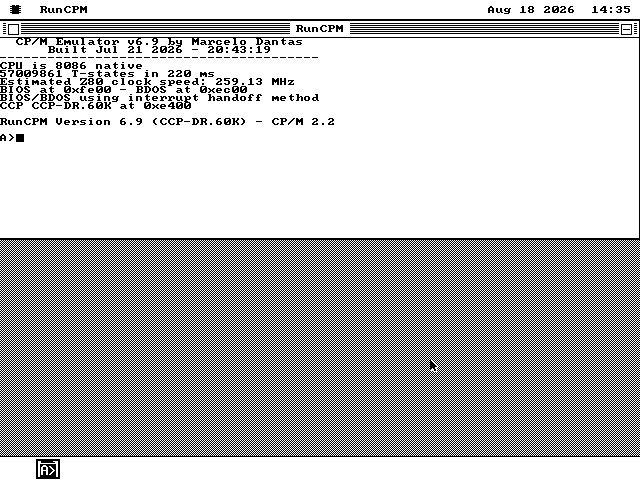
CP/M was the operating system small computers ran before the IBM PC existed, on a processor the PC does not have. os8088 now emulates that processor, so CP/M software runs here: the 1979 command processor at the prompt, Microsoft BASIC, an assembler and an editor, in a window you can drag around like any other.
emulatesa Zilog Z80
written in4,679 lines of C
machine4.77 MHz 8088
Written in C
A new program
A word processor written in C
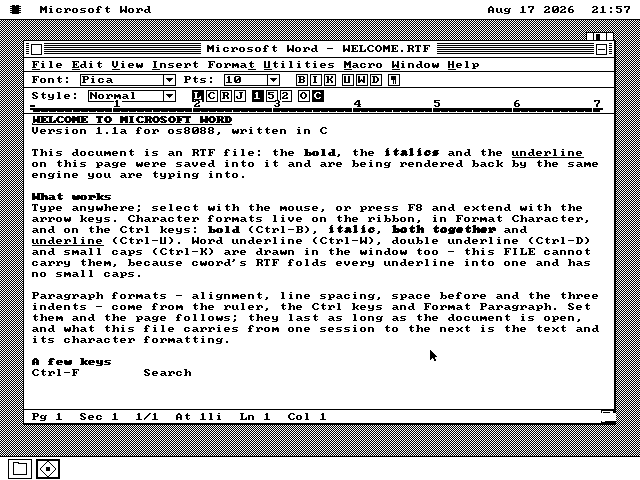
Everything in os8088 up to now was written in assembly language, one processor instruction at a time. There is now a C compiler for it, which is a far quicker way to write a program. To find out whether it could carry something real, I wrote a second word processor with it -- and it turned out too big for the memory a program gets, so it comes in two pieces.
written in8,350 lines of C
the program54,450 bytes
machine4.77 MHz 8088
Microsoft Word
A new program
Microsoft Word, on an 8086
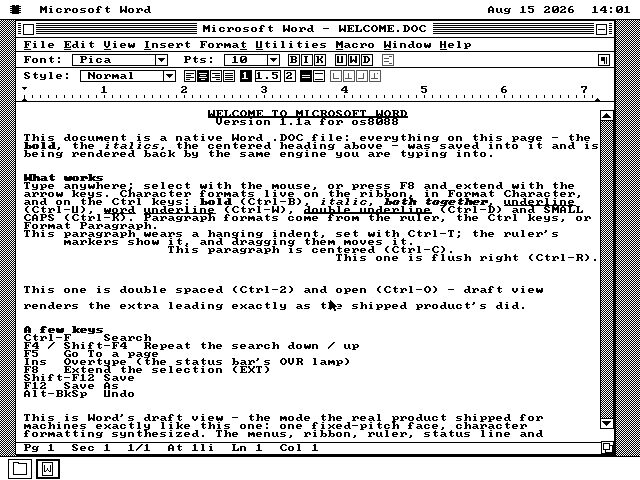
I have added something I have wanted to see for a while: my own os8088 version of Microsoft Word 1.1a. It has the familiar 1990 menus, uses the same clever tricks to show bold and italics on a plain old PC screen, and saves Word .DOC files. The whole program fits in 47KB.
the program47,212 bytes
savesWord .DOC files
machine4.77 MHz 8088
Two monitors
A new feature
Two monitors, one desktop
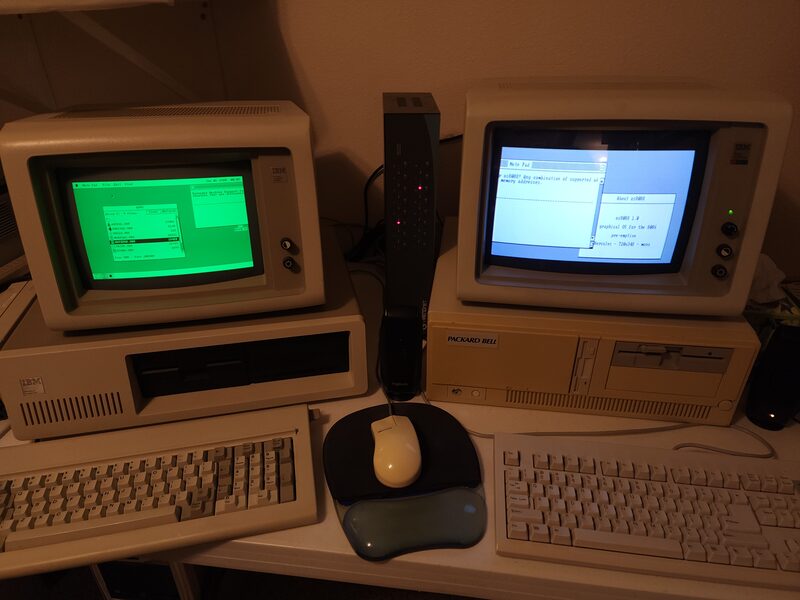
A PC of this era could hold a monochrome card and a colour card at once, because their picture memory sat at different addresses. Almost nothing used both together. os8088 now spans one desktop across the pair -- 1,360 pixels wide, on a 4.77 MHz machine -- and a window that lands over the join is drawn on both screens.
monitors2
one desktop1,360 x 348
machine4.77 MHz 8088
Frotz
A new program
os8088 plays Infocom games now
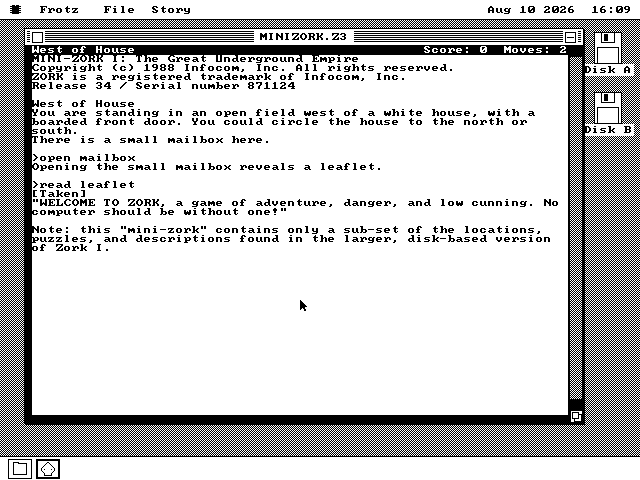
A Z-machine interpreter in 23,722 bytes of 8086 assembly. The Z-machine is the pretend computer Infocom invented in 1979 so one game could be sold for every machine at once -- which is why a story file from 1982 is still a plain file that still runs. Mini-Zork, Colossal Cave Adventure, Zork: The Undiscovered Underground and Photopia all play, off a floppy of their own.
the interpreter23,722 bytes
story formatsv1 to v8
games it fetches15