

When William Schneiderman and California Communists Defeated the Smith Act
Earlier this week I had an article published in Geese Magazine about the first Supreme Court trial of William Schneiderman, the chairman of the California Communist Party. I would heavily suggest giving it a read. It’s not only a fascinating story, it’s also useful reading for the article below. This article is something of an extended afterword to that article, taking the chance to explore William Schneiderman’s second Supreme Court Trial, in 1957, when he took on the Smith Act and the extended forces of Mccarythism.
---
William Schneiderman was the state chairman of the California Communist Party from 1937 to 1964. It was a position that brought him into two major legal disputes in the United States for his political views. In 1939 Schneiderman, who was originally born in pre-Soviet Russia and only naturalised as a US citizen in 1927, faced a battle to retain his citizenship against the US government. Schneiderman would eventually win that case in 1943, having taken it all the way to the Supreme Court. However, like many Communists in that time, Schneiderman remained entangled in legal matters. Between 1943 and 1953 he continued to follow the cases of his friend and colleague Harry Bridges, an Australian-born West Coast Labor leader who was targetted for deportation.1

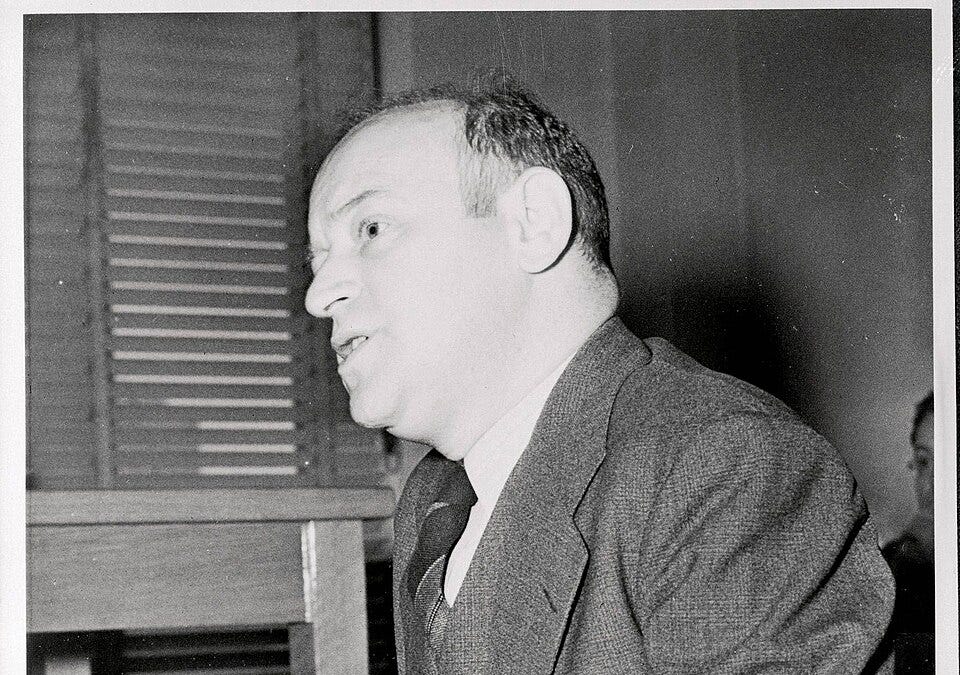
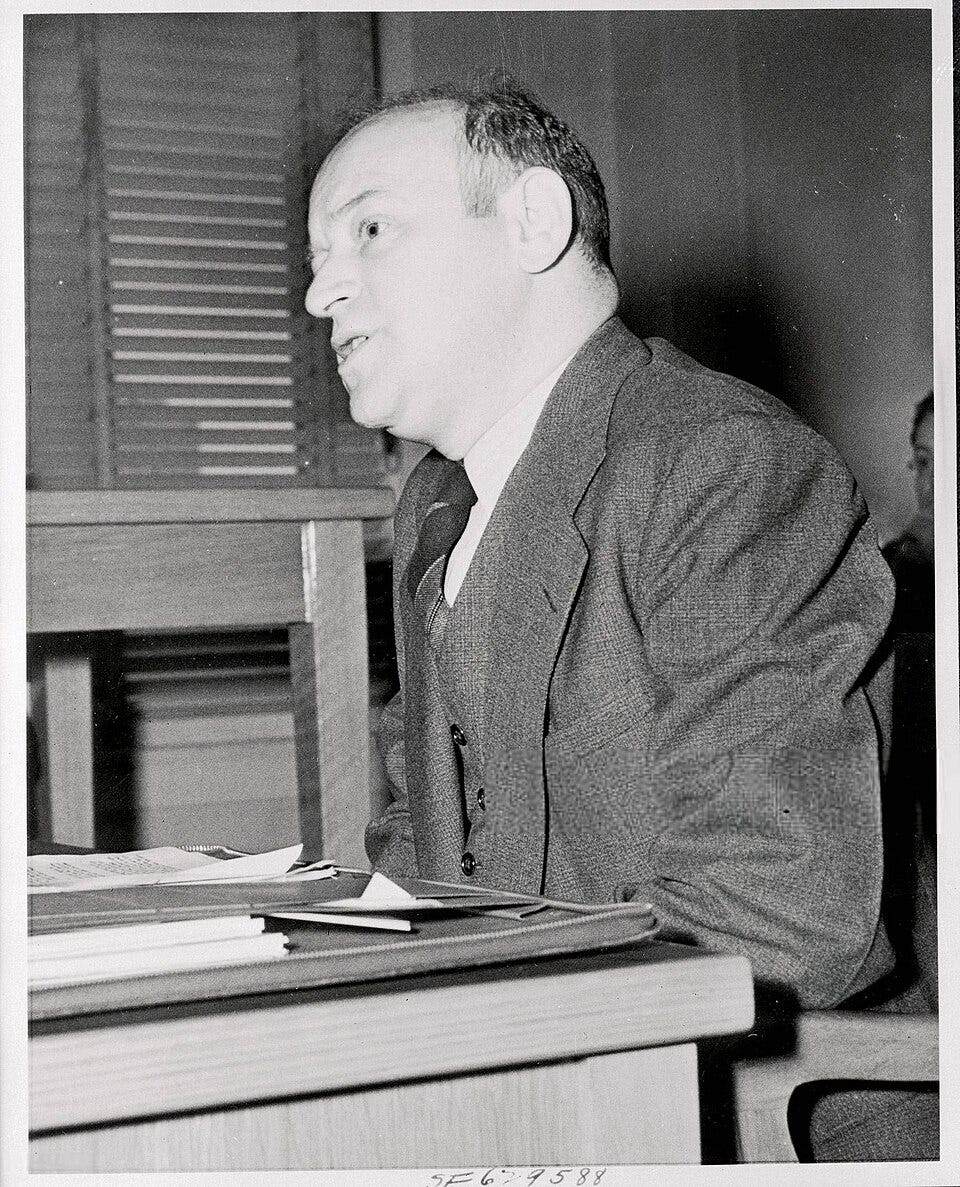
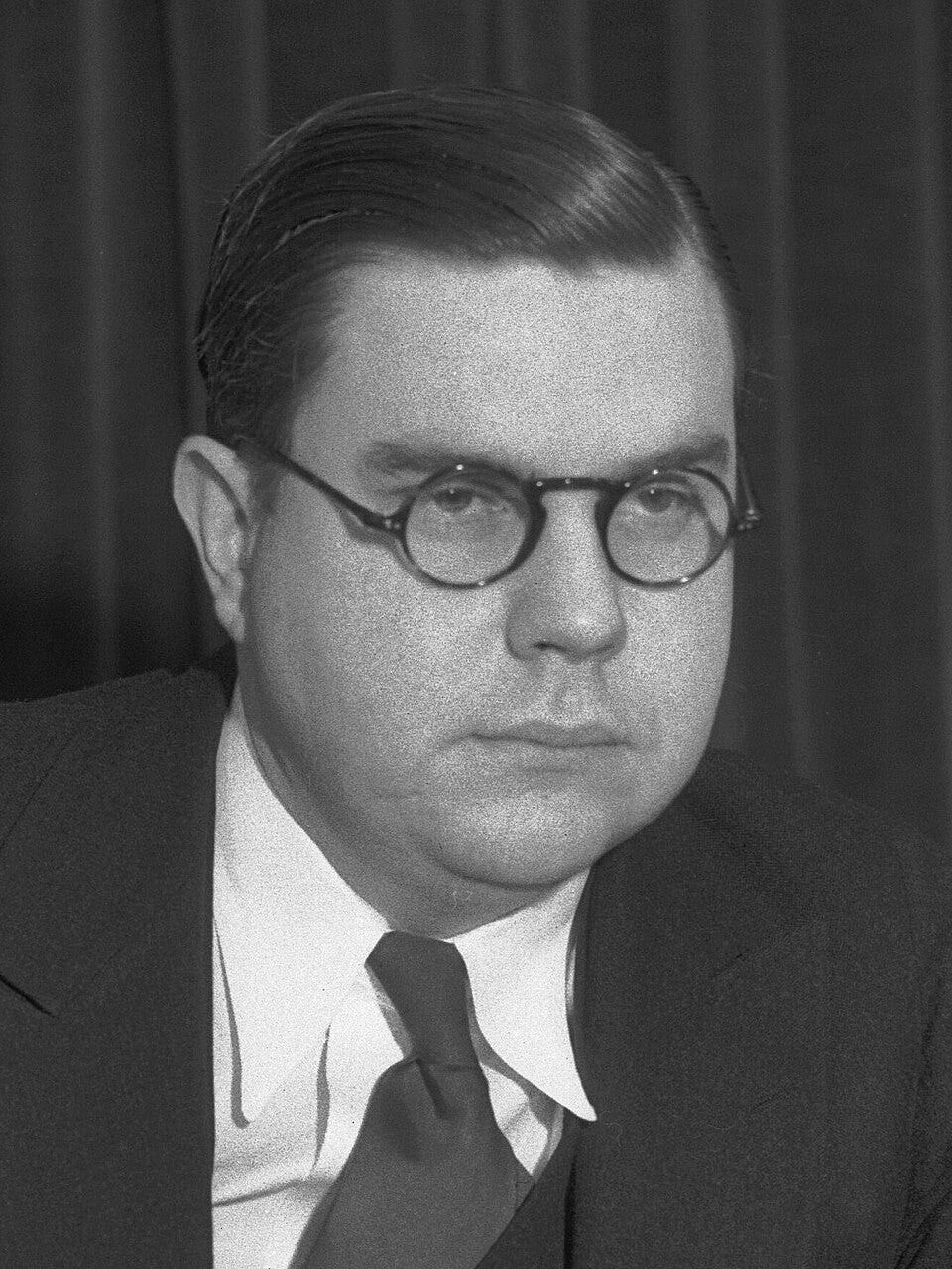
William Schneiderman on the witness stand during one of Harry Bridge’s deportation trials, Source: Wikimedia Commons.
Then, as his friend finally won before the Supreme Court, and earned his own right to become a US citizen, Schneiderman watched as another set of Communists, this time from the East Coast, were unable to defeat the US government’s prosecution that they, by being members of CPUSA, had conspired to overthrow the US government. The act that gave the US such powers to pursue that prosecution was implemented just after the US came after Schneiderman’s citizenship, but had wouldn’t be used to it’s full extent until the political environment became fertile for anticommunist fervor.
As Europe descended into a second major continental conflict in 25 years, the US was dealing with extensive internal debates about what to do about this new age of ideological violence and competition. While the nation’s population remained largely isolationist, leading both major party candidates to advocate at least cautious isolationism (even if the winning candidate, Franklin Roosevelt, was notably more favorable to intervention), the government was also looking to control the rise of movements associated with the European ideologies, in particular the pro-Nazi US-German Bund, and the Comintern aligned Communist Party of the United States (CPUSA). This led to the passage of the Smith Act, intended to be a simpler way for the US to target “internal enemies” and groups who plotted to overthrow the US government and constitution.2
By 1941, one year after its passage, the Smith Act use for targetting the US left was largely ignored because the Japanese attack at Pearl Harbor and the German invasion of the USSR made allies out of the United States and the Communist Soviet Union. This did not stop persectution of Communists in the United States (Schneiderman himself remained on trial throughout the height of US-Soviet collaboration), but it certainly slowed it, as geopolitics made such targettings difficult.3 But then, in 1945, a number of events conspired to once again threaten the left half of the New Deal’s historic left-liberal coalition.
First was the death of FDR, and the rise of a more conservative, Southern Democrat in his VP Harry Truman to replace him. Truman was significantly more anticommunist than FDR had been, and certainly less tactful in his handling of Joseph Stalin and US-Soviet relations. By 1948 Truman and the US were firmly in a cold war with the leading Communist state, and the trials like those of Julius and Ethel Rosenburg who were accused of sharing nuclear secrets with the Soviet Union began shifting the popular environment against Communism’s acceptability within American society.
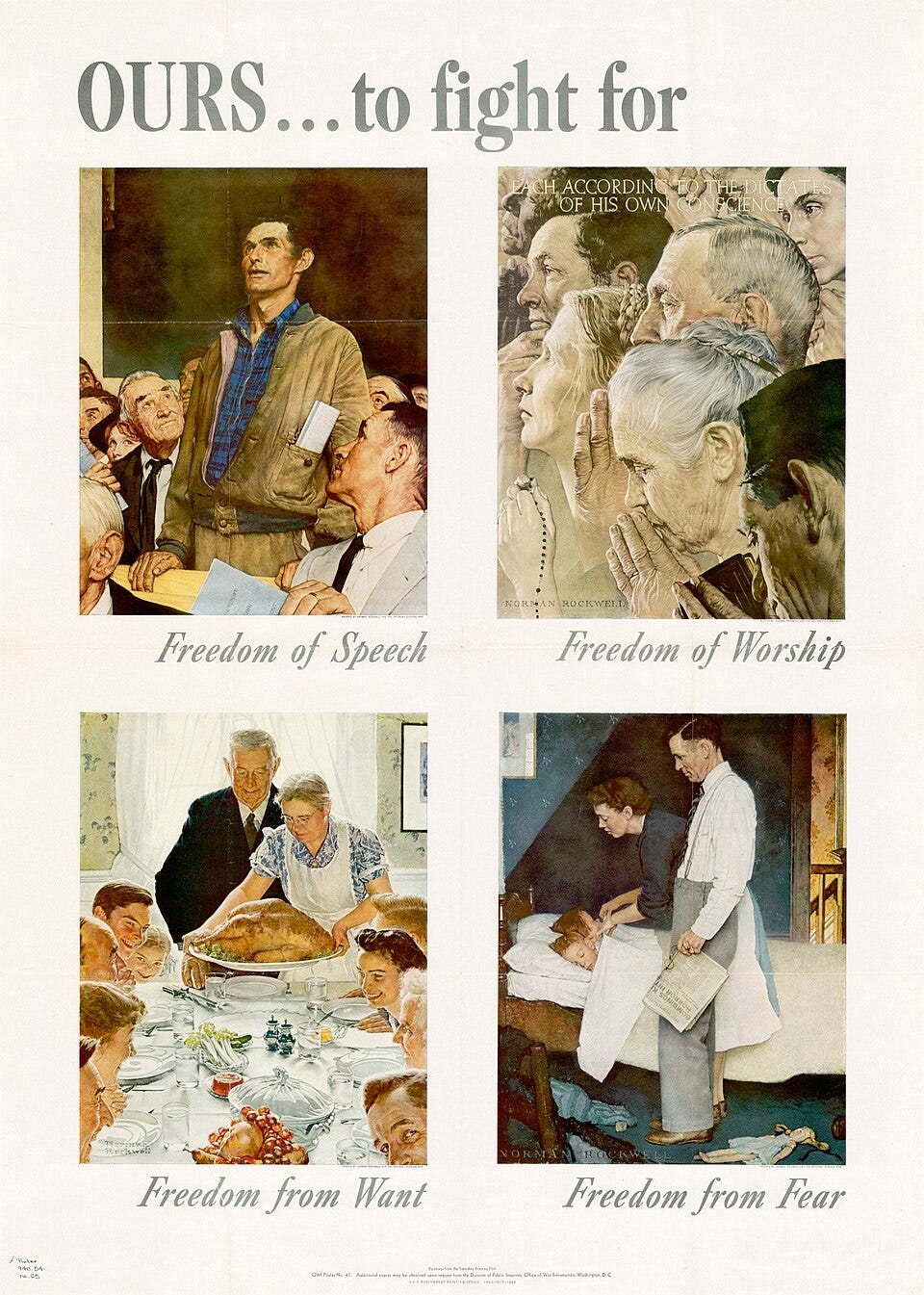
One thing Truman initially struggled with was popularity. When he took over from Roosevelt he got the obvious boost of being a wartime President, who oversaw the successful conclusion of the 2nd World War. However, he also inherited a government and party that had now held power for nearly 15 years, and that he struggled initially to inspire to a long term vision in the way Roosevelt’s post-war promise of a continued transformative Social Democratic state securing the “Four Freedoms” galvanized Americans.4

A Norman Rockwell Poster from 1943 displaying the intentions of Roosevelt’s Four Freedoms, Source: Office of War Information \[Wikimedia Commons\].
He also suffered from splits coming from progressive New Dealers, like Henry Wallace (who Truman just before the 1946 midterms removed from the cabinet and who would undertake a quixotic journey to a third party challenge in 1948) and saw losses both to traditional conservative Republicans, and more radical individuals to the New Dealer’s left such as Leo Isacson of the American Labor Party who secured a house seat at the Democrat’s expense in a 1948 special election. But the US left was not the one driving politics under the new Truman administration. 1946 was a wave year for Republicans which saw them gain control of the House for the first time since FDR won the trifecta in 1932. The House term of 1947-1949 would be among the most conservative in a generation, and forced through a number of conservative policies attacking the New Deal coalition that Truman was unable, or unwilling, to block.5 The most consequential was certainly the Taft-Hartley Act, which secured right-to-work policies at the state level and would wind up slowly crushing the labor movement over the next four decades. But perhaps the most damaging for the communist movement in the US was not a policy, an act, or a vote, it was a man, and a House committee.
Joseph McCarthy, a firebrand, populist judge in Wisconsin won the state’s 1946 senate race, defeating the Progressive Republican incumbent, Robert La Follette Jr in the primary, and easily dispatching the Democrat in the general. McCarthy as a new Senator spent his first years largely unnotable, but after Truman had secured a shock reelection, and anticommunism became a part of US foreign policy following the expansion of communist governments throughout Eastern Europe, China, and increasingly across the Korean peninsula, the apetite for an anticommunist firebrand seemingly increased.6
The House Un-American Activities Committee became a key outlet for this growing anticommunism, bringing thousands of accused Communists in the government, hollywood, and academia before the House to face condemnation and ostracisation for their membership in a fully legal political party in the United States. Mccarthy, despite being the namesake of the anticommunist ideology, was obviously never a member of the House, and handled most of his attacks on US communists through his Senate committee where he famously declared that he knew “men in the State Department who have been named as members of the Communist Party and members of a spy ring”.7
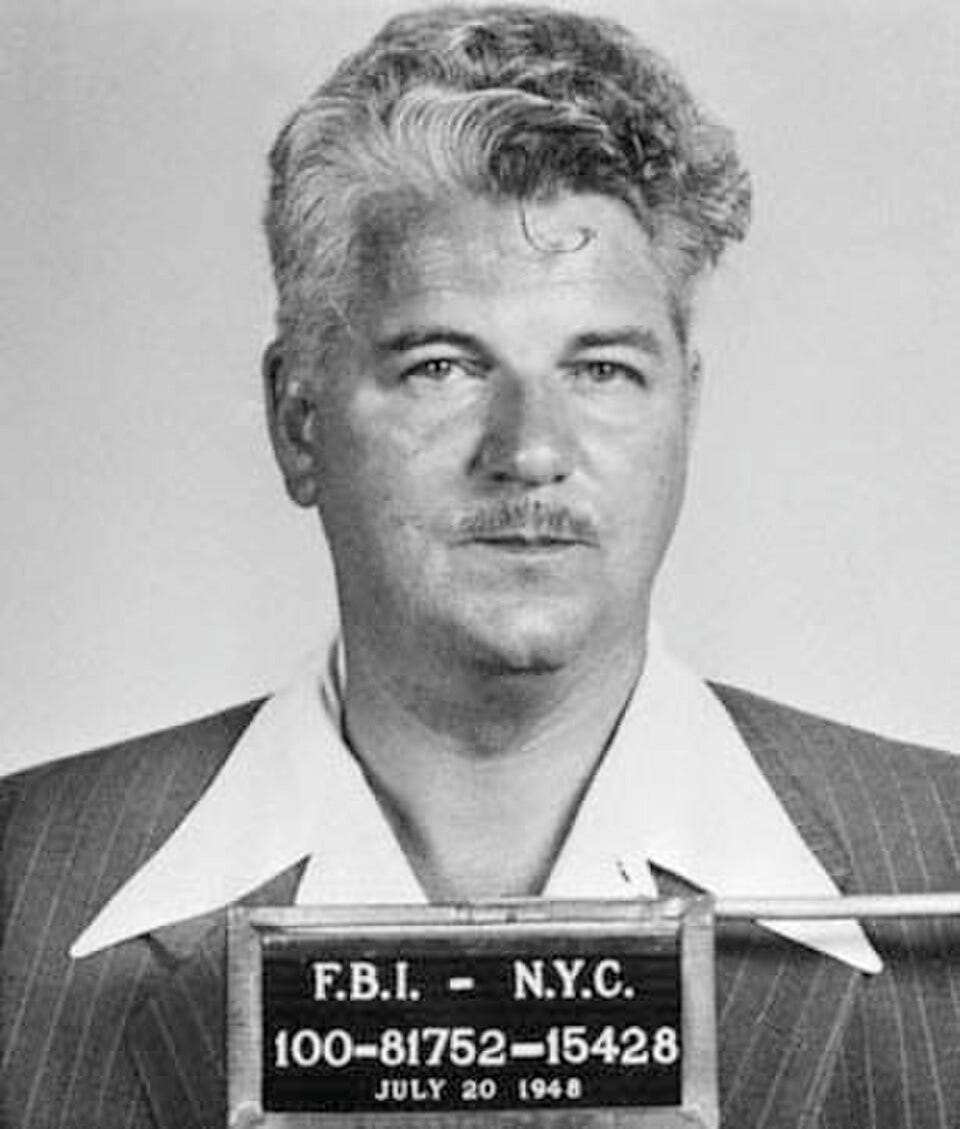
In 1948 11 of the leading CPUSA members, including the party’s General Secretary Eugene Dennis, were charged with violating the Smith Act, and advocating for the overthrow of the US government. The Government’s accusations were that the party’s belief in Communist values, and that Communist values themselves, were inherently subversive, and that in general the philosophy of the Communist movement was in violation of the Smith Act.
Subscribe
Faced with these accusations the 11 Communists decided that they would make their stand for Communism, and their first amendment rights by disputing not just in a legal manner, but by turning the trial itself into a competition of ideas. While the party hired 5 different lawyers to represent the eleven accused, Dennis chose to represent himself, and served as the Party liason to ensure the legal team followed the intended trial strategy of the Communist party. The prosecution focused on proving that Communism itself was a danger to US government by filing as evidence reams of Communist published literature, among them the Communist manifesto, as well as the works of Lenin and Stalin.8 The US did not rest on simply the literature informing Communist philosophy though, they also highlighted the Party’s newspaper, the Daily Worker, and relied on testimony from FBI informants, such as ex-communist Louis Budenz.9 Finally, to emphasize the threat the party posed to the nation and US system of government, the prosecution argued that a conspiracy to overthrow the government would need to be preemptively blocked given the apparent ease such a revolution could be carried out with:
“by placing disciplined Communists, who are subject to their direction, in the proper positions in industry, these defendants, when the time of national crisis is upon us, intend... to bring about the violent overthrow and destruction of the Government of the United States.”10

The FBI mugshot of CPUSA General Secretary Euguene Dennis, Source: FBI \[Wikimedia Commons\].
Meanwhile the defendants focused less on direct legal argumentation, and more on a direct political battle held through the courts.11 Their defense attorneys wanted judgement to focus on the nature of a political prosecution itself, rather than the merits of the case. This Harry Sacher made very clear in his closing statement, “I shan’t dwell at any length on the large significance which necessarily attaches in this country to a criminal trial of a political party. A criminal trial of a political party: just ponder that a moment.”12 The strategy may have been an important one for highlighting the attack this trial represented on civil rights, freedom of speech and freedom of opinion, but as a legal strategy historian Hayden Thorne has highlighted it was very poor, and therefore lost to a similarly weak government argument. After appealing their way up to the Supreme Court, the Communists were defeated 6-2 in 1951, with the court largely upholding that the Smith Act did not violate the First Amendment of the Constitution, and opened up the precedent for such prosecutions of CPUSA figures going forward. It was this precedent that would come for Schneiderman in 1951, when he, along with 14 other California Communist figures were charged with violating the Smith Act.
But their case would be different. For one the legal strategy was much more focused, narrow, and central on the goal of getting their clients freed, not winning a political battle through the court. For another, the case was taking place under a much different context. It is incorrect to say that during the years the trial was battled over, 1952-1957, the United States had overcome its anticommunist fervor, the word still served as something as a slur across the nation, but the movement of virulent domestic anticommunism was now fading. The leader of the anticommunist rage in Washington, McCarthy, had been censured for his attempt to bring the anticommunist battle into the realm of the US military in 1954, and would fade from relevance from there.13 Without him, much of the power of the Mccarthyite faction in Congress was diminshed, even if HUAC would continue their activities until the 1960s before finally being abolished in 1975.
Thanks for reading GreySidewalk! Please share this post and help us build GreySidewalk together.
Schneiderman, perhaps given his good showing in his citizenship cases back in the 1940s,14 was an eager participant in the California trial, which came before the Supreme Court as Yates v. U.S. and Stack v. Boyle. Schneiderman was the only one of the defendants to insist on defending himself, and took up something closer to the strategy of the Communists in Dennis v. U.S., but with a more confined, legally sound defence coming from the rest of the defendants and actual legal defence team. In particular, the witness testimony of defendant Oleta Yates was essential both for defending the beliefs of the party, and her brave refusal to implicate other members during strong cross-examination while on trial, in spite of numerous attempts to force her to divulge information with contempt charges. Yates insisted:
“I will not play the role of a witness for the Government, I will not add to the prosecution’s case against people who have rested, who are defendants and who are putting no further defense.”15
Schneiderman’s defense on the other hand focused more on his beliefs, philosophies and party loyalties:
“I feel that not only my political beliefs and ideals by which I live, but the meaning of my whole life is on trial here, and I must defend it myself. I also feel that I, myself, can best defend my party, the Communist Party, of which I am state chairman in California, against the false charges in the indictment ... I am well aware that none of you may agree with the views or activities of my codefendants and myself, but of couse you understand the merits or demerits of our views and activities are not the issue here. All we are asking is that you keep your minds open to what is the issue ... whether we have the right to advocate these views as Communists, or whether a working-class political party such as ours is to be penalized for these views and in effect barred from American political life, and prevented from submitting its program to the judgement of the people.”16
 ")
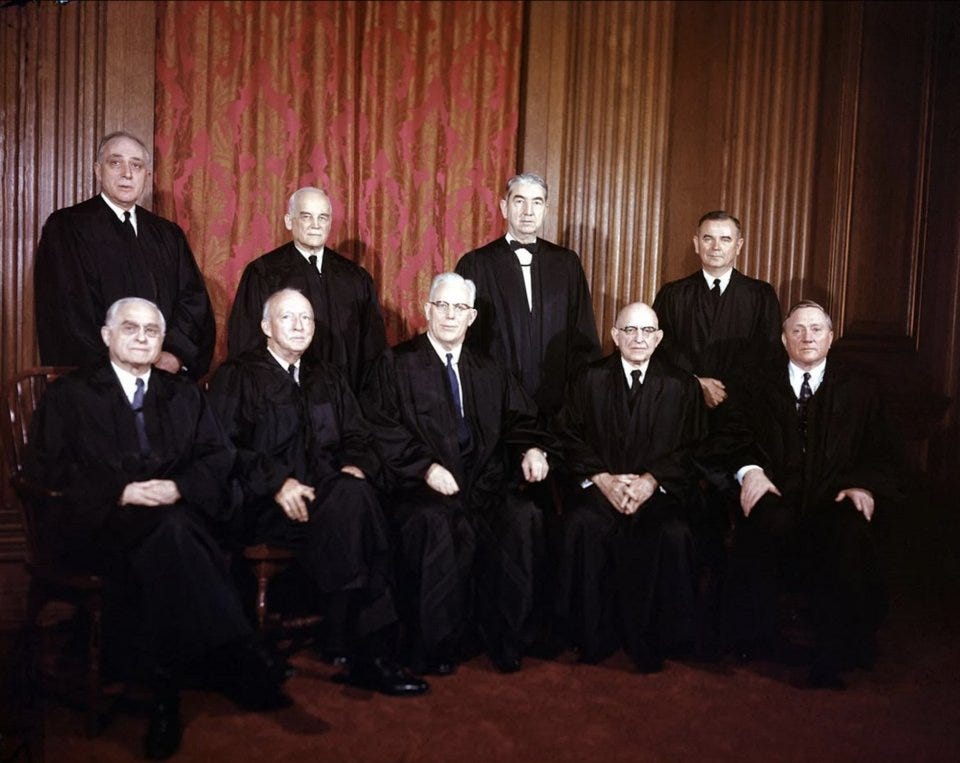
The Warren Court that decided Yates v. U.S. in favor of the California Communists, Source: Supreme Court Official Photo \[Wikimedia Commons\].
The influence of his denaturalisation case was undeniable in his trial approach during his second round of US prosecution. During his arguments he reiterated the support he’d received from the Supreme Court:
“Some of the very same books which the prosecution has announced its intention to introduce into our trial here, were before the Supreme Court when it acted on my citizenship, in fact, nearly all the main theoretical works on which the prosecution appears to be relying in this present trail to shaw that there was a conspiracy to advocate doctrines of force and violence against the United States Government - these same works - were before the Supreme Court when it handed down its decision. If I may quote from the Supreme Court decision on this point: ‘A tenable conclusion from the foregoing is that the Party in 1927 desired to achieve its purpose by peaceful and democratic means, and as a theoretical matter justified the use of force and violence only as a method of preventing an attempted forcible counter-overthrow once the Party had obtained control in a peaceful manner, or as a method of last resort to enforce the majority will if as some indefinite time in the future, because of peculiar circumstances, constitutional or peaceful channels were no longer open.’”17
Despite Schneiderman’s appeals to his previous legal success, and Yates’ defiant performance as defence witness, the charges were sustained, and though group would appeal, it would not come before the Supreme Court for another 4 years. The time proved helpful, given the changing contexts we’ve already explored, and the fact that, beyond the Communists involved in Dennis v. U.S., all the other more than a “hundred Communist members in fourteen states ... put on trial and convicted” were waiting on the fate of this Supreme Court case to determine their own futures. Schneiderman summed up his hopefulness about the affect this changed context would have: “the Korean war was over and the McCarthy madness had died down; there was a revulsion in the nation against the ‘excesses’ committed during that period.”18

Former California Attorney General Robert Kenny, who represented the California Communists before the Supreme Court and his friend Earl Warren, Source: Los Angeles Times \[Wikimedia Commons\].
The Supreme Court case was largely similar, though in between the trials the CPUSA hired two new lawyers, Augustin Donocan, and Robert Kenny, the Democrat attorney general of California. Both men were known to be friends of Supreme Court Chief Justice Earl Warren. The team “focused on the insufficiency of the evidence to prove either a conspiracy, or the specific intent of the individual defendants, and on some technical legal points involving the judge’s instructions to the jury on the meaning of the word ‘organize’.” This time though there would be no grandstand by Schneiderman or Yates defending the party, Communism, or their right to protect their friends and allies.19
Thanks for reading GreySidewalk! All our articles remain free, but if you want them straight to your inbox, just subscribe!
Subscribe
In the summer of 1957, the Supreme Court found in favor of the Communists, 6-2. It was a decision that acquited 4 of the 14 Communists, and sent the other’s cases back to the Federal District Court, where the government would wind up dropping them. The decision was in many ways historic, just like 1951’s Dennis decision had fully weaponized the Smith Act as a tool against the US left and Communist Party, Yates effectively nullified the Smith Act, dropping along with the 14 defendants the cases against many other Communists across the country. Schneiderman was finally disentangled from legal persecution involving his political beliefs.
But as even he was aware, the end of McCarthyism did not mean the end of anticommunism in the US, certainly regarding foreign affairs, but also regarding domestic control. “The dirty tricks of McCarthy, Hoover, and Nixon were not just ‘excesses’; they were the most visible parts of the whole system of repression used against the people.”20 Now US control would come through more subtle levers, no more high profile Supreme Court cases, instead COINTELPRO, the attacks by police on Civil Rights movements, and the long legacy of anticommunism in social life and within US media which took decades to recover from the McCarthy era blacklists.
Check out some of our latest stories on Left History:
[](https://greysidewalk.substack.com/p/the-first-labor-congressman-how-milwaukees)
The First Labor Congressman: How Milwaukee’s 1880s Labor Movement Sent Henry Smith to Washington.
[](https://greysidewalk.substack.com/p/the-first-labor-congressman-how-milwaukees)
[](https://greysidewalk.substack.com/p/the-first-labor-congressman-how-milwaukees)Sebastian
·
Jul 3
When National Rhetoric Unifies on Nativism - The Left Doesn’t Win, Xenophobia Does.
·
Jan 10
A Brief History of Immigration in American Politics
[](https://greysidewalk.substack.com/p/its-time-for-britain-to-return-akrotiri)
It’s Time for Britain to Return Akrotiri and Dhekelia to the Cypriot People
[](https://greysidewalk.substack.com/p/its-time-for-britain-to-return-akrotiri)
[](https://greysidewalk.substack.com/p/its-time-for-britain-to-return-akrotiri)Sebastian
·
Mar 6
For more on Harry Bridges’ life and career see: Michael Reagan, “Harry Bridges: Life and Legacy” in Waterfront Workers History Project, (2010, Seattle), accessed 18/08/2026: <https://depts.washington.edu/dock/Harry%5FBridges%5Fintro.shtml>. For more on Harry Bridges’ initial deportation case see: Rebecca Brenner Graham, “The 1930s Case that Sparked a Debate About Deportation”, in Time Magazine March 4, 2025, accessed 18/08/2026: <https://time.com/7207403/frances-perkins-case-deportation/>.
Robert Cherny, “U.S. Supreme Court Decisions Involving Communist Party Members in International Context: Schneiderman v. U.S. (1943) and Yates v. U.S. (1957)”, Siècles \[Online\], 58, (2025), 7.
For more on the influence of geopolitics in general and on Schneiderman’s denaturalization case see: Cliff Sloan, “A “Barefoot” Lawyer and the Supreme Court During World War II: Schneiderman v. United States”, Journal of Supreme Court History 49(2), (2025); and Cherny, “Decisions Involving Communist Party Members”, 2-6.
Alan Brinkley, “The New Deal and The Idea of the State”, in Eds. Steve Fraser and Gary Gerstle, The Rise and Fall of the New Deal Order, (Princeton: New Jersey, 1989), 85-121; Nelson Lichtenstein, “From Corporatism to Collective Bargaining: Organized Labor and the Eclipse of Social Democracy in the Postwar Era”, in Eds. Steve Fraser and Gary Gerstle, The Rise and Fall of the New Deal Order, (Princeton: New Jersey, 1989), 122-152.
Lichtenstein, “From Corporatism to Collective Bargaining”, 130, 133-4; John Nichols, The Fight for the Soul of the Democratic Party: The Enduring Legacy of Henry Wallace’s Antifascist, Antiracist Politics, (New York, 2020), 114-127.
Nichols, Fight for the Soul of the Democratic Party, 117, 139-141; Paul Heideman, Rogue Elephant: How Republicans Went from the Party of Business to the Party of Chaos, (New York, 2025), 2-6.
“’Communists in Government Service’ McCarthy Says”, Senate Historical Office, accessed 16/08/2026: <https://www.senate.gov/about/powers-procedures/investigations/mccarthy-hearings/communists-in-government-service.htm>.
Hayden Thorne, “The Influence of Legal Strategy in Dennis V. U.S. (1951) and Yates V. U.S. (1957)” The Journal of Supreme Court History 44(2), (2019), 172-174.
Ibid, 173.
John F.X. McGohey, “Summation on Behalf of the Government: Extract from Trial Transcript in United States v. Foster (Transcript, October 12, 1949).” quoted in Thorne, “Influence of Legal Strategy”, 173.
Thorne, “Influence of Legal Strategy”, 174.
Ibid, 175.
Heideman, Rogue Elephant, 5-6.
In my article for Geese, I discuss the findings of the Supreme Court in Schneiderman V. U.S. and the partial victories for the acceptability of Communist views among the Supreme Court Justices, among them were assertions of the validity of the Communist thought, Schneiderman’s attorney Wendell Willkie (the 1940 Republican Presidential Candidate) powerful defence of the importance of Marx and Engel’s Communist Manifesto, and the protections given through that case to political affiliation for US citizens. See: Sebastian Letts, “When a Republican Presidential Candidate Defended a Communist in the Supreme Court”, Geese Magazine August 14, 2026, accessed 14/08/2026: <https://www.geesemag.com/articles/when-a-republican-presidential-candidate-defended-a-communist-t-the-supreme-court>.
Thorne, “Influence of Legal Strategy”, 182-183.
William Schneiderman, Dissent on Trial: The Story of a Political Life, (Minneapolis, 1983), 137-138.
Ibid, 139.
Ibid, 241-242.
Ibid, 242.
Ibid, 244.
Previous