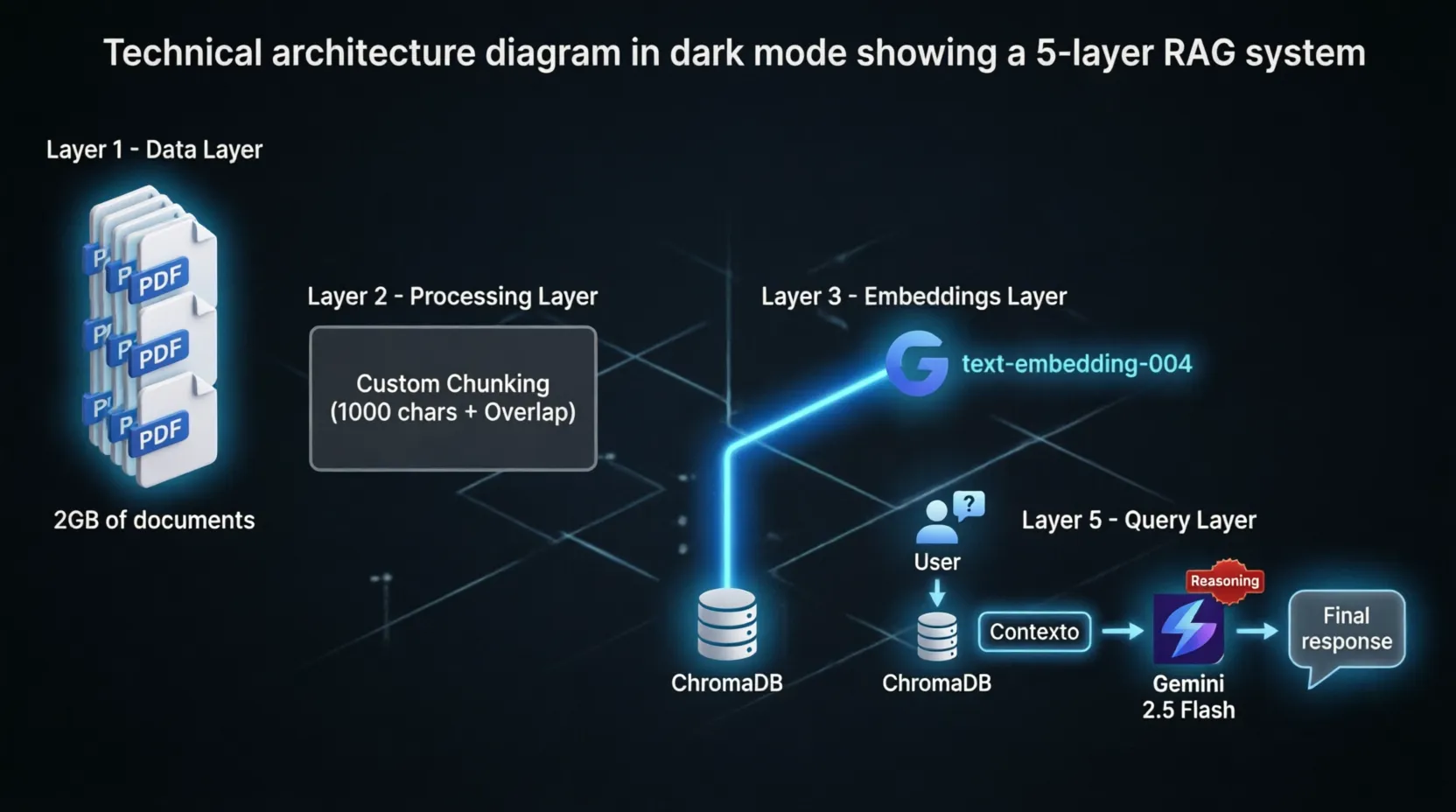

1. The Architecture
1. The Architecture
To process a volume of approximately 2GB (roughly 500,000 text chunks), we need a high-performance pipeline:
- Extraction: PDF processing using PyMuPDF (Fitz) for speed.
- Intelligent Chunking: Semantic splitting to avoid breaking words, including strategic overlap.
- Vectorization: Utilizing `text-embedding-004` (or `gemini-embedding-001`).
- Persistence: ChromaDB for vector storage and metadata management.
- Inference: Gemini 2.5 Flash, leveraging its native reasoning capabilities to filter noise.
2. Environment Setup
We will use the latest Google GenAI SDK. Install the dependencies:
pip install -q -U google-genai chromadb pymupdf3. Smart Chunking: The Secret to Precision
Correctly segmenting text represents 80% of RAG success. This function ensures we don't cut words mid-sentence while maintaining a meaningful overlap.
def chunk_text(text, size=1000, overlap=200):
    chunks = []
    start = 0
    while start < len(text):
        end = min(start + size, len(text))

        if end < len(text):
            last_space = text.rfind(' ', start, end)
            if last_space != -1:
                end = last_space        segment = text[start:end].strip()
        if segment:
            chunks.append(segment)

        start = end - overlap
        if start >= end: start = end + 1
        if end >= len(text): break
    return chunks
4. Extraction and ChromaDB Ingestion
We use PyMuPDF for its high performance when handling heavy technical manuals.
import fitz
import chromadbdb_client = chromadb.PersistentClient(path="./tech_docs_db")
collection = db_client.get_or_create_collection(
name="technical_documentation",
metadata={"hnsw:space": "cosine"}
)
def process_and_store_pdf(pdf_path):
doc = fitz.open(pdf_path)
for i, page in enumerate(doc):
text = page.get_text()
chunks = chunk_text(text)
for j, chunk in enumerate(chunks):
chunk_id = f"{pdf_path}{i}{j}"
collection.add(
documents=[chunk],
ids=[chunk_id],
metadatas=[{"source": pdf_path, "page": i}]
)
5. Embeddings with the New SDK
Defining the vectorization logic using the latest embedding models:
from google import genai
from google.genai import typesclient = genai.Client(api_key="YOUR_API_KEY")
def get_embedding(text):
result = client.models.embed_content(
model="text-embedding-004",
contents=text,
config=types.EmbedContentConfig(task_type="RETRIEVAL_QUERY")
)
return result.embeddings[0].values
6. Retrieval and Reasoning
Gemini 2.5 Flash can "reason" over retrieved fragments. This is crucial for resolving contradictions often found in technical documentation.
def generate_response(query):
    # 1. Vectorize query and search ChromaDB
    query_vector = get_embedding(query)
    results = collection.query(
        query_embeddings=[query_vector],
        n_results=5
    )

    context = "\n\n".join(results['documents'][0])    # 2. Generate response with reasoning capabilities
    prompt = f"""Act as a Senior Systems Engineer. Analyze the context and answer the question.
    Use your reasoning capabilities to validate data points before responding.

    Context:
    {context}

    Question: {query}

    If the information is not present in the context, state it clearly. Do not hallucinate technical data."""

    response = client.models.generate_content(
        model="gemini-2.5-flash",
        contents=prompt
    )
    return response.text
7. Cost Optimization: Context Caching
If your 2GB documentation is static, sending the same tokens repeatedly is inefficient. Gemini 2.5 allows for Context Caching.
Conclusion
Implementing RAG at scale requires precision in chunking and a model capable of distinguishing signal from noise. Gemini 2.5 Flash, combined with ChromaDB, provides an enterprise-grade solution with minimal maintenance overhead.
References: