

Kechlibar.net

Author: František Dostál, Wikipedia
In the West, the year 1968 is strongly associated with the rebellion of leftist students in Paris: an abortive microrevolution which was visually attractive and indeed televised by a dozen journalistic crews. This microrevolution didn’t achieve much, but it was the shape of things to come. The staid, mostly conservative elites of the Western world would now have to struggle against radical newcomers, and sometimes lose.
Behind the Iron Curtain, the meaning of 1968 is completely inverted. This was the year when a genuine attempt to reform a Communist country into a more pluralistic system was crushed from Moscow by military force. The Brezhnev Doctrine was clear: no deviation from orthodoxy would be tolerated. The staid elite won.
Note: I will be reposting this particular article on every August 21st, yearly. Some things should never be forgotten, and this is one of them.
---
Czechoslovakia of the late 1960s was an interesting country. After twenty years of confiscations and nationalizations1, the engines of the Czechoslovak economy were clearly sputtering; nothing worked quite like before, and an industrial nation which was once in the global top ten2 was clearly losing its edge. A need for at least economic reforms was becoming painfully obvious even to the Politburo which de facto governed the country.
The top guy of that period was Antonín Novotný, in the presidential office since 19573. Nicknamed “der schöne Toni” (handsome Tony), he allegedly once won an informal UN ballot for the best-looking politician present. What nature gave him in looks, it took back in smarts; Novotný possessed a mediocre mind, and he was also unlucky enough to recognize that. His feelings of insecurity towards smarter people caused frequent personal conflicts and dissuaded talented cadres from working for him. The Czech people, never particularly reverent towards their bigwigs, mocked him mercilessly4.
Worse still, der schöne Toni hated the Slovaks, the smaller of the two constituent nations of Czechoslovakia, and did not even try to conceal his revulsion. This was causing some serious bad blood right in the middle of a country which needed to work together, and this alone was a reason to get rid of him. Novotný was President, but not a Tsar; the real power rested with the collective Party, and the Party could replace him if it wanted to. And, by late 1967, it reached the conclusion that this could no longer be postponed.
---
Succession is never easy in authoritarian systems, but the Czechoslovak society of the 1960s was undergoing an extensive thaw which unfroze a lot of old skeletons from the early Communist era. In the Stalinist times (1948-53), hundreds of people were hanged on trumped-up charges and tens of thousands put in gulags, sometimes just for being born into the wrong family; Albert Einstein himself pleaded with brutal President Gottwald for the life of Milada Horáková, in vain. A decade later, the regime grew softer and the survivors started clamoring for justice. Not every politically motivated conviction was quashed, but a lot of them were, and it was becoming clear to everyone that the regime had a lot of blood and mayhem on its hands.
In the fall of 1967, a blackout at a student dormitory in Prague-Strahov resulted in student protests whose main slogan “We want light!” could be interpreted in more than one way. Novotný tried to suppress those, but his leadership position was shot so badly that his opponents made use of this occasion to topple him.
His successor, Alexander Dubček, was not as handsome, but he possessed genuine charisma and a capability to connect with the public. A down-to-earth guy whom power did not spoil, he didn’t mind going to a swimming pool full of normal citizens, eschewing the special amenities for the elite of the Party, and the people loved it. Measured by the total amount of jokes, Dubček commanded a lot more natural support than any of his Communist predecessors. He was also quite liberal and recruited more liberal colleagues into the top positions of the Party and the government. The thaw accelerated and, in a few months, turned the glaciers of the Communist regime into a vigorous flood.
The Spring of 1968, also called “building of socialism with a human face” (that face was Dubček’s), very quickly eroded the foundations of the authoritarian regime and uncovered the democratic roots underneath. Censorship was abolished; hundreds of victims of previous injustice were rehabilitated; informal organizations and movements started organizing themselves. The question whether the Party should give up its privileged position and become just one of many parties which compete for voters’ preference was no longer taboo. People talked and wrote and composed songs which, during the previous 20 years, would have been unthinkable. (And unfortunately in the next 20 years as well.)
This did not escape the attention of the Kremlin, whose head, a grim bureaucrat named Brezhnev, had no intention of letting such an important stone fall off and compromise the dam of Communism. Leaders of the satellite countries were alarmed as well; freedom is contagious and what happened in Prague could happen in Berlin, Warsaw and Budapest too.

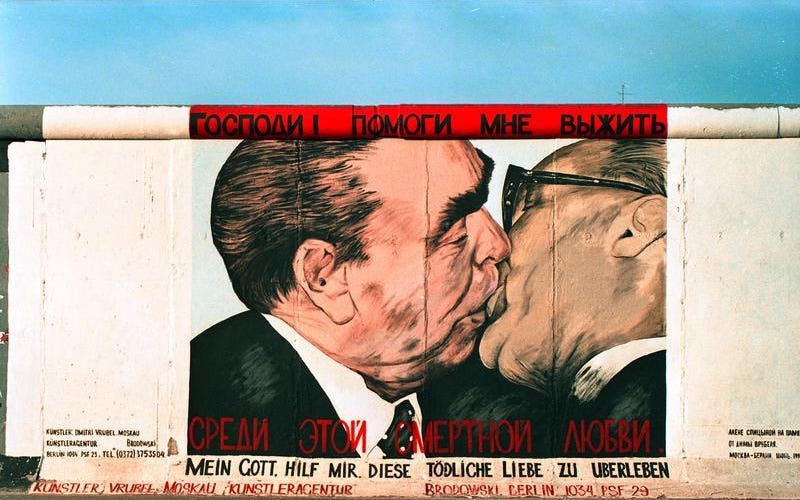
A caricature of Brezhnev giving a comradely kiss to his East German counterpart, Honecker. The caption says: “God, help me survive this deadly love”. CC BY-SA 3.0 de, Bundesarchiv B 145 Bild-F088809-0038, Berlin, Wikipedia
There was one last warning: Brezhnev and Dubček met in late July 1968 in Čierná nad Tisou, a somewhat dilapidated railway hub on the Czechoslovak-Soviet border. The Soviets demanded an immediate return to the old system; the Czechoslovaks refused. “Eto vashe dyelo,” quipped Brezhnev. Much like the student slogan about light, this Russian sentence could be interpreted in two ways. The first would be quite harmless: “This is your business.”
But the second one was outright ominous: “the consequences are yours to bear”.
---
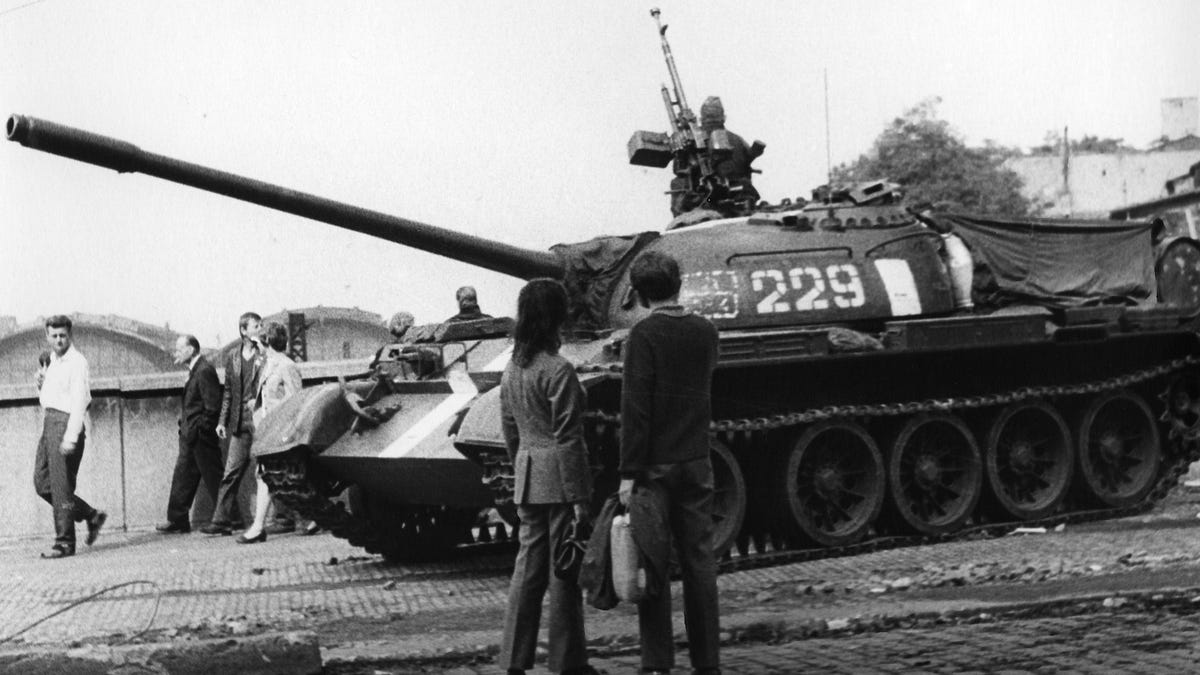
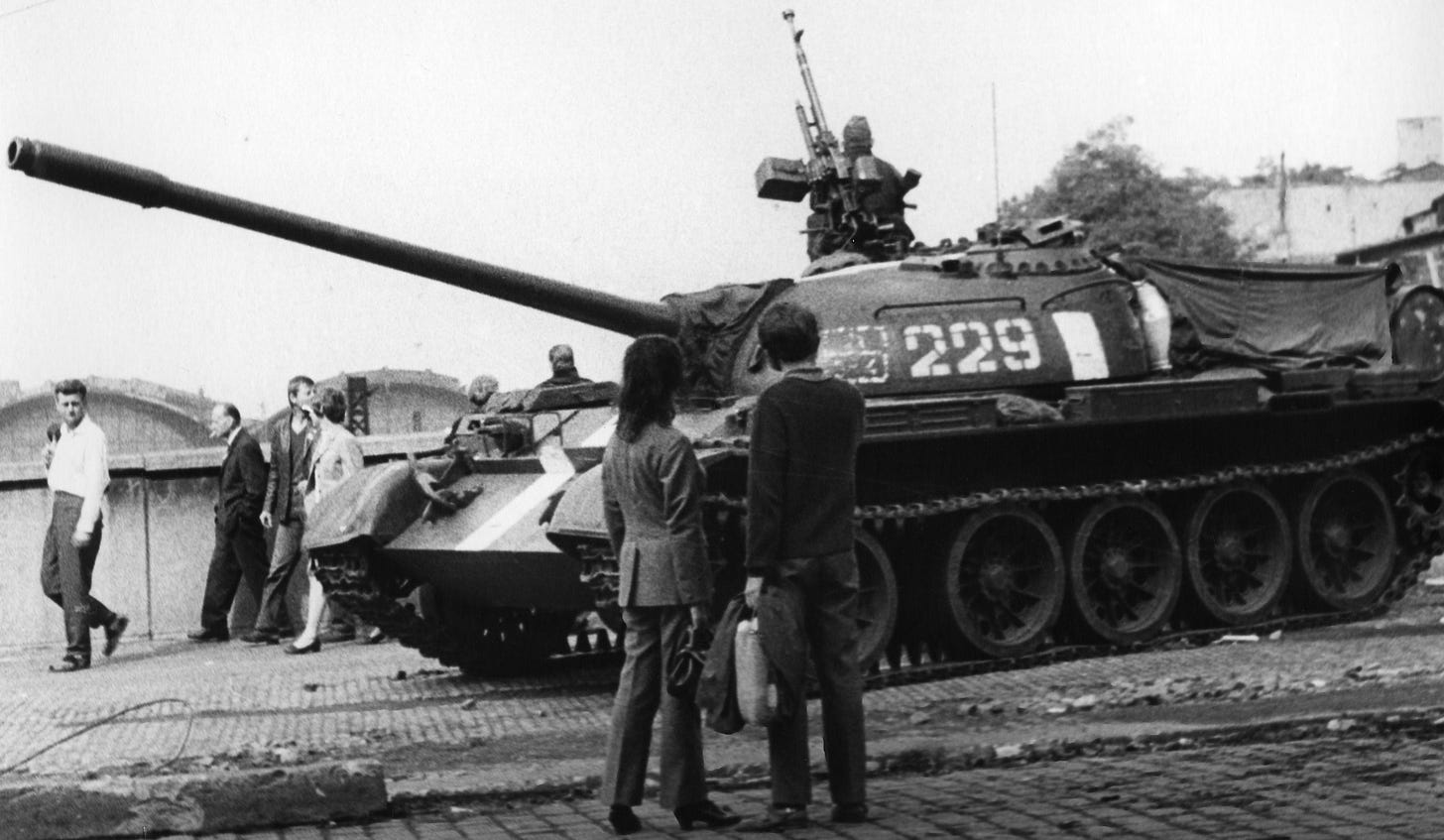
The consequences arrived three weeks later, a flood of soldiers and armor pouring across the border from all sides, mostly Soviet, but with token forces from Poland, the GDR5, Hungary and Bulgaria as well6. Of course, this fooled no one; this was a Soviet initiative and the others were there just to show their “brotherly support”.

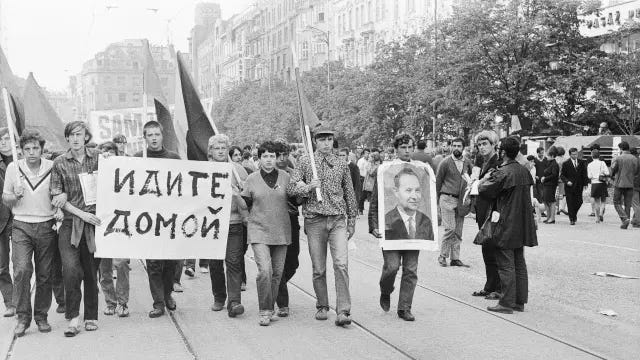
People protesting the invasion; the poster says “Go Home” in Russian. They are also carrying Dubček’s portrait. Source: ČTK, Seznam Zprávy.
Socialism with a human face came to an end and the regime which followed wore an angry, paranoid frown. At least in some aspects, the situation was better than during the Stalinist era: there were no executions, nor were gulags reopened. The reformist political leadership were made outcasts and dissenters were fired from their jobs, studies, jailed in regular prisons or made to leave the country, but compared to the great Soviet Purges of the 1930s, most people kept their lives and limbs. There are different levels even in hell, and this was basically “just” a purgatory.
The level of helpless hatred that this event sowed in the Czechoslovak population cannot be overestimated. Prior to 1968, the Russians were respected as (imperfect) liberators from Nazi rule, and most of the crimes of the Stalinist era were committed by Czechs on Czechs, with just a marginal involvement of Soviet consultants. After 1968, any idea of genuine friendship was gone and buried forever.
Twenty years later, the Soviet Bloc disintegrated. The Czechs and the Slovaks went their own ways and the Soviet occupation force left both countries. But the humiliation and rage of 1968 still live in the collective memory of the people.
When Putin invaded Ukraine, this memory contributed to the Czech Republic becoming an important supporter of the Ukrainian war effort. Privately, a lot of people send 1968 Kč (approx. 95 USD) around the anniversary to Ukrainian military or humanitarian funds, to avenge the “brotherly help” that once suffocated the hopeful Spring.
Friends you can choose; brothers, not.
The extent of AI use in this article: 24 grammatical errors and bad word choices corrected. Three factual mistakes corrected. Zero editing.
The Czechoslovak Communist regime, mostly ruled by city intellectuals, was extra harsh against private farmers, “kulaks”, and expropriated them to a much greater extent than Poland or Hungary did. By 1968, the process was essentially complete and the few die-hards who survived were burdened with high taxes in kind: so many eggs, so much milk, regardless of the weather or other circumstances. That was the intent, though. Failing to supply the required amounts of food even once was a good reason for legal action against the culprit.
Not just that. Czech industry was only slightly damaged during the Second World War, as Anglo-American bombers mostly spared the Protectorate of Bohemia and Moravia. Much of its competition in Germany was bombed to pieces and qualified personnel killed.
He also became General Secretary of the Communist Party inn 1953. Formally, the President was the head of the state. In practice, the General Secretary was important. Anyway, this was a relatively long tenure for Czechoslovak standards, though not a record-breaking one.
Insulting the President was illegal and this was enforced; regardless, everyone knew a few good jokes about him.
The participation of the GDR was kept extremely limited, due to all the ressentiments that were bound to be awoken.
Romania is missing from the list, and for a good reason: Ceausescu, himself an autocrat of a North Korean type, was not submissive to Moscow and denounced the invasion loudly on the international stage.