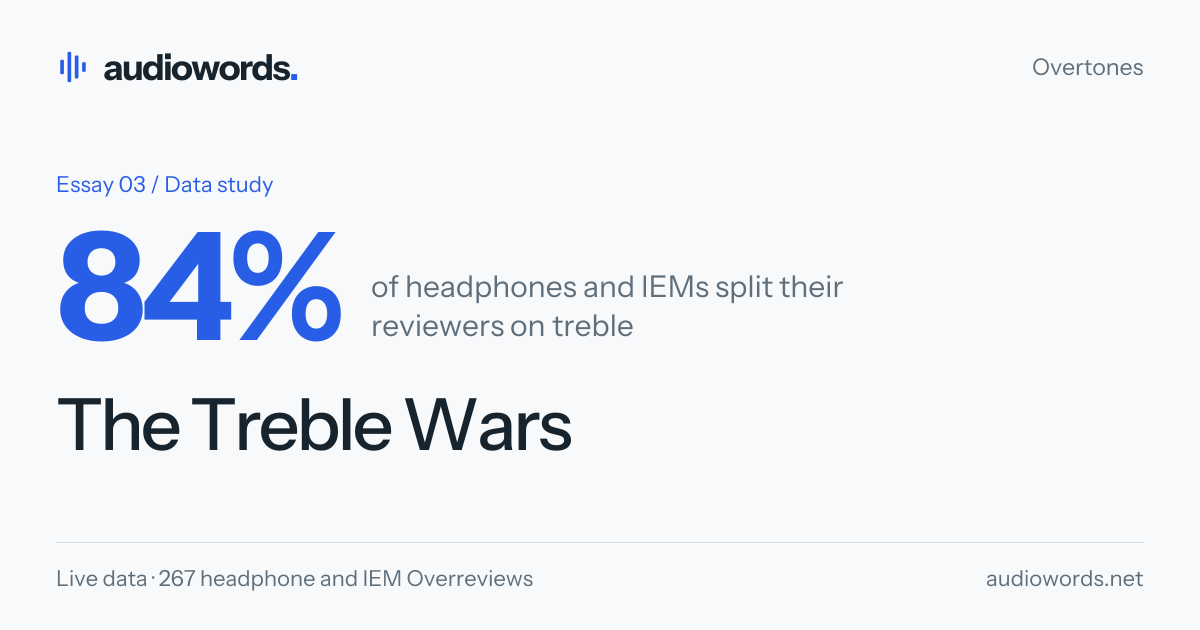
The Treble Wars.
Here are two experienced reviewers on the same IEM, the Sennheiser IE 6001:
The treble is never too bright, but it is crisp and clear. I am usually quite sensitive to bright headphones, but the IE600 doesn’t trigger fatigue for me.>
Chris, The Headphoneer
it edges more toward the spicy side of things to my ears, lacking the refinement that its older sibling, the IE900, approached this derivative of sound with.>
Precogvision, Headphones.com
Both are careful listeners, both heard the same product, and on the treble they could hardly disagree more. Anyone who reads headphone reviews has seen this happen. What’s less obvious is how often it happens.
Every Overreview on Audiowords boils a product’s reviews down topic by topic (bass, comfort, value and so on) and records whether the reviewers agree or split. Line up the verdicts for all 267 headphones and IEMs in the catalogue and one topic stands apart. Value, bass and comfort split reviewers regularly. Treble splits them on more than four in five of the products.
1. Treble84%split 2. Value61%split 3. Bass59%split 4. Comfort44%split 5. Soundstage41%split 6. Tonality41%split 7. Mids40%split 8. Build30%split 9. Dynamics26%split 10. Detail22%split 11. Isolation16%split 12. Imaging14%split
Reviewers splitMostly agreeStrong agreementBars leave out topics with too few sources to call
Almost nobody agrees
Full agreement is rarer still. An Overreview marks “strong agreement” when every source says roughly the same thing. That’s common for isolation and imaging. For treble it has happened three times in 267 products: for the Moondrop Skyland, FiiO JadeAudio JT9 and the Noble Audio FoKus Apollo Pro. Of the JT9, one reviewer wrote that “cymbals have energy without splashing, sibilance stays where it belongs”, and no review of the finished product called it harsh2.
And it isn’t that treble just gets talked about more. Value comes up in just as many reviews and splits reviewers less often, even though value is where you’d most expect an argument: a fair price depends on who’s paying.
Nor are the treble splits lopsided. When reviewers divide, the two sides tend to be close to even: a genuine argument, not one grumpy holdout against a crowd.
Money doesn’t settle it
If treble were only a question of quality (cheap sets harsh, expensive sets refined), spending more would end the argument. It doesn’t. A set that costs under $100 and a flagship over $1,000 split their reviewers almost exactly as often.
100%75%50%25%0%
89%
Under $10045 products
85%
$100–300101 products
79%
$300–1,00092 products
90%
$1,000+29 products
Reviewers split on trebleEvery topic combinedStreet price when each review was written
An argument about ears
So what are they arguing about? Each Overreview also records why its reviewers disagree, and for treble the same few reasons keep coming up. The disagreements are specific: almost all of them point to a particular range of frequencies, usually between five and ten kilohertz, rather than a vague sense that the top end is off. Many mention sibilance, the hiss on “s” and “t” sounds. And nearly two in three bring up fit: which ear tips someone used, how well they sealed, how deep an IEM sat. For IEMs alone, it’s three in four.
Reviewers often say so themselves, like this one:
However, there is some emphasis between 7 – 9kHz (depending on insertion depth and tips used) that can be problematic.>
audioreviews.org (Kazi Mahbub Mutakabbir)
That makes treble different from every other topic. With treble, the listener’s own ears, tips and seal become part of what’s being judged. Two reviewers can be equally careful and equally honest and still hear slightly different things. None of this proves fit is the cause, since the Overreviews only record what reviewers talked about, but the pattern is hard to miss.
Plot every treble verdict and the pattern is easy to see: more than half sit above the line where reviewers split. Tap imaging above the chart and the cloud sinks and drifts right; only one in ten imaging verdicts get that high.
TrebleValueBassComfortSoundstageTonality
MidsBuildDynamicsDetailIsolationImaging
Highlight products by name
highnone↑ reviewers disagree moreabove this line, reviewers splitdislikedmixedliked← how much reviewers like its treble →
Reviewers splitMostly agreeStrong agreement
What reviewers do agree on
Reviewers don’t disagree about everything, though. Imaging, how precisely sounds are placed around you, is the least contested topic of all, and reviewers generally like what they hear. Isolation and detail aren’t far behind. Isolation comes with a footnote: fewer reviewers mention it at all, which leaves less room to disagree.
Reading reviews, then
This doesn’t make reviews less useful; it changes how to read them. A reviewer’s take on build quality or imaging will usually hold true for you too. A take on treble is partly a report on their ears, their tips and their seal. So if a review calls a set harsh, check two things: whether other reviewers split on it (every Overreview shows this), and whether the split has a cause you can fix, like a different ear tip or a deeper fit.
The charts in this piece redraw whenever a new Overreview is published. This version covers 267 headphones and IEMs as of 26 September 2026.
Data & method.
267 Overreviews · 6,306 human reviews
- What was countedEvery headphone and IEM Overreview in the catalogue: 267 products and 6,306 human reviews (editorial, measurement, community, video and owner sources), written between 2 June 2026 and 26 September 2026. Each Overreview gives every topic a verdict from what its sources claim.
- What “split” meansSources are weighted by expertise and independence. A topic’s lean is their weighted average on a −2 to +2 scale, and its spread is their weighted standard deviation, scaled 0 to 1. A topic is marked divided when the spread is 0.5 or more, or when the claims fall into two distinct camps; mostly agreed when the spread is 0.25 to 0.5; and strong agreement below 0.25 with at least three sources. Topics with fewer than two independent sources are left out.
- Reading the notesThe fit, frequency-band and sibilance figures are text matches over each verdict’s own notes: its summary, measurement notes and camp descriptions. They count what reviewers talked about, not what causes a split.
- CaveatsThe verdicts are machine syntheses of human reviews, not a survey. The catalogue leans toward gear enthusiasts discuss, so it is not a random sample of the market. Prices are street prices when each Overreview was written. The Overreview method looks especially hard at treble (measurement rigs, fit notes), which can make a split easier to spot.
- Live dataThe charts and every number in the text are recomputed from the records each time the site is built. The CSV holds one row per headphone or IEM and topic.
Reviews quoted
1. 1 Sennheiser IE 600 Overreview 13 sources 2. 2 FiiO JadeAudio JT9 Overreview 21 sources 3. 3 Kiwi Ears Aether Overreview 12 sources