




A Clever Name Goes Here
Often today there is talk of a crisis of disinformation. We are told that the internet is/has been/will be flooded with deluges of deepfake images, recordings, and videos. This will apparently destroy our ability to trust information on the internet. And indeed, these fake images and media blitzes have come to pass, sometimes to serious effect. Passively and actively, the proliferation of cheap technology to create lifelike video and image outputs is indeed lessening a lot of people’s faith in online reporting and most likely in media in general. Sometimes we are also sold a solution—verification, whether via proprietary schemes or blockchain attestation. My interest is not in addressing the technical specifics of these schemes, some of which are more credible than others. My interest is in giving an account of why verification is hard in the first place.
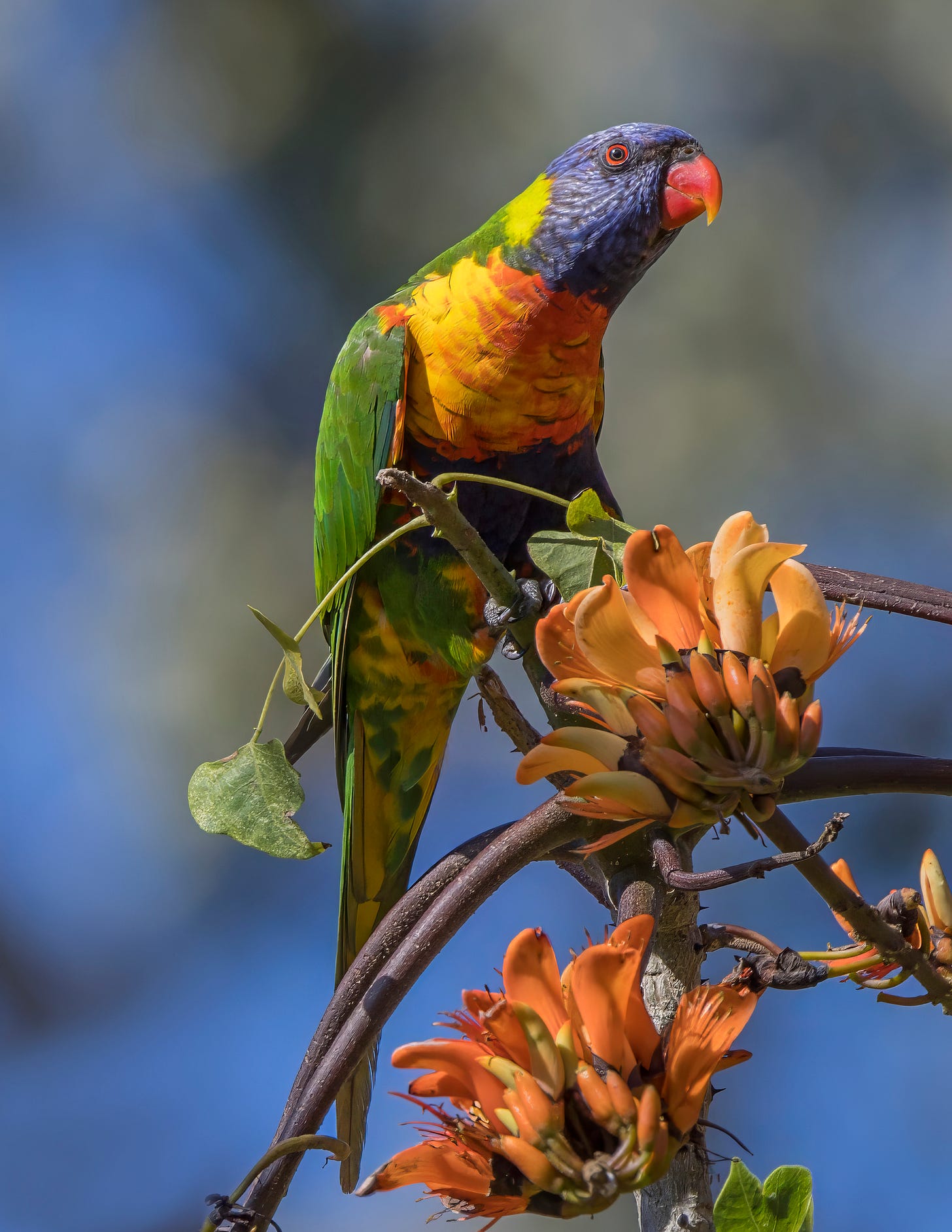
To begin, let’s set the scale of our story using some numbers1. Here’s a picture of a parrot on Wikipedia:

Image Credit: Charles J. Sharp (Reused under a CC BY-SA 4.0 License)
The image is 4.7MB according to my operating system. That’s 4.7 times 106 bytes, or 3.8 times 107 bits. That last number represents how many binary digits we would need we wanted to write the entire file as one long string of zeroes and ones: “010100101000001001”…
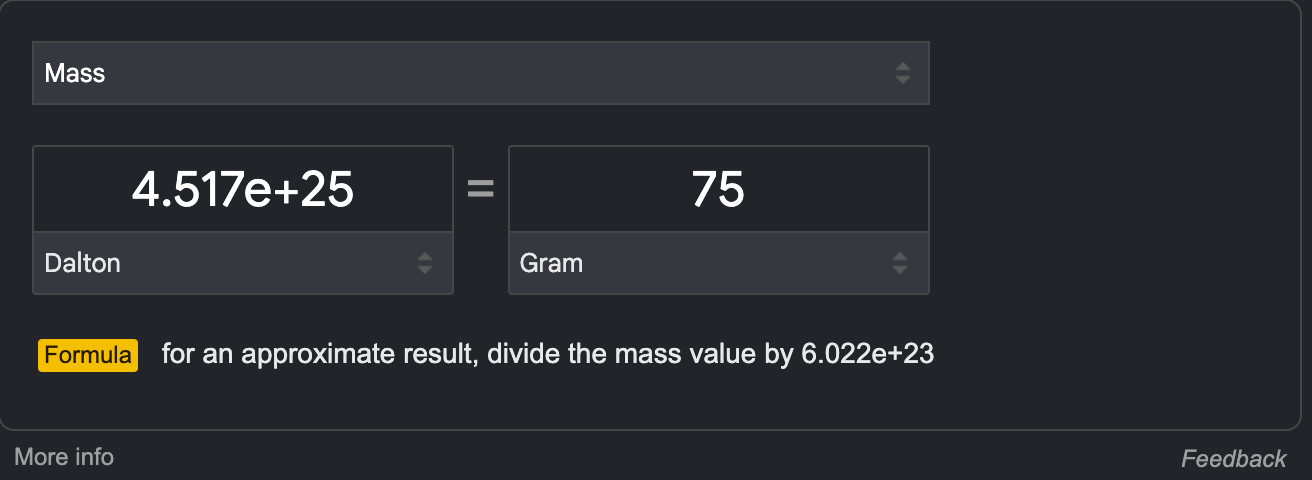
How much data would we need to represent a real rainbow lorikeet? According to Wikipedia, their weight “varies from 75 to 157 g”. Let’s choose a light 75g Lorikeet, and assume for the sake of simplicity that they are made of a single kind of atom, carbon. We will use carbon-12 as our isotope of choice, since that is the reference used to calibrate atomic weight units, so one atom of carbon for our purposes weighs 12 daltons. Now we do a small unit conversion…

That’s 3.8 times 1024 atoms. Of course, each carbon atom must also be given a position and a momentum, which means that we actually need 2.3 times 1025 numbers to represent our carbon sculpture of a rainbow lorikeet. Numbers can have up to infinite digits of precision, but if we use the 64-bit integer standard, that gives us a final tally of 1.5 times 1027 bits, or roughly 1014 (ten million squared) one-terabyte hard drives. Needless to say, a parrot is somewhat more information-dense than a picture of a parrot.
The thing I am pointing to, besides the wonders of image compression technology, is the ridiculous lightness of symbolic information compared to physical matter. With the three-letter word “Sun” I can conjure the image and the effect of the largest celestial body in the solar system, whose mass dwarfs that of the earth and whose energetic output could fuel all of civilisation for literal millennia. Tolstoy’s War and Peace traps entire lives and battlefields in a single, admittedly quite thick, tome. In some way, those old fogeys complaining about the shallowness of these newfangled digital realms compared to the “real world” were right, if only because a McDonald’s hamburger contains more “information” in it than the entirety of Wikipedia. The digital world is really, literally, less dense and less heavy than our nasty, noisy, dirty, analogue universe.
The ramifications of this heaviness are apparent when we think about things like duplication, faking, and editing. To duplicate an apple, you need to grow another apple. To modify the corner of a table, you get out a saw. To copy a toy, you need millions of dollars of injection moulding equipment, or a very good 3D printer. Copying and modification takes work in reality, even if you’re just making a shitty mass market plastic chair. Copying a file is effortless because (as we have shown) files are really, really trivial compared to the things they stand in for. Editing a sign is trivial, such is the purpose of signs.
Yet the digital still feels real to us. Books can move us to tears, movies can change our lives, music can repair a broken heart. Some of you will have chafed when I compared the information in the parrot image to the “information” in the parrot itself, because we are seldom truly, deeply engaged with all the parts and atoms that constitute a parrot2. However, I argue that whatever motive force we attribute to the parrot-image is based on a residual belief that the parrot JPEG is connected, somehow, to a real parrot out there. We feel fear when we see snarling digital tigers, vertigo at digital mountaintops, profundity when faced with simulated ravines, all signs that our minds are summoning residual associations to deep-seated survival-related instincts in the face of decidedly unreal situations.
In any case, we are now living through what happens when sign and signified dissolve, when the reference loses its referent. Today we are trapped in a maze of digital, mass produced, hyperrealistic images. Because they are so cheap to make, they are much easier to use than actual “real” images. They are deployed to stimulate our desires and our fears, to move us to spend or to act in accordance with the desires of the image-makers. There is a profound asymmetry between the ease with which a captivating stimulus is produced and the effect it may have on a slowly desensitizing but by no means desensitized mass audience, an asymmetry which has not gone unnoticed by spammers and hackers and propagandists and trolls. The best of these symbols form networks of self-reference, lending each other meaning by simulated sprachspiel, forming dense entanglements of complete and utter nonsense.
And what about verification, our hoped for saviour? The core problem of verification is that making symbols is too easy. If you can duplicate an image and edit it to mean the opposite of what it stood for with three clicks and a prompt, nothing is sacred. Verification, then, is an attempt to tie the light back to the heavy, connecting a unit of 107 bits to a unit of 1027 bits. Blockchain does this by relying not on the symbols themselves, but the relations between symbols and programs. Bitcoin and its relatives use a relatively simple and agreed-upon program known as a hash function to verify the validity of any proposed addition3 to the blockchain. For an addition to be valid, it is extremely statistically likely that a computer has spent a lot of real-world energy looking for a unique input which satisfies the hash function for that block. Because this verification mechanism is simple and agreed-upon, the work of validation4 can be decentralised, and the results confirmed via majority vote. Over time, these new additions form a “chain” of blocks, each trustworthy because it was validated at time of entry into the unbroken ledger. The energy expenditure, then, is not a bug, but a feature, one that forces alignment between the virtual and the real. If there was a magical program tomorrow that could cheaply give you the correct solution for any proposed block to satisfy the hash function, the validity of Bitcoin as a digital currency resistant to malicious tampering would disappear in seconds.
Apple’s digital signing scheme leverages a different kind of proof of work. In this case, a digital signature is made when the camera hardware uses encoded, proprietary secrets to “sign” raw image data. Digital signatures combine hidden secret data (supplied by the hardware) with data that will eventually be shared publicly (the raw image data itself), using a mathematical mixing process that is—like Bitcoin—cheap to verify but expensive to forge5.
The flaw in these schemes is the same: whether you use a proprietary signing scheme or a public blockchain, there is still an implied bond between physical and digital which you must in the end take on faith. When a major initiative called The DAO utilising the Ethereum blockchain collapsed due to a software flaw in its codebase, a new and valid transaction was made transferring funds to the hackers from the DAO’s account. To reverse the hack, the Ethereum community used the fact that verification was carried out via majority vote to simply create a new ledger6 where that transaction never happened. Effectively, everyone agreed that just this once, the expensive and totally “real” physical work which bound symbols to validity was wrong, and their new collective symbolic fiction where the hack never happened was right.
But the spell, once broken, cannot be repaired: now it is public knowledge that, if something unpopular or sufficiently disruptive happens, all that work establishing physical-virtual binding can simply evaporate and the symbol fabricators can rule the day once more7. Apple’s verification scheme is much easier to break: since the secrets are created and owned by one company, their validity is only as good as Apple’s word, and Apple (with total control over the manufacturing process) can always retain secret information to allow them to forge any digital signature issued by one of their cameras.
In my opinion, we will not be resolving the issue of fabricated media and untrustworthy symbols any time soon. Yet this is not some unprecedented crisis. The title of this piece references the famous symbol-grounding problem, which asks how any reference came to be related to any referent in the first place. Perhaps the ultimate source of trust we have in symbols is that (at least until recently) the recipient of a symbol could be assured that, even if the intent was malicious, some unique human intent was behind the message. Pebbles washed up on the beach do not produce sonnets, nor do monkeys on typewriters. Spam and other repetitious media betray this trust, and are relegated accordingly to the lowest forms of “content”.
Now even this baseline cannot be maintained. One can receive extremely customised, highly responsive messages from inhuman or non-human intelligent systems, symbols that stir powerful emotions within the mind and move people to extreme courses of action. Perhaps the only thing more worrying than the idea of a malicious intent behind such interactions is the idea that there may be no human-comprehendable intent at all.
Subscribe
For those who have seen this demonstration from me before, I sincerely apologise, it really is a very useful device.
That engagement, by the way, is what I think creates feelings of sublimity and awe at the total overwhelming richness of the world, what Sartre was pointing at in Husserl’s phenomenology. In every tree and bush and hill there lives a hyperobject.
Each proposed addition is a new “block”, containing a record of transactions that have not yet been certified and accepted as official. The Bitcoin blockchain itself is nothing more than a collection of such blocks and their accompanying metadata, forming a ledger of all Bitcoin transactions.
Literally, verifying the “proof of work” for a proposed block.
See a related video here.
Technically referred to as a “hard fork”.
Those who didn’t accept this ruling would go on to create Ethereum Classic, a version of the blockchain that rejected this fiction and is today much less popular than mainline Ethereum. Meanwhile, mainline Ethereum eventually abandoned proof of work entirely and moved to proof of stake, turning verification into a pure majority vote that rests on the honesty of those who hold large amounts of Ethereum tokens. But how different is this tampering from, say, a stock market circuit breaker or mechanisms for breaking “clearly erroneous” trades?