


Quantum Formalism
Something significant has happened in mathematics over the past few months. For several years, progress in AI for mathematics was still discussed mainly through benchmarks. These systems became better at formal proof, Olympiad problems, symbolic reasoning and increasingly difficult mathematical exercises. The results were impressive, but they were still largely demonstrations of capability and not direct contributions to research-level mathematics.
We are now moving beyond that stage. On 8 September 2026, OpenAI announced that an internal AI system had produced a proposed solution to the Navier–Stokes existence and smoothness problem, one of the seven Millennium Prize Problems. OpenAI says the proof establishes finite-time singularity formation and has released both a mathematical write-up and a Lean formalisation.
The Clay Mathematics Institute subsequently described the problem as having “apparently been settled”, while making clear that its own process for evaluating the result and assigning credit would take time.
Less than two weeks later came an even bigger announcement. OpenAI said that the same internal model had resolved more than 100 long-standing open problems across much of mathematics. At the time of writing, most of those results have not been publicly released, so for now they should be treated as OpenAI’s claims, not as 100 independently verified mathematical breakthroughs.
Even with that qualification, the direction is becoming difficult to ignore. We may be entering a different era in which proofs are increasingly produced through collaboration between humans and machines. If that happens, mathematics may also need to rethink how intellectual contribution is recognised and how mathematical achievement is rewarded.
We recently explored a related question in our post ‘What Fine-Art Photography Can Teach Us About AI in Mathematics’, using the relationship between photography and painting as an analogy. The arrival of photography created a new way of producing images without making painting obsolete. Fine-art photography developed into an artistic practice in its own right, while painting continued alongside it and changed in response. Once painters no longer had to compete with the camera as the principal means of faithfully recording the visible world, they had greater freedom to explore abstraction, colour, perception and other forms of representation.
Something similar may happen in mathematics. One tradition may continue to place direct human reasoning at its centre, with mathematicians reading papers, constructing examples, developing intuition, pursuing unsuccessful ideas and gradually building arguments. Alongside this, another tradition may emerge in which AI becomes deeply integrated into research, searching the literature, suggesting lemmas, exploring large families of proof strategies, testing examples, verifying arguments and increasingly contributing central mathematical ideas.
Most mathematicians will probably work somewhere between these two extremes. Human and machine contributions are unlikely to divide neatly, and in many cases it may be difficult to say where one ends and the other begins. This is where the analogy with art becomes more interesting, because the question is no longer only about tools, but also about recognition.
Painting and fine-art photography don’t normally compete under exactly the same standards. Their institutions overlap, and both may appear in the same museums and exhibitions, but each has also developed its own prizes, competitions, markets, traditions and ways of recognising achievement. Indeed, a photographer is not expected to prove that they could have painted their photograph by hand, just as a painter is not considered technologically deficient for choosing not to use a camera. We accept that the two practices rely on different tools and involve different forms of skill. Mathematics may therefore eventually need to make a similar distinction.
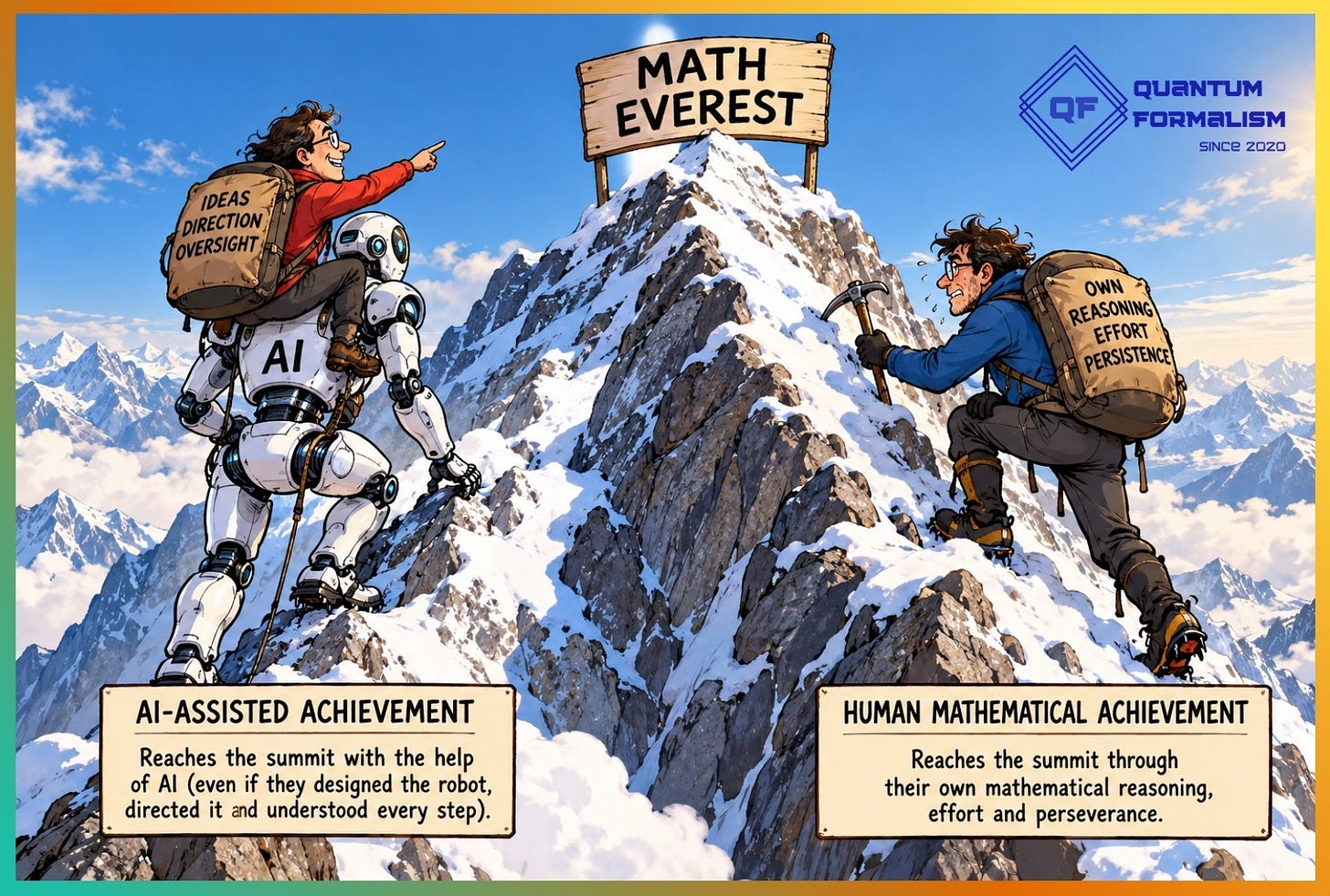
This is where the Mount Everest analogy becomes useful. Imagine two people trying to reach the summit. The first trains for years, chooses a route, carries equipment, struggles with difficult conditions, makes mistakes, retreats and returns, before eventually reaching the top through their own physical effort.
Now imagine a second person reaching exactly the same summit while sitting on the back of an extremely capable humanoid robot. They may have designed the robot, which in itself could require exceptional engineering ability, and they may also have chosen the route, directed the machine throughout the ascent and understood every movement it made. These are all genuine achievements, but most people would still hesitate to say that this person had climbed Mount Everest in the same sense as the first climber. Both reached the summit, yet the nature of the achievement is different.
Mathematics may now be approaching its own version of this problem. Suppose we give an AI system a famous open problem together with the relevant literature, formulate the problem well, explain previous unsuccessful approaches and direct thousands of mathematical agents to explore possible arguments. The system identifies a new construction, proves several intermediate lemmas and eventually discovers the decisive idea, after which another system formalises the proof and we inspect the result, verify the reasoning and write the paper.
The theorem has been proved and, in one sense, we have reached the summit of Math Everest. But saying that one solved the problem seems inadequate if the decisive mathematical reasoning came from the machine, while describing the system as having worked entirely independently may also misrepresent what happened. One may have selected the problem, identified promising directions, supplied crucial mathematical information and repeatedly redirected the search, without which the final argument may never have emerged.
This is why the familiar statement that “X solved the problem” may become increasingly inadequate. A single mathematical result could contain several distinct intellectual achievements, distributed across people and machines.

Image generated with the help of AI to convey the two extremes. We didn’t have space to show the middle ground. Please take it in the spirit of humour! :)
As high-profile mathematicians such as Terence Tao have often pointed out, mathematicians have never cared only about the final theorem. When we admire a great proof, we want to understand why a particular definition was introduced, why someone suspected that two structures were connected, how the crucial lemma was found and which earlier ideas failed. We are interested not only in the argument itself, but also in the techniques it introduced and what those techniques make possible elsewhere. A ten-page paper may represent years of intellectual exploration.
The published proof is the visible outcome of a much larger process of discovery, and that distinction becomes increasingly important once AI begins to take on more of that process. Suppose an AI system produces an outstanding proof and a group of mathematicians subsequently spends months checking it, understanding it and explaining it to the community. All of that work may require deep expertise and considerable mathematical insight, but understanding a proof and discovering it have never been the same achievement.
One could spend years studying Grothendieck and eventually understand a substantial part of his mathematics. That would be a worthwhile intellectual accomplishment, but it would not amount to having discovered Grothendieck’s mathematics. There is no obvious reason for that distinction to disappear simply because the original source of an idea is a machine.
Although this post is centred on mathematics, we believe the same dynamics are likely to apply across other fields of science, including biology, chemistry, physics and computer science.
Wishing you all a great new week!
---
Previous