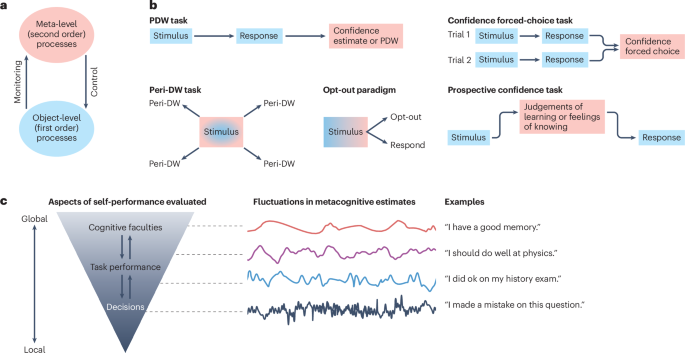
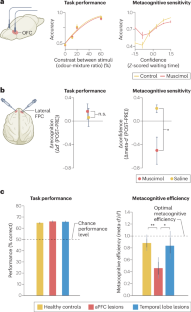
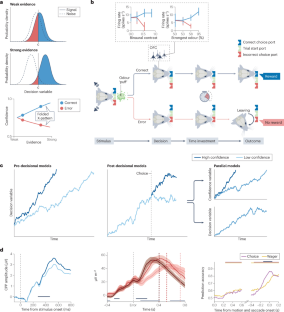
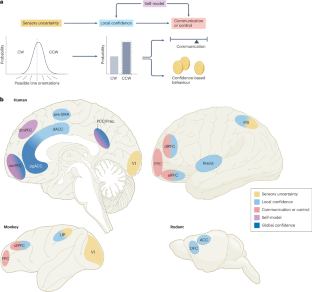
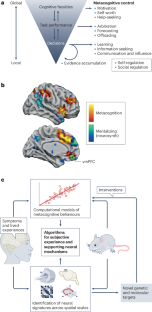
Metacognition enables organisms to self-evaluate their own cognitive processes. In humans, this capacity underpins adaptive learning, social coordination and the formation of self-beliefs about skill and ability. A core motif that underpins multiple forms of metacognition is the ability to form estimates of performance in a self-directed frame of reference, expressed as propositional confidence about one’s own behaviour and mental processes. Convergent behavioural, computational and neural evidence obtained across rodents, non-human primates and humans indicates that these self-evaluations arise from structured transformations of uncertainty. Dynamic evidence accumulation processes provide candidate building blocks for local confidence, whereas multimodal prefrontal brain areas integrate these signals to support abstract, global self-beliefs. This architecture supports metacognitive control at multiple timescales, from rapid error correction to strategic task arbitration and social communication. Dysfunctional metacognition can lead to disorders of reality monitoring and insight, in which erroneous mental representations are endorsed with aberrant confidence. By integrating computational, cross-species and clinical perspectives, metacognitive neuroscience offers a bridge from neural circuit mechanisms to subjective experience. The capacity to self-evaluate and control one’s own cognitive performance, known as metacognition, underpins adaptive learning, social behaviours and self-belief. Stephen Fleming outlines our current understanding of the neural basis of metacognition, its contributions to self-regulation and social communication, and the consequences of its dysfunction in clinical conditions.
Towards an integrative neuroscience of metacognition
Skip to main content
Thank you for visiting nature.com. You are using a browser version with limited support for CSS. To obtain the best experience, we recommend you use a more up to date browser (or turn off compatibility mode in Internet Explorer). In the meantime, to ensure continued support, we are displaying the site without styles and JavaScript.
Close banner Close

Sign up for the Nature Briefing newsletter — what matters in science, free to your inbox daily.
Email address
Sign up
I agree my information will be processed in accordance with the Nature and Springer Nature Limited Privacy Policy.
Close banner Close
Get the most important science stories of the day, free in your inbox. Sign up for Nature Briefing