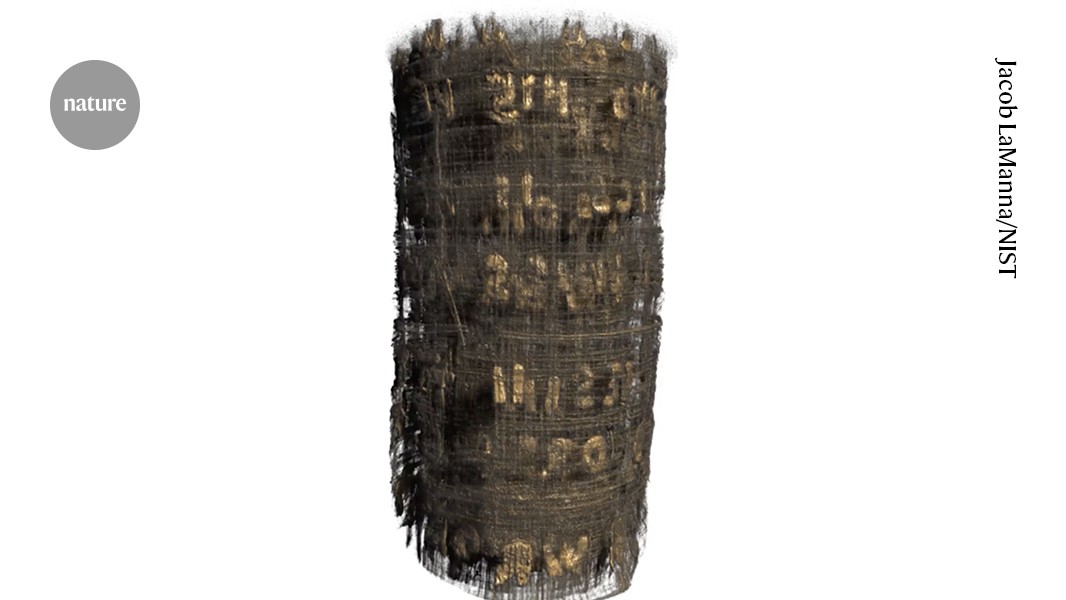


Watch scientists decipher burned scrolls without unrolling them
We might soon be able to read thousands of long-lost ancient scrolls charred by the eruption of Mount Vesuvius. Researchers have made their own burned, rolled-up papyri and showed that the text can be deciphered by detecting the element lead in the ink, in a study published on 16 September in PLoS ONE1.
Almost 2,000 years ago, in ad 79, the Roman town of Herculaneum in what is now Italy was destroyed in a cataclysmic eruption, as a cloud of hot gas, ashes and pumice burnt people and objects. Waves of volcanic mud then buried the town. The event also carbonized more than 1,000 brittle papyrus scrolls and preserved them in that state. It is the only known complete library from antiquity.
A few scrolls were physically unrolled after their discovery in 1752 in attempts to read them, but many crumbled into ash, quickly halting these efforts.
No unfurling needed
In the past few years, X-ray computed tomography (CT) — an imaging technique that can create 3D models of the inside of an object, or a body, by seeing how it blocks X-rays — combined with machine learning have allowed researchers to digitally unroll some scrolls and decipher the writing inside.
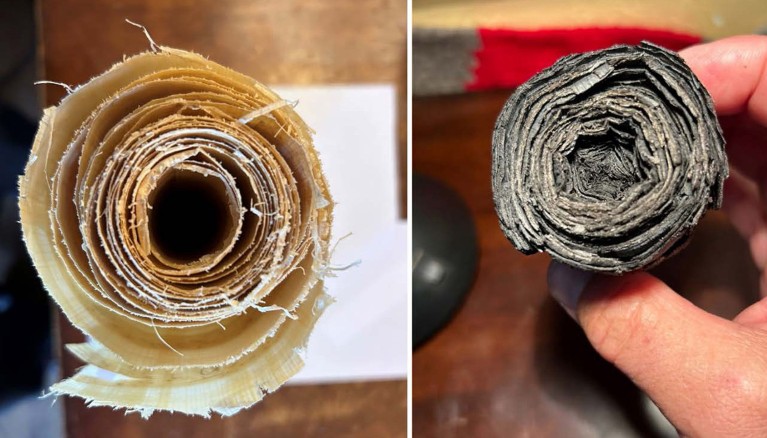
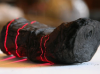
Papyrus recreated, inscribed with text and burnt to simulate ancient damaged scrolls. Credit: Seiler et al., 2026, PLOS One, CC0
Last year, in a milestone effort to virtually unroll and read scrolls from Herculaneum, a team scooped a US$60,000 prize by using an algorithm to identify a Greek work, as part of the Vesuvius Challenge, a global machine-learning and computer-vision competition offering huge cash prizes for reading the scrolls. And earlier this year, a whole scroll was deciphered without being opened2.
But such studies often struggle to spot letters, because standard CT scanning techniques assess carbon-based materials, and both the ink and papyrus contain carbon.
“Overcoming the ink-detection problems would help considerably in revealing the contents of the unrolled Herculaneum papyri and assist in speeding up the process of virtual unwrapping,” says Thomas Coward, a classicist at the University of Nottingham, UK, who wasn’t involved in the PLoS ONE work.
Douglas Seiler, a retired inventor and affiliate of the University of California, Berkeley, and his colleagues, wondered whether trying to detect lead, rather than carbon, in the ink would allow it to be more clearly distinguished from the papyrus. To put the idea to the test, Seiler and his colleagues attempted to recreate carbonized scrolls, sourcing papyrus and reed pens from Egypt and traditional lampblack ink from Japan. “We wanted the ingredients to be as identical to the original scrolls as possible,” says Seiler.
They used ink with various concentrations of lead to inscribe the papyrus. Next, they rolled up the papyri and put them in a high-temperature furnace, replicating the roasting that the ancient scrolls went through at Herculaneum.
To see how well they could read the still-rolled-up burned scrolls, Seiler and his colleagues created a 3D rendering of each one by scanning it as thousands of ‘slices’ in the Neutron and X-ray Tomography system at the US National Institute of Standards and Technology. The team then virtually unrolled them using a custom version of a program originally designed to unroll scans of the coils of thin films inside lithium-ion batteries to understand performance loss.
Enjoying our latest content?
Log in or create an account to continue- Access the most recent journalism from Nature's award-winning team
- Explore the latest features & opinion covering groundbreaking research
-
 First passages of rolled-up Herculaneum scroll revealed
-
 Inside the quest to digitally unroll ancient scrolls burnt by Vesuvius
-
 How AI is unlocking ancient texts — and could rewrite history
-
 AI reads text from ancient Herculaneum scroll for the first time
- Chemistry
- Archaeology
- History
- Machine learning
- Chemistry
- Archaeology
- History
-
 Chemists struggle to ditch hazardous solvents — even after decades of ‘green’ efforts News 25 SEP 26
-
 There’s a new form of boron — and it’s really weird News 23 SEP 26
-
 Sequence-encoded hexagonal lattices in multichannel peptide nanofibrils Article 23 SEP 26
-
 Huge hoard of metal bars hints at vast Iron Age trade Research Highlight 23 SEP 26
-
 Exclusive: New evidence for hidden chambers beyond Tutankhamun’s tomb News 17 SEP 26
-
 Ruins of ancient Asian city show engineering prowess and organization Research Highlight 09 SEP 26
-
 What happens in Vegas: one lecturer’s hunt for a projector News & Views 22 SEP 26
- Exclusive: New evidence for hidden chambers beyond Tutankhamun’s tomb News 17 SEP 26
-
 The geometric genius of René Descartes News & Views 15 SEP 26
- #### Postdoc Opportunity at MSK: Research Scholar, Computational Oncology/Immuno Oncology We are seeking a highly motivated computational biology postdoctoral fellow New York City, New York (US) Memorial Sloan Kettering Cancer Center
- #### Postdoctoral Fellow, Computational Immuno-Oncology and Immune-Related Adverse Events Join the Reznik Laboratory within MSK’s Computational Oncology Service New York City, New York (US) Memorial Sloan Kettering Cancer Center
- #### Associate/Senior Editor BMC Surgery/BMC Urology Job Title: Associate/Senior Editor BMC Surgery/BMC Urology Location: New York, NY or Philadelphia Application Deadline: October 19, 2026 About Spri... New York City, New York (US) Springer Nature Ltd
- #### Associate/Senior Editor BMC Nephrology/BMC Endocrine Disorders Job Description Job Title: Associate/Senior Editor BMC Nephrology/BMC Endocrine disorders Location: New York, NY or London, UK London (Central), London (Greater) Springer Nature Ltd
- #### Chief Editor, Nature Robotics
Access through your institution
or
doi: https://doi.org/10.1038/d41586-026-02920-8
References
1. Seiler, D. et al. PLoS ONE 21, e0353485 (2026). Article PubMed Google Scholar 2. Angelotti, G. et al. Preprint at arXiv <https://doi.org/10.48550/arXiv.2606.29085> (2026).
