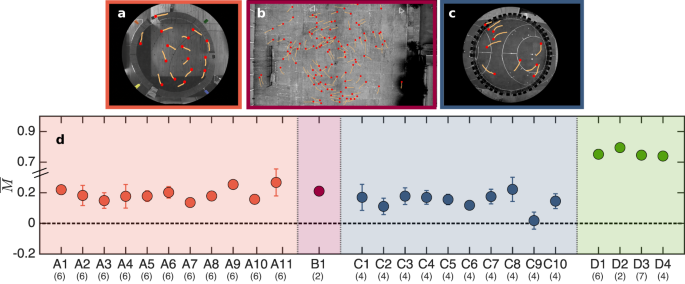
Pedestrian walking behaviour is intrinsic to individuals, yet it is influenced by external factors such as obstacles and the degree of crowding. It is precisely in crowded scenarios that pedestrian interactions lead to collective motions, such as lane formation or waves. Recently, the spontaneous development of collective counterclockwise motion has been reported in both dense and sparse human assemblies. Here we present five experimental studies of this phenomenon conducted across diverse conditions in Spain and Japan, demonstrating that counterclockwise bias in roaming pedestrians is a robust and reproducible feature and originates from individual tendencies rather than from collective interactions. These findings challenge the traditional view that social dynamics shape pedestrian motion, highlighting the existence of an intrinsic locomotor bias. Counterclockwise motion has been documented in human gatherings. The authors show across five experiments in Spain and Japan that this bias reflects individual locomotor tendencies.
Individual locomotor bias drives counterclockwise motion in pedestrian crowds
Skip to main content
Thank you for visiting nature.com. You are using a browser version with limited support for CSS. To obtain the best experience, we recommend you use a more up to date browser (or turn off compatibility mode in Internet Explorer). In the meantime, to ensure continued support, we are displaying the site without styles and JavaScript.
Close banner Close

Sign up for the Nature Briefing newsletter — what matters in science, free to your inbox daily.
Email address
Sign up
I agree my information will be processed in accordance with the Nature and Springer Nature Limited Privacy Policy.
Close banner Close
Get the most important science stories of the day, free in your inbox. Sign up for Nature Briefing