








Timeline of Mathematics
Timeline of Mathematics
20000 BCE
10000 BCE
5000 BCE
4000 BCE
3000 BCE
2000 BCE
1000 BCE
900 BCE
800 BCE
700 BCE
600 BCE
500 BCE
400 BCE
300 BCE
200 BCE
100 BCE
0
100
200
300
400
500
600
700
800
900
1000
1100
1200
1300
1400
1500
1600
1700
1800
1900
2000
Stone Age
Bronze Age
Classical Antiquity
Middle Ages
Renaissance
Enlightenment
Modern
ViazovskaAvilaMirzakhaniTaoPerelmanZhangDaubechiesBourgainWilesShamirYauMatiyasevichThurstonUhlenbeckConwayLanglandsCohenEasleyAppelPenroseNashGrothendieckSerreMandelbrotWilkinsRobinsonBlackwellJohnsonLorenzShannonGardnerErdősTuringChernUlamWeilGödelvon NeumannKolmogorovCartwrightEscherCoxRamanujanNoetherEinsteinHardyRussellHilbertPeanoPoincaréKovalevskayaCantorLieCarrollDedekindRiemannCayleyNightingaleLovelaceBooleSylvesterGaloisJacobiDe MorganHamiltonBolyaiAbelLobachevskyBabbageMöbiusCauchySomervilleGaussGermainWangFourierLegendreMascheroniLaplaceMongeLagrangeBannekerLambertAgnesiEulerDu ChâteletBernoulliGoldbachSimsonDe MoivreBernoulliCevaLeibnizSekiNewtonPascalWallisFermatCavalieriDescartesDesarguesMersenneKeplerGalileoNapierStevinViètePedro NunesCardanoTartagliaCopernicusDa VinciPacioliRegiomontanusMadhavaOresmeZhu ShijieYangQinAl-Din TusiLi YeFibonacciBhaskara IIKhayyamJiaAl-HaythamAl-KarajiThabitAl-KhwarizmiBhaskara IBrahmaguptaAryabhataZuHypatiaLiuDiophantusPtolemyNicomachusHeronHipparchusApolloniusEratosthenesArchimedesPingalaEuclidAristotleEudoxusPlatoDemocritusZenoPythagorasThalesIshango BoneCountersMS 3047VAT 12593Plimpton 322YBC 7289YBC 7290Rhind PapyrusTomb of MennaBamboo TableElementsPalimpsestSuàn shù shūKhmer ZeroAl-JabrAl-JabrLilavatiMaya CodexLiber AbaciSiyuan YujianIncan QuipuPolyhedraAztec Dates
c. 300 BCE: Indian mathematician Pingala writes about zero, binary numbers, Fibonacci numbers, and Pascal’s triangle.
c. 260 BCE: Archimedes proves that π is between 3.1429 and 3.1408.
c. 235 BCE: Eratosthenes uses a sieve algorithm to quickly find prime numbers.
c. 200 BCE: The “Suàn shù shū” (Book on Numbers and Computation) is one of the oldest Chinese texts about mathematics.
c. 100 CE: Nicomachus poses the oldest still-unsolved problem in mathematics: whether there are any odd perfect numbers.
c. 250 CE: The Mayan culture in Central America flourishes, and uses a base-20 numeral system.
c. 830 CE: Al-Khwarizmi publishes “Kitab al-jabr wa al-muqābalah”, the first book about – and the namesake of – Algebra.
1202: Fibonacci’s Liber Abaci introduces Arabic numerals to Europe, as well as simple algebra and the Fibonacci numbers.
1482: First printed edition of Euclid’s Elements
1545: Cardano conceives the idea of complex numbers.
1609: Kepler publishes the “Astronomia nova”, where he explains that planets move on elliptical orbits.
1618: Napier publishes the first references to the number e, in a book on logarithms.
1637: Fermat claims to have proven Fermat’s Last Theorem.
1654: Pascal and Fermat develop the theory of probability.
1684: Leibniz’ publishes the first paper on the calculus.
1687: Newton publishes the Principia Mathematica, containing the laws of gravity and motion, as well as his version of calculus.
1736: Euler solves the Königsberg bridges problem by inventing graph theory.
1761: Lambert proves that π is irrational
1799: Gauss proves the fundamental theorem of algebra.
1829: Bolyai, Gauss and Lobachevsky all invent hyperbolic non-Euclidean geometry.
1832: Galois finds a general condition for solving algebraic equations, thereby founding Group theory and Galois theory.
1858: August Ferdinand Möbius invents the Möbius strip.
1874: Cantor proves that there are different “sizes” of infinity, and that the real numbers are uncountable.
1895: Poincaré’s paper “Analysis Situs” starts modern topology.
1905: Einstein explains the photoelectric effect and Brownian motion, discovers special relativity, and E = mc².
1915: Noether shows that every conservation law in physics corresponds to a symmetry of the universe.
1931: Gödel’s incompleteness theorem establishes that mathematics will always be incomplete.
1939: A group of French mathematicians publish their first book under the pseudonym of Nicolas Bourbaki, on Set theory.
1961: Lorenz discovers chaotic behaviour in weather simulations – the butterfly effect.
1976: Appel and Haken prove the Four Colour Conjecture using a computer.
1977: Adelman, Rivest and Shamir introduce public-key cryptography using prime numbers.
1994: Andrew Wiles proves Fermat’s Last Theorem.
2000: The Clay Mathematics Institute published the seven Millenium Prize Problems.
2003: Perelman proves the Poincaré conjecture, the only one of the seven Millennium problems that have been solved to date.
c. 9100 BCE: Oldest known agricultural settlement in Cyprus.
c. 2030 BCE: The Sumerian city of Ur is the largest city in the world.
c. 3500 BCE: The first vehicles with wheels appear in Mesopotamia and Eastern Europe.
c. 3200 BCE: The first writing systems appear in Mesopotamia, Egypt and the Indus Valley.
c. 3000 BCE: First evidence of smelting iron ore to make wrought iron.
c. 2560 BCE: The Great Pyramid of Giza is built in ancient Egypt, for Pharaoh Khufu.
c. 1754 BCE: The Babylonian King Hammurabi Issues the Code of Hammurabi, one of the first legal documents.
776 BCE: The first Olympic Games competition takes place in Greece.
753 BCE: Legendary date of the founding of Rome.
c. 563 BCE: Buddha is born in India. His teachings become the foundation of Buddhism.
c. 551 BCE: Confucius is born in China. His teachings become the foundation of Confucianism.
490 BCE: Greece stop the Persian invasion at the battle of Marathon. The Classical period begins.
432 BCE: The Acropolis is built in Athens, during its golden age under the rule of Pericles.
399 BCE: Socrates is sentenced to death, refuses to escape, and drinks a cup of poison.
327 BCE: Alexander the Great invades India, having created an enormous empire across Asia.
c. 221 BCE: Qin Shi Huang unifies China and starts construction of the Great Wall.
146 BCE: The Roman army destroys Carthage, ending the Third Punic War.
44 BCE: Julius Caesar is murdered.
4 BCE: Jesus of Nazareth is born in Bethlehem, establishing Christianity.
180 CE: The death of Marcus Aurelius ends the Pax Romana, a 200 year period of peace across Europe.
476 CE: Fall of the Roman Empire
570 CE: Muhammad, the founder of Islam, is born in Mecca.
c. 641 CE: The Library of Alexandria is destroyed.
800 CE: Charlemagne is crowned as the first Holy Roman Emperor.
c. 870 CE: Norse explorers discover and colonise Iceland.
1066: William the Conqueror wins the battle of Hastings and is crowned King of England.
1088: The first university is established in Bologna, Italy.
1096: The First Crusade is launched by Pope Urban II.
1206: Genghis Khan defeats his rivals and receives the title “Universal Ruler of the Mongols”.
1215: King John of England is forced to sign the Magna Carta, restricting his powers.
1266: Marco Polo arrives at the court of Kublai Khan in Beijing.
c. 1347: The Black Death kills millions of people across Europe.
1439: Johannes Gutenberg invents the printing press.
1453: The Ottoman Turks conquer Constantinople, marking the fall of the Byzantine empire.
1492: Christopher Columbus arrives in America, starting a new age of European conquest.
1517: Martin Luther publishes his 95 theses, starting the Protestant reformation.
1522: Ferdinand Magellan’s expedition circumnavigates Earth.
1543: Polish scientist Nicolaus Copernicus writes that the Earth revolves around the Sun.
1588: Under Queen Elizabeth I, England defeats the Spanish Armada.
1603: William Shakespeare’s “Hamlet” is performed for the first time.
1633: Galileo Galilei is tried by the Catholic Inquisition for his scientific writings.
1649: King Charles I is tried and beheaded during the English Civil War.
1756: Wolfgang Amadeus Mozart is born in Austria.
c. 1765: James Watt invents a more efficient steam engine, that will power the industrial revolution.
1776: America Issues its Declaration of Independence from Great Britain.
1789: Revolutionaries storm the Bastille in Paris, starting the French Revolution.
1804: Napoleon is crowned emperor of France.
1819: Simón Bolívar defeats Spain at the Battle of Boyacá, leading to the independence of many South American countries.
1837: Samuel Morse and others develop electrical telegraphs.
1859: Charles Darwin publishes “On the Origin of Species”, introducing natural selection.
1865: Abraham Lincoln is assassinated, at the end of the American Civil War.
1876: Alexander Bell invents the telephone.
1903: The Wright Brothers construct the first powered, heavier-than-air aircraft.
1914: Franz Ferdinand of Austria is assassinated in Sarajevo, starting the first World War.
1929: The Black Tuesday stock market crash starts the great depression.
1939: Adolf Hitler invades Poland, starting World War II.
1953: Watson and Crick discover the double-helix structure of DNA.
1957: The Soviet Union launches Sputnik 1, the first man-made satellite into space.
1969: Apollo 11 astronauts Neil Armstrong and Buzz Aldrin land and walk on the moon.
1975: End of the Vietnam War
1989: Tim Berners-Lee invents the World Wide Web.
Viazovska

CC BY-SA 2.0, by Petra Lein
Maryna Viazovska (born 1984) is a Ukrainian mathematician and only the second woman in history to receive the Fields Medal, the highest award in mathematics.
Viazovska solved the sphere-packing problem in 8 and 24 dimensions, which asks about the most efficient way to arrange solid spheres. She is a professor at the École Polytechnique Fédérale in Lausanne, Switzerland.
Avila
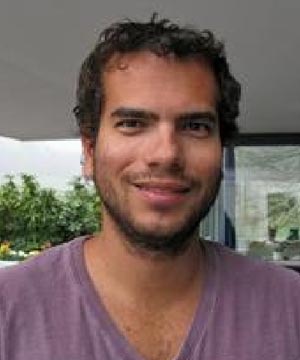
Artur Avila (born 1979) is a Brazilian mathematician, and the first Latin-American to receive the Fields medal. He made numerous discoveries related to chaos theory and dynamical systems.
Mirzakhani

Maryam Mirzakhani (مریم میرزاخانی, 1977 – 2017) was an Iranian mathematician and professor at Stanford University. She was the first woman to receive the Fields Medal, the highest award in mathematics.
Mirzakhani worked at the intersection of dynamical systems and geometry. She studied objects like hyperbolic surfaces and complex manifolds, but also contributed to many other areas of mathematics.
When solving problems, Mirzakhani would draw doodles and diagrams on large sheets of paper, to see the underlying patterns and beauty. Her daughter even described Maryam’s work as “painting”. At the age of 40, Mirzakhani died of breast cancer.
Tao
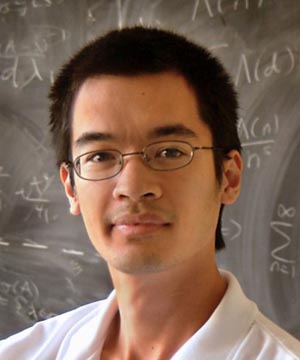
Born in Adelaide, Australia, Terence Tao (born 17 July) is sometimes called the “Mozart of mathematics”. When he was 13, he became the youngest ever winner of the International Mathematical Olympiad, and when he was 24, he became the youngest tenured professor at the University of California, Los Angeles.
Tao has received the MacArthur Fellowship, the Breakthrough Prize in mathematics, as well as the Fields Medal, the highest award in mathematics, for “his contributions to partial differential equations, combinatorics, harmonic analysis and additive number theory”.
Together with Ben Green, Tao proved the Green-Tao theorem, which states that there are arbitrarily long arithmetic sequences of prime numbers.
Perelman
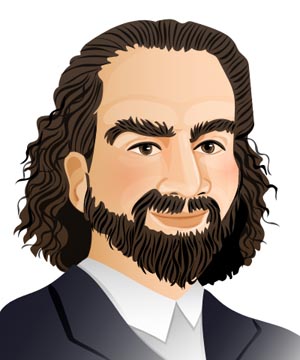
In 2003, the Russian mathematician Grigori Perelman (Григо́рий Перельма́нborn, born 1966) proved the Poincaré Conjecture, which, until then, was one of the most famous unsolved problems in mathematics.
The complex proof was verified by 2006, but Perelman declined two big awards that came with it: the $1 million Clay Millennium Prize, and the Fields Medal which is the highest recognition in mathematics. In fact, he said: “I’m not interested in money or fame; I don’t want to be on display like an animal in a zoo.”
Perelman also made contributions to Riemannian geometry and geometric topology, and the Poincaré Conjecture is still the only one of the seven Millennium Prize problems to have been solved.
Zhang
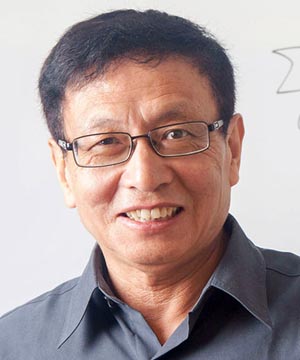
Yitang Zhang (张益唐, born 1955) was born in China and is now a professor of mathematics at the University of California.
Zhang discovered that there is a number k less than 70 million, so that there are infinitely many pairs of prime numbers that are exactly k apart. This was a groundbreaking discovery in number theory, for which he received the MacArthur award in 2014.
This is similar to the Twin Prime conjecture, which states that there are infinitely many pairs exactly 2 apart (for example 11 and 13) – but no one knows if this is true.
Daubechies
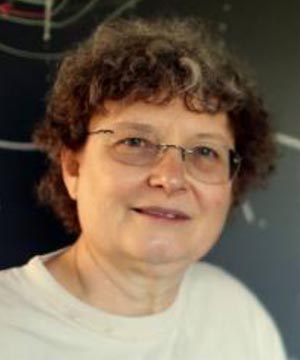
Ingrid Daubechies (born 1954) is a Belgian physicist and mathematician. She was the first female president of the International Mathematical Union (IMU).
Daubechies studied different types of wavelets, which are now an essential part of image compression formats like JPEG.
Bourgain
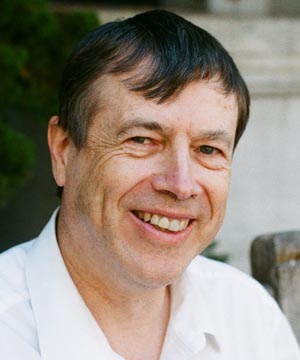
Jean Bourgain (1954 – 2018) was a Belgian mathematician who studied topics like Banach spaces, harmonic analysis, ergodic theory and non-linear partial differential equations. He received the Fields medal in 1994.
Wiles
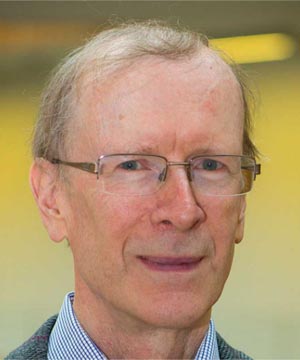
The British mathematician Sir Andrew Wiles (born 1953) is best known for proving Fermat’s Last Theorem, which, until then, was one of the most famous unsolved problems in mathematics.
In 1637, Pierre de Fermat, wrote in the margin of a textbook that he had a wonderful proof that the equation an+bn=cn has no integer solutions for n>2. Unfortunately, no one was able to find a proof – until Wiles, some 400 years later.
Wiles had been fascinated by the problem since the age of 10, and spent seven years working on it in solitude. He announced his solution in 1993, although a small gap in his argument took two more years to fix.
He was too old to receive the Fields medal, the highest award in mathematics, which has an age limit of 40. Instead, Wiles was awarded a special silver plaque for his work.
Shamir
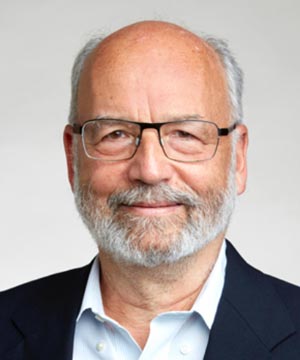
Adi Shamir (born 1952) is an Israeli mathematician and cryptographer. Together with Ron Rivest and Len Adleman, he invented the RSA algorithm, which uses the difficulty of factoring prime numbers to encode secret messages.
Yau

Shing-Tung Yau (丘成桐, born 1949) is an American mathematician, originally from Shantou in China. He studied partial differential equations and geometric analysis, and his work has many applications – including in general relativity and string theory.
Matiyasevich
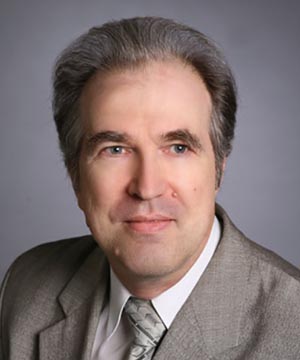
Yuri Matiyasevich (Ю́рий Матиясе́вич, born 1947) is a Russian mathematician and computer scientist. In 1970, he proved that Hilbert’s tenth problem, one of the challenges posed by David Hilbert in 1900, has no solution (building upon the work of Martin Davis, Hilary Putnam and Julia Robinson). This is now known as Matiyasevich’s theorem or the MRDP theorem.
The problem asks for an algorithm to decide whether a given Diophantine equation (a polynomial equations with integer coefficients) has any integer-valued solutions.
Thurston

William Paul Thurston (1946 – 2012) was an American mathematician and a pioneer in the fields of topology, manifolds and geometric group theory.
Thurston's Geometrization Conjecture is about describing the structure and geometry of different three-dimensional spaces. In 1982, he was awarded the Fields Medal for his study of 3D manifolds.
Uhlenbeck
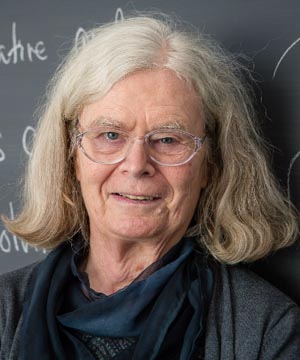
Karen Uhlenbeck (born 1942) is an American mathematician, professor emeritus at the University of Texas, and distinguished visiting professor at Princeton University.
She is one of the founders of the field of modern geometric analysis, and the only woman to have received the Abel Prize, one of the highest awards in mathematics.
Conway
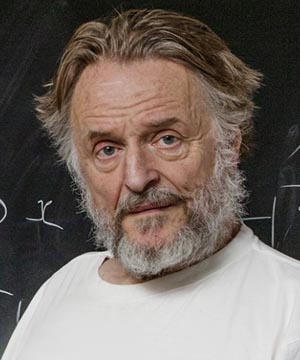
John Horton Conway (1937 – 2020) was a British mathematician who worked at Cambridge and Princeton University. He was a fellow of the Royal Society, and the first recipient of the Pólya Prize.
He explored the underlying mathematics of everyday objects like knots and games, and he contributed to group theory, number theory and many other areas of mathematics. Conway is known for inventing “Conway’s Game of Life”, a cellular automaton with fascinating properties.
Langlands
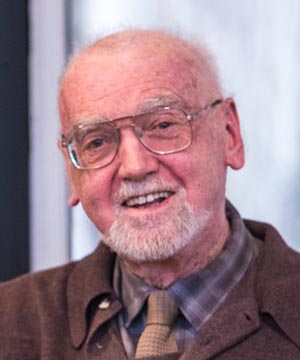
Robert Langlands (born 1936) is an American-Canadian mathematician. He studied at Yale University, and later returned there as a professor. Now he occupies Albert Einstein’s old office as an emeritus professor at Princeton University.
In 2018, Langlands received the Abel Prize, one of the highest awards in mathematics, for “his visionary program connecting representation theory to number theory”. The Langlands program, which he first proposed in 1967, consists of a vast web of conjectures and theorems that link different areas of mathematics.
Cohen
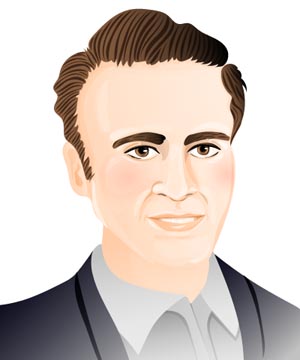
Paul Joseph Cohen (1934 – 2007) was an American mathematician who proved the continuum hypothesis, and that the axiom of choice is independent from the other Zermelo–Fraenkel axioms of set theory. He received the Fields medal for his work.
Continuum HypothesisAxiom of Choice
Easley
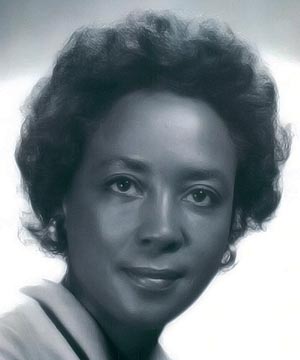
Annie Easley (1933 – 2011) was an American mathematician and computer scientist. She was one of the first African-Americans to work at NASA as a “computer”.
Easley wrote the software for the Centaur rocket stage, and her work paved the way for later rocket and satellite launches. She also analysed battery life, energy conversion, and alternative power technologies like solar and wind.
Appel
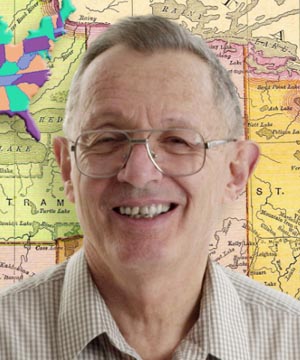
Kenneth Appel (1932 – 2013) was an American mathematician, known for his proof of the Four Colour Theorem with Wolfgang Haken.
In recognition, he and Haken received the Fulkerson Prize of the American Mathematical Society.
Appel studied at Queens College, New York, and the University of Michigan. He taught at the University of Illinois, and the University of New Hampshire.
Penrose
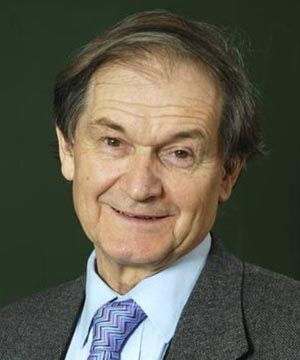
Sir Roger Penrose (born 1931) is a British mathematician and physicist who is known for his groundbreaking work in general relativity and cosmology. He also discovered Penrose Tilings: self-similar, non-periodic tessellations using only two different tiles.
In 1988, he shared the Wolf Prize with Stephen Hawking, and in 2020, he received the Nobel Prize in physics for discoveries about the formation of black holes.
Nash
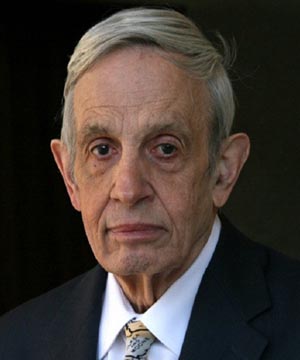
John Forbes Nash (1928 – 2015) was an American mathematician who worked on game theory, differential geometry and partial differential equations. He showed how mathematics can explain the decision-making in complex, real-life systems – including economics and the military.
In his 30s, Nash was diagnosed with paranoid schizophrenia, but he managed to recover and return to his academic work. He is the only person to receive both the Nobel Prize for economics and the Abel Prize, one of the highest awards in mathematics.
Grothendieck
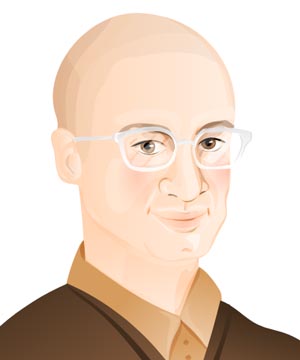
The French mathematician Alexander Grothendieck (1928 – 2014) was one of the key figures in the development of algebraic geometry. He extended the scope of the field to apply to many new problems in mathematics, including, eventually, Fermat’s last theorem. In 1966, he was awarded the Fields medal.
Serre
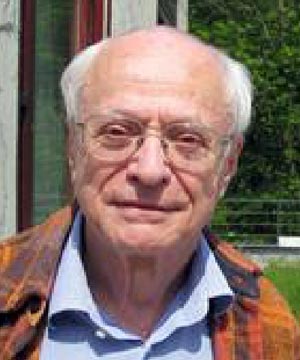
Jean-Pierre Serre (born 1926) is a French mathematician who helped shape the fields of topology, number theory and algebraic geometry. He is the first person to receive the Fields medal, the Abel Prize and the Wolf Prize – the three highest awards in mathematics.
Mandelbrot
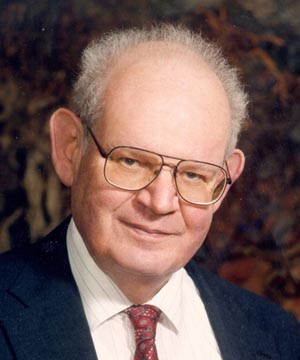
The mathematician Benoit Mandelbrot was born in Poland, grew up in France, and eventually moved to the United States. He was one of the pioneers of fractal geometry, and particularly interested in how “roughness” and “chaos” appear in the real world (e.g. clouds or coastlines).
While working at IBM, he used early computers to create graphical representations of fractals, and in 1980 he discovered the famous Mandelbrot set.
Wilkins
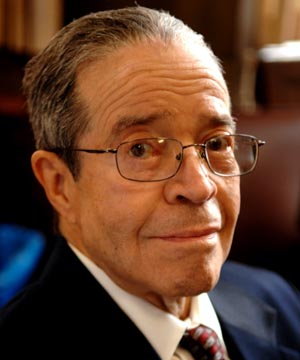
Ernest Wilkins (1923 – 2011) was an American engineer, nuclear scientist and mathematician. He attended the University of Chicago at the age of 13, becoming its youngest ever student.
During the second world war, he contributed to the Manhattan Project to develop the first nuclear weapons. As a nuclear scientists, he later helped to design nuclear reactors to generate power.
Wilkins published more than 100 papers, covering subjects like differential geometry, calculus, nuclear engineering and optics – even though, as an African-American, he was often the target of racism.
Robinson

Julia Robinson (1919 – 1985) was an American mathematician. She is the first female mathematician elected to the US National Academy of Sciences, and was the first female president of the American Mathematical Society.
She spent much of her research studying the tenth problem on Hilbert’s famous list: to find an algorithm for determining if a diophantine equation has any integer-valued solutions. The proof was finally completed by Yuri Matuasevic in 1970, and is now known as the MRDP theorem (where the R stands for Robinson).
Robinson also made contributions to computability theory and computational complexity theory.
Blackwell
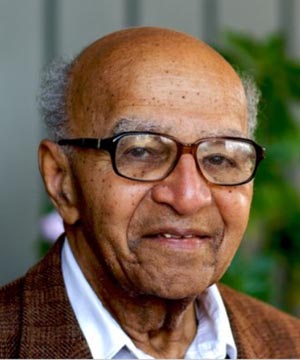
David Blackwell (1919 – 2010) was an American statistician and mathematician. He worked on game theory, probability theory, information theory and dynamic programming, and wrote one of the first textbooks on Bayesian statistics. The Rao-Blackwell Theorem shows how to improve estimators of certain quantities in statistics.
Blackwell was the first African-American elected to join the American National Academy of Sciences, and he was one of the first to receive a PhD in mathematics.
Johnson
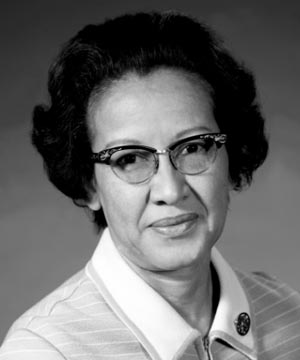
Katherine Johnson (1918 – 2020) was an African-American mathematician. While working at NASA, Johnson calculated the orbits taken by American astronauts – including Alan Shepard, the first American in space, the Apollo Moon landing program, and even the Space Shuttle.
Her extraordinary ability to calculate orbital trajectories, launch windows and emergency return paths was widely known. Even after the arrival of computers, astronaut John Glenn asked her to personally re-check the electronic results.
In 2015, Johnson received the Presidential Medal of Freedom.
Lorenz
Edward Lorenz (1917 – 2008) was an American mathematician and meteorologist. He pioneered chaos theory, discovered strange attractors, and coined the term “butterfly effect”.
Shannon
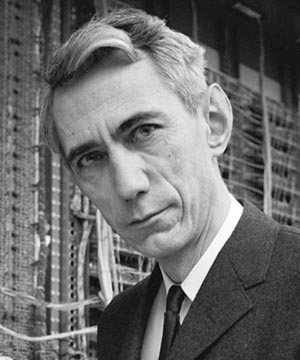
Claude Shannon (1916 – 2001) was an American mathematician and electrical engineer, remembered as the “father of information theory”. He worked on cryptography, including codebreaking for national defence during World War II, but he was also interested in juggling, unicycling and chess. In his spare times, he built machines that could juggle or solve the Rubik’s Cube puzzle.
Gardner
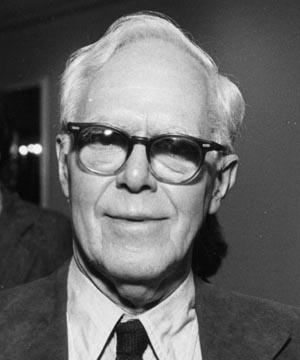
Martin Gardner (1914 – 2010) used stories, games, puzzles and magic tricks to popularise mathematics and make it accessible to a wider audience. The American science author wrote or edited more than 100 books, and is one of the most important magicians and puzzle creators of the twentieth century. For more than 24 years, he wrote a “Mathematical games” column in the Scientific American magazine.
Erdős
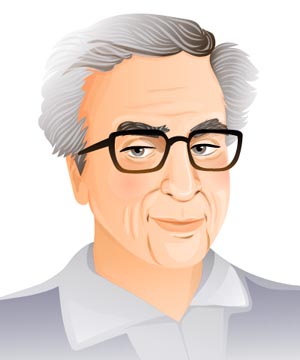
Paul Erdős (1913 – 1996) was one of the most productive mathematicians in history. Born in Hungary, he solved countless problems in graph theory, number theory, combinatorics, analysis, probability, and other parts of mathematics.
During his life, Erdős published around 1,500 papers and collaborated with more than 500 other mathematicians. In fact, he spent most of his life living out of a suitcase, travelling to seminars, and visiting colleagues!
Turing
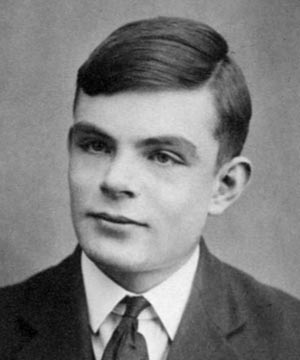
Alan Turing (1912 – 1954) was an English mathematician and is often called the “father of computer science”.
During the Second World War, Turing played a critical role in breaking the Enigma code used by the German military, as part of the “Government Code and Cypher School” at Bletchley Park. This helped the Allies win the war, and may have saved millions of lives.
He also invented the Turing machine, a mathematical model of a general purpose computer, and the Turing test, which can be used to judge the ability of artificial intelligence.
Turing was gay, which was still a crime during his life, and meant that his groundbreaking accomplishments were never fully recognised. He committed suicide at the age of 41.
Chern
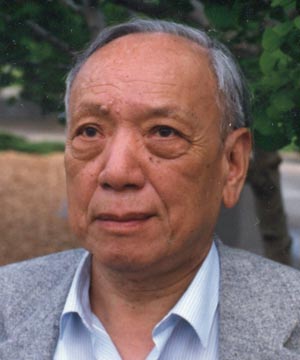
Shiing-Shen Chern (1911 – 2004) was a Chinese-American mathematician and poet. He is the father of modern differential geometry. His work on geometry, topology, and knot theory even has applications in string theory and quantum mechanics.
Ulam
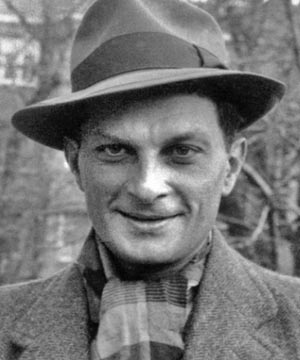
Stanisław Ulam (1909 – 1984) was a Polish-American mathematician. He played an important part in the American Manhattan Project that developed the first nuclear weapons. He also worked on rocket propulsion using nuclear pulses, and developed the Monte Carlo method – an important concept in statistics.
Weil

André Weil (1906 – 1998) was one of the most influential French mathematicians in the 20th century.
He was one of the founders of the Bourbaki group, a group of mathematicians working under the collective pseudonym Nicolas Bourbaki. The goal of the Bourbaki group was to unify all of mathematics with a formal, axiomatic foundation.
Weil believed that many problems in algebra and number theory had analogous versions in algebraic geometry and topology. These are known as Weil conjectures, and became the basis for both disciplines. They also have applications in fields like cryptography and computer science.
During the second World War, Weil fled to the United States and later joined the Institute for Advanced Study at Princeton University.
Gödel
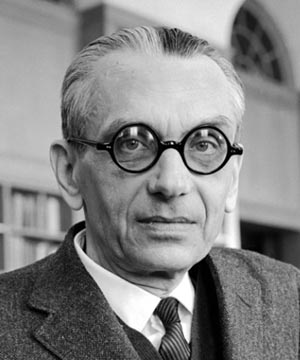
Kurt Gödel (1906 – 1978) was an Austrian mathematician who later immigrated to America, and is considered one of the greatest logicians in history.
At the age of 25, just after finishing his doctorate in Vienna, he published his two incompleteness theorems. These state that any (consistent and sufficiently powerful) mathematical system contains certain statements that are true but cannot be proven. In other words, mathematics contains certain problems that are impossible to solve.
This result had a profound impact on the development and philosophy of mathematics. Gödel also found an example of these “impossible theorems”: the continuum hypothesis.
Unprovable TheoremsContinuum Hypothesis
von Neumann
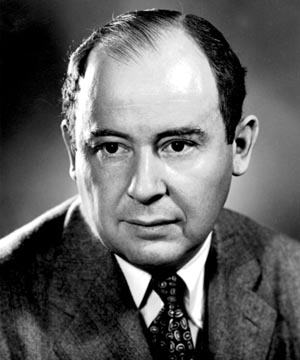
John von Neumann (1903 – 1957) was a Hungarian-American mathematician, physicist and computer scientist. He made important contributions to pure mathematics, was a pioneer of quantum mechanics, and developed concepts like game theory, cellular automata, self-replicating machines, and linear programming.
During World War II, von Neumann was a key member of the Manhattan Project, working on the development of the hydrogen bomb. He later consulted for the Atomic Energy Commission and the US Air Force.
Kolmogorov
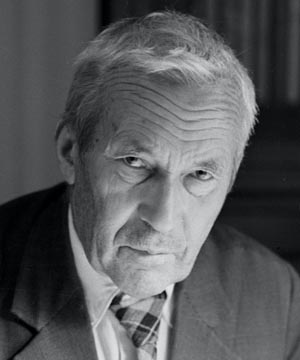
Andrey Kolmogorov (Андре́й Колмого́ров, 1903 – 1987) was a Soviet mathematician. He made significant contributions to probability theory, stochastic processes and Markov chains. He also studied topology, logic, mechanics, number theory, information theory and complexity theory.
During World War II, Kolmogorov used statistics to predict the distribution of bombings in Moscow. He also played an active role in reforming the education system in the Soviet Union, and developing a pedagogy for gifted children.
Cartwright
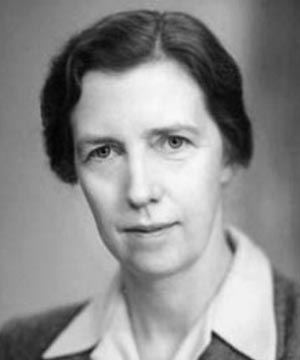
Mary Lucy Cartwright (1900 – 1998) was a British mathematician and one of the pioneers of Chaos theory. Together with Littlewood, she discovered curious solutions to a problem: an example of what we now call the Butterfly effect.
Escher
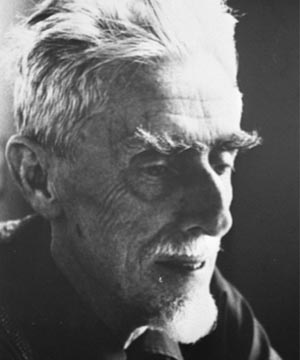
Maurits Cornelis Escher (1898 – 1972) was a Dutch artist who created sketches, woodcuts and lithographs of mathematically inspired objects and shapes: including polyhedra, tessellations and impossible shapes. He graphically explored concepts like symmetry, infinity, perspective and non-euclidean geometry.
Cox
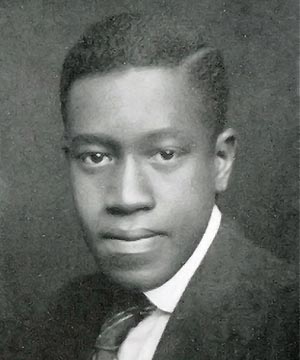
Elbert Cox (1895 – 1969) was the first African-American mathematician to receive a PhD. Universities in England and Germany refused to accept his thesis at the time, but Japan’s Tohoku Imperial University did.
Cox taught at Howard University in the United States, he studied polynomial solutions to differential equations, generalised the Boole summation formula, and compared different grading systems.
Ramanujan
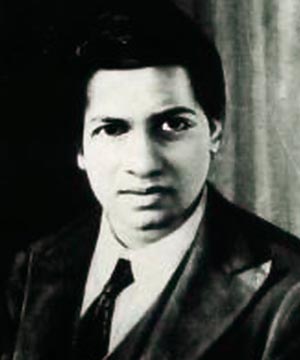
Srinivasa Ramanujan (1887 – 1920) grew up in India, where he received very little formal education in mathematics. Yet, he managed to develop new ideas in complete isolation, while working as a clerk in a small shop.
After a few failed attempts to contact other mathematicians, he wrote a letter to the famous G.H. Hardy. Hardy immediately recognised Ramanujan's genius, and arranged for him to travel to Cambridge in England. Together, they made numerous discoveries in number theory, analysis, and infinite series.
Unfortunately, Ramanujan soon fell ill and was forced to return to India, where he died at the age of 32. During his short life, Ramanujan proved over 3000 theorems and equations, on a wide range of topics. His work created entirely new areas of maths, and his notebooks were studied by other mathematicians for many decades after his death.
Noether
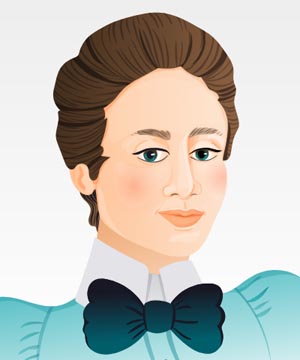
Amalie Emmy Noether (1882 – 1935) was a German mathematician who made important discoveries in abstract algebra and theoretical physics, including the connection between symmetry and conservation laws. She is often described as the most influential female mathematician.
Einstein
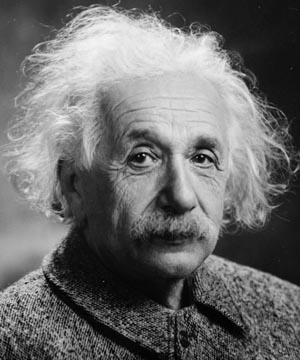
Albert Einstein (1879 – 1955) was a German physicist, and one of the most influential scientists in history. He received the Nobel Prize for physics and TIME magazine called him the person of the 20th century.
Einstein triggered the most significant transformation in our view of the universe since Newton. He realised that classical, Newtonian physics was no longer enough to explain certain physical phenomenons.
At the age of 26, during his “miracle year”, he published four groundbreaking scientific papers that explained the photoelectric effect and Brownian motion, introduced special relativity, and derived the formula E=mc2, which states that energy (E) and mass (m) are equivalent.
Hardy
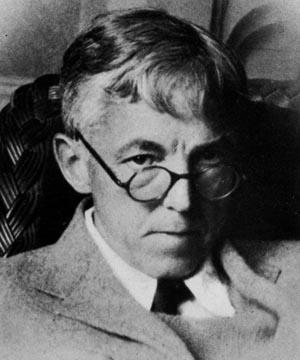
G.H. Hardy (1877 – 1947) was a leading English pure mathematician. Together with John Littlewood, he made important discoveries in analysis and number theory, including the distribution of prime numbers.
In 1913, Hardy received a letter from Srinivasa Ramanujan, an unknown, self-taught clerk from India. Hardy immediately recognised his genius, and arranged for Ramanujan to travel to Cambridge where he was working. Together, they made important discoveries and authord numerous paper.
Hardy always disliked applied mathematics and expressed this in his personal account of mathematical thinking, the 1940 book A Mathematician’s Apology.
Russell
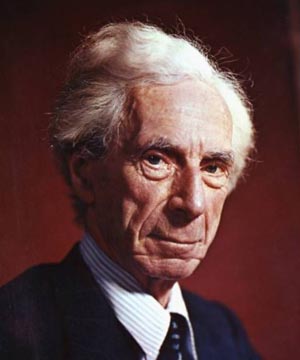
Bertrand Russell (1872 – 1970) was a British philosopher, mathematician and author. He is widely considered to be one of the most important logicians of the 20th century.
Russell co-wrote the “Principia Mathematica”, where he attempted to create a formal foundation for mathematics using logic. His work has had a significant impact not just on maths and philosophy, but also on linguistics, artificial intelligence and metaphysics.
Russell was a passionate pacifist and anti-war activist. In 1950, he received the Nobel Prize in Literature, for his work “in which he champions humanitarian ideals and freedom of thought”.
Hilbert
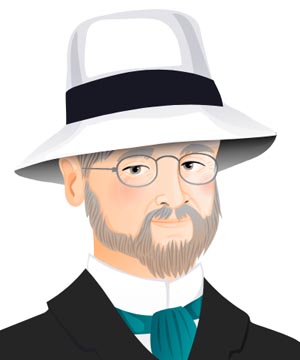
David Hilbert (1862 – 1943) was one of the most influential mathematicians of the 20th century. He worked on almost every area of mathematics, and was particularly interested in building a formal, logical foundation for maths.
Hilbert worked in Göttingen (Germany), where he tutored numerous students who later became famous mathematicians. During the International Congress of Mathematicians in 1900, he presented a list of 23 unsolved problems. These set the course for future research – and four of them are still unsolved today!
Peano
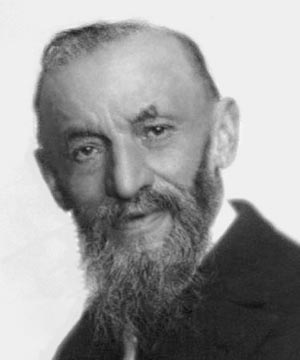
The Italian mathematician Giuseppe Peano (1858 – 1932) published over 200 books and papers about logic and mathematics. He formulated the Peano axioms, which became the basis for rigorous algebra and analysis, developed the notation for logic and set theory, constructed continuous, space-filling curves (Peano curves), and worked on the method of proof by induction.
Peano also developed a new, international language, Latino sine flexione, which was a simplified version of Latin.
Poincaré
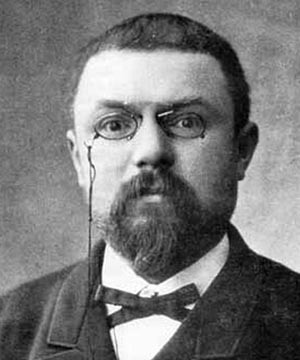
The French mathematician Henri Poincaré (1854 – 1912) is often described as the last universalist, meaning that he worked in every field of mathematics known during his lifetime.
Poincaré is one of the founders of the field of Topology, and he came up with the Poincaré conjecture. This was one of the famous unsolved problems in mathematics, until it was proven in 2003 by Grigori Perelman
He also found a partial solution for the “three body problem”, and discovered that the motion of three stars or planets in space can be completely unpredictable. This laid the foundation for modern Chaos theory.
Poincaré was the first to propose gravitational waves, and his work on Lorentz transformations was the basis upon which Albert Einstein built his theory of special relativity.
Kovalevskaya
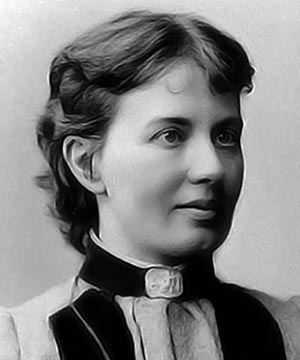
Sofia Kovalevskaya (Софья Васильевна Ковалевская 1850 – 1891) was a Russian mathematician, and the first woman to earn a modern doctorate in mathematics. She was also the first woman to hold full professorship in Northern Europe, and is among the first women to be an editor of a scientific journal.
Kovalevskaya made major contributions to analysis, partial differential equations, and mechanics. She also wrote several works about her life including a memoir, a play and an autobiographical novel.
Cantor
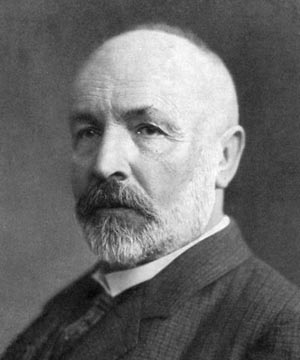
The German mathematician Georg Cantor (1845 – 1918) was the inventor of set theory, and a pioneer in our understanding of infinity. For most of his life, Cantor's discoveries were fiercely opposed by his colleagues. This may have contributed to his depression and nervous breakdowns, and he spent many decades in a mental institution.
Cantor proved that there are different sizes of infinity. The set of real numbers, for example, is uncountable – meaning that it cannot be paired up with the set of natural numbers.
Only towards the end of his life, Cantor started to receive the recognition he deserved. David Hilbert famously declared that “No one shall expel us from the paradise that Cantor has created”.
Lie
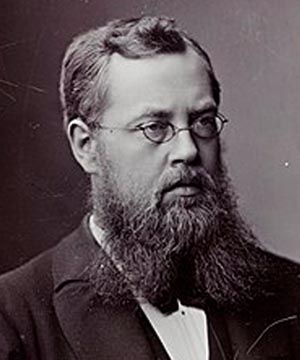
The Norwegian mathematician Marius Sophus Lie (1842 – 1899) made significant advances in the study of continuous transformation groups – now called Lie groups. He also worked on differential equations and non-Euclidean geometry.
Carroll
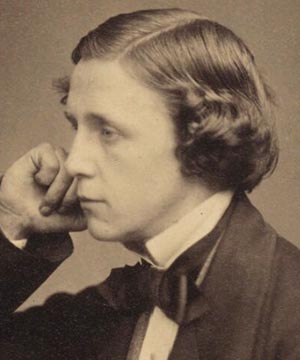
Charles Lutwidge Dodgson (1832 – 1898) is best know under his pen name Lewis Carroll, as the author of Alice’s Adventures in Wonderland and its sequel Through the Looking-Glass.
However, Carroll was also a brilliant mathematician. He always tried to incorporate puzzles and logic into his children’s stories, making them more enjoyable and memorable.
Dedekind
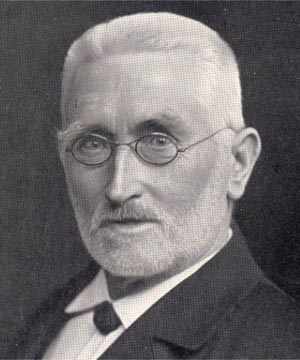
Richard Dedekind (1831 – 1916) was a German mathematician and one of the students of Gauss. He developed many concepts in set theory, and invented Dedekind cuts as the formal definition of real numbers. He also gave the first definitions of number fields and rings, two important constructs in abstract algebra.
Riemann
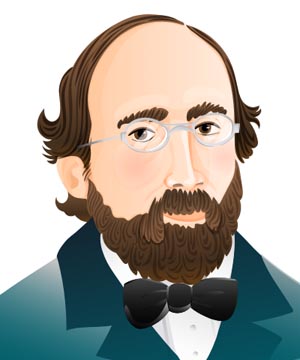
Bernhard Riemann (1826 – 1866) was a German mathematician working in the fields of analysis and number theory. He came up with the first rigorous definition of integration, studied differential geometry which laid the foundation for general relativity, and made groundbreaking discoveries regarding the distribution of prime numbers.
Cayley
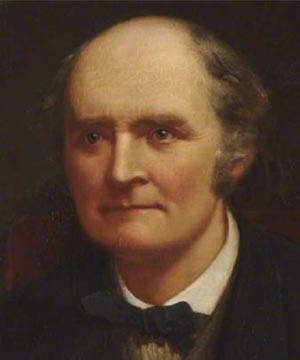
Arthur Cayley (1821 – 1895) was a British mathematician and lawyer. He was one of the pioneers of group theory, first proposed the modern definition of a “group”, and generalised them to encompass many more applications in mathematics. Cayley also developed matrix algebra, and worked on higher-dimensional geometry.
Nightingale
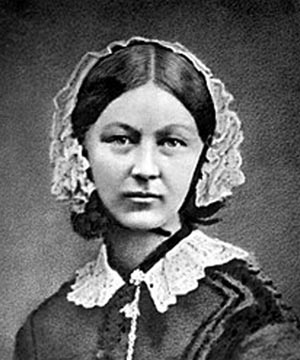
Florence Nightingale (1820 – 1910) was an English nurse and statistician. During the Crimean War, she nursed wounded British soldiers, and later founded the first training school for nurses. As the “The Lady with the Lamp”, she became a cultural icon, and new nurses in the US still take the Nightingale pledge.
One of her most important contributions to medicine was the use of statistics to evaluate treatments. She created numerous infographics, and was one of the first to use pie charts. Nightingale also worked to improve sanitation and hunger relief in India, helped abolish prostitution laws, and promoted new careers for women.
Lovelace
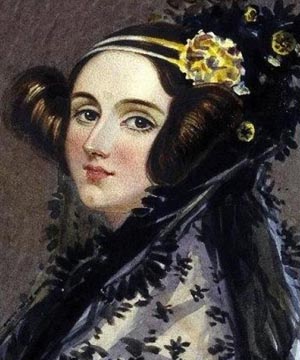
Ada Lovelace (1815 – 1852) was an English writer and mathematician. Together with Charles Babbage, she worked on the Analytical Engine an early, mechanical computer. She also wrote the first algorithm to run on such a machine (to calculate Bernoulli numbers), making her the first computer programmer in history.
Lovelace described her approach as “poetical science”, and spent much time thinking about the impact of technology on society.
Boole
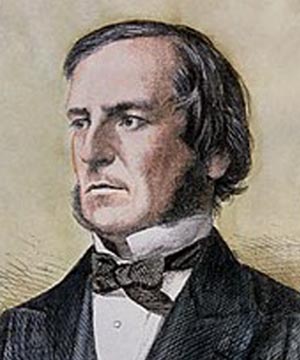
George Boole (1815 – 1864) was an English mathematician. As a child, he taught himself Latin, Greek and mathematics, hoping to escape his lower class life. He created Boolean algebra, which uses operators like AND, OR and NOT (rather than addition or multiplication) and can be used when working with sets. This was the foundation for formal mathematical logic, and has many applications in computer science.
Sylvester
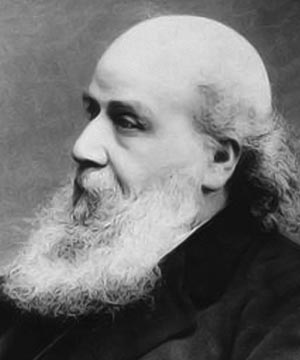
James Joseph Sylvester (1814 – 1897) was an English mathematician. He contributed to matrix theory, number theory, partition theory, and combinatorics. Together with Arthur Cayley, he cofounded invariant theory. Sylvester coined many of the terms we are familar with today including “graph”, “discriminant”, and “matrix”.
Throughout his career, Sylvester faced antisemitism. He was denied a degree from Cambridge, and he later experienced violence from students at the University of Virginia during his short stay as a professor.
Galois
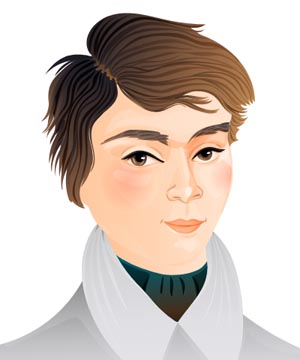
The French mathematician Évariste Galois (1811 – 1832) had a short and tragic life, yet he invented two entirely new fields of mathematics: Group theory and Galois theory.
While still in his teens, Galois proved that there is no general solution for polynomial equations of degree five or higher – simultaneously with Niels Abel.
Unfortunately, other mathematicians who he shared these discoveries with repeatedly misplaced or simply returned his work, and he failed his school and university exams while concentrating on much more complex work.
At the age of 20, Galois was shot in a duel (some say a feud over a woman), and later died of his wounds. During the night before his death, he summarised his mathematical discoveries in a letter to a friend. It would take other mathematicians many years to fully understand these letters, and realise the impact of his work.
Jacobi
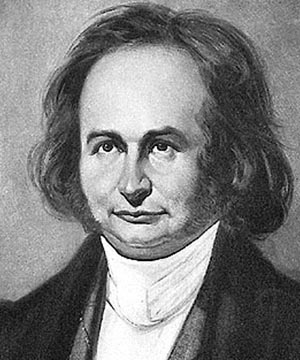
Carl Jacobi (1804 – 1851) was a German mathematician. He worked on analysis, differential equations and number theory, and was one of the pioneers in the study of elliptic functions.
De Morgan
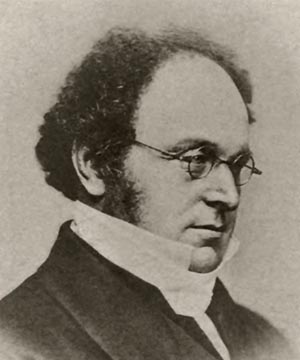
Augustus De Morgan (1806 – 1871) was a British mathematician and logician. He studied the geometric properies of complex numbers, formalised mathematical induction, suggested quaternions, and came up with new mathematical notation.
The De Morgan laws explain how to transform logical relationships in set theory, for example A∩B‾=A‾∪B‾ and A∪B‾=A‾∩B‾.
Hamilton
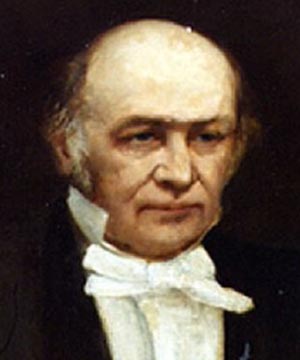
William Rowan Hamilton (1805 – 1865) was an Irish mathematician and child prodigy. He invented quaternions, the first example of a “non-commutative algebra”, which has important applications in mathematics, physics and computer science.
He first came up with the idea while walking along the Royal Canal in Dublin, and carved the fundamental formula into a stone bridge he passed: i2=j2=k2=ijk=−1.
Hamilton also made significant contributions to physics, including optics and Newtonian mechanics.
Bolyai
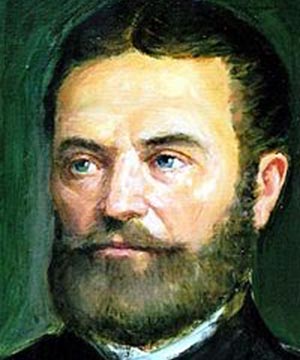
János Bolyai (1802 – 1860) was a Hungarian mathematician, and one of the founders of non-Euclidean geometry – a geometry in which Euclid’s fifth axiom about parallel lines does not hold. This was a significant breakthrough in mathematics. Unfortunately for Bolyai, the mathematicians Gauss and Lobachevsky discovered similar results at the same time, and received most of the credit.
Abel
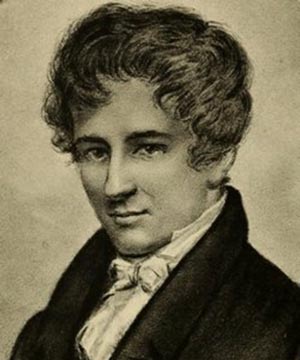
Niels Henrik Abel (1802 – 1829) was an important Norwegian mathematician. Even though he died at the age of 26, he made groundbreaking contributions to a wide range of topics.
At the age of 16, Abel proved the binomial theorem. Three years later, he proved that it is impossible to solve quintic equations – by independently inventing group theory. This had been an open problem for over 350 years! He also worked on elliptic functions and discovered Abelian functions.
Abel spent his life in poverty: he had six siblings, his father died when he was 18, he was unable to find a job at a university, and many mathematicians initially dismissed his work. Today, one of the highest awards in mathematics, the Abel Prize is named after him.
Lobachevsky
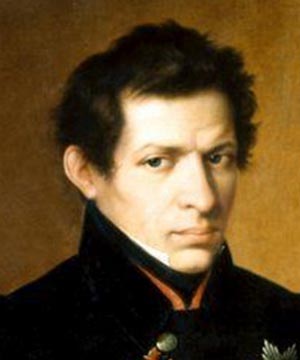
Nikolai Lobachevsky (Никола́й Лобаче́вский, 1792 – 1856) was a Russian mathematician, and one of the founders of non-Euclidean geometry. He managed to show that you can build up a consistent type of geometry in which Euclid’s fifth axiom (about parallel lines) does not hold.
Babbage
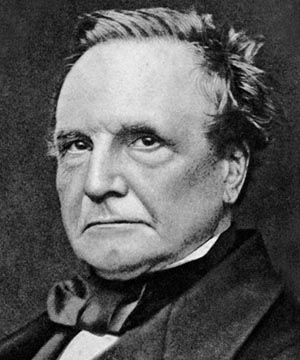
Charles Babbage (1791 – 1871) was a British mathematician, philosopher and engineer. He is often called the “father of the computer”, having invented the first mechanical computer (the Difference engine), and an improved, programmable version (the Analytical Engine).
In theory, these machines could automatically perform certain calculations stored on cards or tape. However, due to the high production costs, they were never fully completed during Babbage’s lifetime. In 1991, a functional replica was constructed at the Science Museum in London.
Möbius
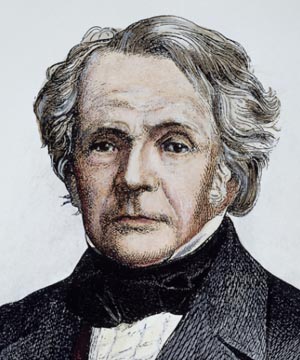
August Ferdinand Möbius (1790 – 1868) was a German mathematician and astronomer. He studied under Carl Friedrich Gauss in Göttingen and is best known for his discovery of the Möbius strip: a non-orientable two-dimensional surface with only one side. (However, it was independently discovered by Johann Benedict Listing just a few months earlier.)
Many other concepts in mathematics are named after him, including the Möbius plane, Möbius transformations, the Möbius function μn in number theory, and the Möbius configuration of two mutually inscribed tetrahedra.
Cauchy
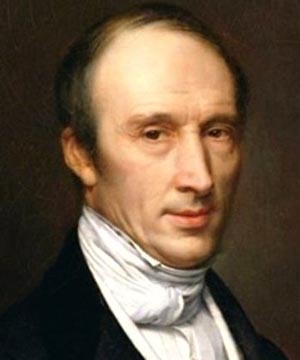
Augustin-Louis Cauchy (1789 – 1857) was a French mathematician and physicist. He contributed to a wide range of areas in mathematics, and dozens of theorems are named after him.
Cauchy formalised calculus and analysis, by reformulating and proving results where previous mathematicians were much more careless and imprecise. He founded the field of complex analysis, studied permutation groups, and worked on optics, fluid dynamics and elasticity theory.
Somerville
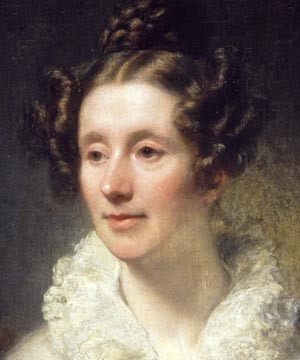
Mary Somerville (1780 – 1872) was a Scottish scientist and writer. In her obituary, she was called the “Queen of Science”. Somerville first suggested the existence of Neptune and was also an excellent writer and communicator of science.
Gauss
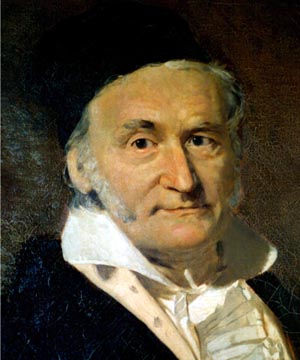
Carl Friedrich Gauss (1777 – 1855) was arguably the greatest mathematician in history. He made groundbreaking discoveries in just about every field of mathematics, from algebra and number theory to statistics, calculus, geometry, geology and astronomy.
According to legend, he corrected a mistake in his father‘s accounting at the age of 3, and found a way to quickly add up all integers from 1 to 100 at the age of 8. He made his first important discoveries while still a teenager, and later tutored many other famous mathematicians as Professor.
Prime Number TheoremNon-Euclidean GeometrySums of Triangle Numbers
Germain

Marie-Sophie Germain (1776 – 1831) decided that she wanted to be a mathematician at the age of 13, after reading about Archimedes. Unfortunately, as a woman, she was faced with significant opposition. Her parents tried to prevent her from studying when she was young, and she never received a post at a university.
Germain was a pioneer in understanding the mathematics of elastic surfaces, for which she won the grand prize from the Paris Academy of Sciences. She also made considerable progress in solving Fermat’s Last Theorem, and regularly corresponded with Carl Friedrich Gauss.
Wang

Wang Zhenyi (王贞仪, 1768 – 1797) was a Chinese scientist and mathematician living during the Qing dynasty. Despite laws and customs preventing women from receiving higher education, she studied subjects like astronomy, mathematics, geography and medicine.
In her books and articles, Wang wrote about trigonometry and Pythagoras’ theorem, studied solar and lunar eclipses, and explained many other celestial phenomena.
Fourier
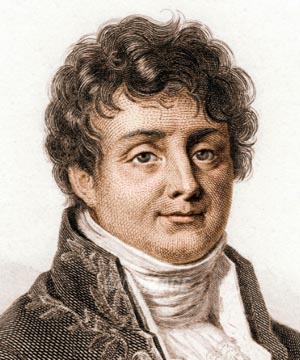
Joseph Fourier (1768 – 1830) was a French mathematician, and a friend and advisor of Napoleon. In addition to his mathematical research, he is also credited with the discovery of the greenhouse effect.
While travelling to Egypt, Fourier became particularly fascinated with heat. He studied heat transfer and vibrations, and discovered that any periodic function can be written as an infinite sum of trigonometric functions: a Fourier series.
Legendre
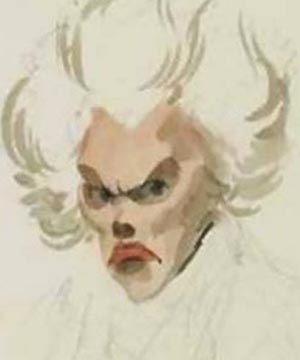
Adrien-Marie Legendre (1752 – 1833) was an important French mathematician. He studied elliptic integrals and their usage in physics. He also found a simple proof that π is irrational, and the first proof that π2 is irrational.
Mascheroni
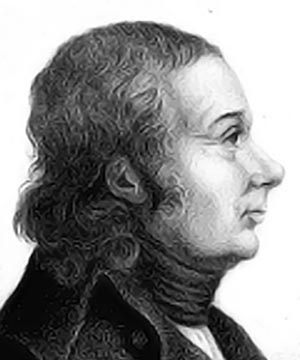
Lorenzo Mascheroni (1750 – 1800) was an Italian mathematician and son of a wealthy landowner. He was ordained to priesthood at the age of 17, and taught rhetoric as well as physics and mathematics.
After writing a book about structural engineering, he was appointed professtor of mathematics at the university of Pavia. Mascheroni proved that all Euclidean constructions that can be done with compass and straightedge can also be done with just a compass: this is now known as the Mohr–Mascheroni theorem.
Even more famously, the Euler-Mascheroni constant γ = 0.57721…, which appears in analysis and number theory, is named after him. He wrote about it in 1790 and calculated 32 of its digits (although with a few mistakes).
Ruler and Compass Construction
Laplace
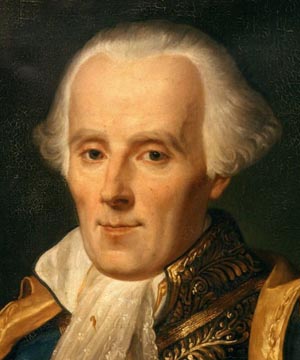
Pierre-Simon Laplace (1749 – 1827) was a French mathematician and scientist. He is sometimes called the “Newton of France”, because of his wide range of interests, and the enormous impact of his work.
In a five-volume book, Laplace translated problems in celestial mechanics from geometry to calculus. This opened up a wide range of new strategies for understanding our universe. He proposed that the solar system developed from a rotating disk of dust.
Laplace also pioneered the field of probability, and showed how probability can help us understand data from the physical world.
Monge
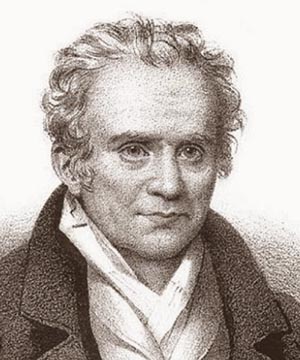
Gaspard Monge (1746 – 1818) was a French mathematician. He is considered the father of differential geometry, having introduced the concept of lines of curvature on surfaces in three-dimensional space (e.g. on a sphere). Monge also invented orthographic projection and descriptive geometry, which allows the representation of three-dimensional objects using two-dimensional drawings.
During the French Revolution, Monge served as Minister of the Marine. He helped reform the French education system and found the École Polytechnique.
Lagrange
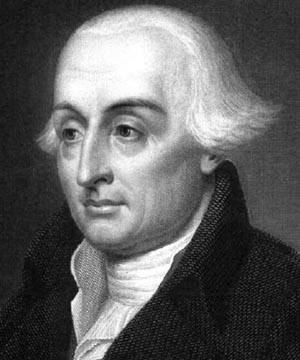
Joseph-Louis Lagrange (1736 – 1813) was an Italian mathematician who succeeded Leonard Euler as the director of the Academy of Sciences in Berlin.
He worked on analysis and the calculus of variations, invented new methods for solving differential equations, proved theorems in number theory, and laid the foundations of group theory.
Lagrange also wrote about classical and celestial mechanics, and helped establish the metric system in Europe.
Banneker
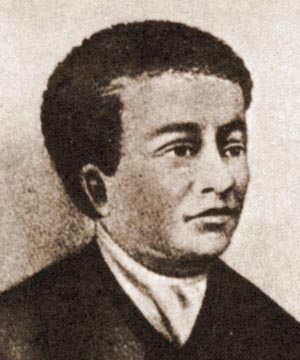
Benjamin Banneker (1731 – 1806) was one of the first African-American mathematicians, and both his parents were former slaves. He was largely self-educated, worked as a surveyor, farmer, and scientist, and wrote several successful “almanacs” about astronomy.
At the age of 21, Banneker designed and built a wooden clock. He helped survey the land that would later become the District of Columbia, the capital of the United States, and he accurately predicting a solar eclipse in 1791.
Banneker also shared some of his work with Thomas Jefferson, then US secretary of state, to argue against slavery.
Lambert
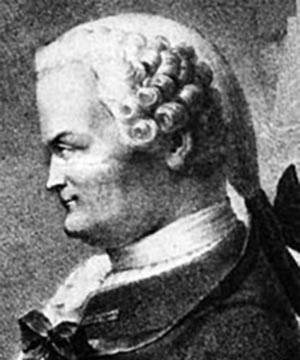
Johann Lambert (1728 – 1777) was a Swiss mathematician, physicist, astronomer and philosopher. He was the first to prove that π is an irrational number, and he introduced hyperbolic trigonometric functions. Lambert also worked on geometry and cartography, created map projections, and foreshadowed the discovery of non-Euclidean spaces.
Agnesi
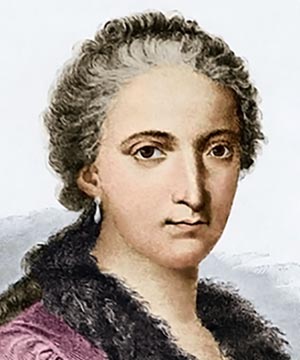
Maria Gaetana Agnesi (1718 – 1799) was an Italian mathematician, philosopher, theologian, and humanitarian. Agnesi was the first western woman to write a mathematics textbook. She was also the first woman to be appointed professor at a university.
Her textbook, the Analytical Institutions for the use of Italian youth combined differential and integral calculus, and was an international success.
Agnesi also studied a bell-shaped curve described by the equation y=a3x2+a2. This function is now called the Witch of Agnesi. The strange name might come from a pun in the Italian language, were the word “versiera” for “witch” sounds similar to the ropes used when sailing.
Euler
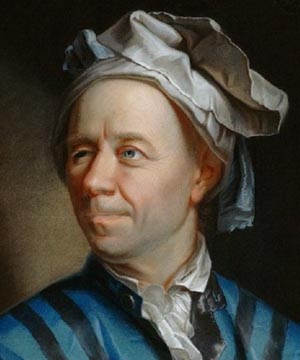
Leonhard Euler (1707 – 1783) was one the greatest mathematicians in history. His work spans all areas of mathematics, and he wrote 80 volumes of research.
Euler was born in Switzerland and studied in Basel, but lived most of his life in Berlin, Prussia, and St. Petersburg, Russia.
Euler invented much of the modern mathematical terminology and notation, and made important discoveries in calculus, analysis, graph theory, physics, astronomy, and many other topics.
Königsberg Bridges ProblemEuler’s FormulaPolyhedrons
Du Châtelet
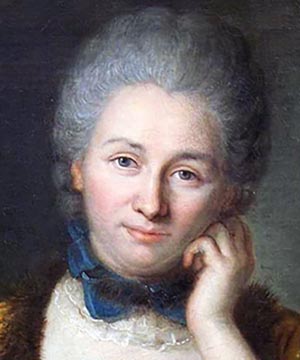
Émilie du Châtelet (1706 – 1749) was a French scientist and mathematician. As a women, she was often excluded from the scientific community, but she built friendships with renown scholars, and had a long affair with the philosopher Voltaire.
She applied her mathematical ability while gambling, and used her winnings to buy books and laboratory equipment, and made important advanced regarding the concepts like energy and energy conservation.
Around the age of 42, Du Châtelet became pregnant again. At the time, without adequate healthcare, this was very dangerous for women of her age. She was also working on a French translation of Newton’s book Principia, which containes the basic laws of physics.
Du Châtelet was determined to finish the translation, as well as a detailed commentary with additions and clarifications, and often worked 18 hours per day. She died just a few days after giving birth to a daughter, but her completed work was published posthumously, and is still used today.
Bernoulli
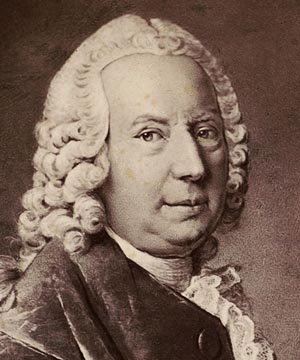
Daniel Bernoulli (1700 – 1782) was a Swiss mathematician and physicist. He was one of the many famous scientists from the Bernoulli family – including his father Johann, his uncle Jacob, and his brother Nicholas.
Daniel Bernoulli showed that as the speed of a fluid increases, its pressure decreases. Now called Bernoulli’s principle, this is the mechanism used by airplane wings and combustion engines. He also made important discoveries in probability and statistics, and first encountered Bessel functions.
At the age of 34, he was banned from his father’s house for beating him at an award from the Paris Academy, for which they both submitted an entry.
Goldbach
Christian Goldbach (1690 – 1764) was a Prussian mathematician and contemporary of Euler, Leibniz and Bernoulli. He was tutor of Russian Tsar Peter II, and is remembered for his “Goldbach Conjecture“.
Simson
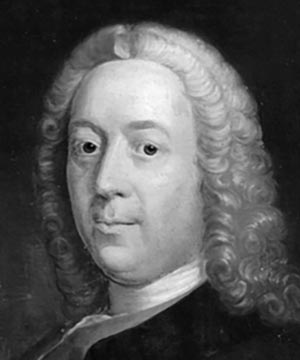
Robert Simson (1687 – 1768) was a Scottish mathematician who studied ancient Greek geometers. He studied at the University of Glasgow, and later returned as a professor.
The Simson line in a triangle is named after him, which can be constructed using the circumcircle.
De Moivre
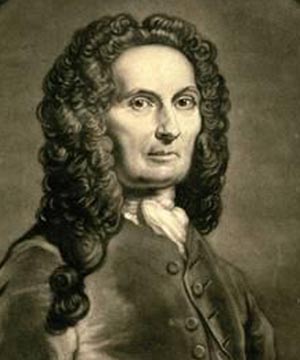
Abraham de Moivre (1667 – 1754) was a French mathematician who worked in probability and analytic geometry. He is most remembered for de Moivre’s formula, which links trigonometry and complex numbers.
De Moivre discovered the formula for the normal distribution in probability, and first conjectured the central limit theorem. He also found a non-recursive formula for Fibonacci numbers, linking them to the golden ratio φ.
Bernoulli
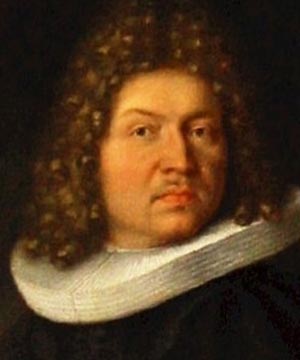
Jacob Bernoulli (1655 – 1705) was a Swiss mathematician, and one of the many important scientists in the Bernoulli family. In fact, he had a deep academic rivalry with several of his brothers and sons.
Bernoulli made significant advances to the calculus that was invented by Newton and Leibnitz, created the field of calculus of variations, discovered the fundamental constant e, developed techniques for solving differential equations, and much more.
He published the first substantial work about probability, including permutations, combinations and the law of large numbers, he proved the binomial theorem, and derived many of the properties of Bernoulli numbers.
Ceva
Giovanni Ceva (1647 – 1734) was an Italian mathematician, physicist, and hydraulic engineer. One of his most enduring contributions to mathematics is Ceva’s Theorem, about the relationship between different line segments in a triangle. However, its publication in De lineis rectis was recieved with little fanfair, and his discoveries weren’t fully recognized until the 1800s.
Leibniz
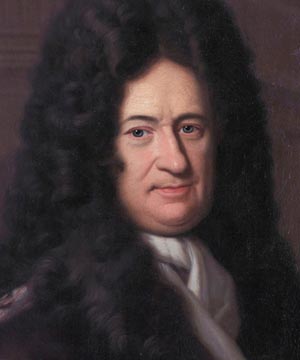
Gottfried Wilhelm Leibniz (1646 – 1716) was a German mathematician and philosopher. Among many other achievements, he was one of the inventors of calculus, and created some of the first mechanical calculators.
Leibniz believed that our universe is the “best possible universe” that God could have created, while allowing us to have a free will. He was a great advocate of rationalism, and also made contributions to physics, medicine, linguistics, law, history, and many other subjects.
Seki
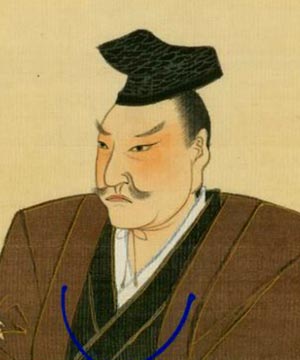
Seki Takakazu (関 孝和, 1642 – 1708) was an important Japanese mathematician and writer. He created a new algebraic notation system and studied Diophantine equations. He also developed on infinitesimal calculus – independently of Leibniz and Newton in Europe.
His work laid foundations for a distinct type of Japanese mathematics, known as wasan (和算), which was continued by his successors.
Newton
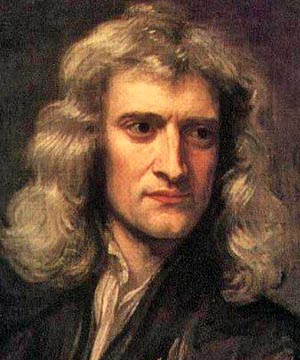
Sir Isaac Newton (1642 – 1726) was an English physicist, mathematician, and astronomer, and one of the most influential scientists of all time. He was a professor at Cambridge University, and president of the Royal Society in London.
In his book Principia Mathematica, Newton formulated the laws of motion and gravity, which laid the foundations for classical physics and dominated our view of the universe for the next three centuries.
Among many other things, Newton was one of the inventors of calculus, built the first reflecting telescope, calculated the speed of sound, studied the motion of fluids, and developed a theory of colour based on how prisms split sunlight into a rainbow-coloured spectrum.
Pascal
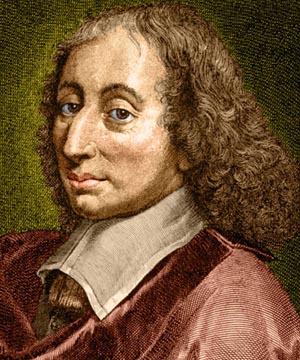
Blaise Pascal (1623 – 1662) was a French mathematician, physicist and philosopher. He invented some of the first mechanical calculators, as well as working on projective geometry, probability and the physics of the vacuum.
Most famously, Pascal is remembered for naming Pascal’s Triangle, an infinite triangle of numbers with some amazing properties.
Wallis
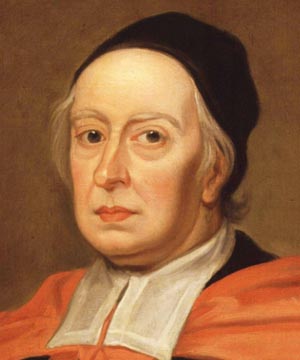
The English mathematician John Wallis (1616 – 1703) contributed to the development of calculus, invented the number line and the symbol ∞ for infinity, and served as chief cryptographer for Parliament and the royal court.
Fermat
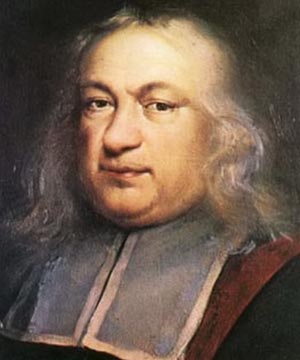
Pierre de Fermat (1607 – 1665) was a French mathematician and lawyer. He was an early pioneer of calculus, as well as working in number theory, probability, geometry and optics.
In 1637, he wrote a short note in the margin of one of his textbooks, claiming that the equation an+bn=cn has no integer solutions for n>2, and that he had a “marvellous proof, which this margin is too narrow to contain”. This became known as Fermat’s Last Theorem, and one of the most famous unsolved problems in mathematics – until it was finally proven in 1994.
Cavalieri
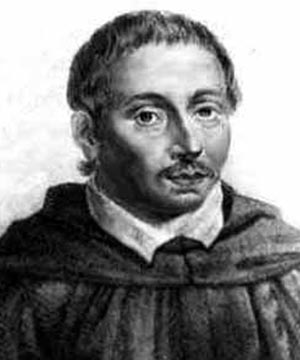
Bonaventura Cavalieri (1598 – 1647) was an Italian mathematician and monk. He developed a precursor to infinitesimal calculus, and is remembered for Cavalieri’s principle to find the volume of solids in geometry.
Cavalieri also worked in optics and mechanics, introduced logarithms to Italy, and exchanged many letters with Galileo Galilei.
Descartes
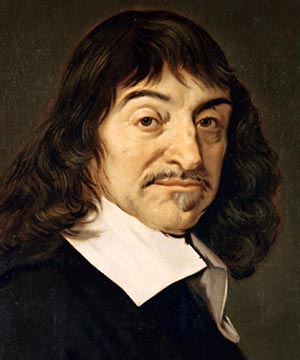
René Descartes (1596 – 1650) was a French mathematician and philosopher, and one of the key figures in the Scientific Revolution. He refused to accept the authority of previous philosophers, and one of his best-known quotes is “I think, therefore I am”.
Descartes is the father of analytical geometry, which allows us to describe geometric shapes using algebra. This was one of the prerequisites, which allowed Newton and Leibnitz to invent calculus a few decades later.
He is credited with the first use of superscripts for powers or exponents, and the cartesian coordinate system is named after him.
Desargues
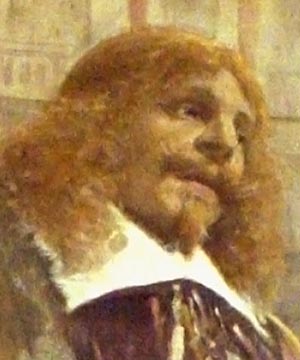
Girard Desargues (1591 – 1661) was a French mathematician, engineer, and architect. He designed numerous buildings in Paris and Lyon, helped construct a dam, and invented a mechanism for raising water using epicycloids.
In mathematics, Desargues is considered the father of projective geometry. This is a special kind of geometry in which parallel lines meet at at “point at infinity”, the size of shapes does not matter (only their proportions), and all four conic sections (circle, ellipse, parabola and hyperbola) are essentially the same.
Mersenne
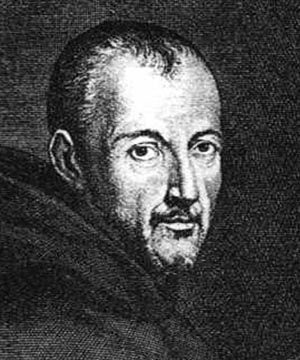
Marin Mersenne (1588 – 1648) was a French mathematician and priest. Because of the frequent exchanges with his contacts in the scientific world during the 17th century, he has been called the “the post-box of Europe”.
Today we mostly remember him for the Mersenne primes, prime numbers that can be written as 2n−1. Most of the largest known primes are of this type. He also studied acoustics and the harmonics of a vibrating string, and wrote about theology and philosophy.
Kepler
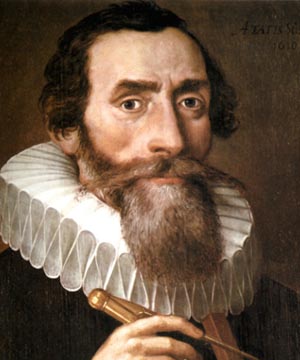
Johannes Kepler (1571 – 1630) was a German astronomer and mathematician. He was the imperial mathematician in Prague, and he is best known for his three laws of planetary motion. Kepler also worked in optics, and invented an improved telescope for his observations.
Galileo
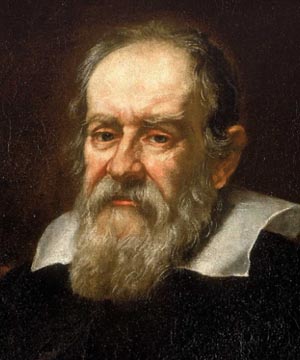
Galileo Galilei (1564 – 1642) was an Italian astronomer, physicist and engineer. He used one of the first telescopes to make observations of the night sky, where he discovered the four largest moons of Jupiter, the phases of Venus, sunspots, and much more.
Galileo, sometimes called the “father of modern science”, also studied the motion of objects in free fall, kinematics, material science, and invented the thermoscope (an early thermometer).
He was a vocal proponent of Heliocentrism, the idea that the Sun was at the centre of our solar system. This eventually led to him being tried by the Catholic Inquisition: Galileo was forced to recant and spent the rest of his life under house arrest.
Napier
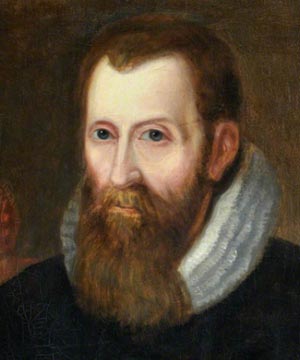
John Napier (1550 – 1617) was a Scottish mathematician, physicist, and astronomer. He invented logarithms, popularised the use of the decimal point, and created “Napier’s bones”, a manual calculating device that helped with multiplication and division.
Stevin
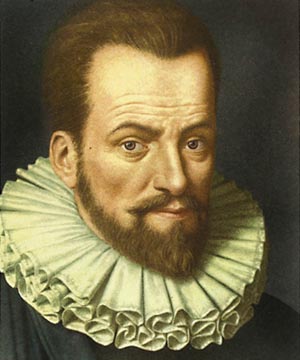
Simon Stevin (1548 – 1620) was Flemish mathematician and engineer. He was one of the first people to use and write about decimal fractions, and made many other contributions to science and engineering.
Viète
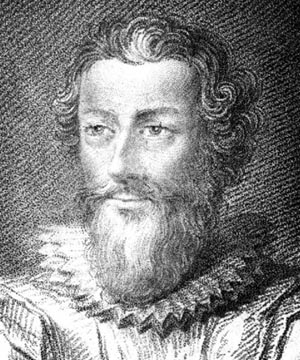
François Viète (1540 – 1603) was a French mathematician, lawyer, and advisor to Kings Henry III and IV of France. He made significant advances in Algebra, and first introduced the use of letters to represent variables.
Viète discovered the connection between the roots and coefficients of a polynomial, called Viète's formula. He also wrote books about geometry and trigonometry, including calculating π to 10 decimal places using a polygon with 393216 sides.
Pedro Nunes
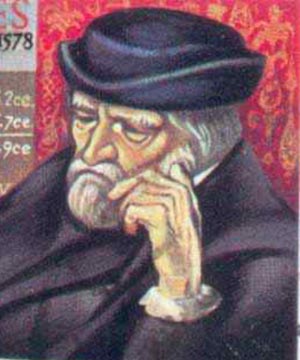
Pedro Nunes (1502 – 1578) was a Portuguese mathematician and astronomer. As Royal Cosmographer of Portugal he taught navigational skills to many sailors and explorers.
Nunes first noticed that if a ship always follows the same compass bearing, it won’t travel on a straight line or great circle. Instead, it will follow a path called a rhumb line or loxodrome, which spirals towards the North or South pole.
Nunes also tried to calculate which day in the year has the fewest hours of sunlight, he disproved previous attempts to solve classical geometry problems like trisecting an angle, and he invented a system for measuring fractional parts of angles.
Cardano
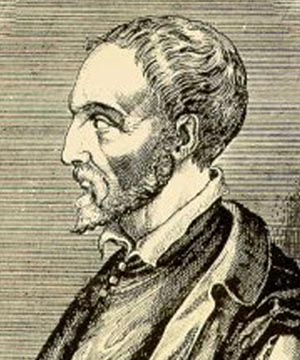
The Italian Gerolamo Cardano (1501 – 1576) was one of the most influential mathematicians and scientists of the Renaissance. He investigated hypercycloids, published Tartaglia’s and Ferrari’s solution for cubic and quartic equations, was the first European to systematically use negative numbers, and even acknowledged the existence of imaginary numbers (based on −1).
Cardano also made some early progress in probability theory and introduced binomial coefficients and binomial theorem to Europe. He invented many mechanical devices, including combination locks, gyroscopes with three degrees of freedom, and drive shafts (or Cardan shafts) that are still used in vehicles today.
Tartaglia
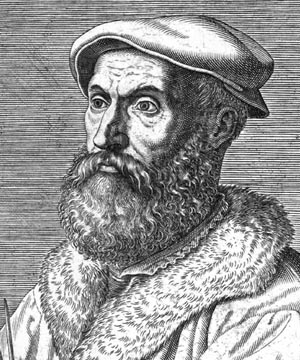
Niccolò Fontana Tartaglia (1499 – 1557) was an Italian mathematician, engineer and bookkeeper. He published the first Italian translations of Archimedes and Euclid, found a formula for solving any cubic equation (including the first real application of complex numbers), and used mathematics to investigate the projectile motion of cannonballs.
Copernicus
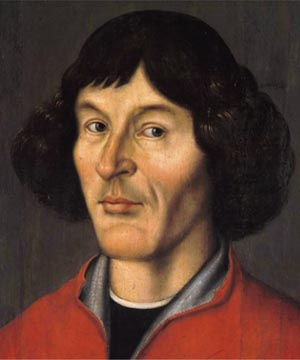
Nicolaus Copernicus (1473 – 1543) was a Polish mathematician, astronomer and lawyer. During his life, most people believed in the Geocentric model of the universe, with Earth at the centre and everything else rotating around it.
Copernicus created a new model, where the sun is at the centre, and Earth moves around it on a circle. He also predicted that Earth rotates around its axis once every day. Afraid that it would upset the Catholic church, he only published the model just before his death – triggering what is now called the Copernican Revolution.
Copernicus also worked as a diplomat and physician, and made important contributions to economics.
Da Vinci
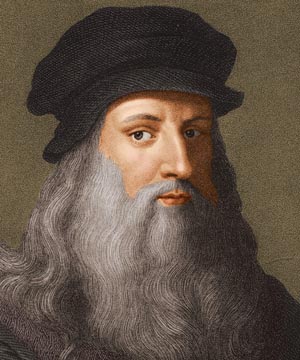
Leonardo da Vinci (1452 – 1519) was an Italian artist and polymath. His interests ranged from painting, sculpting and architecture to engineering, mathematics, anatomy, astronomy, botany and cartography. He is often seen as the prime example of a “Universal Genius” and was one of the most diversely talented individuals ever to have lived.
Leonardo was born in Vinci, educated in Florence, and worked in Milan, Rome, Bologna, and Venice. Only 15 of his paintings have survived, but among them are some of the best known and most reproduced works in the world, including the Mona Lisa and The Last Supper.
His notebooks contain a vast number of drawings, inventions, and scientific diagrams – including the first flying machines and helicopters, hydraulic pumps, bridges, and much more.
Pacioli
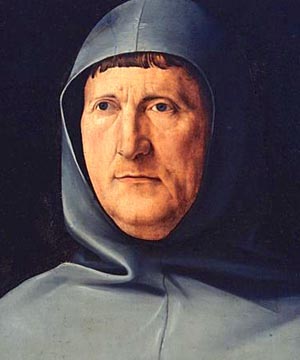
Luca Pacioli was an influential Italian friar and mathematician, who invented the standard symbols for plus and minus (+ and –). He was one of the first accountants in Europe, where he introduced double-entry book-keeping. Pacioli collaborated with Leonardo da Vinci, and also wrote about arithmetic and geometry.
Regiomontanus
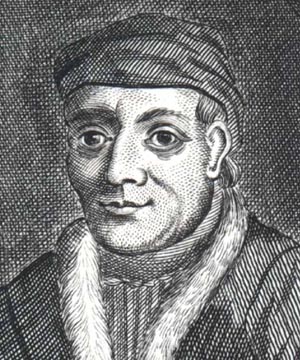
Johann Müller Regiomontanus (1436 – 1476) was a German mathematician and astronomer. He made great advances in both fields, including creating detailed astronomical tables and publishing multiple textbooks.
Madhava
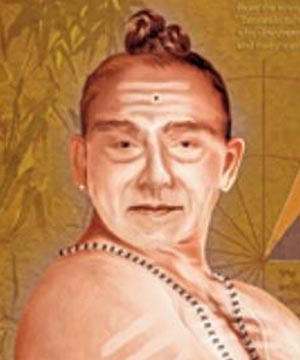
Madhava of Sangamagramma (c. 1340 – 1425) was a mathematician and astronomer from southern India. All of his original work has been lost, but he had a great impact on the development of mathematics.
Madhava first used infinite series to approximate trigonometric functions, which was a significant step towards the development of calculus many centuries later. He also studied geometry and algebra, and found an exact formula for π (also using infinite series).
Oresme
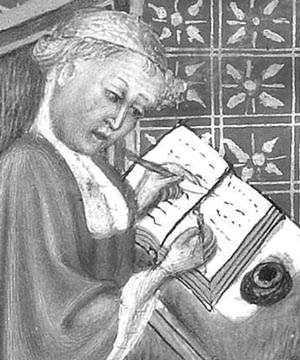
Nicole Oresme (c. 1323 – 1382) was an important French mathematician, philosopher and bishop, living in the late Middle Ages. He invented coordinate geometry, long before Descartes, was the first to use fractional exponents, and worked on infinite series. He wrote about economics, physics, astronomy and theology, and was an advisor to King Charles V of France.
Zhu Shijie
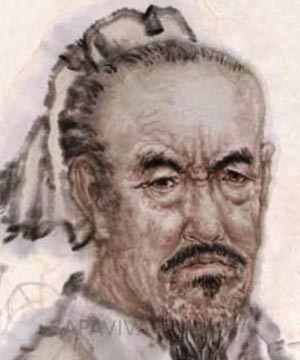
Zhu Shijie (朱世杰, 1249 – 1314) was one of the greatest Chinese mathematicians. In his book Jade Mirror of the Four Unknowns, he showed how to solve 288 different problem using systems of polynomial equations and four variables (called Heaven, Earth, Man and Matter).
Zhu made extensive use of Pascal’s triangle. He also invented rules for solving systems of linear equations – predating our modern matrix methods by many centuries.
Yang

Yang Hui (楊輝, c. 1238 – 1298) was a Chinese mathematician and writer during the Song dynasty. He studied magic squares and magic circles, the binomial theorem, quadratic equations, as well as Yang Hui’s triangle (known in Europe as Pascal’s triangle).
Yang also wrote geometric proofs, and was known for his ability to manipulate decimal fractions.
Qin
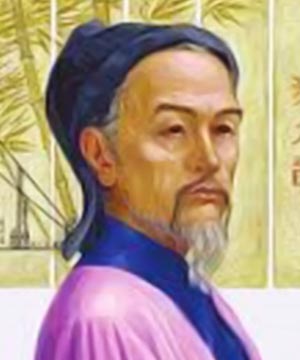
Qin Jiushao (秦九韶, c. 1202 – 1261) was a Chinese mathematician, inventor and politician. In his book Shùshū Jiǔzhāng, he published numerous mathematical discoveries, including the important Chinese remainder theorem, and wrote about surveying, meteorology and the military.
Qin first developed a method for numerically solving polynomial equations, which is now known as Horner’s method. He found a formula for the area of a triangle based on the length of its three sides, calculated the sum of arithmetic series, and introduced a symbol for “zero” into Chinese mathematics.
Qin also invented Tianchi basins, which were used to measure rainfall and gather meteorological data important for farming.
Al-Din Tusi
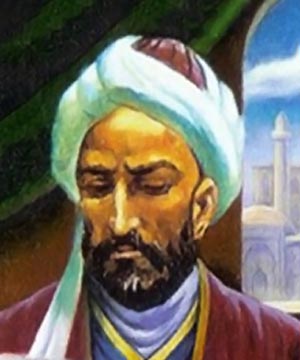
Nasir al-Din Tusi (1201 – 1274, نصیر الدین طوسی), also known as Muhammad ibn Muhammad ibn al-Hasan al-Tūsī, was an architect, philospher, physician, scientist, and theologian, as well as a prolific writer.
Many consider Al-Din Tusi to be the father of trigonometry, and he was perhaps the first person to work on trigonometry independent of astronomy. He also proposed and studied the Tusi couple: a device in which a circle rolls around the inside of a larger circle with twice the diameter.
Li Ye
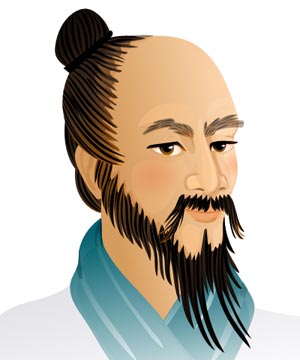
Li Ye (李冶, 1192 – 1279) was a Chinese mathematician. He improved methods for solving polynomial equations, and was one of the first Chinese scientists to propose that the Earth is spherical.
Fibonacci

Leonardo Pisano, commonly known as Fibonacci (1175 – 1250) was an Italian mathematician. He is best known for the number sequence named after him: 1, 1, 2, 3, 5, 8, 13, …
Fibonacci is also responsible for popularising the Arabic numerals (0, 1, 2, 3, 4, …) in Europe, which was still using Roman numerals (I, V, X, D, …) in the 12th century CE. He explained the decimal system in a book called “Liber Abaci”, a practical textbook for merchants.
Bhaskara II
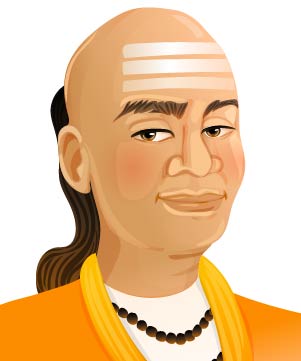
Bhaskara II (1114 – 1185) was an Indian mathematician and astronomer. He discovered some of the basic concepts of calculus, more than 500 years before Leibnitz and Newton. Bhaskara also established that division by zero yields infinity, and solved various quadratic, cubic, quartic and Diophantine equations.
Khayyam
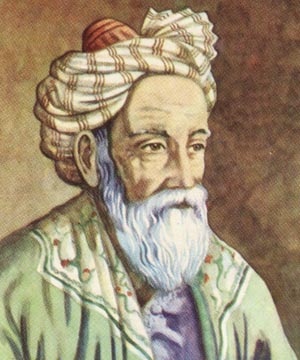
Omar Khayyam (عمر خیّام, 1048 – 1131) was a Persian mathematician, astronomer and poet. He managed to classify and solve all cubic equations, and found new ways to understand Euclid’s parallel axiom. Khayyam also designed the Jalali calendar, a precise solar calendar that is still used in some countries.
Jia
Jia Xian (賈憲, c. 1010 – 1070) was a Chinese mathematician during the Song dynasty. He described Pascal’s triangle, more than six centuries before Pascal, and used it to calculate square and cube roots.
Al-Haytham
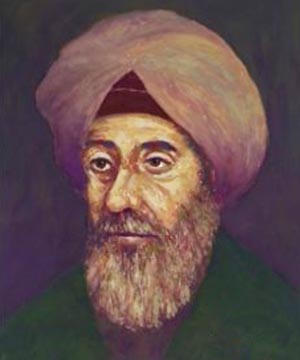
Hasan Ibn al-Haytham (أبو علي، الحسن بن الحسن بن الهيثم, c. 965 – 1050) lived in Cairo during the Islamic Golden Age, and studied mathematics, physics, astronomy, philosophy, and medicine. He was a proponent of the scientific method: the belief that any scientific hypothesis must be verified using experiments or mathematical logic – centuries before European scientists during the Renaissance.
Al-Haytham was particularly interested in optics and visual perception. He also derived a formula for the sum of fourth powers (14+24+34+…+n4), and he studied the link between algebra and geometry.
Al-Karaji
Muhammad Al-Karaji (ابو بکر محمد بن الحسن الکرجی, c. 953 – 1029) was a Persian mathematician and engineer. He was the first person to use proof by induction, which allowed him to prove the binomial theorem.
Thabit
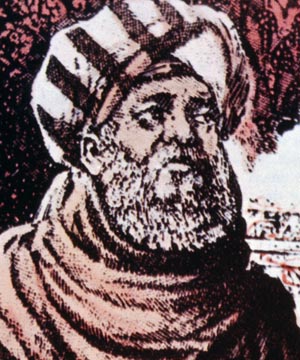
Al-Ṣābiʾ Thābit ibn Qurrah al-Ḥarrānī (ثابت بن قره, c. 826 – 901 CE) was an Arabic mathematician, physician, astronomer, and translator. He lived in Baghdad and was one of the first reformers of the Ptolemaic system of our solar system.
Thābit studied algebra, geometry, mechanics and statics. He discovered an equation for finding amicable numbers: numbers which have the same sum of factors. He calculated the solution to the “chessboard problem” involving exponential series, computed the volume of paraboloids, and found a generalization of Pythagoras’ theorem.
Al-Khwarizmi
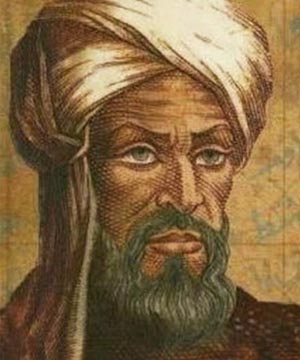
The Persian mathematician Muhammad Al-Khwarizmi (محمد بن موسى الخوارزمي, 780 – 850) lived during the golden age of the Muslim Abbasid regime in Baghdad. He worked at the “House of Wisdom”, which contained the first large collection of academic books since the destruction of the Library of Alexandria.
Al-Khwarizmi has been called the “Father of algebra” – in fact, the word algebra comes from the Arabic title of his most important book: “The Compendious Book on Calculation by Completion and Balancing”. In it, he showed how to solve linear and quadratic equations, and for many centuries, it was the main mathematics textbook at European universities.
Al-Khwarizmi also worked in astronomy and geography, and the word “algorithm” is named after him.
Bhaskara I
Bhaskara I (c. 600 – 680 CE) was an Indian mathematician, and the first to write numbers in the Hindu decimal system with a circle as zero. His commentary on Aryabhata’s work is one of the oldest known Sanskrit prose works on mathematics and astronomy, and includes a unique rational approximation for the sin function.
Brahmagupta
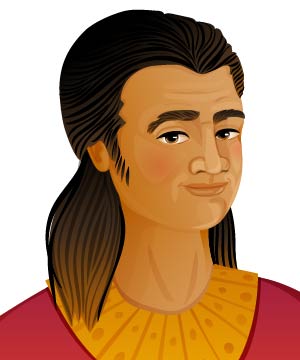
The Indian mathematician Brahmagupta (c. 598 – 668 CE) invented the rules for addition, subtraction and multiplication with zero and negative numbers. He was also an astronomer and made many other discoveries in mathematics. Unfortunately, his writings did not contain any proofs, so we don’t know how he derived his results.
Aryabhata
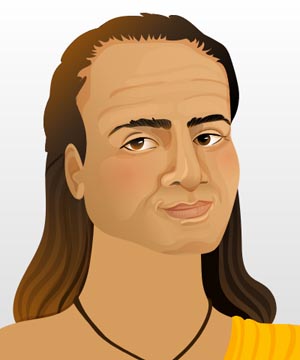
Aryabhata (आर्यभट, 476 – 550) was one of the first mathematicians and astronomers in the golden age of Indian mathematics. He defined trigonometric functions, solved simultaneous quadratic equations, found approximations for π, and realised that π is irrational.
TrigonometryQuadratic Equations
Zu
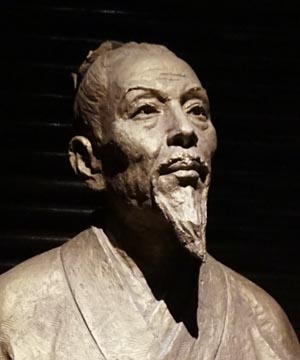
Zu Chongzhi (祖沖之, 429 – 500 CE) was a Chinese astronomer, mathematician, writer, politician and inventor.
He calculated Pi accurately to 7 decimal places – a record which was not surpassed until 800 years later. To do this, he approximated a circle with a 24,576-sided polygon.
Zu also discovered the formula 43πr3 for the volume of a sphere. His precise astronomical observations allowed him to create a new, more accurate calendar and to predict solar eclipses. He also calculated that Jupiter takes almost 12 years to orbit the sun.
Hypatia
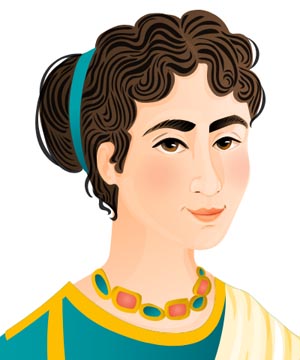
Hypatia (c. 360 – 415 CE) was a prominent astronomer and mathematician in ancient Alexandria. She was also the first female mathematician whose life and work are reasonably well recorded. She edited or wrote commentaries on many of the scientific books of her time, and constructed astrolabes and hydrometers.
She was renowned during her life as a great teacher, and she advised Orestes, the Roman prefect of Alexandria. Orestes’ feud with Cyril, the bishop of Alexandria, led to Hypatia being murdered by a mob of Christians.
Liu
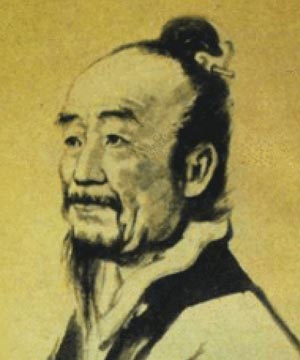
The mathematician and writer Liu Hui (c. 225 – 295 CE) lived during the Three Kingdoms period of China. He might be the first mathematician to understand and use negative numbers, while writing a commentary with solutions for The Nine Chapters on the Mathematical Art, a famous Chinese book about mathematics.
Diophantus
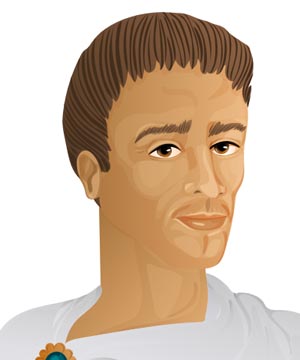
Diophantus was a Hellenistic mathematician who lived in Alexandria. Most of his works are about solving polynomial equations with several unknowns. These are now called Diophantine equation and remain an important area of research today.
It was while reading one of Diophantus’ books, many centuries later, that Pierre de Fermat proposed one of these equations had no solution. This became known as “Fermat’s Last Theorem”, and was only solved in 1994.
Ptolemy
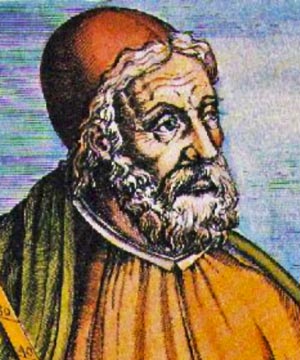
Claudius Ptolemy (c. 100 – 170 CE) was a Greco-Roman mathematician, astronomer, geographer and astrologer. He is best remembered for the Ptolemaic or Geocentric model of our universe – that Earth is in the centre and all planets and the sun revolve around this.
While we know today this model is incorrect, Ptolemy’s scientific impact is indisputable. He developed trigonometric tables with many practical applications, which remained the most accurate for many centuries. He also created detailed maps of the Earth, and wrote about music theory and optics.
Nicomachus
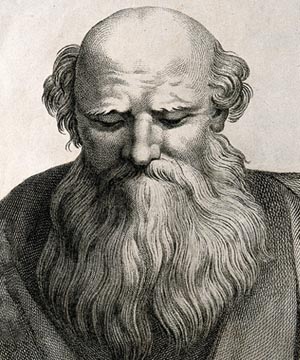
Nicomachus of Gerasa (c. 60 – 120) was an ancient Greek mathematician who also spent much time thinking about the mystical properties of numbers. His book Introduction to Arithmetic contains the first mention of perfect numbers.
Heron
Heron of Alexandria ( Ἥρων ὁ Ἀλεξανδρεύς, c. 10 – 70 CE) was a Greek mathematician and engineer. He lived in the city of Alexandria in Egypt, and is one of the greatest “experimenter” of antiquity.
His inventions include windmills, pantograph, as well as a radial steam turbine called aeolipile or Hero’s engine. Hero’s formula allows you to calculate the area of any triangle, using just the length of its three sides.
Hipparchus
Hipparchus of Nicaea (Ἵππαρχος, c. 190 – 120 BCE) was a Greek astronomer and mathematicians, and one of the greatest astronomers of antiquity.
Hipparchus made detailed observations of the night sky and created the first comprehensive star catalog in the western world. He is considered the father of trigonometry: he constructed trigonometric tables and used these to reliably predict solar eclipses. He also invented the astrolabe and solved different problems in spherical trigonometry.
Apollonius
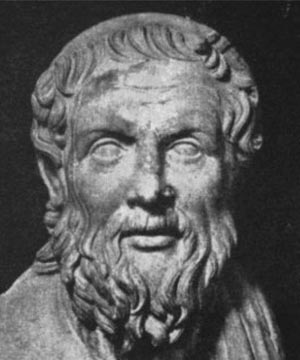
Apollonius of Perga (c. 200 BCE) was a Greek mathematician and astronomer best known for his work on the four conic sections.
Eratosthenes
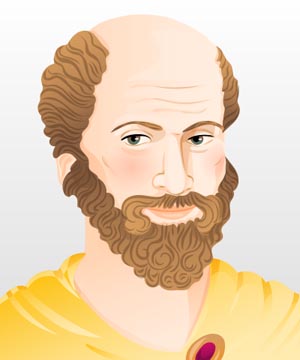
Eratosthenes of Cyrene (c. 276 – 195 BCE) was a Greek mathematician, geographer, astronomer, historian, and poet. He spent much of his life in Egypt, as head of the library of Alexandria. Among many other achievements, Eratosthenes calculated the circumference of the Earth, measured the tilt of the Earth’s axis of rotation, estimated the distance to the sun, and created some of the first maps of the world. He also invented the “Sieve of Eratosthenes”, an efficient way to calculate prime numbers.
Radius of the EarthSieve of Eratosthenes
Archimedes
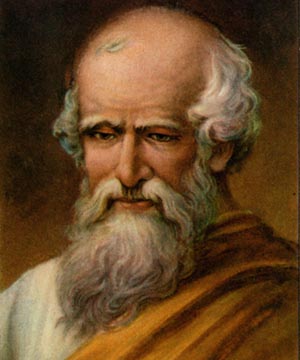
Archimedes (c. 287 – 212 BCE) was an ancient Greek scientist and engineer, and one of the greatest mathematicians of all time. He discovered many concepts of calculus and worked in geometry, analysis and mechanics.
While taking a bath, Archimedes discovered a way to determine the volume of irregular objects using the amount of water they displaced when submerged. He was so excited by this discovery that he ran out on the street, still undressed, yelling “Eureka!” (Greek for “I have found it!”).
As an engineer, he built ingenious defence machines during the siege of his home city Syracuse in Sicily. After two years, the Romans finally managed to enter, and Archimedes was killed. His last words were “Do not disturb my circles” – which he was studying at the time.
Pingala
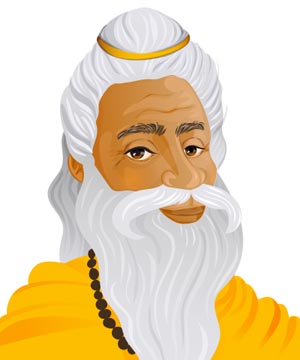
Pingala (पिङ्गल) was an ancient Indian poet and mathematician who lived around 300 BCE, but very little is known about his life. He wrote the Chandaḥśāstra, where he analysed Sanskrit poetry mathematically. It also contained the first known explanations of binary numbers, Fibonacci numbers and Pascal’s triangle.
Euclid
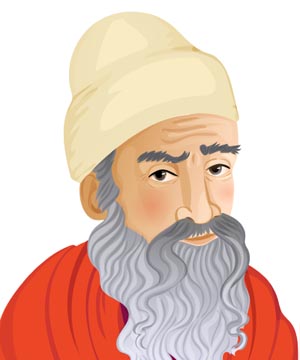
Euclid of Alexandria (Εὐκλείδης, around 300 BCE) was a Greek mathematician and is often called the father of geometry. His book The Elements first introduced Euclidean geometry, defines its five axioms, and contains many important proofs in geometry and number theory – including that there are infinitely many prime numbers. It is one of the most influential books ever published, and was used as textbook in mathematics until the 19th century.
Euclid taught mathematics in Alexandria, but not much else is known about his life.
Euclid’s AxiomsInfinitely many Primes
Aristotle
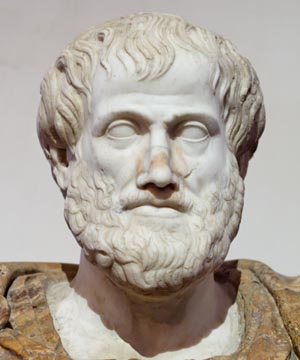
Aristotle (Ἀριστοτέλης, c. 384 – 322 BCE) was a philosopher in Ancient Greece. Together with his teacher Plato, he is considered the “Father of Western Philosophy”. He was also the private tutor of Alexander the Great.
Aristotle wrote about science, mathematics, philosophy, poetry, music, politics, rhetoric, linguistics, and many other subjects. His work was highly influential during the Middle Ages and into the Renaissance, and his views on ethics and other philosophical questions are still being discussed today.
Aristotle is also the first known person to formally study logic, including its applications in science and mathematics.
Eudoxus
Eudoxus of Cnidus (Εὔδοξος ὁ Κνίδιος, c. 390 – 337 BCE) was an ancient Greek astronomer and mathematician. Among his most enduring contributions to astronomy are his planetary models.
History remembers him as the first to write mathematical explanation of the planets. He developed the method of exhaustion in mathematics, which laid the foundation for integral calculus. Eudoxus traveled to several places around the Mediterranean to study. He studied under Plato in Athens, Greece and under Egyptian priests in Heliopolis, Egypt. He later returned to Athens to teach in Plato's Academy during the time Aristotle was a student.
Plato
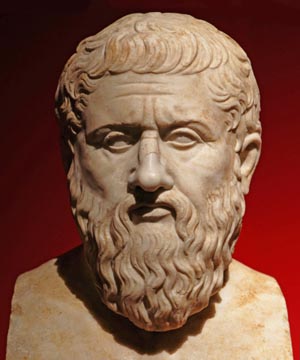
Plato (c. 425 – 347 BCE) was a philosopher in ancient Greece, and – together with his teacher Socrates and his student Aristotle – laid the very foundation of Western philosophy and science.
Plato founded the Academy of Athens, the first higher learning institution in the Western world. His many writings on philosophy and theology, science and mathematics, politics and justice, make him one of the most influential thinkers of all time.
Democritus
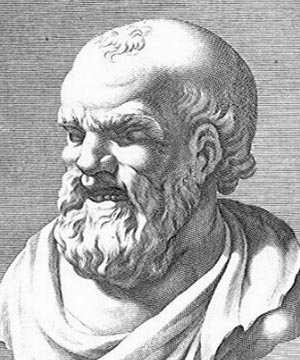
The Greek mathematician Democritus (c. 460 – 370 BCE), may be the first person to speculate that all matter was made up of tiny atoms and is considered the “father of modern science”. He also made many discoveries in geometry, including the formula for the volume of prisms and cones.
Zeno
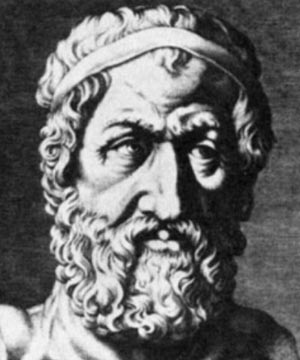
Zeno of Elea (c. 495 – 430 BCE) was a Greek philosopher who his known for his famous paradoxes, which have fascinated mathematicians for centuries.
One example is the paradox of motion: imagine that you want to run a 100 meter race. You first have to run half the distance (50 meters). But before doing that, you have to run a quarter of the distance (25 meters). Before running a quarter, you have to run 18th, 116th, and so on. This is an infinite number of tasks, which means that you’ll never arrive!
Pythagoras
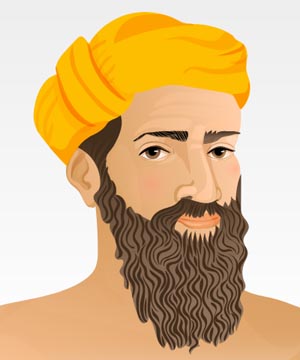
Pythagoras of Samos (c. 570 – 495 BCE) was a Greek philosopher and mathematician. He is best known for proving Pythagoras’ Theorem, but made many other mathematical and scientific discoveries.
Pythagoras tried to explain music in a mathematical way, and discovered that two tones sound “nice” together (consonant) if the ratio of their frequencies is a simple fraction.
He also founded a school in Italy where he and his students worshipped mathematics almost like a religion, while following a number of bizarre rules – but the school was eventually burned down by their adversaries.
Thales
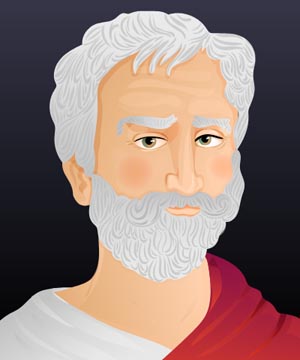
Thales of Miletus (c. 624 – 546 BCE) was a Greek mathematician and philosopher.
Thales is often recognised as the first scientist in Western civilisation: rather than using religion or mythology, he tried to explain natural phenomena using a scientific approach. He is also the first individual in history that has a mathematical discovery named after him: Thales’ theorem.
Ishango Bone
The Ishango Bone is possibly the oldest mathematical artefact still in existence: it was discovered in 1950, in the Democratic Republic of Congo in central Africa, and is named after the region where it was found. It is dates back to the Upper Paleolithic period of human history, and is approximately 20,000 years old.
The bone is 10 cm long and contains a series of notches, which many scientists believe were used for counting. The grouping of the notches might even suggest some more advanced mathematical understanding, like decimal numbers or prime numbers.
Mesopotamian Accounting Tokens
In ancient Mesopotamia, almost 10,000 years ago, scribes and merchants started using small, three-dimensional clay objects as counters, to represent certain quantities, units or goods. Thousands of these were found on archaeological sites across the Middle East, like these from Tepe Gawra in Iraq (from around 4000 BCE):
The cone, sphere and flat disc were used to represent small, medium and large measures of grain. The tetrahedron probably measured the amount of work done in one day.
These two tablets from Susa in Iran were created around 3200 BCE and used a more advanced technique: the counters were pressed into the clay while it was still soft, to create a record:
Again, the triangular and circular impressions represent smaller and larger measures of grain. The patterns across the rest of the tablet were the official seals of the scribes.
These simple markings actually laid the foundations for cuneiform, one of the first writing system in history.
Mesopotamian Tablets
This is the oldest known clay tablet with mathematican computations – it was created around 2700 BCE in Sumer, one of the earliest civilisations that flourished in the Middle East.
It shows a multiplication table in cuneiform, which may have been used by student scribes to learn mathematics.
Sumerian Multiplication Table
This tablet shows a multiplication table that was created around 2600 BCE in the Sumerian city of Shuruppak. It is one of the oldest mathematical tablets we have ever discovered.
The table has three columns. The dots in the first two columns represent distances ranging from around 6 meters to 3 kilometres. The third column contains the product of the first two, which is the area of a rectangle with the given dimensions.
Sumer was a region of ancient Mesopotamia in the Middle East. They invented Cuneiform as one of the earliest writing systems, by pressing small, wedge-shaped markers into clay tablets like this one. They also developed the base-60 number system.
Babylonian Tablet (Plimpton 322)
This Babylonian clay tablet, called Plimpton 322, was created around 1750 BCE in Sumeria, during the reign of Hammurabi the Great.
While more than 1000 years older than Pythagoras, the rows and columns on this table contain Pythagorean triples: integer solutions for the equation a2+b2=c2. For example, (3, 4, 5) is a Pythagorean triple because 32+42=52.
The exact purpose of the tablet has been debated by archeologists. Some think that it was a “teachers aid”, designed to help generate right-angled triangles. Others think it may be a very early trigonometry table.
YBC 7289
This circular tablet from the Yale Babylonian Collection, called YBC 7289, was created around 1800 – 1600 BCE in ancient Babylon. It shows the geometric diagram of a square with its diagonals.
The cuneiform numerals indicate that one side of the square is 30 units long, and show how to find the length of the diagonal: 302+302≈42 units.
The tablet shows that Babylonian scribes knew Pythagoras’ theorem, more than 1000 years before Pythagoras was even born. They were also able to calculate square roots and had an estimate for 2 accurate to 6 decimal places. It is the highest computational accuracy ever seen in the ancient world!
While this simple tablet may have just been a practice exercise by a novice scribe, its mathematical and historical importance is enormous.
Babylonian Area Tablets
These two clay tablets from the Yale Babylonian Collection were created between 1800 and 1600 BCE, and contain exercises by student scribes, to calculate the area of different geometric shapes.
Tablet YBC 7290 shows how to calculate the area of a trapezium, by multiplying the average of the bases and the average of the sides.
Tablet YBC 11120 shows how to calculate the area of a circle, using the approximation π=3.
Rhind Papyrus
The Rhind Papyrus is one of the most famous mathematical documents from ancient Egypt. It was written around 1550 BCE by a scribe called Ahmose, who is maybe the earliest contributor to maths in history, whose name we still know today.
The papyrus is around 2 meters long and contains 84 problems about multiplication, division, fractions, and geometry. It was probably used as a kind of “textbook” by other scribes.
One of the most notable sections is a 2n table. This shows how you can write rational numbers of the form 2n, where n is an odd number, as sums of unit fractions.
The papyrus is named after Scottish antiquarian Alexander Henry Rhind, who purchased it in Luxor, Egypt. Today, most of its remains are located at the British Museum in London.
Tomb of Menna
Menna was a chief scribe in ancient Egypt, and in charge of measuring the size of fields for farming, inspected crop yields, reporting to the Pharaoh’s central field administration, and calculating taxes.
The wall paintings in his tomb show the different measuring and calculating techniques used more than 3,000 years ago. For example, in the first row, you can see how long distances were measured using ropes with knots at regular intervals.
The tomb was built around 1420 BCE in the Valley of the Kings.
Bamboo Multiplication Table
Here you can see a set of 21 Bamboo Strip that were created around 2300 years ago in China. When arrenged correctly, they form a multiplication table in base 10, written in ancient Chinese calligraphy.
While earlier civilisations like the Babylonians created multiplications tables in base 60, this is by far the oldest known decimal multiplication table – and it looks very similar to what we still use today.
Euclid’s Elements
Around 300 BCE, Euclid of Alexandria wrote The Elements, collection of 13 books that contained mathematical definitions, postulates, theorems and proofs, and covering topics like geometry and number theory.
It is one of the most famous books ever written, and one of the most influential works in the history of mathematics. Copies were used as textbooks for thousands of years and studied all around the world, with thousands of new editions published
No original copies of the Elements still exist today. This small papyrus fragment dates back to around 100 AD, and may be a part of the oldest existing copy of Euclid’s work.
It is part of the Oxyrhynchus papyri, which were found in 1897 in an ancient rubbish dump in Egypt. The diagram shows the 5th proposition in book 2 of the Elements, a geometric version of the identity x+yx−y=x2−y2.
Archimedes Palimpsest
A palimpsest is a scroll or parchment from which the text has been washed or scraped off so that it can be reused. This method was common in the Middle Ages – even for documents by brilliant scientists and mathematicians.
Archimedes of Syracuse lived in the 3rd Century BCE and was one of the greatest mathematicians in history. A Greek copy of some of his work, created around 1000 CE in Byzantium, was later overwritten by Christian monks in Palestine. More recently, forgers added pictures to increase the value of the documents.
In 1998, scientists started studying the Archimedes Palimpsest, and used X-rays, ultraviolet and infrared light to uncover the hidden original text.
Suàn shù shū
The Suàn shù shū (筭數書), which means Book on Numbers and Computation, is one of the oldest mathematical manuscripts from China. It was written around 200 BCE and consists of 200 strips of bamboo.
There are 69 problems, each with a solution, covering topics like arithmetic, fractions, integer factorisation, geometric sequences, inverse proportions, unit conversion, and error handling. Geometry problems show how to find the area of circles and rectangles, as well as the volume of three-dimensional solids, while assuming that π=3.
Khmer Zero
The inscription on this stone includes the oldest known use of the number zero: it dates back to the Khmer civilisation in Cambodia, around the year 683 CE.
Part of the text contains the number 605. Can you spot the dot that represents the zero? The inscription was only recently rediscovered by Amir Aczel.
Many ancient civilisations, like the Greeks and Romans, did not have a “zero” in their numeral system. From Cambodia, the concept was passed to India, where the Hindu-Arabic numeral system originated. From there, it spread to the Middle East and Europe, and we still use it today.
Some ancient American civilisations like the Maya also used zero in their calendars, but their numbers systems did not survive colonisation.
Al-Jabr
The title of the book Al-kitāb al-mukhtaṣar fī ḥisāb al-ğabr wa’l-muqābala (الْكِتَابْ الْمُخْتَصَرْ فِيْ حِسَابْ الْجَبْرْ وَالْمُقَابَلَة, short just \\_Al-Jabr\\) translates to _The Compendious Book of Calculations by Completion and Balancing.
Page 15 from a translation of Al-Jabr, which shows how to solve quadratic equations of the form x2+bx=c.
It was written by the Persian mathematician Muḥammad ibn Mūsā al-Khwārizmī around 820 CE, and established Algebra as a new area of mathematics. In fact, the name algebra derived from the word al-ğabr in the title of the book.
Al-Khwārizmī is often called the father of algebra. In the book, he shows how to solve linear and quadratic equations, how to calculate the area and volume of certain geometric shapes, and he introduces the concept of “balancing” when solving equations.
Maqalah fi al-jabra wa-al muqabalah
Maqalah fi al-jabra wa-al muqabalah, which means Demonstration of Problems in Algebra, is a manuscript written by the Persian mathematician Omar Khayyam, around 1100 CE.
Khayyam managed to classify and solve all cases of cubic equations, using the intersection of conic sections. For example, on this page he shows how to solve equations of the form x3+cx+d=bx2 using the intersection of a circle and a hyperbola.
He also explored a triangle of binomial coefficients. In Iran, this triangle is called the Khayyam triangle, while in Europe and America it is more commonly known as Pascal’s traingle.
Lilavati
The Lilāvatī is the first volume of a series of books written by Bhāskara II, one of the greatest mathematicians and astronomers in medieval India. It was published around 1150, when he was 36 years old.
Bhāskara wrote the book for his daughter, and the title actually means “playful”. He writes about problem-solving, number sequences, Pythagoras’ theorem, combinatorics, and many other topics.
These two pages show a problem about a pet peacock standing on a column, which can be solved using Pythagoras’ theorem.
In the following volumes, Bhāskara also writes about algebra and astronomy. The combined work is called Siddhānta-Śiromani, which is Sanskrit for Crown of Treatises.
Dresden Codex of the Maya
Very few Mayan documents have survived until today: one of them is the Dresden codex. It was created in the 13th century and describes Mayan mathematics and astronomy.
The Mayan number system had base 20 – using both fingers and toes for counting. Every digit from 1 to 19 consists of circles (representing 1) and horizontal lines (representing 5). Can you work out what all the numbers on this page are?
The Dresden Codex was used as a divination almanac, to record the date of astronomical events important for certain rituals. This fragment may contain the dates of eclipses of the planet Venus.
Liber Abaci – Book of Calculation
The Liber Abaci, Latin for Book of Calculation, was published in 1202 by Leonardo Fibonacci, the son of an Italian merchant. Together with his father, he spent his youth travelling around the Mediterranean.
He studied mathematics from Islamic scholars and learned about new ideas like algebra and the Hindu–Arabic numerals, both of which greatly simplified business transactions. When he returned to Italy, Fibonacci wrote a book about everything he learned.
He first introduced our current number system to Europe, which was still using Roman numerals at the time, and explained how to convert between both systems. In later chapters, he explains how to calculate profit and interest, how to approximate irrational numbers, how to determine whether a number is prime, and many other topics in mathematics. Most famously, he shows how rabbit populations might grow using the numbers 1, 1, 2, 3, 5, 8, … These numbers are now known as Fibonacci numbers.
Fibonacci NumbersNumber Sequences
Siyuan Yujian
The Siyuan Yujian (四元玉鉴), which means Jade Mirror of the Four Unknowns, is a masterpiece of Chinese mathematics, published in 1303 by Zhu Shijie. It consists of four individual books and 288 different problems.
Zhu shows how to solve problems using systems of polynomial equations with up to four unknown variables, 天 (Heaven), 地 (Earth), 人 (Man) and 物 (Matter). He explains how to eliminate variables and how to find the side length of two and three-dimensional shapes given their volume or area.
To solve some of these problems, Zhu even used the numbers in Pascal’s triangle, more than 300 years before Pascal was born!
A modern copy of diagrams from the Siyuan Yujian
Zhu also published a number of other mathematics texts, like the Suanxue Qimeng (New Arithmetic Enlightenment) in 1299. This textbook is written in verse, like many similar books at the time, which makes it wasy to memorise the arithemtic calculations.
Incan Quipu
Quipu are a recording system that was used by the Incan civilisation in South America around 1400 – 1560. They consist of many strings with small knots, all of which are attached to one larger rope. The type and position of the knots, as well as the colour of the strings, was used to record numbers, dates and maybe even text.
The Incans used a decimal number system like we do today. The position of a knot indicates the place value (ones, tens, hundreds, …). Different types of knots (e.g. figure-8 knots and long-knots) represents the digit from 0 to 9.
Da Vinci’s Polyhedra
When the Italian mathematician Luca Pacioli needed illustrations for his book De divina proportione (published in 1509), he asked Leonardo Da Vinci, a renown artist and former student.
Da Vinci created 60 different images of polyhedra. He often made a solid version, as well as a transparent version that only shows the edges, which was a completely new way to represent these 3-dimensional solids.
Aztec Dates from Codex Mendoza
The Codex Mendoza is a description of the Aztec civilisation, which was commissioned in 1541 by Antonio de Mendoza. Its three sections explain the history and daily life of the Aztec people and list the different rulers and towns that were conquered.
The codex also contains examples of the Aztec calendar system, which you can see along the blue bar. Each of the symbols represents a date, and consists of a small image combined with several small circles.
The Aztec calendar used 20 day signs represented by a small image (crocodile, wind, house, lizard, snake, rabbit, water, etc.), together with up to 13 circles. This gives a cycle of 20 × 13 = 260 days.
Can you see which dates are be represented by the symbols on this page?