Postgres with QUIC: Why Stream Multiplexing Beats Traditional TCP Connection Pooling
Lupyd Systems & Architecture #PostgreSQL #QUIC #Networking
Postgres with QUIC: Why Stream Multiplexing Beats Traditional TCP Connection Pooling
Why database connection poolers still choke on client-side TCP bottlenecks, how QUIC stream multiplexing cuts through the 30ms WAN latency wall, and real benchmark numbers from production testing.
S
Sri Pranav Tene, CEO
Lupyd
Sept 30, 2026
•
10 min read
On this page (10 sections)
- The Synchronous Postgres Reality
- The Latency Asymmetry: 30ms WAN vs 2ms LAN
- The Math of Client-Side Connection Starvation
- Why You Can't Just Open 1,000 TCP Sockets
- How QUIC Solves the Bottleneck
- The Reality Check: What QUIC Cannot Fix
- Implementation: Wiring Tokio-Postgres to QUIC
- The Hard Numbers: 500 TCP vs 50 QUIC
- Architectural Verdict: When to Use It
- Conclusion
- Client to Pooler (WAN / Inter-region): Round-trip time (RTT) is 30ms.
- Pooler to Postgres (Internal LAN / Same VPC): Round-trip time is <2ms (often sub-millisecond).
- Query execution time inside the Postgres engine: A fast indexed point lookup or one-liner takes 0.5ms.
- Streams are not sockets: In QUIC, opening a stream does not create a Linux kernel socket, does not allocate a file descriptor, and requires zero network handshakes. It is simply an in-memory frame with a 62-bit stream ID sent inside an existing encrypted UDP association.
- No Head-of-Line Blocking: If Stream #4 drops a packet, only Stream #4 pauses. Stream #1 through Stream #3 and Streams #5 through #40 keep streaming data without waiting.
- Negligible Client-Side Pooling Overhead: Instead of opening 1,000 TCP sockets, your client can maintain just 10 to 50 QUIC connections, and open 40, 80, or 200 concurrent streams on each one.
- 0-RTT Resumption (And the Postgres Handshake Reality): In theory, QUIC supports 0-RTT session resumption via TLS 1.3 session tickets. This makes it possible to absorb transient network hiccups or aggressively drop and resume idle connections without waiting 1 RTT for transport handshakes. While we have not implemented 0-RTT resumption in this prototype yet, there is an important database reality to keep in mind: even if your transport layer resumes in zero round trips, you still have to execute the application-level Postgres handshake (sending the `StartupMessage` with credentials and database name, and awaiting `AuthenticationOk` and `ReadyForQuery`) before queries can execute. Even with that constraint, eliminating the initial TCP and TLS transport setup latency is a major win for connection stability.
View Full Visual
Every backend engineer running Postgres at scale eventually learns the same painful lesson: connection pooling does not fix network physics. We deploy PgBouncer or PgCat, configure transaction pooling, lock down backend connections so the database doesn't run out of memory, and celebrate. But if your application or edge services sit tens of milliseconds away from your database cluster, your queries are still choking on a transport bottleneck we rarely talk about: the client-side TCP connection pool.
Recently, I ran an experiment to address this directly: running the Postgres protocol over QUIC (UDP) instead of traditional TCP. We modified PgCat to accept QUIC connections and multiplexed hundreds of virtual database streams over a tiny handful of UDP associations.
The outcome was startling. Under heavy load, our QUIC setup pushed 9,718 queries per second at an average latency of 246ms. The identical workload over traditional TCP collapsed into a catastrophic queue pileup of over 40,000 backlogged queries, spiraling to 7,088ms average latency.
Here is the real engineering breakdown of why this happens, the arithmetic of latency asymmetry, where QUIC genuinely changes the rules, and where it cannot save you.
The Synchronous Postgres Reality
To understand the problem, you have to look at the PostgreSQL frontend/backend wire protocol (Protocol 3.0). Postgres is fundamentally synchronous at the connection layer.
When a client sends a `Query` or `Execute` message down a Postgres TCP connection, that socket is tied up until the server finishes processing and returns the matching `CommandComplete` and `ReadyForQuery` message. You cannot interleave two independent queries from different application threads on the same physical connection without strict sequential serialization.
#### The PostgreSQL Wire Protocol Invariant
1 Connection = 1 Active In-Flight Query or Transaction. A client socket is completely blocked from the moment bytes leave the network card until the final row batch and `ReadyForQuery` flag return across the wire.
Because establishing a new Postgres backend process on the database server involves fork-exec overhead, memory allocation (several megabytes per connection for `work_mem`, cache metadata, and process state), and catalog locks, we can't let 5,000 application threads open 5,000 direct connections to Postgres. The server would instantly melt from context switching and OOM crashes.
So we put connection poolers in the middle. But look closely at where the pooler actually sits.
The Latency Asymmetry: 30ms WAN vs 2ms LAN
In modern distributed architectures, your services don't live in the database rack. You have edge nodes, serverless workers, microservices in different availability zones, or regional clusters in `us-east-1` querying a centralized database cluster in `us-east-2` or `eu-central-1`.
Let's consider a realistic, standard production deployment:
#### Figure 1: The Asymmetric Latency Pipeline
Application Pod
Client Pool
max\_connections = 10
10 Sockets Bound
← 30ms WAN Pipe →
Each query occupies 1 connection for 30.5ms total waiting on network wire flight
Database VPC
PgCat + Postgres
<2ms internal LAN latency
Cap: 50,000+ QPS
!
The Starvation Dilemma:
The database engine executes the query in 0.5ms and the internal pooler recycles the connection in 2ms. But the client socket cannot be reused for 30.5ms because the bytes are still flying over the public internet or cross-region fiber!
The Math of Client-Side Connection Starvation
Here is where basic arithmetic exposes the flaw.
Suppose your application client maintains a pool of 10 TCP connections. Why 10? Because in microservice architectures, you might have 50 pods. If every pod creates 200 connections, you quickly overwhelm the pooler and exceed connection limits.
Now, calculate the maximum possible throughput your client can achieve:
// Little's Law applied to client connection pooling:
Throughput (QPS) = Concurrent Connections / Latency per Query
Max QPS = 10 connections / 0.030 seconds = 333.3 queries/sec
Read that number carefully: 333 queries per second.
It does not matter that your Postgres server is an AWS `r6i.16xlarge` with 64 vCPUs sitting at 3% CPU utilization. It does not matter that PgCat has 100 warm backend connections ready to serve. Your client physically cannot send more than 10 queries every 30 milliseconds.
Now, what happens if an inbound burst of 500 HTTP requests hits that pod at once, and each request needs one simple query?
1. The first 10 queries claim the 10 TCP connections and fly out across the 30ms pipe. 2. The remaining 490 queries are forced to wait in an in-memory client queue inside your application runtime (Tokio task queues, connection pool mutexes, Go channel buffers). 3. At 333 QPS drain rate, query #500 will wait in client memory for 1.5 seconds before its bytes even touch the network wire! 4. Your APM dashboard reports that database latency spiked to 1,500ms, even though Postgres executed the query in 0.4ms!
Why You Can't Just Open 1,000 TCP Sockets
The naive response to this math is: "Just bump client pool size! Change `maxconnections = 1000`!"
Every backend engineer who has tried this in production knows the wall you hit immediately:
#### 1. OS Sockets & File Descriptors
Every TCP connection consumes a file descriptor. When you scale pods and raise connection pools, you quickly trip `EMFILE: too many open files`. Even if you tune `ulimit -n`, the kernel has to track state for tens of thousands of active sockets across epoll queues.
#### 2. Kernel Buffer RAM Bloat
TCP is not free memory. The Linux kernel allocates transmit and receive buffers (`tcp_wmem` and `tcp_rmem`) for every socket. 2,000 open TCP connections can quietly chew through hundreds of megabytes of kernel slab memory just waiting on keep-alives.
#### 3. Handshake Penalties
If idle connections drop or timeout, re-establishing a TCP connection requires a 3-way handshake (1 RTT) plus a TLS handshake (1 to 2 RTTs). Over a 30ms link, creating a new connection takes 60ms to 90ms before a single byte of SQL can be sent.
#### 4. Head-of-Line (HOL) Blocking
If any TCP packet in the sequence drops on the public internet, the TCP window freezes. The entire connection halts until that missing packet is retransmitted and acknowledged, even if the application has subsequent data ready to process.
We are caught in a trap: we need thousands of concurrent queries in flight over the 30ms pipe to utilize the database, but we cannot afford the architectural overhead of thousands of raw TCP connections.
How QUIC Solves the Bottleneck
QUIC (RFC 9000) changes the transport mechanics entirely. QUIC runs on top of UDP and provides natively multiplexed, independent bidirectional streams over a single connection.
Here is why this shifts the equation for database pooling:
#### Figure 2: TCP Connection Overhead vs QUIC Stream Multiplexing
Traditional TCP Pooling
Query 1 1 TCP Socket (FD #12)
Query 2 1 TCP Socket (FD #13)
Query 3 1 TCP Socket (FD #14)
... Query 1000 1000 Sockets (FD Exhaustion)
High memory footprint, socket table limits, and kernel buffer overhead per connection.
QUIC Multiplexed Streams
Stream ID 0x04 Query 1 (In-memory frame)
Stream ID 0x08 Query 2 (In-memory frame)
Stream ID 0x0C Query 3 (In-memory frame)
1 Physical UDP Socket ∞ Concurrent Streams
Zero kernel socket allocation per query. Concurrency is limited only by buffer limits and pooler capacity.
Now, apply Little's Law again:
// With 50 QUIC connections and 40 streams each = 2,000 concurrent streams:
Max QPS = 2,000 streams / 0.030 seconds = 66,666 queries/sec!
By removing the socket tax, the client can keep thousands of queries in flight across the 30ms pipe simultaneously. The client queue drops to zero, and the pooler on the other end is finally saturated with the queries it was designed to handle!
The Reality Check: What QUIC Cannot Fix
Any engineer telling you QUIC is a universal silver bullet for database performance is selling snake oil. We need to be completely clear about the boundary between transport multiplexing and database execution.
The Multi-Statement Transaction Trap
QUIC works miracles for single-statement queries (auto-commit reads, single writes, key lookups, and transaction units bundled together). But what happens if your application does this?
1. BEGIN; \-- 30ms WAN roundtrip 2. SELECT balance FROM accounts WHERE user\_id = 42; \-- 30ms WAN roundtrip \-- Client application computes business logic in Node/Go/Rust (10ms) 3. UPDATE accounts SET balance = balance - 100 WHERE user\_id = 42; \-- 30ms WAN roundtrip 4. COMMIT;
Notice what happens:
1. The moment `BEGIN` runs, PgCat or PgBouncer pins an entire physical Postgres backend process to that client connection. 2. While the client is waiting for 3 separate round trips (90ms) and running 10ms of application computation, that real Postgres backend connection is completely locked. No other client, thread, or stream can use it. 3. QUIC cannot solve this! Even if your client opens 10,000 QUIC streams, if those streams all open multi-statement transactions, you will exhaust your backend database connections immediately.
#### ⚠Architectural Rule of Thumb
QUIC solves the transport concurrency bottleneck. It does not re-architect Postgres MVCC or session state. If your workload is dominated by chatty, multi-statement transactions over WAN, your solution is stored procedures, CTEs, or moving compute co-located with the database. But for high-throughput single-statement traffic, QUIC eliminates the transport wall entirely.
Implementation: Wiring Tokio-Postgres to QUIC
One of the most surprising discoveries during this project was how clean the integration was. We did not have to alter the PostgreSQL wire protocol at all.
In the Rust ecosystem, tokio-postgres provides a low-level primitive: `connect_raw(stream, tls_mode)`.
AWS's s2n-quic library exposes bidirectional streams via `s2n_quic::stream::BidirectionalStream`. Because this struct implements standard Tokio `AsyncRead`, `AsyncWrite`, and `Unpin` traits, `tokio-postgres` consumes it as a drop-in byte transport!
Connecting Tokio-Postgres over an s2n-quic Stream
// Connecting tokio-postgres directly over an s2n-quic bidirectional stream
use s2n_quic::Client;
use std::net::SocketAddr;
use tokio_postgres::NoTls;// 1. Establish or reuse the underlying QUIC UDP connection (TLS 1.3 is native)
let connect = s2n_quic::client::Connect::new(pooler_addr)
.with_server_name("pg-pooler.internal");
let mut connection = quic_client.connect(connect).await?;
// 2. Open an independent, lightweight bidirectional stream over the single connection
// This requires NO kernel socket creation, NO 3-way handshake, and NO new file descriptor.
let stream = connection.open_bidirectional_stream().await?;
// 3. Hand the raw stream to tokio-postgres.
// Because BidirectionalStream implements AsyncRead + AsyncWrite + Unpin,
// tokio-postgres treats it as a drop-in transport stream!
let (pg_client, pg_connection) = pg_config.connect_raw(stream, NoTls).await?;
// Spawn the Postgres connection driver task in background
tokio::spawn(async move {
if let Err(e) = pg_connection.await {
eprintln!("Postgres connection error on stream: {}", e);
}
});
// Execute regular synchronous query over the isolated QUIC stream
let rows = pg_client.query("SELECT id, username FROM users WHERE id = $1", &[&user_id]).await?;
Notice the `NoTls` passed to `connect_raw`. This is deliberate: QUIC mandates TLS 1.3 at the transport layer. Every UDP datagram is already encrypted with TLS 1.3 authenticated encryption (AEAD). Running Postgres TLS inside a QUIC stream would be redundant double encryption!
On the pooler side, we modified PgCat. Instead of only binding a TCP listener, PgCat binds a UDP socket with an `s2n-quic` server. When a client opens a QUIC stream, PgCat accepts the stream, reads the standard Postgres startup packet, and feeds it directly into its existing transaction pooling state machine.
Client-Side Multiplexing Manager
// Multiplexing pool: 50 physical connections, up to 40 concurrent streams each
pub struct QuicManager {
    connections: Vec<QuicConnectionWrapper>,
    streams_per_connection: u64,
}impl QuicManager {
    pub async fn acquire_stream(&self) -> Result<s2n_quic::stream::BidirectionalStream> {
        // Find an established QUIC connection with capacity < streams_per_connection
        for conn in &self.connections {
            if conn.active_streams.load(Ordering::Relaxed) < self.streams_per_connection {
                conn.active_streams.fetch_add(1, Ordering::Relaxed);
                return conn.connection.open_bidirectional_stream().await;
            }
        }
        // If all existing connections are saturated at 40 streams, open a new QUIC connection
        self.spawn_new_quic_connection().await
    }
}
The Hard Numbers: 500 TCP vs 50 QUIC
Giving benchmark numbers without detailing the exact conditions under which they ran is meaningless in systems engineering. If you run these tests on a beefy bare-metal server with 64 dedicated cores and heavily tuned kernel buffers, your inflection points will look very different from running them on a modest VM. The environment, host setup, and network topology dictate when and how the transport wall collapses.
#### Test Environment & Topology Setup
Host & Container Runtime
Pool Parameters & Workload
#### Why Environment & Query Design Matter
Two critical caveats must be kept in mind when interpreting these results:
Here is how the metrics recorded in our telemetry CSVs stacked up at peak saturation:
Avg Latency (Peak)
246 ms
7,088 ms (TCP)
Nearly 30x faster response time under heavy queue pressure.
Processed QPS
9,718
4,749 (TCP)
More than double the throughput cleared before backlog.
Active / Stalled Queries
40
36,041 (TCP)
TCP experienced a massive 40,000+ query queue explosion.
Client Memory
91 MB
474 MB (TCP)
TCP bloated 5x more RAM trying to hold stalled query buffers.
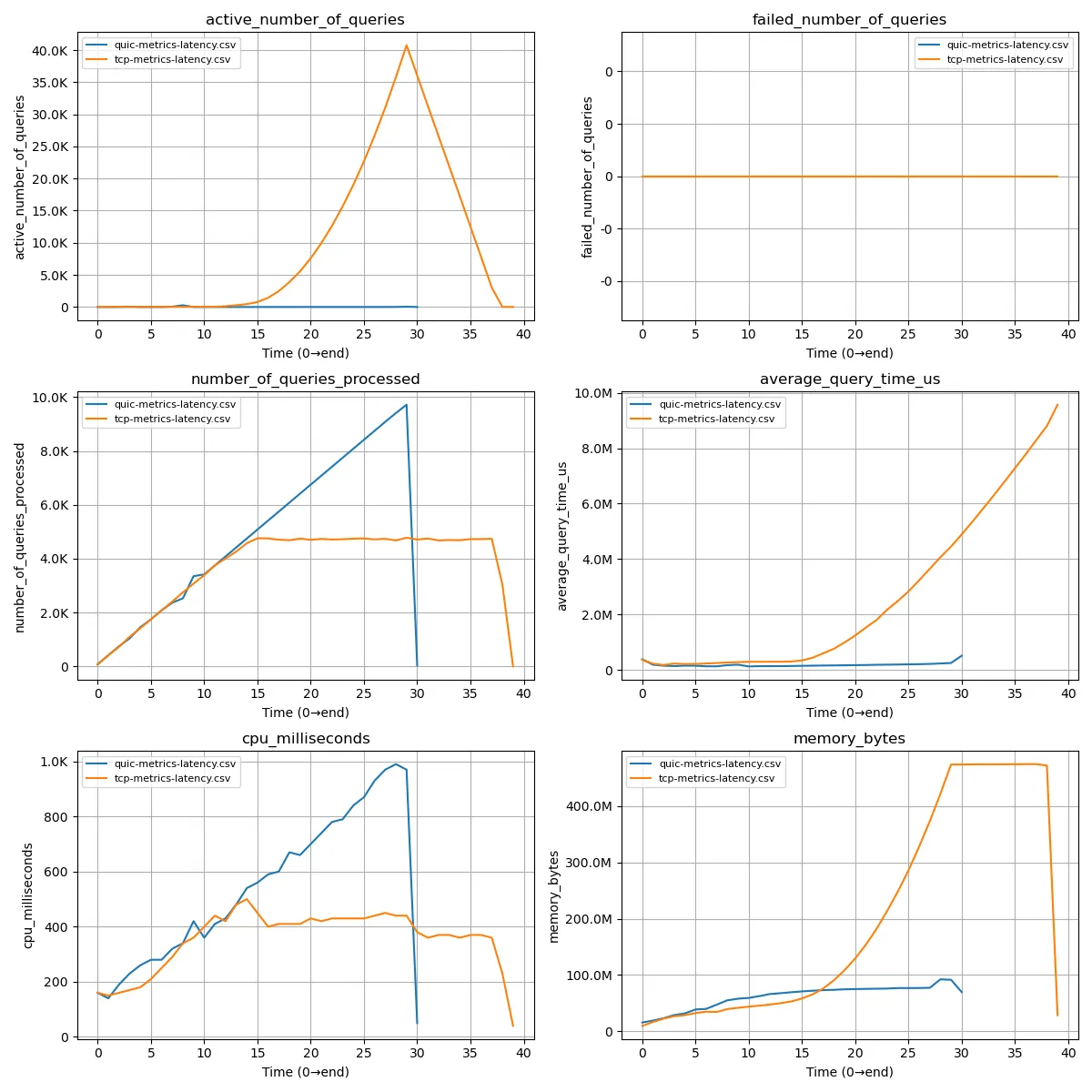
Figure 3: Real telemetry comparison over 30-second load ramp. Notice the catastrophic divergence in active query backlog and query latency.
Analyzing the Divergence:
Architectural Verdict: When to Use It
Before you rush to rewrite your database drivers, evaluate your infrastructure topology honestly:
#### ✓ High-Value Use Cases
#### ✗ When It Doesn't Matter
Conclusion
Database connection pooling has spent two decades optimizing the server-side relationship between the pooler and the database engine. We perfected transaction pooling, prepared statement caching, and backend connection pinning.
Yet we left the client-to-pooler hop trapped in the 1980s: one heavyweight TCP socket per concurrent query.
By taking advantage of QUIC's lightweight bidirectional streams, we can eliminate the client-side socket bottleneck without touching PostgreSQL's internal engine. It turns connection pooling from a fragile game of managing file descriptors and kernel buffers into a high-throughput, multiplexed data pipe.
For distributed architectures and edge infrastructure, transport multiplexing isn't an experimental novelty: it is the inevitable future of database connectivity.
#### Explore the Code & Benchmarks
The modified PgCat pooler supporting QUIC and the Rust benchmark suite are open source.
postgres-with-quic Repo Modified PgCat (QUIC)
Key Takeaways
Continue Reading
Related Articles
 Lupyd Systems & Architecture Sept 29, 2026 • 9 min read Protobuf Everywhere: How Lupyd Uses Protocol Buffers Across Web, Mobile, and Databases Why Lupyd, Firefly, and Noon are binary-first across client HTTP endpoints, Protobuf Web Tokens, database storage, and cryptographic workflows without touching gRPC. S Sri Pranav Tene, CEO Read
 Feature Real-Time Communication Sept 28, 2026 • 5 min read How We Built Real-Time Audio and Video Calling in Lupyd A look at how Lupyd brings together WebRTC, React, Tauri, Rust, Android, and Cloudflare RealtimeKit to support one-to-one and group calling. G Ganji Pranay Raj, Developer Read
 Secure Communication Messaging Security Mar 31, 2026 • 6 min read How Message Verification Proves Your Chat Was Not Changed in Transit How cryptographic hash checks guarantee that nobody in the middle altered, reordered, or tampered with the message you received. M Meenakshi Karnataka, Project Lead Read
Open Source
Explore Lupyd on GitHub
Inspect our open-source repositories, cryptography libraries, and client tools on GitHub.
Postgres with QUIC: Why Stream Multiplexing Beats Traditional TCP Connection Pooling