


Secret watermark labels proteins as ‘made by AI’
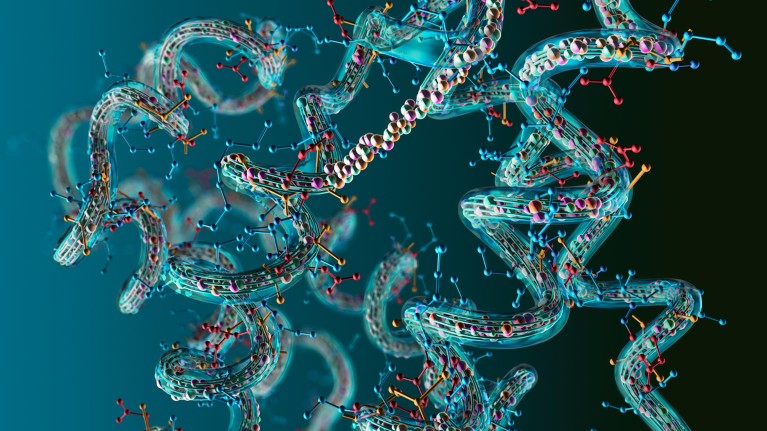
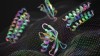
Proteins (artist’s illustration) designed by AI tools can now incorporate a hidden digital tag revealing their origins. Credit: Christoph Burgstedt/SPL
Proteins designed by artificial intelligence could soon carry a hidden signature of their machine-generated origins, thanks to a watermarking system described today in Nature1.
The technology, developed by researchers at Google DeepMind in London, borrows a trick that is already used to identify AI-made content across images, video, audio and text. It involves weaving a faint statistical tell into both the amino-acid sequence and 3D shape of computer-designed proteins — without noticeably compromising their function.
Known as SynthIDBio, the approach could distinguish AI-generated proteins in biological repositories from their natural counterparts, helping to preserve the integrity of databases that underpin both scientific research and biosecurity screening.
 Five protein-design questions that still challenge AI
Steph Guerra, a biosecurity scholar at the non-profit research organization RAND in Washington DC, sees value in an approach that aligns interests across the life-sciences community. Watermarking can support innovation and scientific reproducibility, she says, “and, at the same time, have a security benefit”.
The catch is that this molecular stamp can be scrubbed away. Someone who wants to erase the ‘made by AI’ tag can, in many cases, run a watermarked protein through another design tool and generate a new sequence that retains the protein’s structure and function but obscures its synthetic origins.
It is therefore best viewed as one more tool in a layered framework for guarding against biological threats, says Tessa Alexanian, a biosecurity researcher formerly at the International Biosecurity and Biosafety Initiative for Science, a non-profit organization in Geneva, Switzerland. “We’re in a wild new world,” she says.
Blind spots in biosecurity
Among the potential users of the watermarking system are companies that make DNA sequences to order. Customers then use this DNA to produce their desired proteins.
Such companies routinely check whether a customer’s DNA sequence encodes known toxins, proteins made by pathogens and other concerning molecules. But they could miss a design dreamt up by AI with a protein sequence that bears little or no resemblance to anything in their reference databases, even if the resulting protein performs much the same function once produced and put into a cell.
 AI can design viruses, toxins and other bioweapons. How worried should we be?
One solution, outlined by Alexanian and her colleagues, involves screening not only for sequence matches but also for the biological function that a DNA sequence might encode.2–4 That still requires working out what the resulting protein might do, however.
SynthIDBio offers a simpler alternative: it inserts a hidden clue into any AI-designed protein — encoded both at the sequence level, by subtly changing the pattern of amino acid building blocks that comprise the protein, and in the protein’s 3D shape, through tiny changes in how its atoms are arranged.
The watermark would automatically be added to proteins designed by AI tools such as AlphaFold and RFdiffusion. It could be spotted by anyone who held a secret detection key, which would be shared only with trusted partners such as DNA sequence makers.
The watermark could still be useful even though it reveals nothing except that a protein was made using an AI tool. “The synthesis providers I’ve talked to have been kind of like, ‘Any information you can give us to make sense of these orders is good’,” Alexanian says.
Marking without mangling
But that utility is undermined if the watermark interferes with what a protein is designed to do. So, computer scientist Pushmeet Kohli and his team at DeepMind “stress-tested the approach on a number of challenging problems”, he says. They found that the watermarked proteins were able to bind to a range targets — including those involved in viral infection, blood-vessel formation and immune regulation — as efficiently as unwatermarked ones.
Enjoying our latest content?
Log in or create an account to continue- Access the most recent journalism from Nature's award-winning team
- Explore the latest features & opinion covering groundbreaking research
- Clarification 01 October 2026: This article has been changed to clarify the information that is not provided by SynthIDBio.
-
 Could AI-designed proteins be weaponized? Scientists lay out safety guidelines
-
 I told AI to make me a protein. Here’s what it came up with
-
 Scientists are using AI to dream up revolutionary new proteins
-
 Seven technologies to watch in 2024
-
 Five protein-design questions that still challenge AI
- Machine learning
- Computer science
- Structural biology
- Machine learning
- Computer science
- Structural biology
-
 Sign of the times: AI lingo muscles into esteemed dictionary News 01 OCT 26
-
 This award-winning microscopy image used AI — igniting controversy in a prestigious competition News 30 SEP 26
-
 Function-preserving watermarking of AI-generated proteins Article 30 SEP 26
- Sign of the times: AI lingo muscles into esteemed dictionary News 01 OCT 26
-
 AI ‘speech clock’ assesses how fast you’re ageing from your voice News 30 SEP 26
-
 Scalable decision-making for games of imperfect information Article 30 SEP 26
-
 Harmful tau spreads like self-propagating prion proteins News & Views 30 SEP 26
-
 Prion-like transmission of human tau strains in the mouse brain Article 30 SEP 26
-
 Sequence-encoded hexagonal lattices in multichannel peptide nanofibrils Article 23 SEP 26
- #### Assistant or Associate Professor of Cell Biology Assistant or Associate Professor of Cell Biology The Department of Cell Biology at the University of Virginia (UVA) School of Medicine invites appl... Charlottesville, Virginia University of Virginia
- #### Faculty Positions in the Advanced Leukemia Therapies and Research Center - JR152492 Cincinnati Children's invites applications for tenure-track faculty positions in the Cancer and Blood Diseases Institute. Cincinnati, Ohio Cincinnati Children's
- #### Postdoctoral Position in Circular RNA Biology and Inflammatory Bowel Disease Postdoctoral position (3 years) in circular RNA (circRNA) biology and intestinal inflammation/IBD — Necker Institute (INEM), Paris. Paris, Ile-de-France (FR) INEM Institute
- #### AI Scientist Join the Casale Group at Human Technopole in Milan to build AI systems that turn human genetics and biomedical data into disease discoveries. Milan (IT) Human Technopole
- #### Graduate Student - Microbiome Therapeutics and Cancer Immunotherapy
Access through your institution
or
doi: https://doi.org/10.1038/d41586-026-03033-y
Updates & Corrections
References
1. Stutz, D. et al. Nature https://doi.org/10.1038/s41586-026-10965-y (2026). Article Google Scholar 2. Wittmann, B. J. et al. Science 390, 82–87 (2025). Article PubMed Google Scholar 3. Abel, G. R. Jr. et al. Front. Bioeng. Biotechnol. 14, 1832724 (2026). Article PubMed Google Scholar 4. Wittmann, B. J. et al. Front. Bioeng. Biotechnol. 14, 1858951 (2026). Article PubMed Google Scholar 5. Zhang, Z. et al. Preprint at bioRxiv <https://doi.org/10.1101/2024.10.23.619960> (2026). 6. Zhang, Z. et al. Preprint at arXiv <https://doi.org/10.48550/arXiv.2510.15975> (2025).
