Architecture Deep Dive: Startup Time & Import Optimization
Architecture Deep Dive: Startup Time & Import Optimization
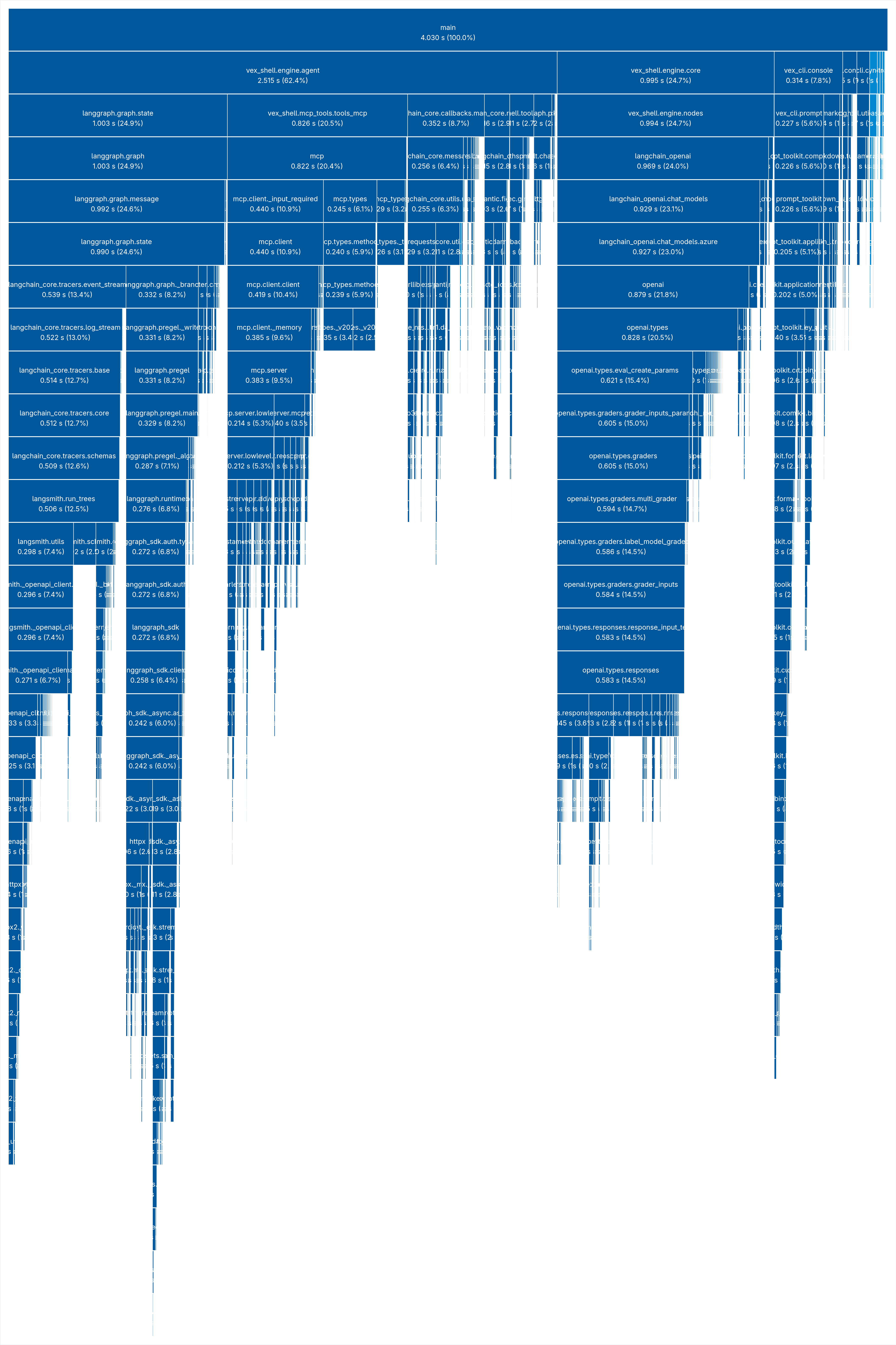
Here's where I started about 4s of cold start for both utility functions and main vex program - just disgusting speed for a cutting-edge agentic runtime.
The difference between main app and utility functions
All utility functions are a shortcuts that usually avoid main program functionality, for example
- `--help` \- just show help message
- `--ls` \- list session, touch only sqlite database
Obviously such functions should work almost immediately. How to speed up utility functionality in this case ? Just bypass main program initialization:
# Main CLI start point
async def run_agent(args):
    # ...    # Short circuits for utility functions
    if args.init:
        init_workspace(console=console)
        return
    if args.list_sessions:
        await list_sessions(settings,console)
        return    # Start agent, heavy lift imports
    from vex_shell.engine import core
    from vex_shell.engine.agent import Agent    tools,mcp_manager = await core.get_tools(settings)
    graph = core.build_graph(settings, tools)
    agent = await Agent.create(graph, args.session, settings, mcp_manager)
All heavy imports occur after utility args checking(`from vex_shell.engine import core` etc).
Main App Startup Optimization
Okay let's consider that we have blazingly fast utility functions, but what about main app startup ? Using some extremely useful tools, like tuna and `-X importtime`. I have investigated which modules slow down startup. Tuna generated visual map showing the exact time required for module imports.
Based on this map, I found several bottlenecks in the codebase.
Type Annotation-Only Imports
During development, module-level imports are often added purely for type annotations:
from vex_shell.utils.config import SettingsEven if `Settings` is used for type hints only, the entire `config` module, will still be loaded. To prevent this unexpected behavior, we can use the following pattern:
from _future_ import annotations
from typing import TYPE_CHECKINGif TYPE_CHECKING:
    from vex_shell.engine.agent import Agent
    from rich.console import Console
    from vex_shell.utils.config import Settings
`TYPE_CHECKING` evaluates to `False` during runtime, ensuring these imports are used strictly for static type checking during development. This yields zero resource overhead during execution.
Function-Scoped Imports
Usually we just import most of modules at the top of `.py` file, but in this case we transfer all imports to application start time. Which isn't always a good choice. Alternatively we can use `on-demand imports`, thus import module during function call. Of course it will slow down function call time, but we can achieve shorter start time, moving delays to runtime, and it's also worth noting that any imports loaded only on the first call, after modules are already in cache.
def build_graph(settings: Settings, tools:List[BaseTool]) -> StateGraph:
    # On demand importing for heavy modules, only when function CALLED
    from langgraph.graph.state import  StateGraph
    from langgraph.prebuilt import ToolNode    from .nodes import llm_call_node, verification_node, should_continue, should_verify
    from .state import State    tool_names = [e.name for e in tools]

    graph = StateGraph(State)

    # LLM Nodes
    graph.add_node(
        "llm_call", partial(llm_call_node, settings=settings, tool_names=tool_names)
    )
    graph.add_node("tool_node", ToolNode(tools))
    graph.add_node("verification_node", partial(verification_node, settings=settings))
    # ...
Fun to note
In nodes.py I used `from langgraph.graph.state import END`only for `END` constant, but it leads to a whole module import which consumes `1.36s`. By just replacing this import with `END = "_end_"` I saved this time.
Approximate results
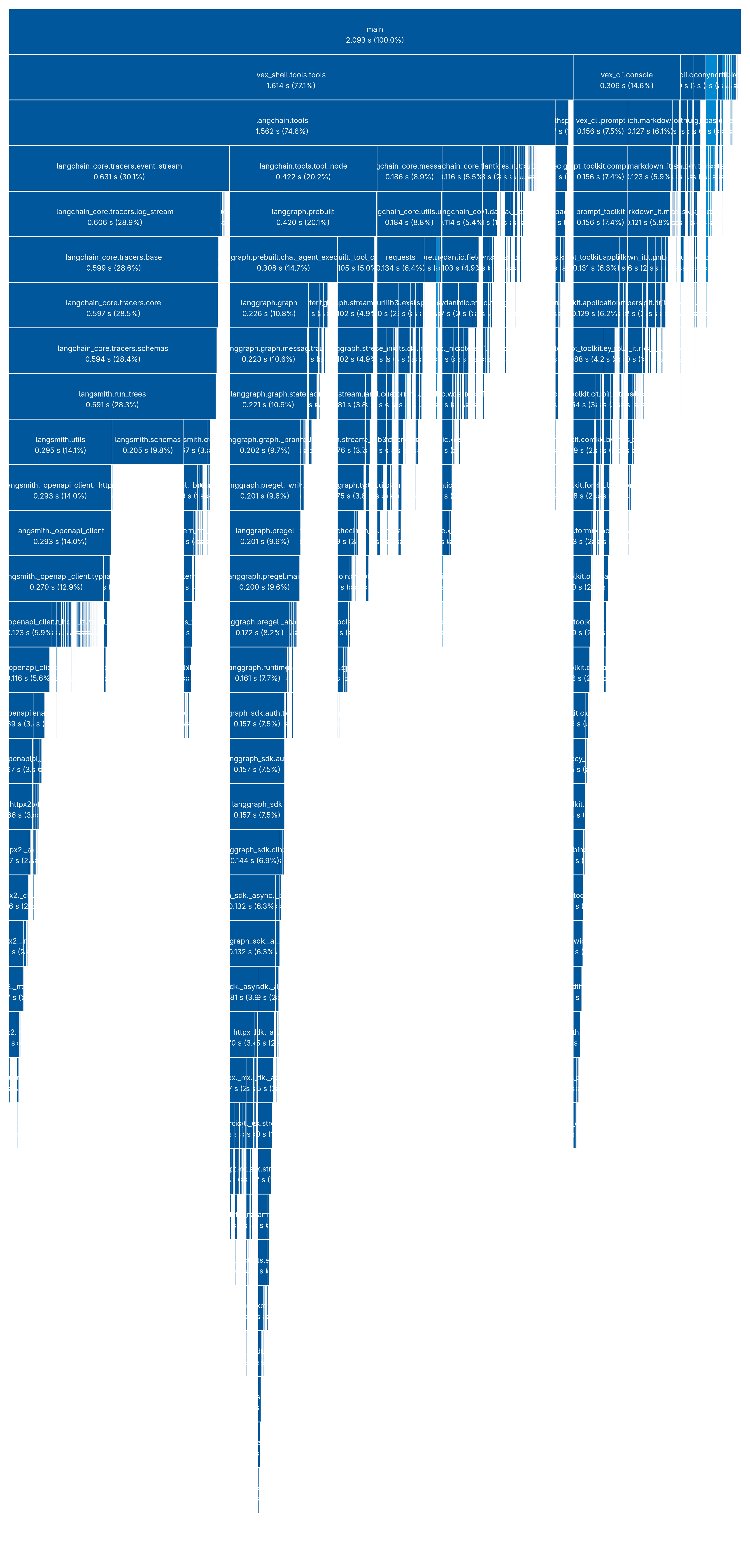
1. MCPManager - imported only if defined in CONFIG.toml, saves 1 second. 2. Move all annotation-only imports into a `TYPE_CHECKING` guard. 3. Move all heavy imports inside functions (`ChatOpenAI`,`langchain.messages`,etc)
Timings
P.S.
VEX shell source code: <https://codeberg.org/Enji/vex>
Thanks for reading, Bye ₍^. .^₎⟆