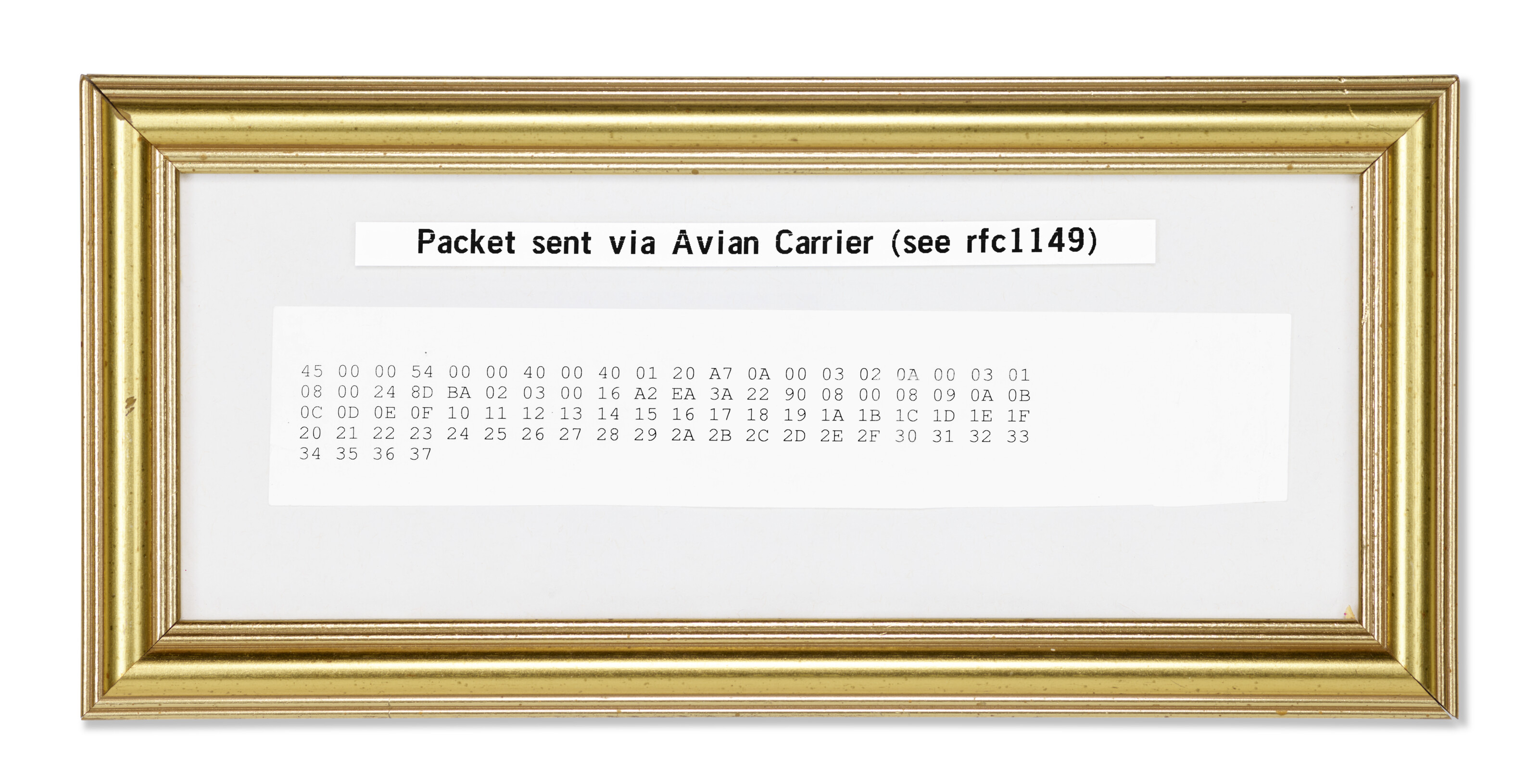
Carrier Pigeon Internet Protocol
Clients are required to upload proof of identity documents in order to bid in this sale.
Important: Please ensure you have read and understood the Buyers Premium Schedule prior to registering for the sale.
Visit the pages of the lots you wish to place an absentee bids.
Click Here to Complete your Account
\[WAITZMAN, David and the BERGEN LINUX USER GROUP.\] One printed IP/ICMP "ping" packet sent by carrier pigeon per RFC 1149. Small scroll of paper, 41 x 210 mm. Rolling creases visible from when attached to pigeon's leg. Framed. Inscribed and signed on the verso of backing board: "Property of David Waitzman". A surviving packet from the first and most famous implementation of the Carrier Pigeon Internet Protocol. In 1990, the American network engineer David Waitzman authored RFC 1149, A Standard for the Transmission of IP Datagrams on Avian Carriers, on April Fools' Day. It describes, in deadpan technical language, the transmission of Internet packets by carrier pigeon. Although written as a joke, RFC 1149 became one of the best-known pieces of Internet folklore and remains widely cited more than three decades later. On 28 April 2001, members of the Bergen Linux User Group in Norway (BLUG) carried out a full-scale implementation of the protocol. Using printers, scanners, and racing pigeons, they printed individual IP packets as hexadecimal strings, attached them to birds' legs, and transmitted them between two lofts separated by approximately three miles. Nine packets were dispatched and four successful replies were returned. The present scroll is one of those transmitted packets: a physical Internet datagram that actually traveled by carrier pigeon during the experiment. It was presented to Waitzman, the original author of RFC 1149, the following year. Appropriately, BLUG sent the packet in a physical frame just as IP packets are sent within coded frames. The RFC 1149 implementation has been described as a quintessential example of the Internet's tradition of the "artful hack," embodying the playfulness, technical ingenuity, and collaborative spirit that characterized the early Internet community.
- Conditions of Sale
- FAQs
- This lot is offered by Christie's Inc
Brought to you by
Sorry, we are unable to display this content. Please check your connection.
More from
Fine Printed Books, Manuscripts, and Science
Place your bid
Cost calculator
Or set your maximum bid below:
Your maximum bid USD
Cancel
You have agreed to be bound by the Conditions of Sale and if your bid is successful, you are legally obliged to pay for the lot you have won. The purchase price for a successful bid will be the sum of your final bid plus a buyer’s premium, any applicable taxes and any artist resale royalty, exclusive of shipping-related expenses.
Condition report
A Christie's specialist may contact you to discuss this lot or to notify you if the condition changes prior to the sale.
I confirm that I have read this Important Notice regarding Condition Reports and agree to its terms. View Condition Report
Print Report
Cancel
Close
Cost calculator
Enter your bid amount for an estimated cost
Bid amount
Please enter numbers only Amount must be higher than the starting bid Amount must be higher than the current bid
Buyer's premium
Loss, damage and liability
Shipping
Estimated Excise Duty
Artist Resale Royalty
Estimated total cost exclusive of customs duties/charges and tariffs
Close