



FR 192: “Infinite Personalized Music” Is Just Music

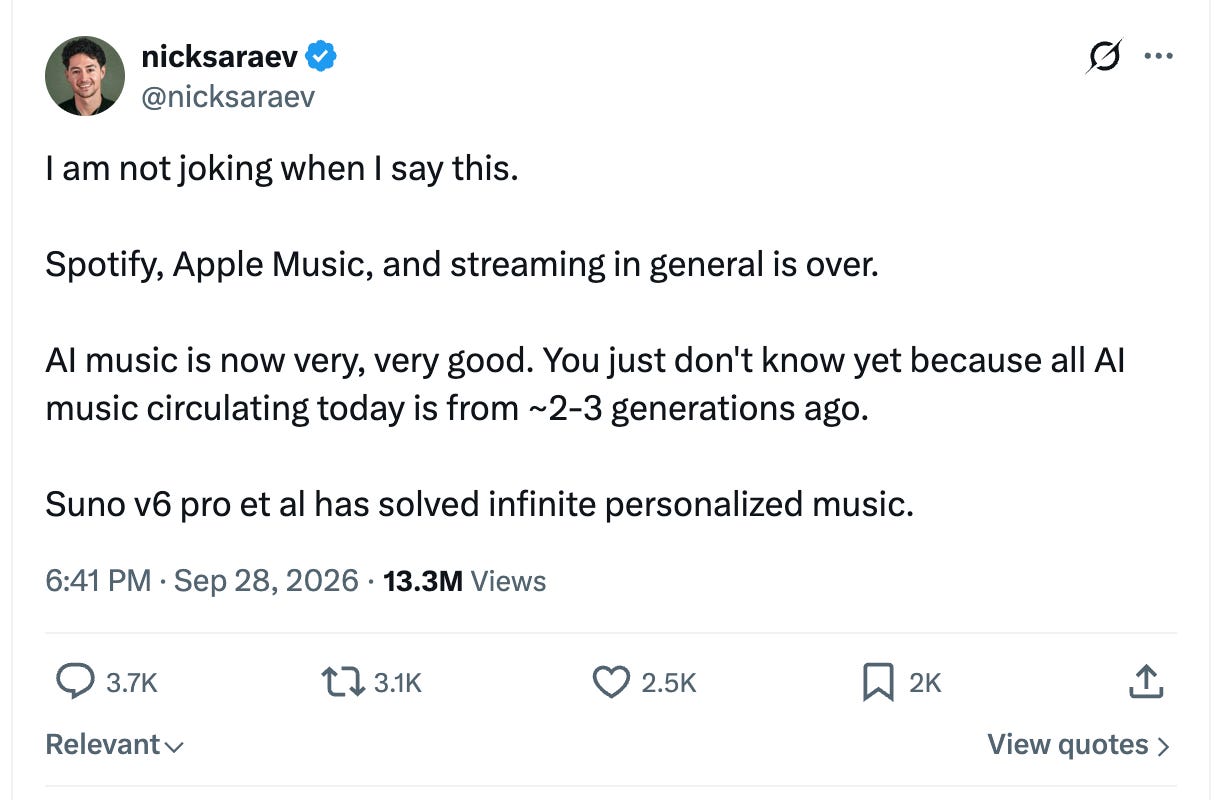
The other day a post from some tech bro started making the rounds.

There are many things wrong with his framing, beginning with the smug attitude (“Yes, this probably hurts your feelings. It’s still going to happen,” he wrote, or asked AI to write for him, in another post), although such triumphalist smugness seems to be the default setting for tech bros these days.
I hesitate to dignify the guy’s post with a response; among other things, this is someone that uses the R-word as a slur, which is an automatic disqualification in my book. But to the point at hand, as my friend Mat Schulz pointed out, AI music actually needs streaming, because how else is it going to find its way to listeners’ ears? Severed from an ecosystem of artists, labels, genres, scenes, and fans, the stuff is otherwise doomed to die on the cybernetic vine; there will be nothing to distinguish one track from another, to give any of it any kind of value whatsoever. Slop, after all, needs a trough.
---
Your support makes this newsletter possible
Subscribe
Paid subscriptions are $5 a month or $50 a year; perks include exclusive playlists for chilling and clubbing (now available on Tidal as well as Apple Music, Deezer, and Spotify); Eavesdropping, a series of mixes by me; the ongoing Mixes Digest series; and full access to the archives, including interviews with Topdown Dialectic, Bill Orcutt, Kara-Lis Coverdale, Call Super, Avalon Emerson, Nick León, and more.
---
But one phrase from his post has stuck in my craw to such an extent that I can’t let it slide.
“Suno v6 et al has solved infinite personalized music.”
The idea that music is something that needs to be solved is absurd, ridiculous; it deserves ridicule. Music is not a problem. Music is a gift. Are there problems related to music? Sure. That’s why we have piano teachers, conservatories, YouTube tutorials, copyright lawyers. If we’re talking about the logistics of distribution and “music discovery,” that’s why we have record labels, record stores, festivals, streaming platforms, radio, Bandcamp, SoulSeek, magazines, blogs, forums, threads on social media, friends with whom we share our enthusiasms. But music, in itself, will never be “solved,” because there’s nothing wrong with it in the first place.
So what about “infinite personalized music”? Music is already infinite. There is more recorded music in this world than anyone could listen to in a lifetime, in many lifetimes, and there is more being released every day. The output is only accelerating. And that doesn’t even touch on the realm of live music, or music you play on your own instruments in your own home.
And music contains infinities within infinities. There are albums I’ve been listening to for 40 years that I still hear new things in. Records are like rivers; you never wade through them the same way twice. They change depending on your mood, your age, the setting, the weather, the person you’re listening to them with. It’s one of the most beautiful things about recorded music: that something immutably fixed on a vinyl disc or within a collection of bytes can be so alive, so changeable, so giving.
You can’t find something you want to listen to? In the parlance of the internet, that’s a you problem, buddy.
“Personalized” is where he really loses me. How would we “personalize” our music? Tweak a bassline, take the high end off the vocals? Cut out an extraneous bridge? Maybe add a superfluous key change, for those with short attention spans? That’s just psycho behavior. It’s onanism. It’s an expectation that the world should bend to your every need and desire. Music isn’t a utility. As much as it may be used for mood regulation or social lubrication, it’s not a drug, or a line of code, where a certain input yields a predetermined output. Music is messy and intractable, because music is human.
This is the thing: Music is a form of communication. Now, it’s an incredibly inefficient form, because what the musician is “trying to say” may not be at all what you take from it. It might be that the musician isn’t trying to say anything. Maybe they were just experimenting with a new synthesizer and a delay pedal, or an acoustic guitar and a set of chord changes. What you take from it might really have more to do with what you put into it—a sunny day, a breakup, a memory of another song that sounded similar, but different. But the emotion that arose in the nexus between the artist, their creation, and you is the whole point of the thing.
Maybe a piece of music isn’t perfect? Maybe it could be improved! But then, its flaws are part of its essential unity; they contribute to its identity as a human creation, as an attempt to make meaning in the world.
To think that a piece of music needs to be personalized because it doesn’t suit your needs is the worst kind of arrogance. It’s narcissistic, infantile, antisocial.
So much of the meaning that we bring to music is social: not just who made it, but who we listen with, and in what context. Are we in a blacked-out basement club or an outdoor stadium? A backyard or a church? But even music listened to on our own—I’m imagining here a private discovery, something you don’t share with any of your friends or internet acquaintances—is a social experience, because we project upon it, or attempt to tease out, what we think the musician is trying to get across. Our mind goes somewhere when we listen to music, into the music, and it meshes with the musician’s mind; we listen for what they were listening for. We are both on a quest, and if we are lucky, we both arrive at the same place. And if we don’t, sometimes that very disconnect creates its own unique pleasures.
To listen to music is to exercise our curiosity. It is to ask, Why does this piece of music sound like this? Why did the artist do X instead of Y? We might unconsciously consider things like when they made it, or where they lived, or who we think they were hanging out with, what other artists they might have listened to. Maybe we don’t know any of those things, but that doesn’t stop us from wondering. Music is a kind of language, and it is always communicating something, even if we don’t know exactly what.
(Trying to be generous, I consider the idea that maybe the AI proponents are using “personalize” like I might use the word “remix.” Which, OK, sure; I’m a DJ, I have made remixes and edits in my day, I understand the desire to get your hands into someone else’s creation and bend it to your own will. But the internet is already deluged with user-generated content that nobody will ever listen to, and in any case, I don’t really think that’s what the personalize-everything contingent means. Because they talk about this stuff in rapturous terms, like it was ushering in some final phase of artistic evolution, whereas the phenomenon of laypeople remixing songs for fun is, at best, a gimmick, or a hobby. And gimmicks and hobbies don’t merit the sort of breathless, this will change everything tone that the AI boosters favor.)
Here’s the thing: I fundamentally do not trust what the AI hardliners say. I know they don’t care about music, because most of their arguments don’t hold water. Even they have to know that. Which means that they’re trying to sell us some other shit. I don’t know what that shit is. But it’s not music, which makes me deeply suspicious of their motives. (“AI will cure cancer,” we’re told, but all I see is a bunch of blowhards trying to “solve” the pressing problems associated with securing restaurant reservations and ordering lukewarm takeout. Tell you what: Once you’ve cured cancer you can try to force your telepathic DoorDash fantasies on us as much as you like.)
I’m sympathetic to the idea that artists—real, human artists—may find uses for AI-assisted tools. There’s a long tradition of surrendering control to technology, from aeolian harps to chance operations to algorithmic composition methods. It’s likely that artists will find ways to incorporate AI technologies similarly. And in those cases, the relevant question will be: does the work hold up? Does it make the case for its existence? Does it communicate something meaningful?
But that’s not what AI boosters like Nick Saraev are trying to sell us on. He’s not talking about virtual samplers that grab snare drums from across six decades of recorded music and collage them into white-noise gamelans the likes of which we’ve never even imagined, or some other mind-bendingly avant-garde gambit that would be much more difficult, if not impossible, with today’s technology. He wants to fine-tune his songs so that they are “infinitely customized to my tastes,” to satisfy his every needy little whim, like a toddler who wants mommy to break his banana into pieces for him, and then cries anyway because now the pieces are too small.
Music doesn’t need to be “personalized”; it is already as personal an experience as art offers us. To try to personalize it any further misses the entire point. It would be like wanting a novel that could be adapted to your own perspective, because you didn’t identify sufficiently with the protagonist. It would be like viewing sex as something that could be ordered off a menu, so there is zero daylight between the act and your expectations of it. It would be like a device that you hold up in front of someone’s mouth while you’re talking to them, to make what they say sound more like what you want to hear. It would be like inventing an antidote for the very feeling of surprise. To think that music needs to be modified to suit the vagaries of your own taste is to assume that you are the center of your universe, and everything in it exists solely to serve your desires. It is, I repeat, a breathtaking display of vanity.
---
Subscribe
Thanks for reading Futurism Restated! This post is public so feel free to share it.