

Mars For The Rest of Us

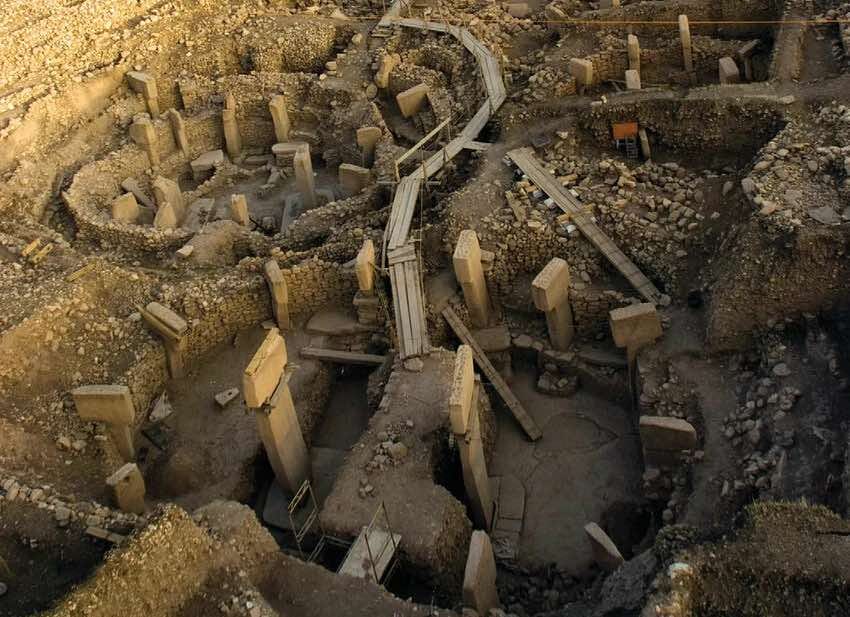
The first archaeological sign of complex human civilization is a 11,500 year old temple complex at Göbekli Tepe, in modern-day Turkey. But behaviorally modern humans1 have been around for about 50,000 years, making it tempting to wonder if we’re not missing some interesting history in that four hundred century gap. Might there be very old human societies, possibly at a high level of technical sophistication, whose memory is lost to us?
Consider that India, a civilization over five thousand years old, produced no written historical records of itself until the 12th century AD2. Entire Indian dynasties are known today only because their kings stamped their faces on coins, a practice they copied from invading Greeks. The ancient Harappan civilization in the Indus Valley, more populous and technologically advanced than its contemporaries in China or Egypt, stayed unrecognized until the 20th century.
In more recent years, we’ve started discovering entire lost cities in the Amazon with lidar. How far can we stretch this? Is there a chance some precocious empire before the last ice age was flying around in biplanes and using radio?
There are many examples of calamities and population bottlenecks that sent societies sliding back down the technical ladder. Multiple island descendants of Polynesian settlers lost the ability to build canoes. The Roman recipe for making concrete disappeared for almost 2,000 years. And kids these days, of course, can’t even read a clock face. Losing advanced technology is a cherished human tradition, from ancient times to today, and for much of history it was natural to live with cultural memories of a more technically advanced Golden Age, sometimes with physical evidence to back up the legends.
Still, there are observations we can make in the present day that put a ceiling on the technical level of any lost civilization.
Any ancient megalopolis would still be a recognizably artificial urban complex, no matter how badly carved up by kudzu or glaciers. An early Industrial Revolution would have exhausted the easily accessible deposits of fossil fuels that were just lying around for the taking during ours. Any culture capable of advanced shipbuilding or aviation would have carried ancient animals and crops far from their origins, anticipating the Columbian exchange by millennia. And if rival tribes were nuking each other during the Younger Dryas, they would have left isotopic traces of their activity easily detectable today.
On timescales of tens of thousands of years, this kind of negative evidence is dispositive. A precocious city state in Doggerland in 10,000 BC may have reached the technology level of Tudor England, or even the Napoleonic era, but we can be certain they were not making plastic bags or smelting aluminum.
Still, history is long. We can zoom out a little and ask if analogous negative evidence rules out technological civilizations across our planet’s entire past. The earliest metazoans (animals) appear in the geological record 630 million years ago, while it took only three million years for the genus homo to diverge from some unremarkable fellow apes and begin the evolutionary climb to you and me, sitting here at our computers. That means there were about 200 rolls of the dice available for a species to acquire fire, language, aerosol cheese, and the other accoutrements of civilization. Were we really the first ones to do it?
The Silurian hypothesis is a fun 2018 thought experiment about what traces would remain today if a civilization at a similar technological level to our own existed in Earth’s remote past.
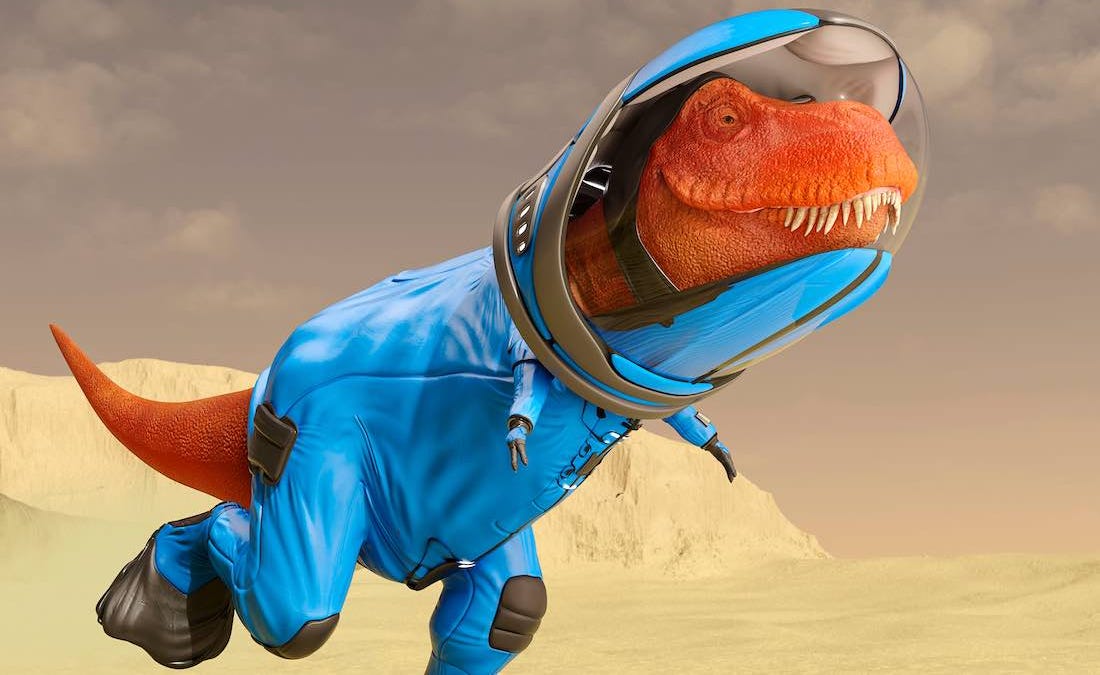
Imagine Elonosaurus Musk, living 201 million years ago at the end of the Triassic, in a society as advanced as our own. Unlike his human namesake, Elonosaurus lacks access to ketamine and has the follow-through to act on plans to colonize Mars, or at least start landing rockets there in numbers. But it’s not long before a dinogenic catastrophe (or simple bad luck) triggers the end-Triassic extinction event that wipes out Musk’s many descendants, along with half of land-based life on Earth.
What could we observe of his civilization today?
We can start by saying that a civilization of spacefaring saurids is entirely consistent with the fossil record. But that’s because nearly anything is consistent with the fossil record. Earth is a notoriously active world, making it terrible at recordkeeping. The ocean floor moves like a conveyor belt, from spreading centers at mid-ocean ridges to the edges of tectonic plates, so that the average piece of ocean crust spends no more than 60 million years before being subducted back into oblivion. Continental crust, which floats on top of everything like froth in a bucket, can be much older. But it is constantly recycled, lifted up in mountain building events and then eroded into the sea, where it forms sediments that form back into mountains again.
At distances over a few million years, trying to reconstruct the state of the biosphere is like trying to guess the plot of a movie based on just a few damaged frames of film. Of all the dinosaur species to ever exist on Earth, for example, fewer than two thousand—maybe 1%—are known from fossils, most of them fragmentary.3
Earth’s constant ferment would not only erase all traces of technology from the planet’s surface within a few hundred thousand years, but bury and distort even the grossest evidence for a human-like presence on (depleted mines, dams, asphalt roads, concrete cities) on the timescale of a few million years.
You might think an advanced technical civilization would leave some signs in the climate record. Anthropogenic global warming, after all, is supposed to be raising temperatures to levels not seen in millions of years. Surely an equally imprudent predecessor civilization would have left a very clear signal?
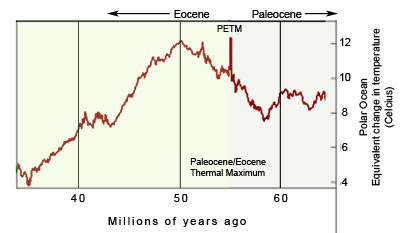
But our climate history is full of these signals! Consider the Paleocene-Eocene Thermal Maximum, a sharp spike in warming 55 million years ago whose origins are unclear. It could not look any more like a civilization frying itself with uncontrolled emissions.
 ")
Evidence of sudden and extreme human-style global warming, as seen 55.9 million years ago.
We know that an abrupt injection of biogenic carbon lasting no more than 2,000 years preceded a rise in temperature that persisted for about 200,000 years, and the extinction rate for marine life went through the roof. This is exactly what the climate signal from our present era will look like, if anyone is around to examine the evidence.
Nor can we infer anything about the nonexistence of an ancient civilization by looking at whether they used up easily-reachable deposits of fossil fuels. The Triassic ended with a major global warming event whose victims and successors created whole new beds of those fuels for later generations to benefit from. You don’t know when you’re filling your car with gasoline whether it might not be the liquefied remains of some early Einstein or Chaucer.
Ultimately, whether an ancient technical civilization would remain legible to us depends more on their physical footprint than absolute technology level. Over the last seventy years, humanity has covered massive portions of the Earth in concrete, some of which could persist as a distinct geological bands for hundreds of millions of years. Coal burning in high-temperature furnaces creates distinctive, pollen-sized globules of fly ash that should be similarly long-lived. Even mundane mass-produced objects like ballpoint pens can leave durable mineral traces (in the case of pens, spheres of almost indestructible tungsten carbide).
But such technogenic artifacts are a numbers game. Unless that ancient sauroid civilization was as world-spanning and profligate as ours, there’s every chance we could be living on an Earth peppered with their technosignatures, and simply miss them.
To find unequivocal traces of ancient technology civilization, it might be better to look off-world.
Searching for ancient satellites sounds like a good start. The astronomer Beatriz Villarroel and her team have been doing exactly this, performing computer searches of pre-Sputnik astronomical photographs for signs of artificial objects in orbit around Earth. They’ve found stuff! Naturally, these extraordinary findings are mired in disputes around methodology. Still, it seems like an excellent idea to go look for weird stuff in orbit around Earth.
That said, three factors would limit the lifetime of any ancient satellite.
The first is Earth’s tenuous outer atmosphere, which drags satellites in any orbit below 1,500 km down to destruction on timescales ranging from decades to a few thousand years. Sattelites in the Starlink constellation, for example, are designed to have an orbital lifetime of just a few months once their stationkeeping fuel runs out. Since most useful orbits are below 1000 km, this rules out most satellites from the get-go.
The second limiting factor is a radiation effect called Poynting-Robertson drag, which shaves something like 1 meter/year off the orbit of any satellite exposed to sunlight. This is a subtle effect in the short term, but over tens of millions of years it starts to lose its subtlety. A satellite placed in distant Earth orbit (say 100,000 km) a hundred million years ago might occupy a 20,000 km orbit today. And the more distant the initial orbit, the more easily it is perturbed by the Moon, which could send it crashing to Earth.
The third and biggest problem is micrometeorites and dust. Space is empty, but it’s not that empty, and over megayear timescales a satellite will find itself pulverized by pieces of debris ranging in size from dust specks to rocks big enough to shatter it completely.
So while it’s worth looking for inhuman satellites in some obvious places (Lagrange points, stable resonant orbits), we should not expect to see any survive for more than a few tens of millions of years.
Of course, the Earth already has a perfectly stable, natural satellite that is a good place to put stuff. Here again, the limiting factor is micrometeorite impact. Over the centuries, a steady pounding from cosmic dust grains and sand ‘gardens’ the top twenty centimeters or so of the lunar surface, while nearby impacts cover surface objects with dust. The Apollo 11 footprints might make it a few hundred thousand years before they are rendered unrecognizable, and the nearby lander will probably last for a few millions of years more before it completely blends in to the landscape.
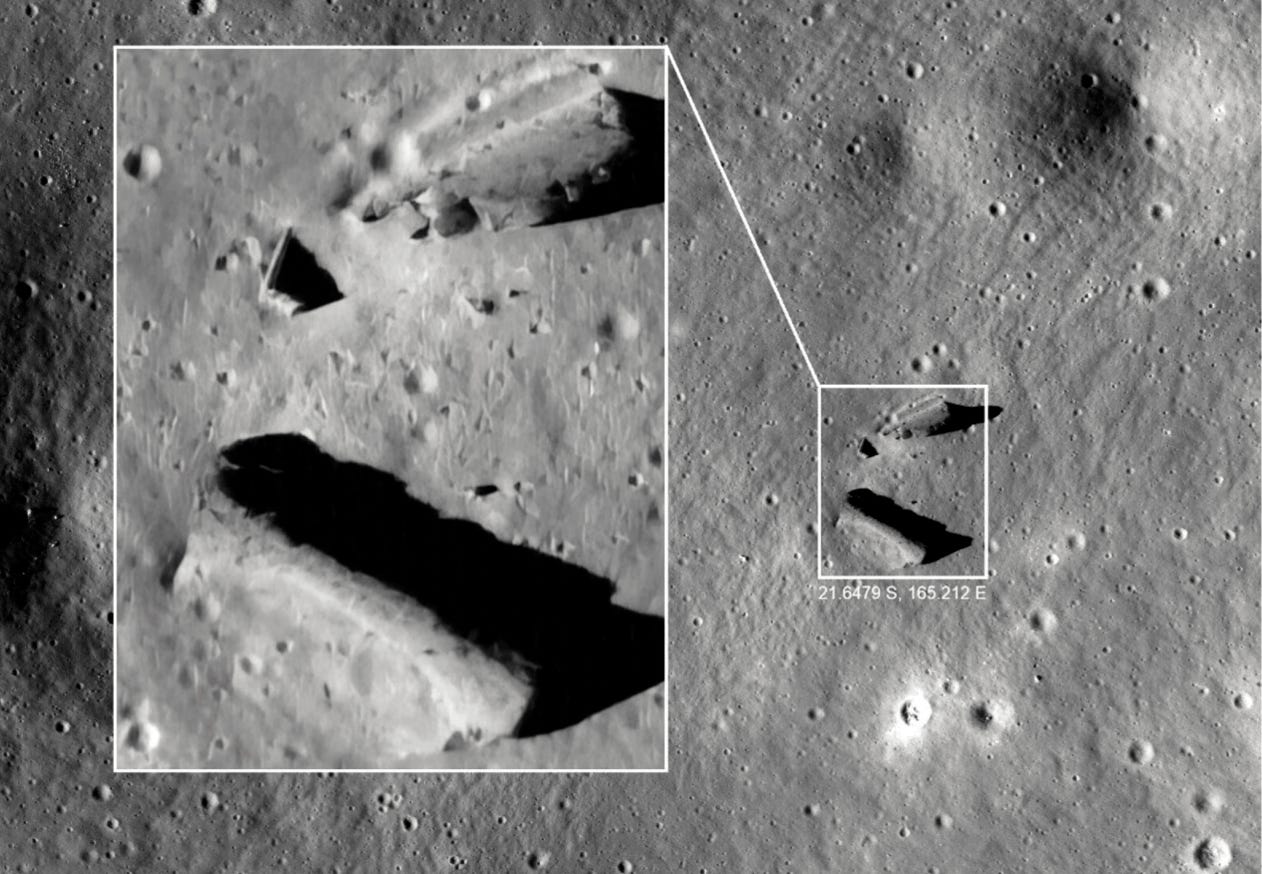
Larger artifacts that have been broken up by impactors might remain recognizably artificial for a long time. In that spirit, someone should really go take a closer look at whatever this is, lying at the bottom of Paracelsus C crater on the far side of the Moon:

Strange finds on the far side of the Moon. The bottom object is about the length of an airliner.
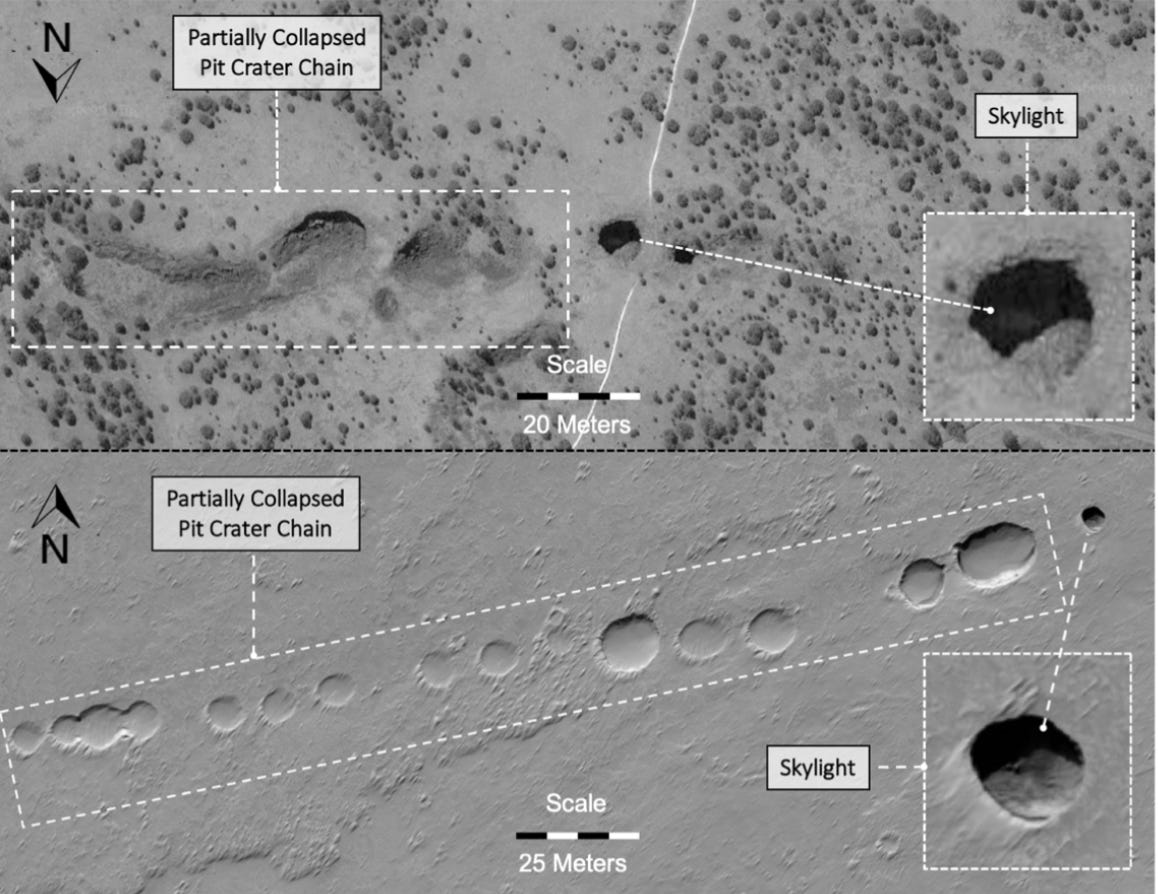
When you really want to keep things pristine on the Moon, the best thing you can do is put it in a lava tube. Lava tubes are long tunnels that also exist on the Earth and Mars, forming natural protected vaults that can be kilometers long. Occasional skylights where the top of the lava tube has collapsed provide access to the surface. Lunar lava tubes maintain an even temperature (17˚C) and are well-protected from cosmic debris. There’s probably no better place to store a classic car collection in the Solar System.
The role of these caverns as a sort of permanent archive make them extremely interesting exploration targets even if you’re not expecting to find technological artifacts. JPL’s Laura Kerber has proposed a cool two-wheeled rover capable of descending into such a tube on a tether. The project, called Moon Diver, would cost around $500 million, or about what NASA plans to spend on a single lunar space suit, but was rejected back in 2019.
The thin Martian atmosphere makes an excellent screen, intercepting any arriving meteorites smaller than about the size of an acorn. Since most space debris is tiny, this means objects on Mars can endure for eons without the kind of abuse they experience on the moon. On the flip side, the atmosphere leads to dust storms, wind erosion, and sand dunes. While objects on the Moon get smashed up over time by random impacts, anything lying around on Mars will get very gently sandblasted, abraded away by a faint but persistent cold wind of fine dust.
We know large metal objects can survive for eons on the Martian surface because the Opportunity rover found several large iron meteorites that have been chilling on Mars for a billion years or more4. While heavily pitted and weathered, these meteorites have retained their overall shape and are still recognizably metallic, one reason the rover had an easy time finding them.
By an analogous process, old metal artifacts on Mars would find their shape softened. Any thin sheets of metal would be eaten through by wind erosion at a rate of about 1 centimeter per 100 million years. But large metallic structures, particularly if they were not partially buried to begin with, would remain noticeable.
The question is, who would notice them? The highest-resolution images of Mars we have right now come from the HiRise camera on the Mars Reconnaissance Orbiter, but that has only imaged about 4% of the planet. And even at this resolution, something like the Viking lander is only a blip about ten pixels wide. It took over a decade to find the Beagle 2 lander in satellite photographs, and in that case we knew exactly what we were looking for, and roughly where to look for it.
It’s not clear whether plastic or composite structures could survive Martian conditions for any length of time. In their case, the limiting factor will be ultraviolet light, which degrades polymers on a timescale of decades even on Earth. And of course, if our hypothetical dinosaur astronauts used in situ techniques to build a shelter out of regolith (imagine Martian adobe huts), then the search for those structures might be hopeless.
 and a similar formation on Mars (bottom).")
Just like on the Moon, there’s good reason to go see what’s going on inside Martian lava tubes. While not quite the museum-quality archives that they are on the Moon, they form a natural shelter for any ancient terrestrial visitors (who would be as wary of galactic cosmic radiation as we are) and a great place to search for Martian relic life. The hard part will be finding lava tubes that are old enough to hide anything truly ancient—Mars remains a volcanically active world.
The Solar System is a big place, and while it’s hard to get inside the neural carapace of a rival life form and anticipate what they would find worth visiting, some obvious locations leap to mind.
One attractive destination is the asteroid belt. Asteroids are easy to land on, rich in minerals, and the big ones probably retained residual heat and liquid water for a substantial fraction of the Solar System’s history. A large body like Ceres is a prime target for exploration today, and would have been a correspondingly more interesting target hundreds of millions of years ago.
If anyone got far enough along to start mining asteroids in space, traces of that activity should be well-preserved. Asteroids face the same problem as the Moon, with cosmic shrapnel tearing up the top couple of centimeters of regolith on a timescale of millions of years. But if you strip-mine one of them, that is going to remain noticeable essentially forever.
The moons of Mars are another obvoius draw. They are already anomalous, two space potatoes of uncertain origin, and being far easier to land on than Mars proper, they form a kind of natural waypoint.
Looking for technological artifacts on the surface of Venus brings to mind the words of Jack Handey: “If you ever drop your keys into a river of molten lava, let ‘em go, because man, they’re gone.” But Mercury might be worth checking out, though it’s a pain to get to.
Further afield, the icy moons of the outer solar system that are the most appealing targets for human exploration and settlement are too geologically active to preserve any surface trace of pre-human visitors. But if there are any sapient fish under the ice, they might retain a cultural memory of explorers from long ago (or maybe even some souvenirs), and it’s probably worth going there to ask them.
Everything I’ve written so far presupposes that a pre-human spacefaring civilization would have arisen on Earth, their eventual collapse perhaps masked in the geological record by one of our convenient mass extinctions.
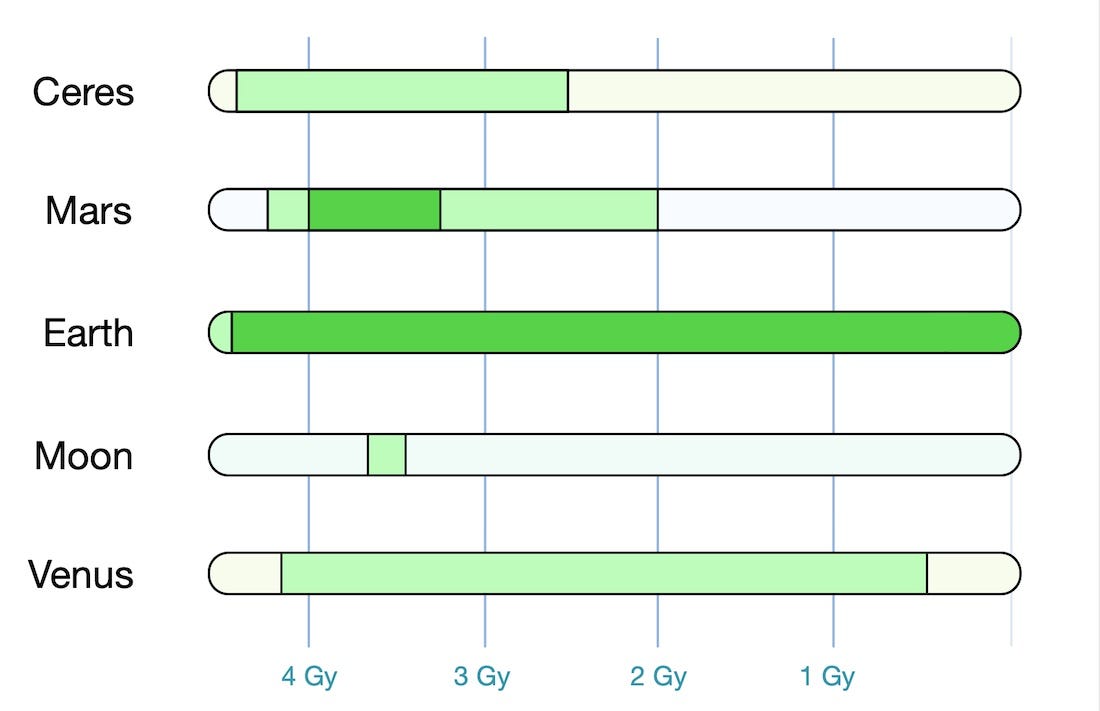
But this is a very geocentric assumption, and there’s no good reason to believe an early civilization had to arise on Earth. Consider that an observer looking around the inner Solar System about 3.6 billion years ago would have found up to five habitable worlds:

Timeline of early habitability. Dark green is known, light green conjectured
Both Mars and Earth in that era were fully livable, at least for microbes, while Ceres and the Moon had liquid water in contact with warm rock. The Moon was still volcanically active, and outgassing from eruptions may have given it a transient atmosphere twice as dense as what Mars has today, enough for water to be stable on its surface in liquid form.
Mars was clement for a long period of time, but we have probaby seen enough of its surface to rule out signs of a planet-spanning technical civilization, which would have left visible traces in the least-eroded areas that world. But as I’ve said above, we’ve only barely started to look at Mars.
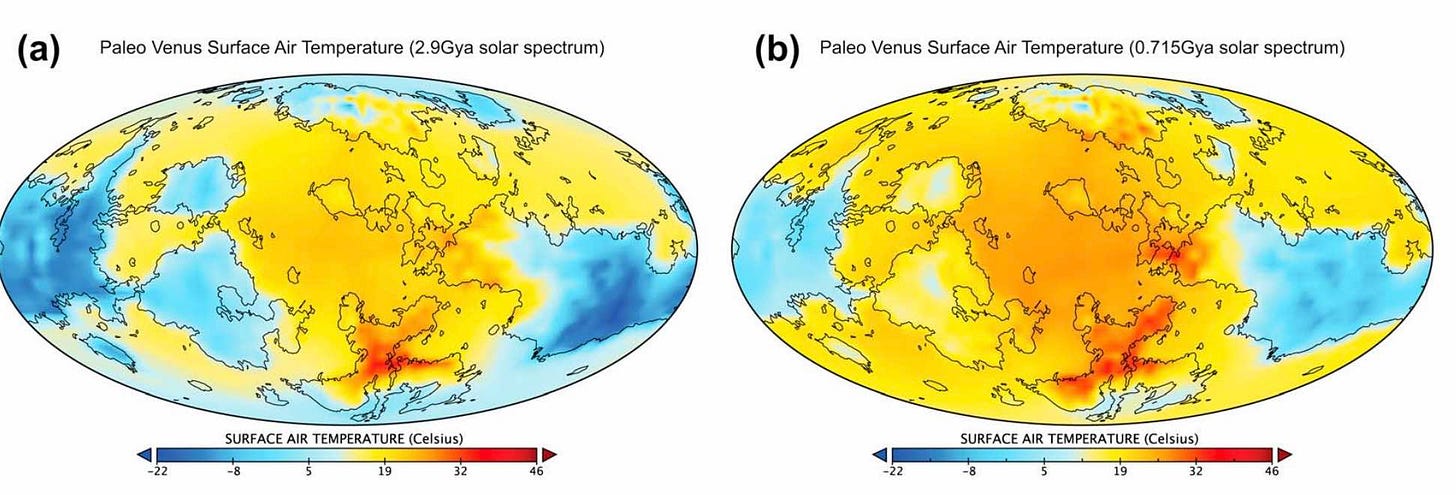
Venus is the Solar System’s wild card. In some climate models, the planet was never habitable, losing all its water while still covered with a slowly-cooling magma ocean. In other models, the planet was a temperate and livable Eden that enjoyed mild temperatures and ocean breezes for over three billion years.

The problem is very under-constrained; we can’t even guess how fast an early Venus rotated, which has implications for habitability (counterintuitively, a barely-rotating Venus with a permanent sub-solar cloud deck stays much cooler than a planet that rotates once every 16 days or faster).
What we know for sure is that Venus has a young surface, reworked circa 700 million years ago by planet-wide volcanism. A technical civilization of arbitrary complexity could have existed there for a billion years and we would see no sign of it today.
Intriguingly, the last habitable epoch on Venus coincides with the Cambrian Explosion, the abrupt and still mysterious appearance of complex animal life on Earth. Maybe someone on Venus got fed up all the volcanism and packed a suitcase full of trilobites.

Continue reading this post for free, courtesy of Maciej Cegłowski.
Claim my free post