Periodic Table of Elements
Periodic Table of Elements
Grid List
Temperature 298 K (24.9 °C)
0 K 0 °C 25 °C 100 °C 1000 K 3000 K
1 2 3 4 5 6 7 8 9 10 11 12 13 14 15 16 17 18 1 2 3 4 5 6 7 Lanthanides Actinides 1HHydrogen1.008 2HeHelium4.003 3LiLithium6.94 4BeBeryllium9.012 5BBoron10.81 6CCarbon12.011 7NNitrogen14.007 8OOxygen15.999 9FFluorine18.998 10NeNeon20.18 11NaSodium22.99 12MgMagnesium24.305 13AlAluminum26.982 14SiSilicon28.085 15PPhosphorus30.974 16SSulfur32.06 17ClChlorine35.45 18ArArgon39.948 19KPotassium39.098 20CaCalcium40.078 21ScScandium44.956 22TiTitanium47.867 23VVanadium50.942 24CrChromium51.996 25MnManganese54.938 26FeIron55.845 27CoCobalt58.933 28NiNickel58.693 29CuCopper63.546 30ZnZinc65.38 31GaGallium69.723 32GeGermanium72.63 33AsArsenic74.922 34SeSelenium78.971 35BrBromine79.904 36KrKrypton83.798 37RbRubidium85.468 38SrStrontium87.62 39YYttrium88.906 40ZrZirconium91.224 41NbNiobium92.906 42MoMolybdenum95.95 43TcTechnetium98 44RuRuthenium101.07 45RhRhodium102.91 46PdPalladium106.42 47AgSilver107.87 48CdCadmium112.41 49InIndium114.82 50SnTin118.71 51SbAntimony121.76 52TeTellurium127.6 53IIodine126.9 54XeXenon131.29 55CsCesium132.91 56BaBarium137.33 57LaLanthanum138.91 58CeCerium140.12 59PrPraseodymium140.91 60NdNeodymium144.24 61PmPromethium145 62SmSamarium150.36 63EuEuropium151.96 64GdGadolinium157.25 65TbTerbium158.93 66DyDysprosium162.5 67HoHolmium164.93 68ErErbium167.26 69TmThulium168.93 70YbYtterbium173.05 71LuLutetium174.97 72HfHafnium178.49 73TaTantalum180.95 74WTungsten183.84 75ReRhenium186.21 76OsOsmium190.23 77IrIridium192.22 78PtPlatinum195.08 79AuGold196.97 80HgMercury200.59 81TlThallium204.38 82PbLead207.2 83BiBismuth208.98 84PoPolonium209 85AtAstatine210 86RnRadon222 87FrFrancium223 88RaRadium226 89AcActinium227 90ThThorium232.04 91PaProtactinium231.04 92UUranium238.03 93NpNeptunium237 94PuPlutonium244 95AmAmericium243 96CmCurium247 97BkBerkelium247 98CfCalifornium251 99EsEinsteinium252 100FmFermium257 101MdMendelevium258 102NoNobelium259 103LrLawrencium266 104RfRutherfordium267 105DbDubnium268 106SgSeaborgium269 107BhBohrium270 108HsHassium277 109MtMeitnerium278 110DsDarmstadtium281 111RgRoentgenium282 112CnCopernicium285 113NhNihonium286 114FlFlerovium289 115McMoscovium290 116LvLivermorium293 117TsTennessine294 118OgOganesson294 57–71La–LuLanthanides 89–103Ac–LrActinides
Periodic Table of Elements
Hover over an element to see its data. Click to open its full page.
Alkali metal Alkaline earth metal Transition metal Post-transition metal Metalloid Reactive nonmetal Halogen Noble gas Lanthanide Actinide Unknown properties
Alkali metal Alkaline earth metal Transition metal Post-transition metal Metalloid Reactive nonmetal Halogen Noble gas Lanthanide Actinide Unknown properties
Swipe sideways to see the whole table →
Look it up
Find any element, value or formula in seconds.
- All 118 elements
- Groups 1–18 and families
- Periodic table with charges
- Electron configuration
- Molar mass calculator
- Compare elements
Learn from zero
A free course in 20 short lessons, from atoms to chemical equations. Each lesson ends with three quick questions.
1. 1Atoms and elements4 lessons 2. 2Reading the periodic table5 lessons 3. 3Electrons4 lessons 4. 4Chemistry with elements7 lessons
Start the course Quizzes History
For you
New cards every day
Did you know? BkBerkelium
The first visible sample of a berkelium compound, made in 1962, weighed only about three billionths of a gram.
Open Quick challenge
What is the symbol for Cobalt?
Co Sr Zn
AnswerCo · Cobalt More quizzes Word of the day
Anion
A negatively charged ion, formed when an atom or group of atoms gains one or more electrons.
Open Compound of the day
Iron(II,III) oxide Fe3O4
The molar mass of iron(II,III) oxide (Fe3O4) is 231.531 g/mol.
Open Try this tool
Percent yield calculator
Compare the product you actually made with the most you could have made. Solve for the percent yield, the actual yield or the theoretical yield.
Open Two-minute lesson
What are isotopes?
Isotopes are atoms of the same element that have different numbers of neutrons. They have the same number of protons, so they are the same element and react in almost exactly the same way, but their masses are different. Carbon-12 and carbon-14 are two isotopes of carbon.
What is the periodic table?
The periodic table arranges all 118 known chemical elements in order of atomic number – the number of protons in the nucleus of each atom. Rows are called periods and columns are called groups. Elements in the same group have the same number of outer electrons, so they behave in similar ways: the alkali metals in group 1 all react with water, while the noble gases in group 18 hardly react at all.
Dmitri Mendeleev published the first widely accepted version in 1869. He left gaps for elements nobody had found yet and predicted their properties; gallium, scandium and germanium were discovered over the next 17 years and matched his predictions. Today the table is complete up to element 118, oganesson.
How to read the periodic table
Each box shows one element: its atomic number at the top, its chemical symbol in the middle, then its name and its atomic mass in grams per mole.
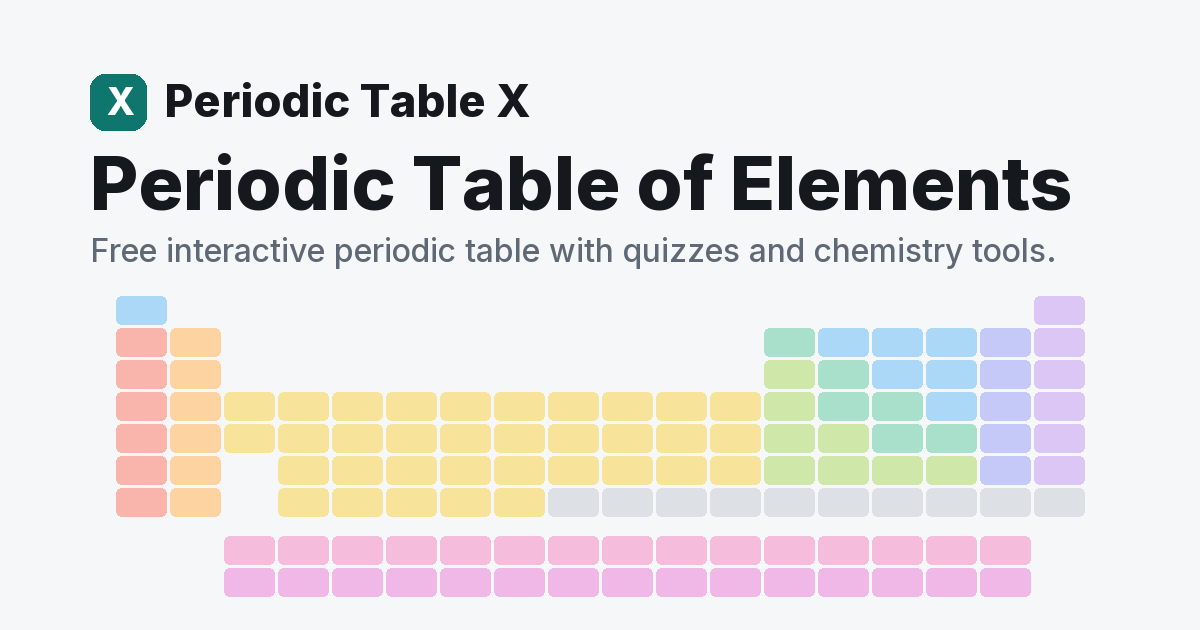
The colors sort the elements into families such as the alkali metals, transition metals, halogens and noble gases. Metals fill the left and center of the table, nonmetals sit at the upper right, and the metalloids form a staircase between them.
The two rows at the bottom are the lanthanides and actinides. They belong in periods 6 and 7 but are shown separately so the table does not become too wide.
Hover over or tap any element to see its electron configuration, electronegativity, melting and boiling points, density and discovery year, then open its page for the full story.
Explore the periodic table by property
Charges Electronegativity Valence electrons Atomic mass Names and symbols Metals, nonmetals & metalloids Electron configuration Groups and periods Periodic trends Oxidation states Atomic radius Ionization energy Blocks (s, p, d, f) States of matter Melting point Boiling point Density