

PMZ Opinion
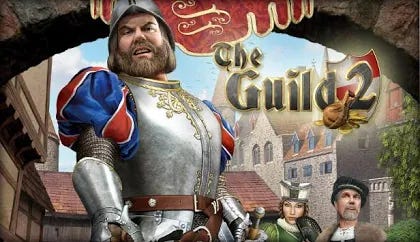
One of my all-time favourite games is The Guild 2 from 2006, a sort of strange mix of The Sims and an economic tycoon game.

You run a small family business (such as a blacksmith’s workshop) in late medieval Europe. You need to invest in your business, buy supplies, hire workers, but also find a suitable partner to marry, run for political office, sue someone in a court of law, and build a beautiful house. The game progresses in turns, each spanning four years, confusingly advancing the seasons one at a time, with your original character ageing and eventually dying, motivating you to sire a child you can continue playing as.
This game captivated my imagination, not because of what it was, but because of what it could be. The Guild 2 is a very buggy and unbalanced game. Its expansions (nowadays called DLCs) are inconsistent with the style of the main game. Plus, if you play this game a bit longer, you quickly figure out that it is not that challenging and the AI is a bunch of aimless dummies. The economic simulation stays coherent only for a few years before rampant inflation and outrageous real estate prices blow it up, or maybe this part was just too realistic. Aside from the passage of time eventually killing you and thus motivating you to have kids, there are few incentives to do anything in particular. Since running a small business is a central part of the game, you do focus on making it successful and your dynasty richer, but you don’t need to. It is also not that hard.
The idea of a simulator like this, with both economic and social elements, is brilliant. The price of iron drops when a local mine (operated by your neighbour, whom you can talk to) increases output. When you buy too much at once, the price will rise again. This alone is not innovative or rare in games, but the fact that you can marry into the family that owns this mine, or abuse a political office to dispossess them, or bake them a cake to make them like you - this all sparks the imagination about all kinds of moves you can make to better your position, other than just min-maxing worker assignments and tooling upgrade paths.
Then there are things that were never in the game but could be. This is where my own idea for a game comes in, still very much inspired by The Guild 2 but with a slightly different focus. While in The Guild 2 you are kind of left to your own devices and have no goals that really matter, the AI is not competitive at all, and even if it were... there is no single metric by which you can “win”. The game is fairly open-ended, like The Sims.
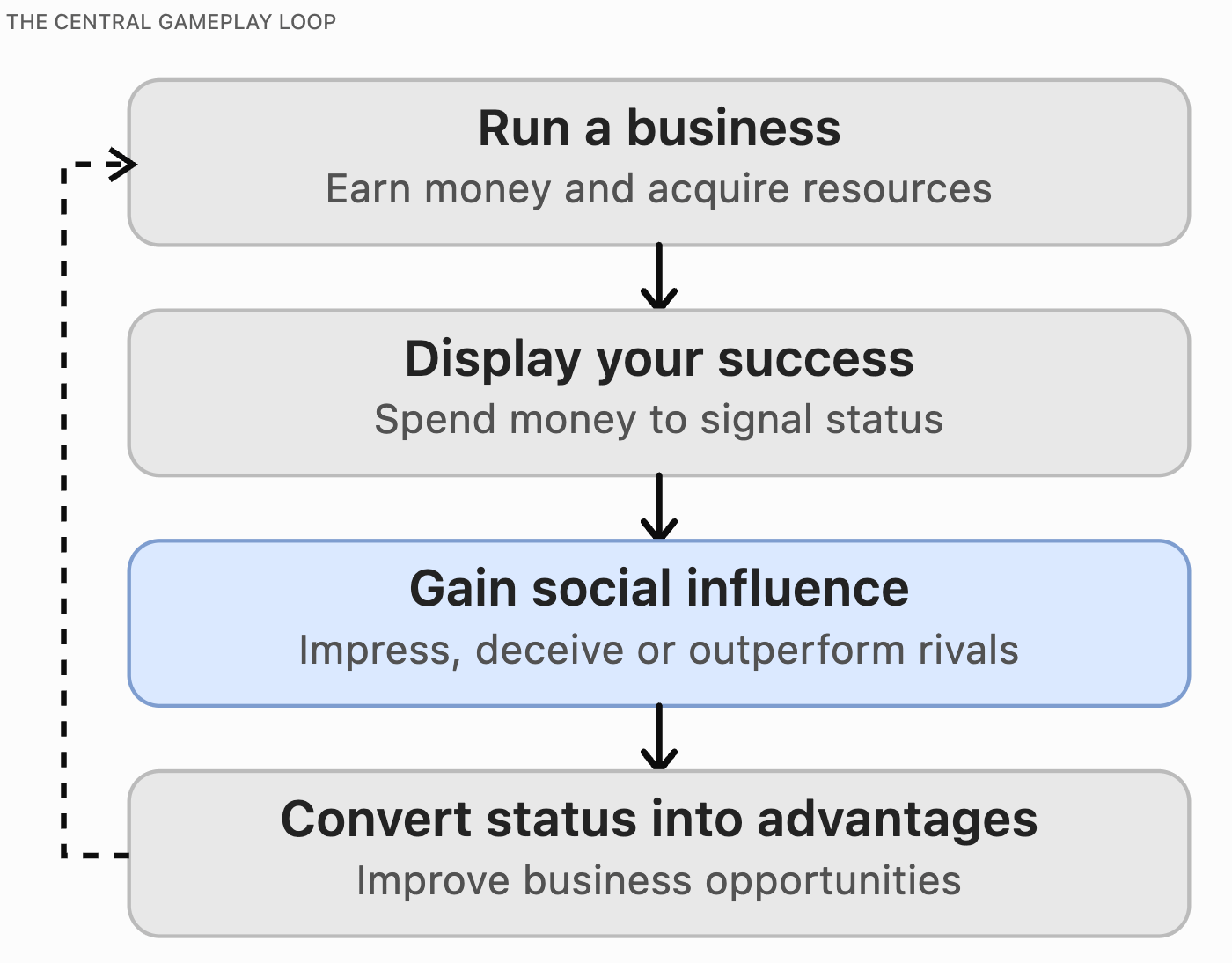
My idea for a game I would love to play is The Guild 2, but where everyone is single-mindedly obsessed with their social status. Let’s call it The Social Status Game. You still run your small craft workshop and have a small family and your house, but at regular intervals (like the original The Guild 2 turns), you go to a party or host one. Does your dynasty have better clothes than the other guests? Does your dynasty have a bigger house than the visitors? Did you marry off your daughter to an esteemed nobleman? It would be The Guild 2 where you make money to win the social ranking, which helps you... run the business that makes money. The competitive aspect would give the game more dynamism and clearer winning criteria. But there is more to it than just a simple score. Let me explain why I think that would be both more fun and more lifelike.
A naïve implementation of this idea would work as follows:

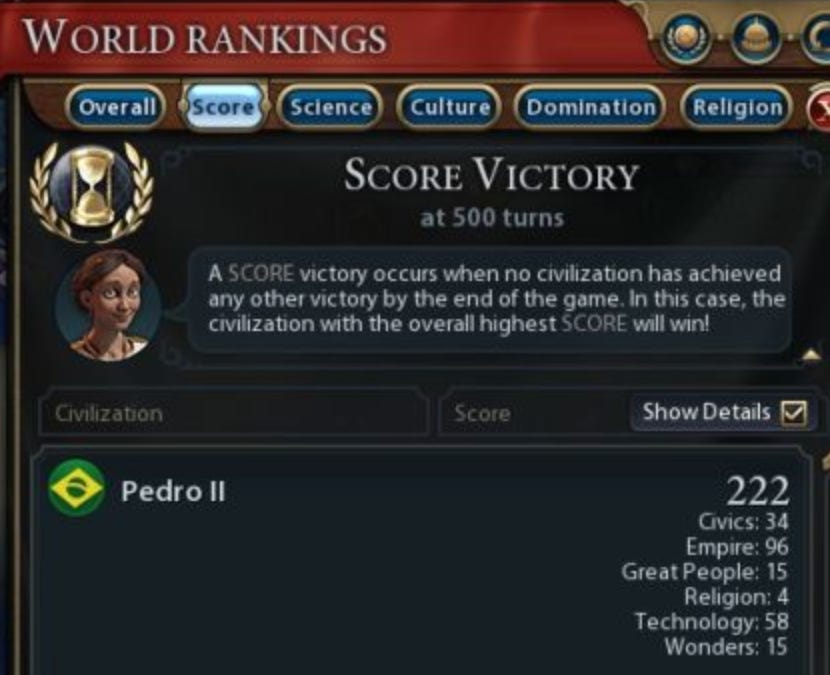
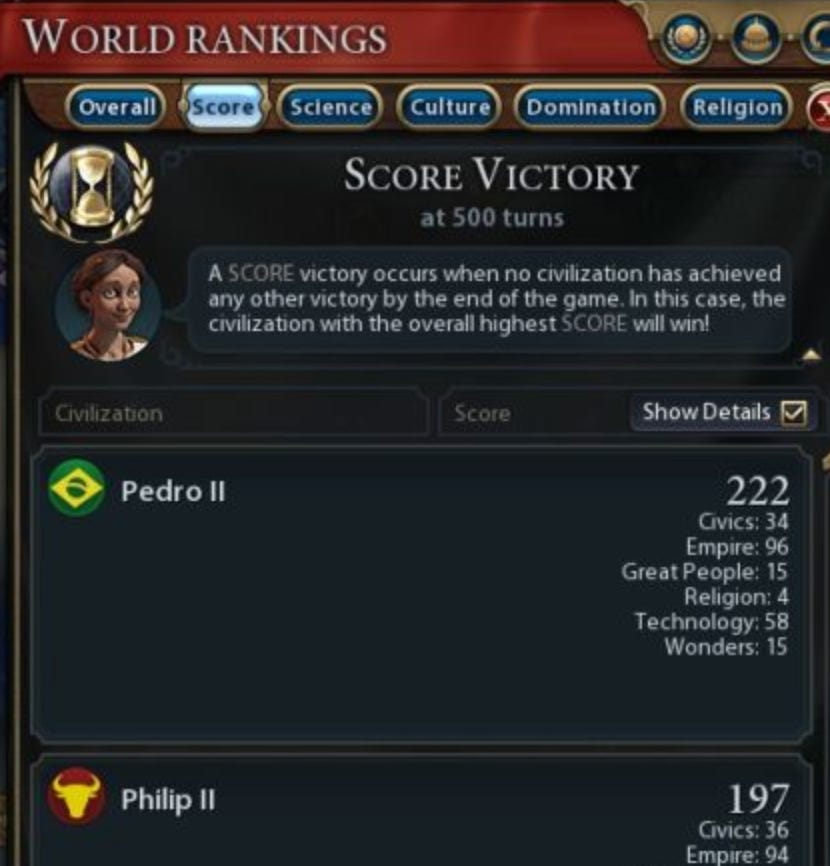
Since it is an economic game... you win if you have the most money? That would be some equivalent of different victory scenarios in Civilization.

This has been done many times, and I do not find it particularly interesting. I don’t think that many players playing economic tycoon games (or even Civ) would even be motivated primarily by a place in this ranking while playing the game. But maybe an innovative mechanism is just one step removed from a simple money table? Let’s think: how could small-town, status-obsessed families figure out which one is the richest of them all? Only in a video game is there a central and truthful register showing scores in real time to all participants, and everyone trusts it. In real life... it would be quite crass to just show each other your bank balances or, keeping true to the late medieval setting, bring all your gold to the party and publicly count it. But people bring different things to parties: nice clothes, jewellery and, well, they visit each other’s houses. All of these things cost money and can be a good proxy for how wealthy your host is, assuming they maximise spending on these items and that the prices of these things are public knowledge.
That already makes the game much more interesting. You run your little blacksmith’s workshop, buying cheap iron and selling tools, just so that at the end of the turn you can go to a party and wear the most expensive clothes you can get. Or maybe you steal them? Prop them up somehow to look more expensive than they really are? Then, at the party, you see how you are being compared to others, moving up and down in the ranking, not quite sure where you end up until the very last moment. Maybe your social status helps you marry off your children? Or secure an iron supply deal? Better than a crude gold count and sorting by who has more of it. But I think there is one more element that no proper social status game, be it a real-life one or my made-up digital one, can go without. It is fashion.
Do you know if the clothes you are wearing are fashionable? I rarely do. I assume mine are not fashionable; I am a nerdy guy. But I do find the social mechanisms behind fashion and social status fascinating. How about this: your friends see you, and they all agree you look good in your new clothes. They all agree you are fashionable. You go out, and everyone agrees too. Is there a world where everyone agrees your clothes are in fashion, but in reality they are not fashionable? Or the opposite: where you have discovered some perfectly fashionable combination, but nobody other than you calls it that? I don’t think so! So it is a form of distributed consensus algorithm where the majority decides what is and what isn’t fashionable. But how would your friends themselves know what is fashionable? The knowledge has to be bootstrapped at some point.
Sure, there must be some basic principles of aesthetics or timeless rules, maybe even rooted in our biology or more persistent cultural norms, that make certain pieces of clothing better-looking and others worse. But these should just hold constant, and fashion is... ever-changing by definition. Think about the word itself, often used as a synonym for a trend, something temporary. If fashion is arbitrary and temporary, who gets to be the first one to pick the new fashion and say “it is fashion now”, so that others accept it... without the majority behind it yet? The high-status people. Like noble courtiers at a medieval court blindly copying fashion choices from the royal family (or as much as they were allowed to...), modern people look up to celebrities, athletes and local cool kids for what to wear. Even if they don’t like this mechanism, they know that others will follow and soon the consensus will be built by the majority.
But why fashion in The Guild 2 knock-off? What good or fun would it add? To make the game more challenging! Imagine that in this social status game, the easiest way to prove your wealth is just to buy the most expensive piece of clothing and wear it to the party at the end of the turn. Even with some additional mechanics I mentioned, such as embellished, counterfeit or stolen goods, clothes become all too good a proxy for wealth. Plus, while social status in real life is certainly closely tied to money, it is not just that. Having the most expensive piece of clothing puts you high in the social ranking, but wearing one that is fashionable and in the same style as the ruling family is just the jackpot.
While writing this, I caught myself thinking, “Social status, especially defined by such crude metrics, is kind of gross”, but I still think it would make a great, innovative game mechanic that would breathe life into a game like The Guild 2, just like other nasty things we do not want in our lives, such as war, make great topics for video games.
Throughout the years, I have toyed with many implementation ideas, but never managed to make meaningful progress on making this game, as I am not a game developer and lack the artistic skills to bring this idea to life. I do hope that someone steals this idea, or independently develops it and releases it as a game. I will surely buy it.