


Can We Still Govern?
Over the past thirty years, research to improve government programs became routine in federal agencies. Now, much of that infrastructure has been dismantled, and it is time to think about what comes next. Tomorrow’s high performance government requires new thinking, powered by sharper statutes, better learning structures, and new professional career tracks.
Consider what America built and what we’re in danger of losing.
Can We Still Govern? brings you independent and expert voices. Support us by becoming a free or paid subscriber.
Subscribe
When I started working in the federal government 20 years ago, too many civil servants mistrusted research. My most recent role in government was to lead one of the premier research, evaluation and data offices in the federal government, the Office of Planning, Research and Evaluation at the Administration for Children and Families. Our mission was to improve the efficiency and effectiveness of anti-poverty programs in Health and Human Services. Twenty years ago civil servants worried my office’s evaluation efforts would only expose what programs were doing wrong.
By 2024, this had changed.
It was a quiet success. Evidence-based policy had become part of how high-functioning agencies operated. Civil servants saw building and using evidence as part of their job requirements, partnering with offices like my former office to strengthen policy and programs.
For example, we worked with the Office of Head Start to use research to develop a regulation that aimed to ensure teachers made a living wage. We worked with the Office of Family Assistance and state welfare offices to move from measuring job preparation activities to whether people actually got jobs and no longer needed government assistance. We helped local non-profits use data to identify problems in the services they were providing, identify evidence-based solutions, and test if those solutions worked.
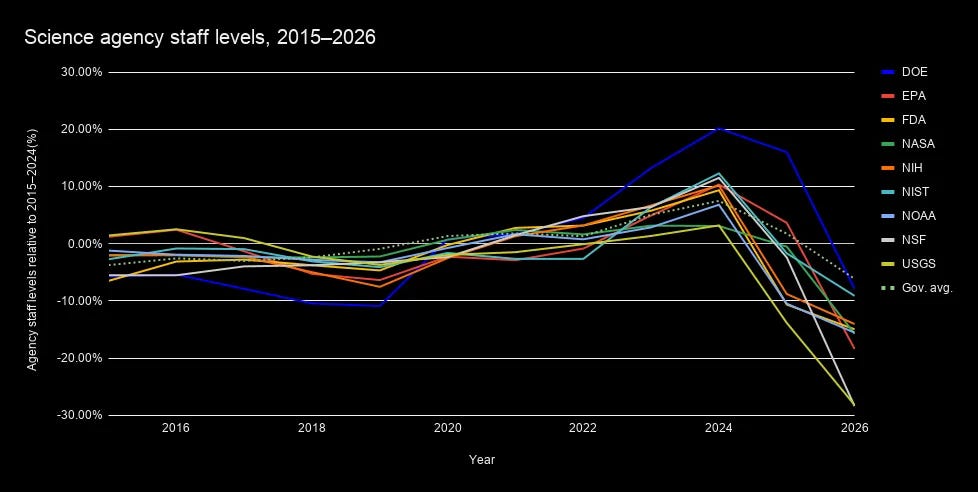
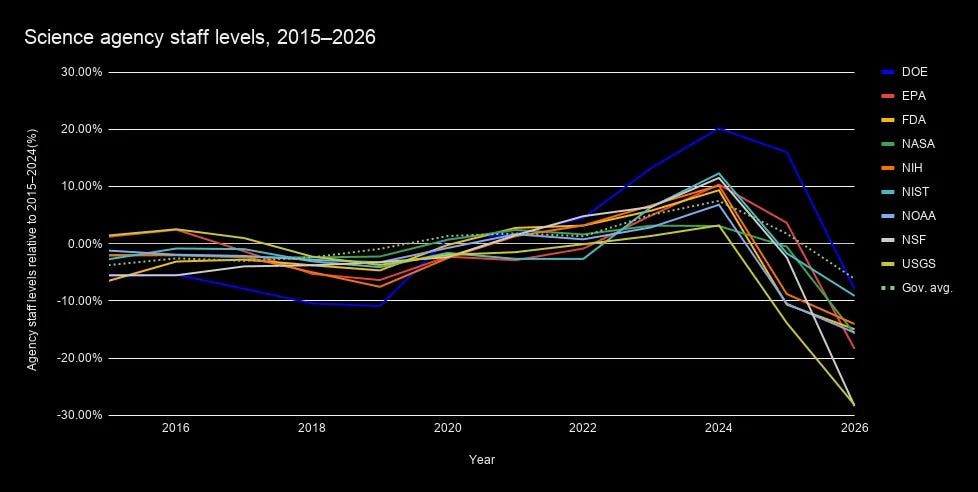
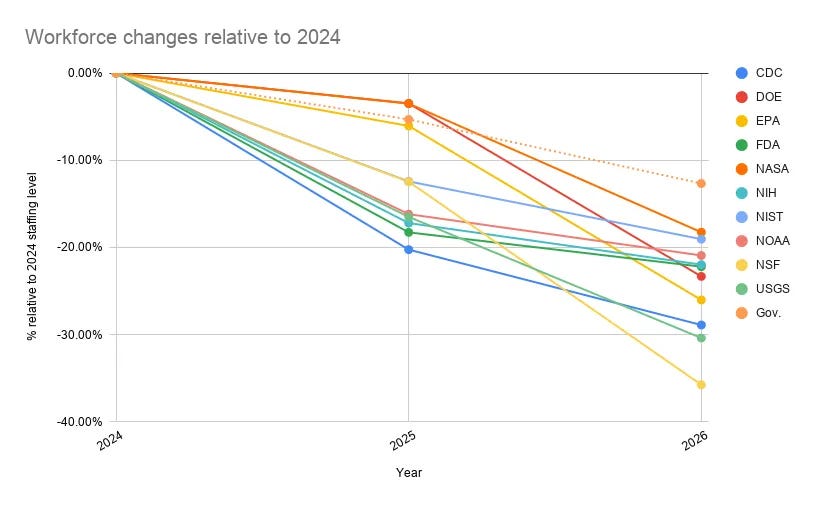
Then came the recent federal reorganization targeting science. More than 10,000 PhDs have left the government under Trump. Estimates of the loss of the federal scientific workforce vary from ten to twenty to as high as forty percent. The graph below focuses on the larger scientific agencies, showing a dramatic decline in 2025 alone, and is likely an underestimate given there are federal scientists across most federal agencies. The loss of scientific staff includes staff at dozens of science and evaluation offices that had responsibilities reduced or eliminated. Working inside the government at this time it seemed like our colleagues were being hit from every angle. Sister offices to my former office were hit particularly hard with staff loss. For example the research arm of the Department of Education lost 90% of their staff and the research office for the Secretary of Health and Human Services lost an estimated 60% of their staff.

Figure is an updated figure from an article in Nature, US science after a year of Trump: what has been lost and what remains. This graph is provided by Dan Garisto, who also offers an alternative way of visualizing the data below.

Beyond the raw numbers of staff cuts, what I saw on the inside that was less reported in the media was the politicization of science in more subtle ways: permission to post reports rescinded, findings manipulated, and projects cancelled for political reasons. Decades of infrastructure were dismantled in months, experienced career scientists sidelined, and evaluation functions shuttered.
How did a thirty-year bipartisan project crumble so quickly?
Language in laws about research and evaluation written decades ago had not been updated. Many critical research programs that aimed to improve programs were merely “allowable expenses” rather than requirements. Statutes called for research and evaluation with undefined terms like “rigorous,” “independent,” or “portfolio,” and the administration exploited these to gut work while staying in technical compliance. “Shall” versus “may” meant everything. “Shall”-mandated research programs were often continued; “may”-allowable research was often eliminated.
The Evidence-based Policymaking Act of 2018 was a major step forward. At least on paper, the Act, which mandated thinking about important questions agencies might have about their programs, made research an agency executive priority for the first time. Yet many of the requirements in the Act were underfunded or became symbolic instead of driving change.
To be sure, some criticism of the large investments in research and evaluation was valid. For years, many acted as if doing research and posting reports was enough for evidence to get used to improve programs. Far from it. We needed to also create the conditions for that research to be used to strengthen agencies. If using evidence to improve program integrity and service delivery isn’t embedded in agency operations and cultures and facilitated by trusted partnerships between researchers and policymakers, research doesn’t get results.
One of my proudest moments was after my office was dismantled, the outcry from state welfare agencies, local Head Start programs and tribal governments showed the work we did mattered to them. Often the use of the research we produced happened behind the scenes - informing the development of policy proposals, regulations, using continuous quality improvement to strengthen programs. Just one of many examples is the use of the National Survey of Early Care and Education to inform both executive and legislative branch actions related to child care over the last few decades or the continual integration of research findings into healthy marriage and fatherhood grant opportunities.
The Evaluation Policy of my former agency emphasizes independence as a key principle. The policy gave me, the career scientific head of the office, the authority to release reports without political approval in order to maintain independence. Behind the scenes, that authority was rescinded.
The administration’s attack on independent agencies, upheld by the Supreme Court, weakens the ability for research and evaluation to ever speak truth to power and provide rigorous, independent research to strengthen government programs. History has shown that government leaders only surrounded by sycophants are not particularly successful.
What comes next?
Rebuilding the pre-2024 status quo will not do. America needs a resilient evidence-to-policy system to deliver for the American people, powered by sharper statutes and better learning structures.
Sharper statutes should fix the hodge-podge of funding flows and legislation for research and evaluation for program improvement. Statutes should move away from specific dollar figure set-asides to percentage-based set-asides of overall program dollars, so evaluation capacity will keep up with inflation and program growth. Finding a new balance between precision and discretion is key: statutory language needs to convey the will of Congress to use funds to generate evidence to improve programs without locking agencies into outdated practices over time.
Funds should flow to mechanisms like research-practice partnerships where policymakers work directly with scientists to answer relevant questions. Evidence-building and use of that evidence should be mandated in discretionary and block grants to ensure tax dollars are spent wisely. The production and use of evidence should be free from political influence so it can be trusted. Without legal protections, agency scientific integrity policies meant to protect from inappropriate influence have been cancelled and recent reports from formerly trusted agencies are questioned for their integrity.
To prevent past blindspots, the public sector research and evaluation community needs to be held accountable. Career federal leaders must look for ways to bake evidence loops – creating new evidence about what works, using it to improve results, and coming up with new questions for the next wave of improvements – into regular government routines and incentives, such as performance evaluations and the budget development process. Evidence offices ought to regularly report to Congress not just on whether evaluations are performed, but, more importantly, on when and how evidence is being created and used to deliver for the American people.
Agency executives and mid-level leaders should be evaluated on how they use evidence to strengthen policy and practice, making the use of evidence a part of how the government works day in and day out. Agencies need specialists: career civil servants with the skills, training, and mandate to translate complex research into plain-language answers for decision-makers in real time, and to translate agency needs into research requests. Colleges and universities and other job training providers need to create a pipeline of future scientists ready to arrive with these skills on day one on the job. The overall disruptions to the scientific pipeline exacerbates this problem. AI can be a useful tool to summarize research, but it is no substitute for workers whose job it is to deeply understand programs, build trust, and deploy science to improve government.
Through bipartisan work over three decades, government agencies began to use evidence and data systematically to deliver better results. Embers of this achievement still glow. Leaders must fan them to improve federal performance in the years ahead.
Lauren Supplee served for 15 years under Presidents Bush, Obama, Biden and Trump as an embedded scientist in the Department of Health and Human Services. Most recently, Supplee was Deputy Assistant Secretary for Planning, Research and Evaluation at the Administration for Children and Families at the US Department of Health and Human Services.
Can We Still Govern? is a reader-supported publication. To receive new posts and support my work, consider becoming a free or paid subscriber.
Subscribe
·
Sep 16
One of the challenges of living in the Trump era is wondering if anyone actually believes Trump’s claim that his presidency has made America stronger and more globally respected than ever. Trump has dismantled much of the international infrastructure that America built and largely controlled, allowing it to become the dominant superpower over the last 8…
Mamdani, media, and negativity bias
·
Sep 6

Behold: one of my favorite explanatory images about American government:
Which stories about academia matter?
·
Sep 2

As the new academic year begins, the dominant story of the summer was that of Jason Arday, a Cambridge professor who studied education. Arday, accused of being a fabulist and plagiarist, and was found dead a week after resigning. The particulars of his case were so