

What does it take to make an independent local newsroom work? More than good journalism.
(Courtesy of Syracuse University)
By: Kristen Hare
October 1, 2026
There’s no “Field of Dreams” for local independent publishers, no “if you build it, they will come,” where the “it” is powerful, critical journalism and the “they” is subscribers happy to pay for it because they recognize the quality of the product and the necessity of that work for healthy communities.
We’ve known that for a while now.
But plenty of local news entrepreneurs are still finding ways to make it work.
A new study from Syracuse University’s Institute for Democracy, Journalism and Citizenship digs into the hard realities facing the local news entrepreneurs working to fill the huge and growing gaps left by shrinking local newspapers.
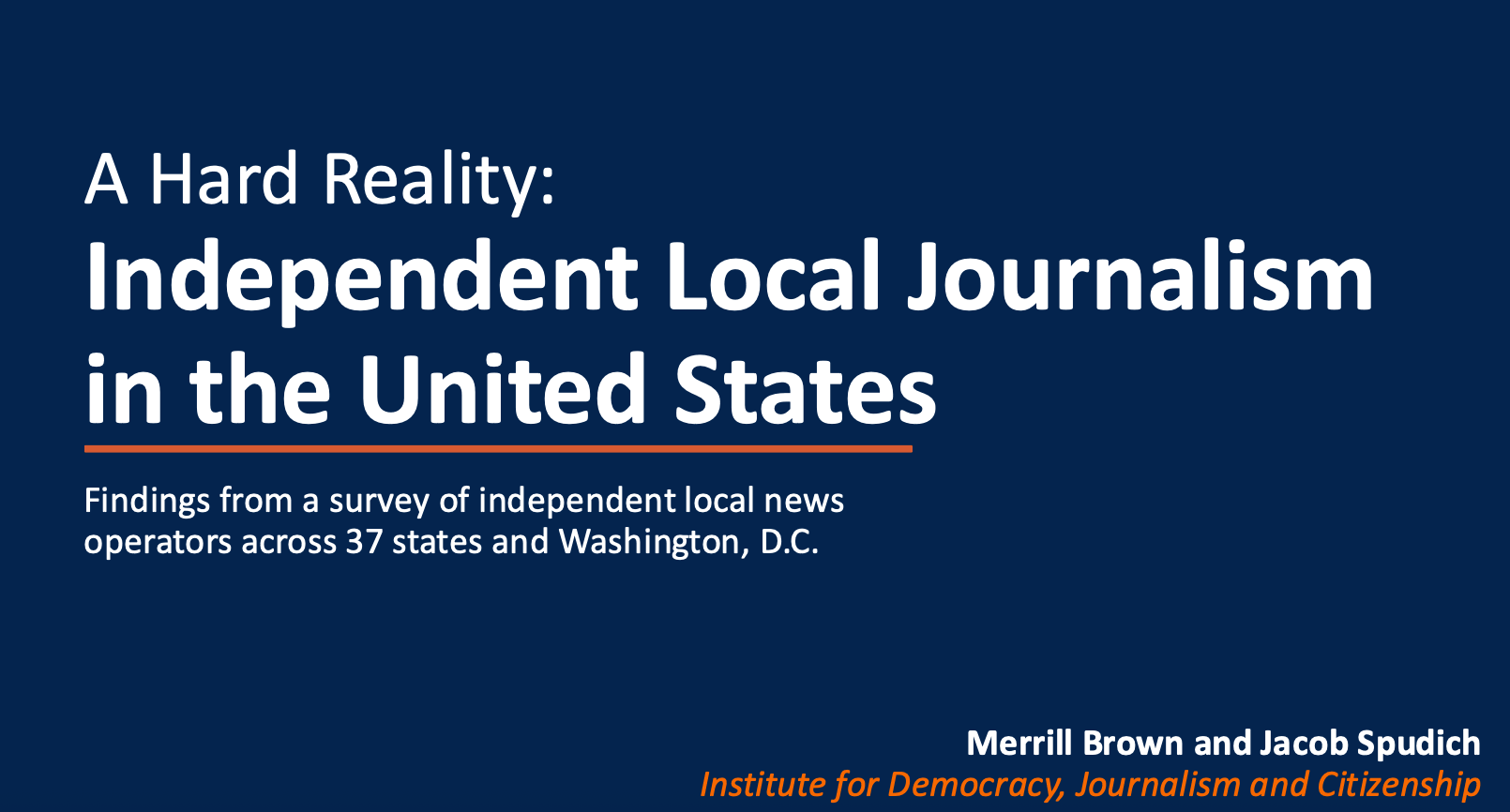
“A Hard Reality: Independent Local Journalism in the United States,” by Merrill Brown and Jacob Spudich, looks at survey responses from 112 publishers in 37 states and Washington, D.C.
The newsrooms Brown and Spudich surveyed are in vastly different phases of development, Spudich said.
But for many of them, he said, “the fact that they are all running and providing journalism is mission accomplished already.”
Their report shows something those entrepreneurs know well: Success isn’t just about producing great journalism. From day one, entrepreneurs have to be thinking about revenue, the product itself and community engagement, Brown said.
“Community engagement doesn’t fall neatly into an editorial bucket,” Brown said, noting that it used to be the work of the folks in the marketing department. “The people who feel like they’re making it are really involved in their communities.”
Brown and I dug more into the report and its findings in an email Q&A that was lightly edited for brevity and clarity. You can see the full report here.
Kristen Hare: When you set out to conduct this research, what were you hoping to learn about the state of the local news industry?
Merrill Brown: We set out to look at how local news entrepreneurs are faring. There are thousands of them around the country dealing with the reality of covering and engaging with their communities with small teams, if they have any support at all. They are often working out of their homes and on their own. But it’s not a brand-new phenomenon or movement and there’s enough history here that it seems it merits taking a hard look at who they are and how they’re doing. We wanted to learn something about their businesses, their products and their lives.
Hare: What did you learn?
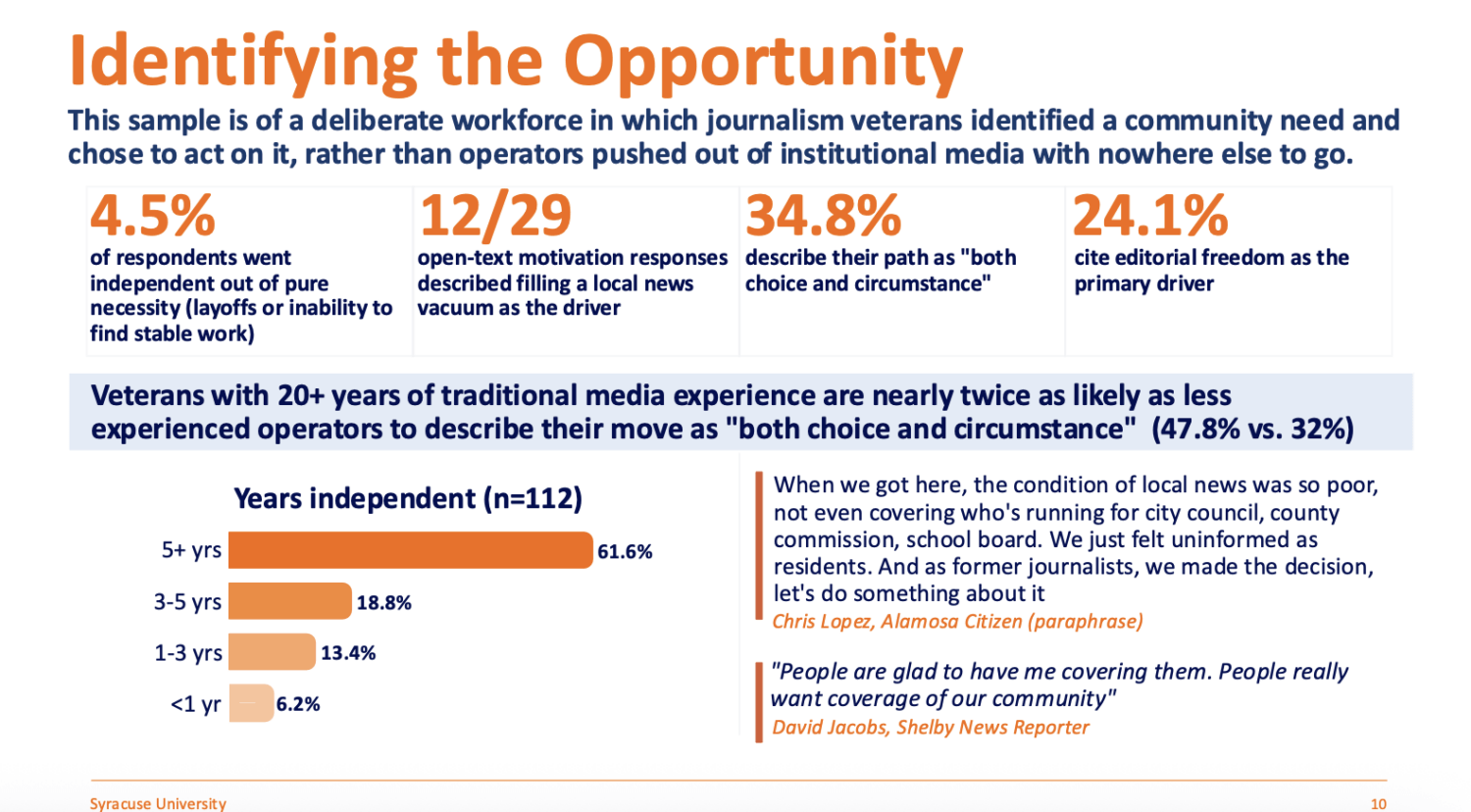
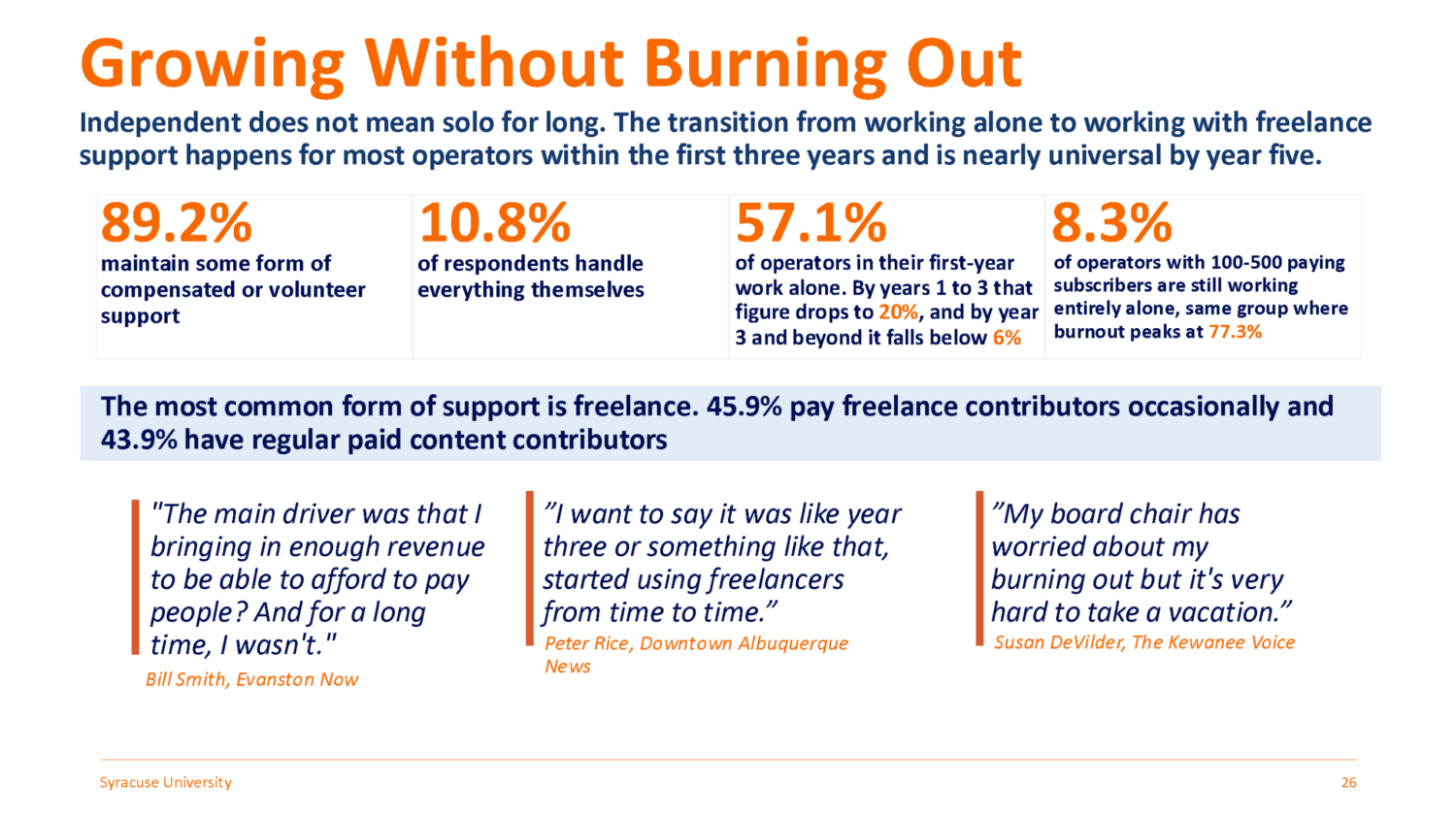
Brown: This is demanding work, relentlessly so. We learned that for all the progress that’s been made in developing a rapidly growing and vital sector of the news industry, there’s an enormous amount of work to do. Burnout is a real problem, especially among those entrepreneurs who are growing. More than half the respondents with peak burnout risk are doing well with paying subscribers. So, the work gets harder and almost unmanageable with success.
While there are lessons to be learned, revenue models vary based on community size or geography. It may not be a sustainable living for many in the entrepreneurial group. Only four in 10 get all their personal income from their local news sites and one in five still earns less than a quarter of their income from their news organization. More work on creating reader revenue strategies seems necessary, and four out of five are nearly solely dependent on ad models.
(Courtesy of Syracuse University)
Hare: What’s the most surprising?
Brown: Even this far along, many in the field are still getting their arms around the complexities of running a business. While they are likely to believe they’re getting the editorial and product parts right, they are often unprepared or don’t have the time to balance the editorial work with sales and other revenue development tasks. More training around this is surely needed.
Hare: Is there a “local news industry” at all? After reading this report, you make a good case for something I’ve seen for years in my reporting — it’s not one thing, not one size, not one approach. Broadly, are we asking the wrong questions about an industry that maybe isn’t just one thing? How should we shift our thinking about it?
Brown: It’s a business that’s as much about community engagement as journalism. And by that we mean that the most productive local news entrepreneurs appear to see their work as certainly having a journalism pillar but that it’s also about working in their communities, visiting people where they live and work, knowing the merchants and business leaders and understanding what makes the place tick as well as covering city hall.
(Courtesy of Syracuse University)
Hare: I wasn’t surprised by your findings around burnout, but I’m not sure I’ve seen it articulated so clearly before. What should people understand about what it takes to run a local news operation?
Brown: Most sites are started by journalists prepared to cover their communities. From the outset, they should be prepared to dig into what it takes to raise money, convince people to subscribe or donate and what potential commercial sponsors need in reaching out to their customers. It’s as important as identifying stories and beats. And it is especially important to have a sense of what resources will be required and, if they’re operating on their own, how they’re going to balance their time between editorial and business operations.
Hare: You spend some time talking about how unprepared a lot of journalists are for the business side of things. Is that a journalism school issue? A master’s program issue? There are a lot of programs aimed at helping founders scale up their businesses and business skills, including LION, the American Journalism Project and the Local Media Association. Can you envision a big-picture solution for this gap? Or should it be more of an all-hands approach like what currently exists?
Brown: There is enormous room for the expansion of business skills academic programs. People going into this facet of the “creator economy” have to understand how they’re going to build businesses. At the same time, organizations like LION and INN are doing tremendous work but they have funding challenges and many priorities. I’m not sure today’s funders recognize how much attention and, of course, funding all these news entrepreneurs require. There aren’t enough boot camps, aren’t enough places for people considering starting news sites to get advice and too few playbooks.
Hare: Another fascinating finding: For years, we’ve seen stories of journalists who got laid off and set out to start their own shops. Some have done so very successfully. You found that of those surveyed, fewer than 2% would go back to a traditional newsroom. What does that tell you about the state of our industry?
Brown: It would appear that the entrepreneurs view traditional newspaper newsrooms, especially in these smaller markets, as failing. Layoffs of significant scale continue, and especially if the local newspaper is tied to private equity or remote investors, the independent journalists know that their priorities aren’t about serving communities. Perhaps they value the independence they now have more than anything else.
Hare: What else do you want people to know about this report?
Brown: It is enormously frustrating that there isn’t a wider understanding even in the media community that local journalism is in the midst of a promising revolution. Somebody in Washington seeing the troubles of The Washington Post or someone in a news desert seeing the collapse of local news coverage in their community or region probably doesn’t recognize that all this is part of a larger set of circumstances that’s a national problem, a problem for our democracy and for our civic lives.
But at the same time, there are about 1,500 local digital news organizations that have launched over the past 20 years. There’s been real progress. Entrepreneurs are building important new news organizations and people like the American Journalism Project are bringing meaningful resources to the effort. Institutions like the Center for Cooperative Media at Montclair State University (I was director of the school in which it sits) are building cooperative models across states. It remains an important positive sign about news in our communities, but one that is barely understood, analyzed and supported.
##### Press freedom depends on people like you.
Poynter’s fact-checking, watchdog reporting, and journalism training is possible because readers like you support us. Will you join our community of over 1,500 donors with a gift today?
Tags: independent local news, Institute for Democracy Journalism and Citizenship, journalism business models, journalism entrepreneurship, Local journalism, local news, local news funding, news startups, newsroom sustainability, nonprofit news, Syracuse University

##### Opinion | Paramount CEO asks Mark Thompson to stay on at CNN after the merger. Will he?
Reportedly, David EIllison wants Thompson to remain the leader of CNN, but Thompson has stipulations
October 2, 2026

##### No, Joe Biden didn’t ban 440 reporters from the White House
Trump and his allies cited a Biden-era press policy to defend the White House’s ban on CNN, Politico and MS NOW. The comparison doesn't hold up.
October 2, 2026
 (Courtesy of Syracuse University)
##### What does it take to make an independent local newsroom work? More than good journalism.
A new study of 112 independent publishers shows just how much local news entrepreneurs have to juggle
October 1, 2026

##### Opinion | Trump attacks Fox News as Hegseth blasts the press
The president questioned why Fox News gives airtime to Democrats while Hegseth accused the press of ‘treason’
October 1, 2026

##### Opinion | 6 overlooked reasons California’s Community NEWS Act is ‘a big deal’
The new law offers newsrooms tax credits for retaining and hiring journalists. Its backers hope it can do much more.
October 1, 2026
Comments
You must be logged in to post a comment.
This site uses Akismet to reduce spam. Learn how your comment data is processed.