





The Examined Life
This is the first essay in a series called ‘Exam of the Month.’ Every month I plan to publish a profile of an unusual examination. This week’s entry is the All Souls Prize Fellowship Examination.
The All Souls Prize Fellowship examination is widely known as the “hardest exam in the world.”1 Those who fail receive nothing; those who pass receive everything: seven years of free accommodation and meals; a yearly stipend of £16,000; and unlimited freedom in a medieval Oxford palace. Every year around 150 Oxford graduates apply.2 Two are elected.
[](https://substackcdn.com/image/fetch/$s%5F!-YmZ!,f%5Fauto,q%5Fauto:good,fl%5Fprogressive:steep/https%3A%2F%2Fsubstack-post-media.s3.amazonaws.com%2Fpublic%2Fimages%2Ffc0f8a47-4612-42f0-b75e-9f51b9b4145f%5F650x429.jpeg)
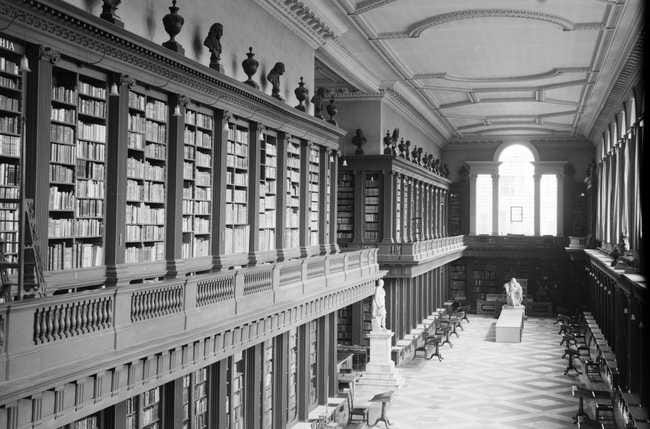
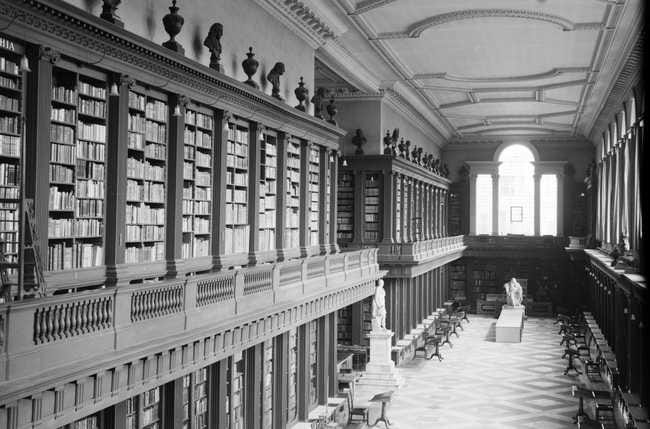
The ‘Codrington Library’, The beauty of the architecture led John Strachey to suggest “the birds are not worthy of the cage.”
The modern Prize Fellowship examination has two stages.3
- First, you sit four 3-hour papers: two General Papers and two Specialist Papers selected from Classics, Law, History, Literature, Philosophy, Economics, and Politics. Note the absence of STEM subjects.4
- Second, applicants undergo an oral viva lasting around 25 minutes. In bygone days, the viva used to involve all 50 fellows en masse (a firing squad?).5
- Are Damien Hirst’s sheep and cow works of art? (1997)
- Does the information superhighway pose a significant threat to established governments? (1995)
- Are genes selfish? (1988)
- Will race relations be the same after the O.J. Simpson trial? (1996)
- Is China overrated? (2006)
4-6 candidates pass.
Until 2010, the first stage had another infamous paper called the “Essay.” The 3-hour Essay is a blank page with a single word prompt.6 In 2006 the word was “Water”, “Space” in 1967, “Compromise” in 1938, “Revolution” in 1926, and “Eugenics” in 1920.7 One gets the impression of spinning gold from hay; historian Robin Briggs described his essay on “innocence” in 1964 as
a tour de force effort that began with the opening chords of Wagner’s “Das Rheingold” and then brought in, among other things, the flawed heroes of Stendhal and the horrors of the prisoner-of-war camp in the William Golding novel “Free Fall.”8
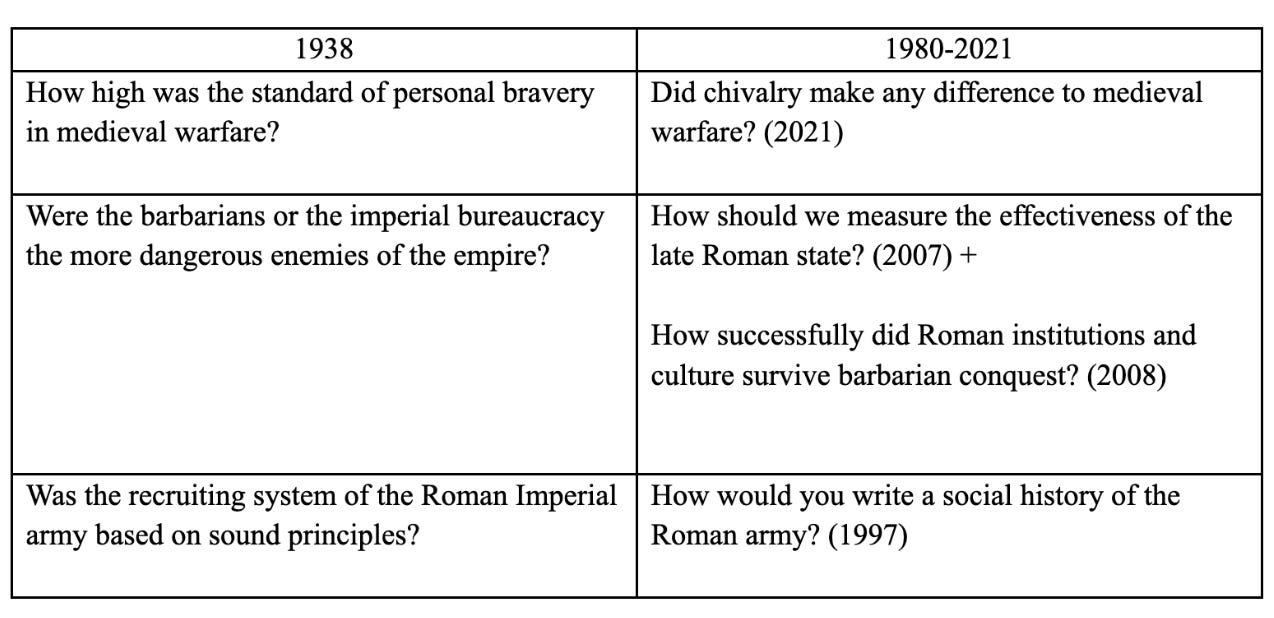
The “Essay” was abolished in 2010, but the exam has other interesting features. Most intriguing is how the exam reflects the changing perspective of Britain’s elite. Let’s take a look at a few history questions from 1938. Their tone is one of command and imperial destiny:


I really like these questions. They feel like the ponderings of a King, or the urgent requests to a court alchemist. Modern historians would never ask such great-souled questions. Look at the later All Souls exams (and Oxford Full Honours Year History past papers) to see how things have changed:

The later questions are written for researchers and scholars, whilst the 1938 exam questions were written for rulers. “Were the barbarians or the imperial bureaucracy the more dangerous enemies of the empire?” can be comfortably restated as:
Are the barbarians or the imperial bureaucracy the more dangerous enemies of our empire?
There is a sound historical basis to this reading. The 1938 paper appears to be a remnant of the College’s ‘Golden Age.’ From 1880-1920, All Souls College deliberately mixed men of affairs with leading scholars. It was a great success; in the Golden Era, the college could boast England’s leading historian, a Prime Minister, several cabinet ministers, two famous authors, three Viceroys of India, and Lawrence of Arabia.9 Hence questions like:

and

The perspective of a ruler may be a distasteful and unpleasant one, but at least it is dynamic.10 It always asks What are you going to do? It is also more enchanted.It is no good writing a history essay in which the role of Great men is rounded down to zero when a decision must be made. Hence questions asking which Pope succeeded best in making Rome beautiful; the importance of Matthew Arnold; and what made the Benthamites such successful reformers.
After WWII, the tone of the questions fundamentally shifts.11 The questions become equivocal and uncertain; ‘how far’, ‘what part’, ‘what significance’ questions proliferate. Action and valuation give way to discussion, accounting, examining, estimating, and comparing:
Q16: What major problems remain to be solved by the historian of English agrarian economy in either the thirteenth or the fourteenth century? (1950)
This denouement was the product of several factors. After 1918, and doubly so after 1946, All Souls College became a research institution rather than a home base for adventurers and statesmen.12 Simultaneously, British academia in general became more professionalised and our civil service was rationalised (those successful Benthamites!). A scholarly aristocrat-adventurer could no longer sail smoothly into office. What about his technical specialism; what of his qualifications?13

All Souls Hall, 1901, during the Golden Age. For a charming (and certainly apocryphal) anecdote about how the Oak beams in the ceiling were replaced, click here
At a deeper level, the wind came out of our sails. Something snapped, and we ceased to see ourselves as the protagonists of history; we forgot, even, what it meant to have such a dream:
Do you consider the advice to cultivate your garden represents a policy of despair? (1947)
“This is the American century.” Discuss. (1948)
Is there any value to climbing tall mountains? (1953)
Geopolitical questions remained but were typically abstract, presented like the weather or interesting social trends in a foreign country. Concurrently, the General paper questions began to focus increasingly on domestic issues: questions of fine art, classical music, poetry, and literature take up the majority of questions from 1946-1987, alongside concerns over urbanisation, centralisation, and ‘science’; and detached commentary on changing social mores. You can feel the British intellect ascending Maslow’s hierarchy of needs in real time:
1. Do we live in an age of plenty? (1946) 2. How widely should we seek to extend university education? (1947) 3. Is it possible to over-educate a nation? (1957) 4. Are economists too attached to growth? (1978) 5. Should philosophy try to discover the meaning of life? (1988)
If the 1938 questions were pitched at the timeless ruler of empires, the 1946 questions were pitched at the cloistered Don. The post-46 examiners were uninterested in ruling the country directly: for them, simply knowing the truth was a kind of power. Yet if you never leave your medieval pleasure dome, you risk obsessing over the process of study itself. Hence the distressing trend of General Paper questions focusing on Oxford itself: the university,14 its architecture,15 its academic courses,16 its alumni;17 even its bus services.18
A second shift occurred sometime in the early-90s. By this point, the exam was considerably easier. The translation papers were removed across Oxbridge entrance exams in the 1960s because they were too exclusive,19 and in the 1980s foreign language quotes were accompanied by translations. The number of applicants had also risen. In 1863 there were only 3 candidates applying. In the 1920s there were around 20 per year.20 By 1990-2000 this had risen to 60 per year. In 2015 it would rise to ±80 and ±150 by 2024.21
Simultaneously, the exam’s topics become more varied. The General Paper was previously addressed to a specific academic community with its own priorities and interests (aka: the Dons). In the 1990s it was pitched at generic members of a semi-digital, mass print society, anchored around book releases, magazines, television and radio interviews, and blogs. The 1990-2000s questions picked up every media trend, every salacious event, every non-fiction book sensation from Nudges to The God Delusion, without pausing to reflect on their significance or deeper importance:
These zeitgeisty topics will be familiar to anyone growing up in the 2000s-2010s. They were the ‘Hot Topics’ of the decades and appear in remarkably standardized forms across the education system from primary school to graduate study. No progress was made on them and we never learned anything. Nonetheless, this was O.K. because the process of debate and communication, rather than research and knowledge accumulation, was what ultimately mattered. Sinceprocesscame before content, any topic could be worth seriously debating:
Is Eminem the new Elvis? (2003)>
Do too many people support Manchester United? (2003)>
Make a robust case against keeping calm and carrying on. (2015)>
Should Jade Goody be in the Oxford Dictionary of National Biography? (2009)22
The stupidity of the questions ran alongside their multiplication - from 20 in 1938 to 45 in 1978 to 67 in 1995. Questions on evolution collapse into ruminations on football coaches and classical art which tumble into speculation on soundbites and astrology and China’s future and extraterrestrials, handbags, Oxford buses, 3D cinema and Twitter which run into questions on Amazon and blogs and… In my notes I scrawled “IS ANY OF THIS SERIOUS?” Questions and topics were endlessly remixed and juxtaposed. The 2009 paper could ask candidates:
Is Globalisation just Pax Americana?
alongside
What is the significance of binge drinking?
The examiners lived in epistemic hell where no filtering or sorting occurred, and everything was potentially significant; where international intellectual talking heads would happily discuss the importance of dark energy versus dark matter and string theory alongside Britain’s lack of cafe culture; too much SFX in cinema wedged next to anti-zionism versus anti-semitism and manga Shakespeare. And if the cultural references started feeling disembodied in this period, so too did the examinee they were pitched at:
Do we owe duties to our fellow nationals? (1998)>
What will become of the English? (2013)

A 2009 English Literature Question
The 1990-2010 phase addressed the examinee as a future talking head, ready to have interesting debates with journalists, publishers, and the public about anything and everything. Globalised communication was the source oftheir power rather than mere fact-accumulation. Like the Don of old, however, this media persona was superseded and fell into obscurity. In its place was a new sort of candidate with a new sort of question:

General paper (2023)
Several things changed between 2009 and 2023. In 2010, the college implemented diversity monitoring to comply with the 2010 Equality Act. Consequently, the number of women in the college increased at a slightly faster rate than usual. At least one, sometimes four, women were added every year from 2014-2020, pushing the total female membership from 18.5% in 2008 to 42% in 2020 (the all-time peak). The tone of the questions altered in turn:
Postmodernism – sooo last century. Discuss. (2014)>
Can you be a feminist and get married in a white wedding dress? (2015)>
Has masculinity ever not been in crisis? (2019)>
Should calories be declared on menus? (2022)>
Was Roman literary culture a male space? (2023)
At the same time, the Fellows seem to have gotten more online. Post-2015 exam questions introduce a jungle of ugly, internet-inflected phrases: “All lives matter”, “Alt-right”, “defund the police”, “colonise mars”, “ghosting”, “Elon Musk”, “pronouns”, “virtue-signalling”, and “style as a refuge from AI.” The examiners were self-aware enough to realise what was happening, although one suspects they had lost control of the process:
Should intellectuals tweet? (2013)>
Defend tweeting. (2018)>
Should we deactivate our social media accounts? (2022)>
Explain the internet to a dinosaur (2024)
Finally, the social media-speak accompanies a set of familiar topics: decolonisation, climate guilt, feminism, language as violence, gender as a social construct, wealth inequality, science as a cultural artefact, and the arbitrariness of national borders. Scarcity breathes down your neck:
Are there too many of us? (2015)>
Can Formula One motor racing be justified in today’s world? (2022)>
Is it moral to spend billions to discover the Higgs boson or gravitational waves while billions suffer hunger? (2023)
If the pre-2013 exam was addressed to talking heads, the post-2013 exam is addressed to young online activists. The questions still presuppose discussion is useful, but the tone is no longer diffident. Social injustice is assumed to be more urgent than ever and, more importantly, discussion is no longer innocent. The exam assumes language has the power of violence which, in a written exam for humanities exams, gives the questions a sense of moral sincerity absent since the 1930s:
Is it part of a scholar’s role to counter far-right appropriations of the ancient world? (2023)
Alongside urgency is a sense of exasperation. Questions on racism, nationalism, borders, classism, wealth inequality, colonialism, and environmentalism, come with an implicit “still?” That is unsurprising: most, if not all, of the hot topics of the 2020s can be found in the 1990s, and often the 1980s. Reading the whole sweep at once is dizzying and gives the impression of being trapped in a fish tank. The only difference today is the water is hotter: the issues are more pressing, the stakes higher, and every word you write potentially dynamite.
\~
Many things could be said about the evolution All Souls Prize Fellowship exam, but I think the most important is that it is no longer a very good exam. Too many of the questions are trivial and ephemeral. This is probably connected to their politics in some way,23 but it is not reducible to them - the exam questions start degrading from the 1990s, and arguably the 1980s, onwards.24 My problem is not politics per se; it is that the exam - or at least the General Paper - has become increasingly lazy and insignificant:

General Paper (2018)
It is possible to have questions which address contemporary developments and which touch on more fundamental tensions in modern society. Relevance need not trade off intellectual rigour. For example, one could imagine a question like:
“If John Stuart Mill were shown contemporary social media, he would revise his liberal principles.” Do you agree?
Which leaves open a variety of positions a candidate could take, from the moderately illiberal and technophobic to a more relativistic paper accounting for the wide range of social and philosophical changes since the 1850s. Another might ask whether the same criticism could be directed at television, radio, or mass print newspapers, or perhaps even writing itself.
Or, to echo the sort of questions from the 1940s and 1950s, we could ask something like:
The horrors of WWII have all but left living memory. What political developments do you foresee developing in their absence?
An examinee could answer this question in a number of ways. They could point to the role of WWII in sustaining, perhaps erroneously, the positive image of Britain as a liberating force. They could suggest it will undermine the foundations of the European Union as young Europeans forget its original peaceful purposes. They could suggest, quoting Santayana, that we are doomed to repeat the same mistakes, highlighting unsettling developments in right-wing thought on social media. Or they could come up with something completely different.
There are so many baffling, bizarre, incredible, terrifying developments happening in the 21st century - changes which call into question assumptions we have had for centuries and political settlements which have lasted decades. All Souls College is a temple filled with the best in their respective fields; a temple insulated, one hopes, from the toss and turn we outside daily face. Is it too much to expect them to step up to the plate and ask some questions we really want answers to?
The All Souls fellowship examination is not actually the “Hardest Exam in the World” (although such a title is meaningless). If anything, it is easier it has ever been. The superlative first appeared around 2010 when a journalist introduced the decision to remove the one-word essay; this was picked up subsequent news articles and cited as if popular consensus; it was then given the imprimatur of fact on Wikipedia.
Oxford students achieving firsts once received hand-written letters inviting them to apply to All-Souls.
Legends suggest there was also once a third stage called the “knife and fork test.” It included a secret challenge during dessert: “\[I\]t was said that cherry-pie appeared on the menu, to see what the candidates do with the stones. One candidate passed the test perfectly by swallowing them, but he did not survive to be elected.” Rowse, A. (1993). All Souls in My Time, Duckworth.
All Souls college has historically been averse to the natural sciences. When asked about the absence of engineering or science in the college, the 1920s Warden replied “a Greats man can get up the natural sciences in a fortnight.”
https://archive.ph/KuuC8; Scott, P. (1973). “All Souls of Oxford.” Change: The Magazine of Higher Learning, 5(5), 25–27; see also Armand D’Angour’s account, describing the fellows ‘Draped around the room like vampire bats.’ D’Angour was rejected for his pessimistic assessment of studying Ancient Greek music in reply to a question from Isaiah Berlin. A single wrong answer, it seems, could spell doom for an application.
Edmond relays some obscure apocrypha about the one-word essay: “A probably mythical story is that this was of such fascination to the outside world that even non candidates would congregate outside the college to discover which word had been chosen.” Edmonds, P. (2023) Parfit: A Philosopher and His Mission to Save Morality. Princeton University Press.
https://web.archive.org/web/20250829015750/https://www.whatdotheyknow.com/request/one\_word\_exam
He didn’t get in, although Derek Parfit did on the same word. Edmonds, Derek Parfit.
Its success inspired the Institute for Advanced Studies in America, and in the 1930s an anonymous essay implied the college alumni – described as “the mallards” – were secretly guiding England towards enlightened prosperity.
Tanner Greer also makes this argument in Yale and the Education of Governing Elites.
In fact, the shift likely began in 1918 and the 1938 exam is already past the meridian. Indeed, the History paper hints at this with equivocal questions like “In what sense was the Roman Empire “renewed” by Charles the Great? (History I, 1938)”
For more detail, see Woolridge, A. (2011) “Prizes, Fellowship, and Open Competition” in S.J.D. Green & Peregrine Horden (eds.), All Souls and the Wider World Statesmen, Scholars, and Adventurers, C. 1850-1950. Oxford University Press.
Interestingly, this change left a grudge in the exam throughout the 1950s-1980s, until full assimilation occurred in the 90s: Limits of professional etiquette justification (1938); Is professionalism a good thing? (1982); Do falling academic salaries explain the declining social standing of the profession? (1996)
The 1952 one-word essay was “Oxford”; If you were given full power to make recommendations about the University of Oxford what would you propose? (1956)
Illustrate from Oxford buildings your preference among styles of architecture (1950)
Write a part of your inaugural lecture as Professor of Prose (1956); Oxford no longer has a post for the study of Akkadian. Do you think this matters? (1984); Should Oxford offer a course in Gender studies? (1990); Should Oxford establish a Chair of Business Ethics? (1994).
Twenty-seven British Prime Ministers have been Oxford alumni. What is the right response to this? (2015)
Should the Oxford city bus services be regulated, and if so, how? (1996)
Oxford and Cambridge dropped the mandatory requirement of Latin and Greek proficiency in May 1960 to avoid deterring able scientists. Individual colleges could still require Latin if they wished. https://www.nytimes.com/1960/06/01/archives/oxford-eases-rule-on-latin-and-greek-required-for-entry.html
A.L. Rowse, above, describes a ‘score or so.’
Naturally, Rowse regarded this expansion of applicants as a sign of ‘levelling standards’ and an un-stiffening of competition. “Democracy had broken in.”
Jade Goody was a contestant on Big Brother, Celebrity Big Brother, and Bigg Boss. She was added to the ONB in 2013.
A review of the 2025 College report shows that the actual research being done at All Souls has relatively little to do with the General Paper. One gets the strong sense of the General Paper being a sort of superego imposed from above which one must placate before doing one’s preferred projects.
An 1983 question, for instance, was “Must there by an energy crisis?” which is flippant at best and childishly callous at worst.