



Radio signal detected for the first time from a planet outside our solar system

RNZ / News / World
Link: <https://www.rnz.co.nz/news/eyJhbGciOiJIUzI1NiJ9.%5FQ.VKhexyL5oal5uCV3AUQmI1EOdryHi3hh73RdibV20lY/world/1736845%2Fradio-signal-detected-for-the-first-time-from-a-planet-outside-our-solar-system>
5 October 2026, 8:51am
Radio signal detected for the first time from a planet outside our solar system
Jacopo Prisco for
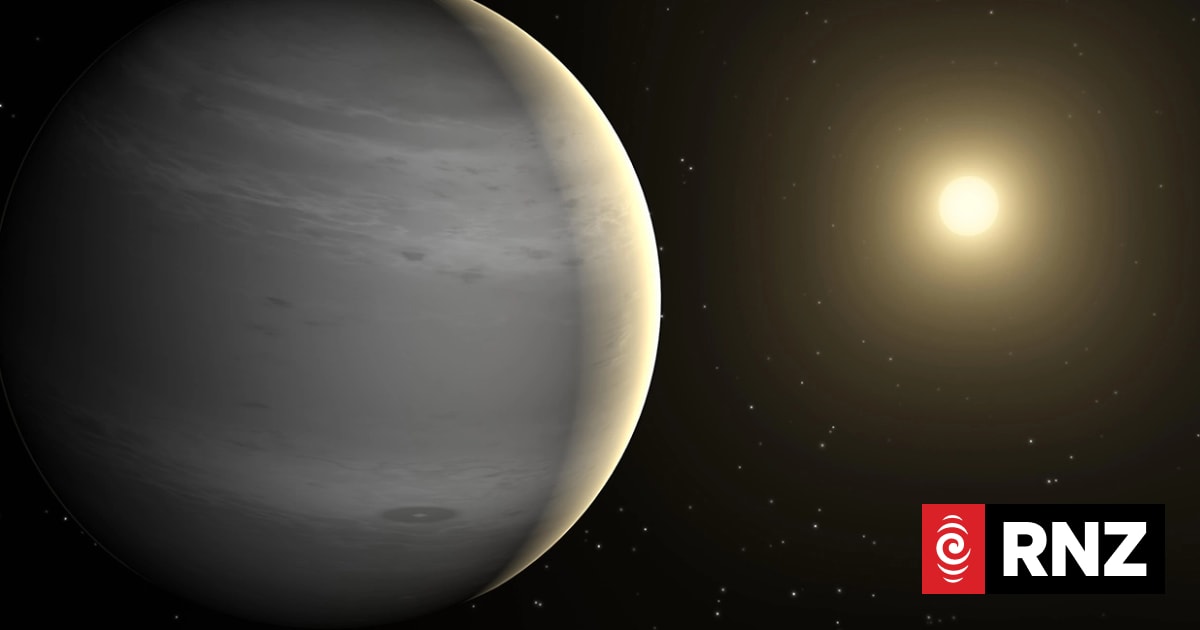
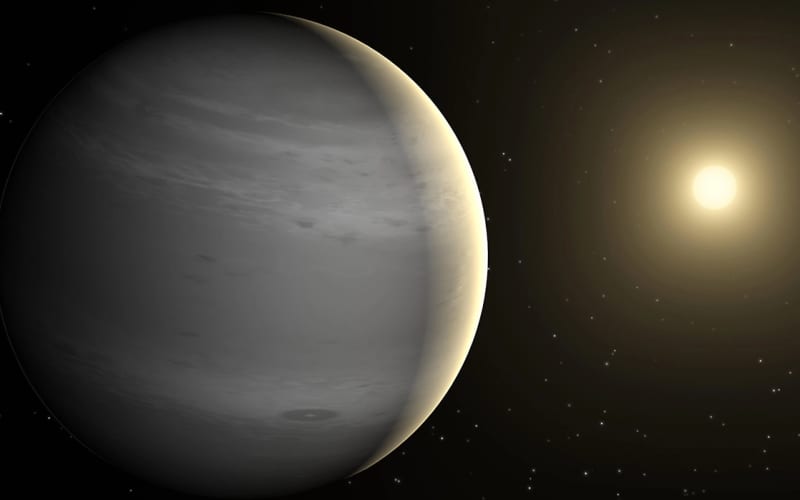
Caption:An artist's impression of Beta Pictoris b, a gas giant exoplanet.Photo credit:NASA / SUPPLIED
Astronomers say they have directly detected the first-ever radio emission from a planet outside the solar system. The signal, however, is evidence of a colossal magnetic field - not intelligent life.
"I know radio signals are associated with searches for extraterrestrial intelligence," said Edo Berger, a professor of astronomy at Harvard University. "But this is something very different."
The discovery, described in a new paper awaiting publication in a peer-reviewed journal, traces repeating radio bursts that appear to come from the exoplanet Beta Pictoris b, located 63 light-years from Earth - a short distance, astronomically speaking. The gas giant, about 12 times the mass of Jupiter, is one of three planets orbiting a young star that is 1.75 times as massive as the sun.
Processes associated with the planet's magnetic field produce the radio emission, according to Berger, a researcher at the Center for Astrophysics | Harvard & Smithsonian in Cambridge, Massachusetts.
Specifically, the detection involves auroras similar to Earth's northern lights - the spectacular displays sparked by magnetic storms involving charged particles from the sun. "In order to see radio waves that extend all the way to the frequencies that we observed, you need an incredibly strong magnetic field," added Berger, a coauthor of the paper posted September 15 to the preprint platform ArXiv.
Not all planets have a magnetic field. Those that have one benefit from a natural shield that deflects disruptive energy. Earth's magnetic field, for example, protects our atmosphere from being stripped away by solar wind, a continuous outflow of plasma that contains charged particles like protons and electrons.
"The magnetic field on this planet is at least 200 times stronger than the magnetic field of Jupiter," Berger said, referring to Beta Pictoris b. Jupiter's magnetic field, according to NASA, is powerful enough to generate a magnetosphere - the region of space influenced by the magnetic field - that ranks as the largest structure in our solar system, stretching up to 2 million miles (3 million kilometres) toward the sun.
Jupiter's field also creates striking auroras, when electrically charged particles spewed from volcanoes on its moon Io become trapped around the field's poles. As the gas giant rotates, the charged particles emit a glow but also a radio signal. "As these very high-energy particles are spiraling inside the magnetic field, along with the aurora they also produce radio waves," Berger said.
Astronomers call this type of signal an auroral radio emission. The phenomenon has been previously observed from Jupiter, Saturn and the sun, as well as stars outside the solar system and cool objects known as brown dwarfs - an intermediate between a star and a planet. This type of signal is what Berger and his colleagues detected from Beta Pictoris b, which ultimately points to the presence of an intense magnetic field that's causing auroras and the radio emission.
Magnetic fields have implications for the structure of exoplanets and their atmospheres, according to Berger. "Radio observations can give us a completely new view on planets beyond our system," he said.
A well-studied star system
There had been hints of radio emissions from exoplanets before, but none had been confirmed, largely because it couldn't be ruled out that the source was actually the host star, said Joseph Callingham, an associate professor at the Anton Pannekoek Institute for Astronomy of the University of Amsterdam in the Netherlands.
"What is unique for this study is that they localise the emission to the planet itself, separate from the star," Callingham, who was not involved in the new research, wrote in an email.
The Beta Pictoris system is astronomically very young at about 23 million years old compared with our own solar system's age of 4.5 billion years. Beta Pictoris b - the planet from which the radio signal potentially originates - was discovered in 2008. Two additional planets, Beta Pictoris c and Beta Pictoris d, were discovered in 2019 and 2026, respectively.
The planetary system is among the most studied in our galaxy, and its star is known to host 30 orbiting comets and a giant disk of dust and debris, which NASA's Hubble Space Telescope photographed in detail in 2015. Some of the debris swirling in the rotating disk is a remnant from planetary formation.
The researchers used MeerKAT, an array of 64 radio telescope dishes in South Africa, to detect the signal, but they were highly surprised to see it coming from such a well-observed set of celestial bodies, Berger said.
"My graduate student Kevin was going through the data. He came into my office one day with the detection and he said, 'I don't think you're going to believe this,'" Berger recalled, referring to lead study author Kevin Ortiz Ceballos, a doctoral researcher at the Center for Astrophysics | Harvard & Smithsonian. "This was really unexpected for us. We were doing the survey as a bit of a fishing expedition, knowing that we would only detect sources if the magnetic field was incredibly strong."
The surprise stems from the fact that astronomers had assumed, according to Berger, that if exoplanets have magnetic fields, they should look roughly like Jupiter's, and therefore their radio emissions would be at lower frequencies than what he and his colleagues found. Detecting the signal was the result of "going against the perceived wisdom in the field," he said.
However, the researchers noted the report has not yet undergone peer review, the process in which independent experts assess a research paper before publication in a scientific journal. The review is underway and will be completed over the next few months.
Berger said he is confident about the quality of the detection. The research team pinpointed the radio emission's source as Beta Pictoris b, ruling out an initial suspicion that it could be coming from the star instead. "We recorded it multiple times, at multiple frequencies. It's there every single time," he said.
Cautious enthusiasm for radio signal detection
Scientists who were not involved with the new research urged caution when interpreting the findings.
If the discovery holds up under the scrutiny of peer review, it would represent an incredibly exciting and key step forward in understanding the behavior of worlds beyond our solar system, according to Jonathan Nichols, a professor in planetary auroras at the University of Leicester in England. "Auroral radio emissions are important because they allow us to understand how an object interacts with its local space environment," he wrote in an email.
"They allow us to infer properties of the planet that we cannot otherwise measure," Nichols explained, referring to auroras, "and, importantly, they enable us to test theories and ideas developed for our own solar system in more extreme conditions."
If confirmed, the results would show that exoplanets can have much stronger magnetic fields than expected, which would be a crucial learning, according to Callingham of the University of Amsterdam.
The authors have requested more telescope time to further study Beta Pictoris b and perhaps unlock some of its puzzles, such as why the planet's magnetic field is so strong. "I think that's going to be a question that occupies people for a while," Berger said.
\- CNN
5 October 2026, 8:51am
More World
Woman at centre of Cornell rape allegations targeted with threats, lawyer says

US execution survivor Christa Pike critically ill, on ventilator: lawyer

Trump, crime and corruption loom over Brazil’s presidential vote

Yemeni government launches offensive to seize all areas from Iran-backed Houthis

More News
Near miss with train interrupts Greens' level crossing announcement

Three injured, including baby, after overnight stabbing in West Auckland's Glendene

'We are expected to work as if we don't have children': the school holiday juggle

Animal crackers: Finalists for the Comedy Wildlife Photography Awards 2026

© RNZ, original at <https://www.rnz.co.nz/news/eyJhbGciOiJIUzI1NiJ9.%5FQ.VKhexyL5oal5uCV3AUQmI1EOdryHi3hh73RdibV20lY/world/1736845%2Fradio-signal-detected-for-the-first-time-from-a-planet-outside-our-solar-system>