


Rabbit Thoughts
There is a tremendous amount of information regarding evolutionary history and biochemical function implicit in each sequence and the number of known sequences is growing explosively.>
— Margaret O. Dayhoff (1967)1

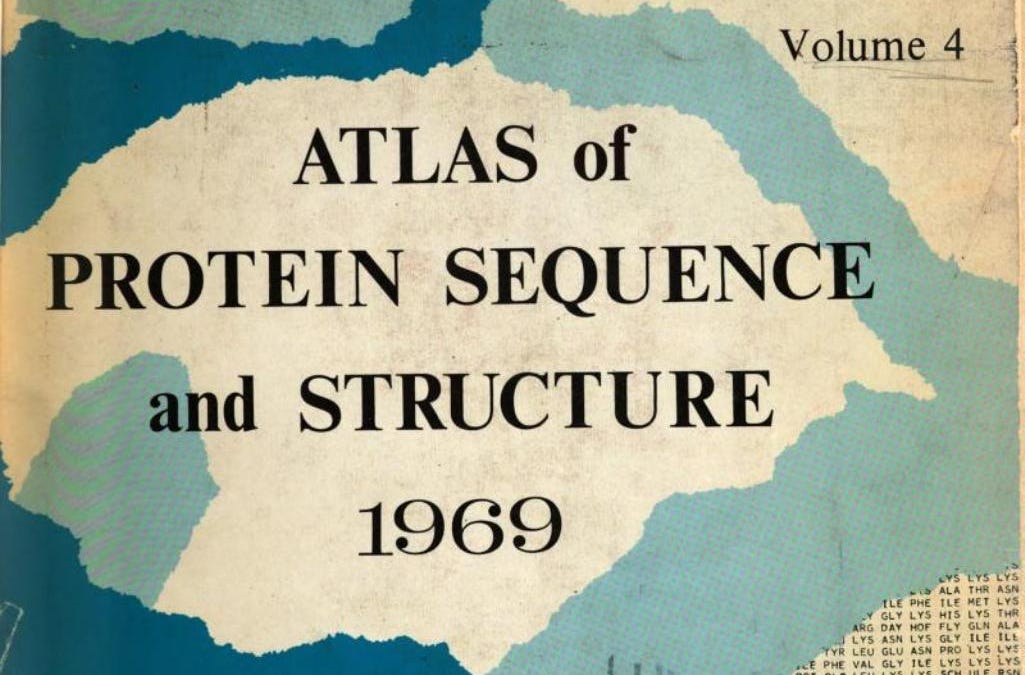
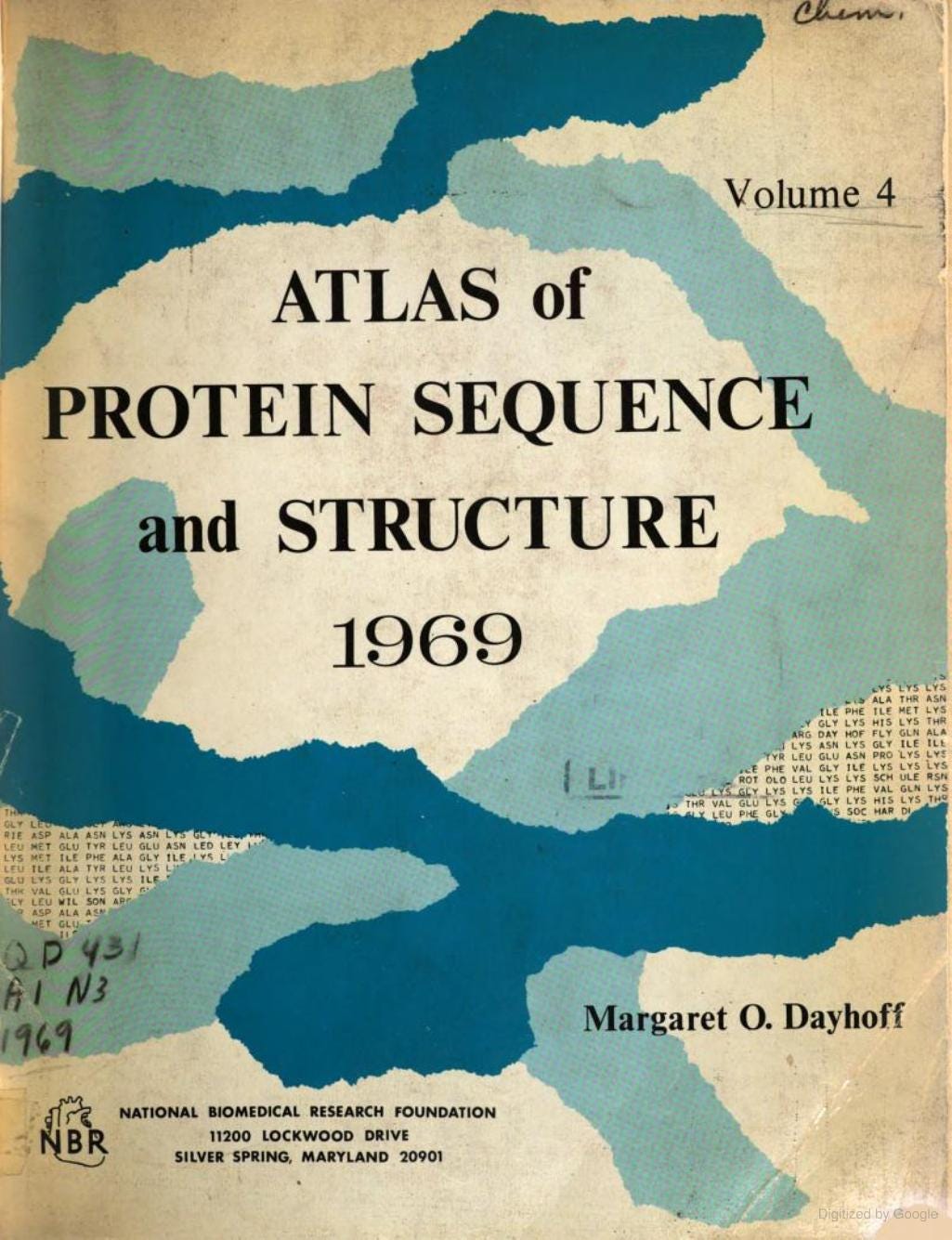
Margaret Dayhoff’s Atlas of Protein Sequence and Structure started as a book of 100 pages in 1965, it had exploded to 400 pages by 1969.2

“With the development of large data banks of protein and nucleic acid sequences, the need for efficient methods of searching such banks for sequences similar to a given sequence has become evident.”>
– Wilbur & Lipman, 1983

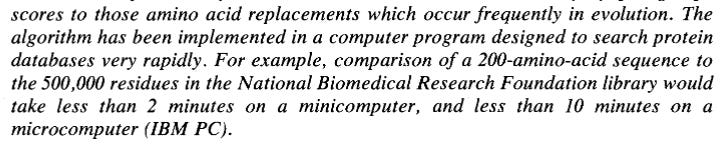
“Comparison of a 200-amino-acid sequence to the 500,000 residues in the National Biomedical Research Foundation library would take less than 2 minutes on a minicomputer, and less than 10 minutes on a microcomputer (IBM PC).”>
– Lipman & Pearson, 1985
The entire protein universe was half a million residues. A two-minute search felt fast.

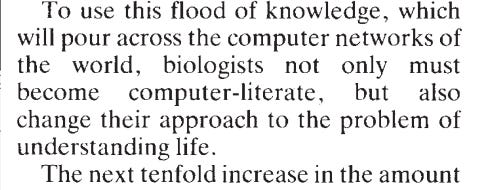
“To use this flood of knowledge, which will pour across the computer networks of the world, biologists not only must become computer-literate, but also change their approach to the problem of understanding life.”>
– Walter Gilbert, 1991

“The advent of rapid DNA sequencing technology in the mid-1970s led to an information explosion that continues unabated today.”>
– Altschul et al., 1994

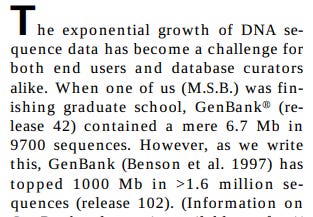
“The exponential growth of DNA sequence data has become a challenge for both end users and database curators alike. When one of us (M.S.B.) was finishing graduate school, GenBank (release 42) contained a mere 6.7 Mb in 9700 sequences. However, as we write this, GenBank has topped 1000 Mb in >1.6 million sequences.”>
– Ouellette & Boguski, 1997

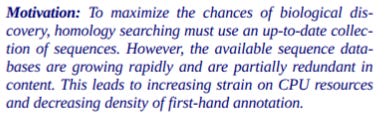
“The available sequence databases are growing rapidly and are partially redundant in content. This leads to increasing strain on CPU resources and decreasing density of first-hand annotation.”>
– Holm & Sander, 1998

“GenBank continues to grow at an exponential rate. Over the past 12 months 770 000 sequences were added… GenBank now contains approximately 1.8 genome equivalents of finished sequence and approximately 1.8 genome equivalents of unfinished sequence.”>
– Benson et al., 1999

“In the last few years methods have emerged, which for the first time challenge the supremacy of the dideoxy method. The common feature of these methods is that they are ‘massively parallel’, meaning that the number of sequence reads from a single experiment is vastly greater than the 96 obtained with modern capillary electrophoresis-based Sanger sequencers.”>
– Clyde Hutchison, 2007

“The breadth of life’s diversity is unfathomable, but public nucleic acid sequencing data offers a window into the dispersion and evolution of genetic diversity across Earth. However the rapid growth and accumulation of sequence data have outpaced efficient analysis capabilities.”>
– Chikhi et al., 2025, bioRxiv
Subscribe for free to receive new posts.
Subscribe
(This is from a talk I gave at BrisJAMS last month and I will probably be posting a bit more from my notes on it)
Margaret O. Dayhoff to Carl Berkley, February 27, 1967, NBRF Archiv. Cited in Strasser (2010) J Hist Biol 43:623–660.
Margaret Dayhoff was so ahead of her time that it’s ridiculous. She wrote about a world that she barely got to see, as she passed in 1983, but we are now all live in the world she imagined.
PreviousNext