


Saharanism and the Myth of the Empty Desert: Five Questions for Brahim El Guabli

Saharanism and the Myth of the Empty Desert: Five Questions for Brahim El Guabli
By
September 10, 2026
in

Desert Imaginations: A History of Saharanism and Its Radical Consequences (University of California Press, 2025)
When you think of the word “desert,” you may (if you are not a desert dweller yourself) associate the word with images of an inhospitable space lacking water and nourishment for human beings. You may also think of what you’ve seen in movies or television shows: a skeleton at the base of a generic cactus, or a camel passing through a sandy waste. If there are people in sight, they may come from their own clichés of nomadic bands or cowboy outlaws. In reality, desert landscapes are far more complicated and lively.
Dr. Brahim El Guabli, author of Desert Imaginations: A History of Saharanism and Its Radical Consequences (University of California Press, 2025), examines how deserts have come to be imagined, and the consequences of such imaginary constructions. El Guabli uses a multilingual archive of historical literature, cultural output, and contemporary events to trace the histories of thought that have shaped ideas about what a desert is, what it can be, and who it is for. To understand more, I spoke with El Guabli about his work, his concept of Saharanism, and the complicated ways that Saharanism can be seen across multiple facets of society.
Gustavo Sanchez-Bachman (GSB): What first inspired you to take on a project to elaborate on how desert spaces have been approached? And for our readers first encountering your work, could you define Saharanism?
Brahim El Guabli (BEG): Thank you for this great question. In fact, I did not set out to write a book on Saharanism and its devastating impacts. Between 2009 and 2012, I read the works of Libyan Tuareg writer Ibrahim al-Koni in conjunction with the novelistic output of Saudi novelist Abdelrahman Munif. Munif’s novels Mudun al-milḥ (Cities of Salt) and Sharq al-mutawassiṭ (East of the Mediterranean) left a strong imprint on me when I read them. Mudun al-milh is about the proletarianization of nomads and their transformation into oil workers in the Arabian Peninsula. Sharq al-mutawassit is an offshoot, in that it depicts a merciless desert jail where political prisoners are subjected to a “desertified” form of slow genocide.
Having read al-Koni’s two volumes of al-Majūs (The Magians), which is a desert-centered epic, I wanted to put these two authors’ focus on their respective deserts into conversation in a book. Both Munif and al-Koni are widely known as desert writers, but their work has larger ramifications for history, environmentalism, politics, and even economics.

The Ouarzazate Solar Power Station in Morocco is the world’s largest concentrated solar power complex. Photo by Richard Allaway, 2019.
This initial idea took a different direction when, in 2010, I learned about the nuclear experiments France conducted in the Sahara in 1960. Over a decade later, I returned home to Morocco in 2022 to find out that a sprawling solar plant had changed the visual identity of my city forever. These two events compelled me to adopt broader conceptual frameworks to explain why things happen the way they do in deserts. So, there is both an intellectual-literary component to the inspiration as well as a personal story that helped me harness different bodies of knowledge to write Desert Imaginations.
Saharanism has made deserts into profitable spaces whose very invisibilization and negation allows things that would not be conceivable in other places that are constructed as normal or vital for human life to be naturalized.
I define Saharanism as “a globalizing desert imaginary that undergirds the way deserts are perceived and acted upon globally,” adding that it is the “outcome of an extensive history of treasure-hunting, racialization, adventurous enterprises, and imperialistic intervention in desert spaces.” Saharanism furnishes a conceptual tool for understanding what happens in deserts and why these spaces, which represent 33 percent of the land area of planet Earth, are treated as a category separate from discourses about environmentalism, law, life, morality, and experimentation.
This phenomenon, which many scholars have grappled with productively and provocatively, has gone unnamed and unarticulated in theoretical terms that would help us identify and deal with its extensive consequences. Desert Imaginations historicizes Saharanism by delving into the transnational and trans-desert history of ideas that has undergirded it for a very long time.
**GSB: There seem to be contradictions in how Saharanism created an idea of deserts as dangerous, unruly places but also profoundly attractive sites of personal or spiritual growth. How does the notion of Saharanism help us to think through all the different ways that deserts have been approached and controlled?
BEG: This is a great observation. Saharanism’s own internal logic establishes deserts in both its discursive and entrepreneurial practices as extraordinary spaces. It exacerbates deserts’ attractiveness to people who seek adventure and unheard-of feats, as well as those who espouse misanthropic ideas or seek to live in ways that are inconsistent with the types of sociality that organized societies require. The manic rush to find Timbuktu between the eighteenth and nineteenth centuries was part of this imaginary. Thus, Saharanism is both the ideology that makes deserts the ordinary life’s other and the impact that this ideational apparatus has amongst those who find their answers in deserts.
There are many examples that illustrate this relationship. Take Burning Man and the festival’s countercultural aspirations. It’s all about its revelers’ rejection of the status quo of living in California (and other places). The desert provides them with a way to live in a state of both unjudged and unfettered freedom, albeit temporarily for the duration of the festival.

The harsh desert landscape of Nevada’s Black Rock Desert, where Burning Man is held, is meant to inspire deep personal reflection. Photo by RawWriter, 2018.
This is not a new phenomenon. Almost two thousand years ago, “Desert Fathers” (Christian monks) sought refuge in the desert to extirpate themselves from what they perceived as the depravity of their society. Some of them could not tolerate what they thought was sexual permissiveness in their time and endeavored to avoid physical intimacy and social promiscuity by relocating to the desert in Egypt. So, seeking solitude in deserts is inherently informed by the prevalence of ideas that foreground deserts’ emptiness.

Isabelle Eberhardt spent years as a nomad in the Algerian and Tunisian Saharan desert. Photo by Louis David, 1895.
Similarly, take someone like Charles de Foucauld, a French colonial-officer-turned-priest, who spent over a decade in different Saharan locations. On the one hand he found God in the Sahara, but he could not include desert people in the way he talked about the divine space he found. The contradiction is obvious, but Saharanism has a way of dissolving the dissonance.
Isabelle Eberhardt, a Franco-Swiss crossdresser who went by the male name of Mahmoud Saadi, experienced persecution in Europe. As an illegitimate child, she was disinherited. She spent years as a nomad in the Algerian and Tunisian Saharan desert, and you would assume that her love of the desert and the social acceptance that she found in it would compel her to be equally generous and respectful of its people. The reality, however, was that Eberhardt was a hardcore eugenicist whose racism is now inscribed into history. The same thing could be found in the journals of scientists and military men who conducted military experiments in deserts even as they wrote about their beauty.
So, these contradictions are inherent to the logic of Saharanism, which allows its proponents to reconcile the irreconcilable. One can even push further to say that there is something deeply irrational about the way Saharanism unfolds.
GSB: In your book, you discuss several different facets of Saharanism, interconnected with each other by the overarching notion that deserts are spaces imagined to be exploitable, empty, deadly, yet compelling. What did the architects of this empty desert imaginary have to gain in building out what you identify as Saharanism?
BEG: My research compelled me to investigate the way that there is a system of ideas that shapes how deserts have been viewed and acted upon globally. However, I needed to parse this big idea into tighter units of analysis. That is why I decided to organize the book thematically to tease out as many aspects of Saharanism as possible.
Saharanism furnishes a conceptual tool for understanding what happens in deserts and why these spaces, which represent 33 percent of the land area of planet Earth, are treated as a category separate from discourses about environmentalism, law, life, morality, and experimentation.
One of these aspects is “spiritual Saharanism,” which centers on the way spiritual discourses and their networks participated in the demonization of the Sahara in the nineteenth and early twentieth centuries. Drawing on the history of prostitution and desert pornography, Burning Man’s transgressive aspirations, and the depiction of sexual violence in the HBO series Westworld, I articulate “sexual Saharanism” as an ideational apparatus that places deserts as exceptional sites where notions of morality, ethics, and law can be suspended, enabling those engaged in these actions to behave with impunity.
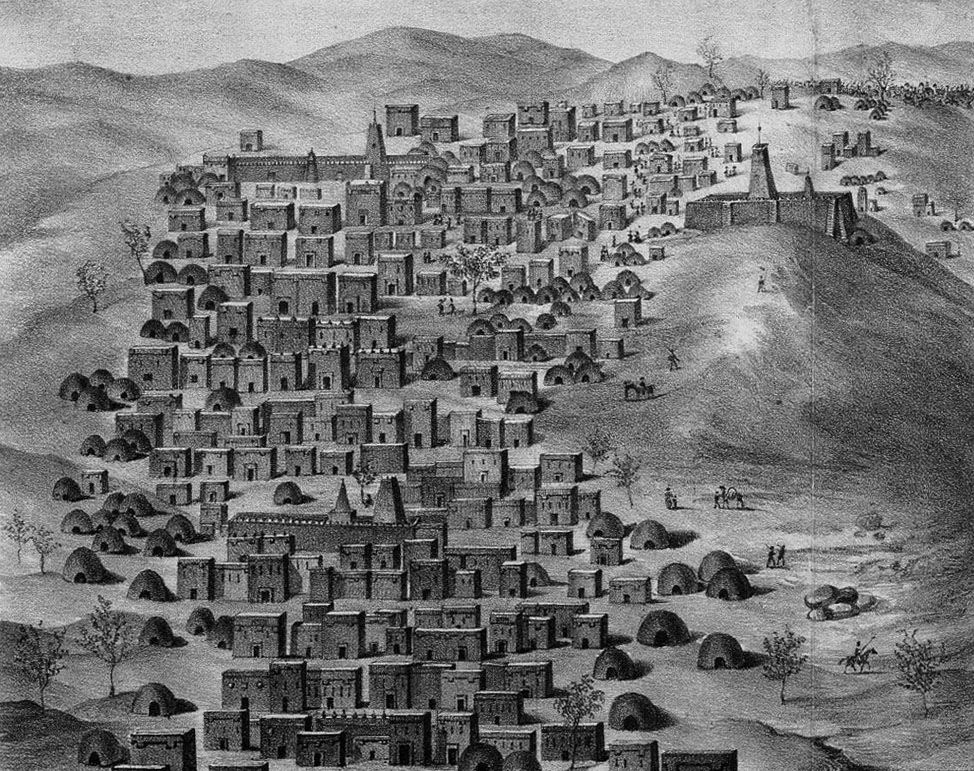
A 19th-century view of Timbuktu, drawn by René Caillié following his 1828 journey to the city. Illustration by René Caillié, 1830.
Meanwhile, the terms “extractive Saharanism” and “experimental Saharanism” speak to each other in their focus on the various ways in which constructed desert emptiness and terra nullius served as disempowering forces that legitimized the unbridled excavation of desert natural resources and the exploitation of their spaces for dangerous enterprises that are clearly not allowed in what is considered ordinary spaces. The “extraordinarization” of deserts, as this spatial shift is called, allows its propagators to get away with the environmental and legal crimes that stem from their undertakings.
The gains that Saharanism offers are obvious. Cardinal Lavigerie was deeply invested in evangelizing Africa and propagating a civilizational war. Casting the people in the Sahara as barbarian enslavers placed the space outside the purview of divine mercy and paved the way for the French army to take over. The legacy of this spiritual Saharanism even manifests today in the fear Europeans have of immigrants arriving from North Africa after crossing the Mediterranean.
When humans realize that even their anthropocentrism depends on centering other creatures, maybe their view of deserts and their life will change.
Similarly, placing deserts outside the purview of law and morality incentivizes engagement in all sorts of fantasies that require impunity. During the colonial era, Europeans frowned upon and blamed what they called “Arabs” for prostitution in the Sahara, but the clients of these practices were mostly European as well as some American journalists who participated in sexual voyeurism in the land. There is no difference between racializing dwellers of the Sahara and making their bodies available for unbridled sexual fantasies. The same logic extends to the extraction of labor from desert dwellers as well as the exploitation of oil and mineral resources deposited in their homelands.
The gains are enormous, and their achievement requires the sustenance of deserts’ emptiness and death. Notions like desert mise en valeur (colonial development) would not be required if deserts were approached as environments that enjoy their own biodiversity and are run according to the logic of their own inhabitants. Saharanism has made deserts into profitable spaces whose very invisibilization and negation allows things that would not be conceivable in other places that are constructed as normal or vital for human life to be naturalized.
GSB: You note that deserts are used as metaphors for empty or primal spaces, not just by colonizing forces and extractive enterprises but also as metaphors within academic theoretical works. What is lost and/or afforded by this relegation of deserts into merely a theoretical concept used by scholars to “think with”?
BEG: As you certainly know, there is an important body of theory that draws on desert tropes to generate ideas about home, environment, nomadism, and other hot topics. In Nomadology, Deleuze and Guattari, for example, invite their readers to “enter a becoming, people your desert. So experiment.”

Saharanism describes a desert imaginary that portrays desert spaces as empty, remote, and available for exploration or use. Photo by Luca Galuzzi, 2007.
These ideas may sound great, but they really do significant harm because they overlook deserts’ harsh reality. They do not invite critical grappling with the cost of such egoistic endeavors in a place where collectivity and community are crucial for life. Reading through Deleuze and Guattari would mean reproducing their biases and the different forms of Saharanism that inhabit their work whereas reading them critically allows us to nuance their thoughts and understand nomadism in its complicated manifestations. Caren Kaplan’s invitation to critique “theoretical ‘tourism’” is deeply resonant here.
GSB: Deserts, you argue, are lively spaces that are inhabited and deeply cultural. What is a suggestion you may have for our audience as a framework to move away from Saharanist thinking and into a mode that can appreciate deserts for all they hold?
BEG: Life is not just about what is visible to the eye or what is useful for human use. Life is much broader and encompasses ways of being that our overly rational thinking cannot accommodate. For instance, as a child, I learned that we do not pour hot water on the ground because it might burn the invisible beings that live there. Similarly, I learned that “tagat” (a form of vengeful karma) would catch up with you if you destroyed bird nests or threw stones at cats. Most importantly, the wide-open space that looks barren was populated by Ayt Rabbi (jinns).
One may argue that these are mythical ways of both populating the seemingly empty desert land and preserving the life it contains. It is true, but these beliefs indicate something significant in terms of the need to understand that life for desert peoples includes the visible dimensions that emerged as part of their myths to make sense of their vast space.
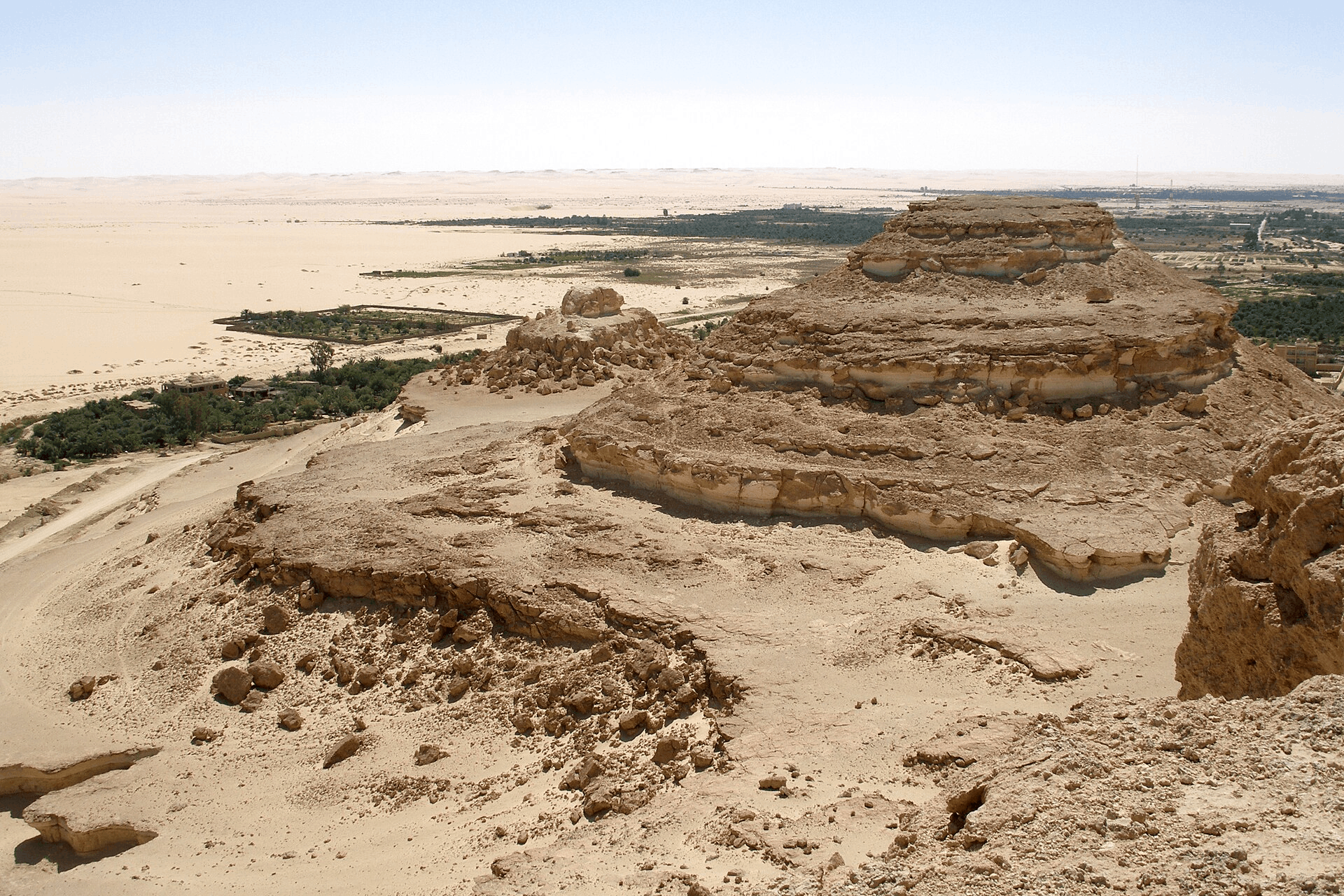
Saharanism empties deserts of all life. Photo of Siwa Oasis in Libya by Vyacheslav Argenberg, 2007.
Saharanism empties deserts of all life. The contrived desert nonlife prevents mobilization of human natural empathy to include deserts. Look at the depictions of deserts in Star Wars and Dune, and you will see that they are forlorn, junky, and forsaken places. Their dwellers are usually mired in poverty and suffer from a yoke of some sort. The image of a treeless desert in one of these fantastic movies lasts longer in the brain of a child or a young adult than would an adorable book about the same places.
Desert ecological care, which I call “Indigenous ecocare” in the book, provides some deeply needed answers. Ibrahim al-Koni, author of al-Majūs (The Magians), proposes his notion of “waḥdar al-kā’ināt” (the unity of beings/creatures) to stress that no human life can be sustained in deserts without the sustenance of all lives.
When humans realize that even their anthropocentrism depends on centering other creatures, maybe their view of deserts and their life will change.
---
Featured Image: Burning Man in the Black Rock Desert, taken from space. Photo by European Space Agency, 2024.
Gustavo Sanchez-Bachman is a Ph.D. Candidate in Cultural Anthropology at Binghamton University. They study migration, conservation politics, and practices of care in Southern Arizona and Northern Sonora, and their work is informed by ongoing activist work with humanitarian aid groups since 2016. Gustavo has also worked in climate governance and international development projects surrounding women’s involvement in climate diplomacy. Contact.
Brahim El Guabli is an Indigenous Amazigh scholar from Morocco. He is Associate Professor of Arabic Studies and Comparative Literature at Williams College, where he also coordinates the Coordinate Program on Native American and Indigenous Studies. He is the author of the award-winning book Moroccan Other-Archives: History and Civilization after State Violence (Fordham University Press, 2023), Desert Imaginations: A History of Saharanism and Its Radical Consequences (University of California Press, 2025), which is a finalist for the African Studies Association’s 2026 Best Book Award, and of the forthcoming book provisionally entitled Amazighitude: Living Amazigh Indigeneity in the World. Instagram. BlueSky. Contact.
- Share on Bluesky (Opens in new window)Bluesky
- Share on Facebook (Opens in new window)Facebook
- Share on X (Opens in new window)X
- Share on Threads (Opens in new window)Threads
Desert Landscape History Interviews Landscapes of Extraction
---