
Micron’s Numbers Show Why HBM4 Memory Is Worth 15X Its Weight In Gold
It may turn out that HBM stacked DRAM is the most profitable product in the six decade history of commercial information technology. IBM’s mainframe engines in the 1970s might be in the same zone, depending on how you allocate costs and revenues. But my gut says in terms of driving revenues and profits, HBM stacked DRAM packaging beats the monolithic systems technology (MST) packaging of the System/370s in the 1970s and the thermal conduction module (TCM) packaging of the System/3081 in the 1980s.
It just goes to show you how valuable advanced packaging has been in the past and how it still matters here in the future.
NEXTPLATFORM AD
And no matter what, the growth of the HBM market, and the revenues of Micron Technology, Samsung, and SK Hynix are skyrocketing much faster than the IBM mainframe ever did. This is a thing to behold, and it underpins the growth of Nvidia and AMD. Not to put too fine a point on it, but without the high bandwidth stacked DRAM these companies make, the GenAI revolution would not – and could not – have happened.
I have been covering Micron’s financials since this boom started, and I will be adding Samsung and SK Hynix in the next round of numbers to complete the set. But for now, let’s go over the results from Micron in its fiscal 2026 ended on September 3. The numbers are downright agog. (Or maybe they are upright gog. . . . )
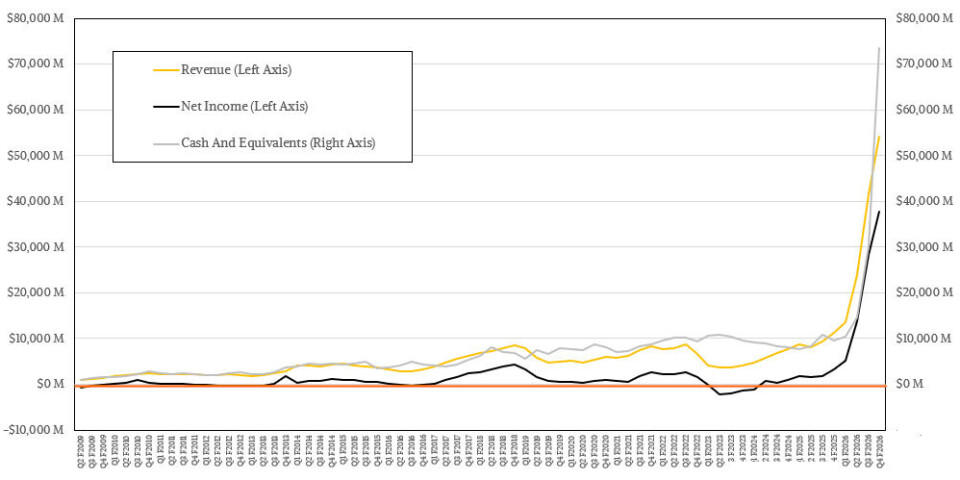
In the quarter, Micron’s revenues went skyward, up 4.8X year on year to $54.23 billion. Operating income was up nearly 12X from the year ago period, to $43.75 billion, and net income also rose by 12X to $37.7 billion. Micron is bringing 69.5 percent of revenue to the bottom line, and it is not even a little tempted to try to build its memory and flash foundries any faster than its already ambitious plan.
Micron has enough cash on hand to build about nearly four fabs, at $73.45 billion, up by 7.6X from a year ago, but it only spent $10.77 billion on capital expenses because building foundries is like having a baby. You can’t have nine women split the work up in parallel and do it within a month. You have to go from conception to birth, serially. Moreover, all of the memory makers are pretty sure that the AI bubble will hold through 2028 at the very least and probably into 2030, and none of them are in any hurry to create a bust cycle where there is a massive boom.
NEXTPLATFORM AD
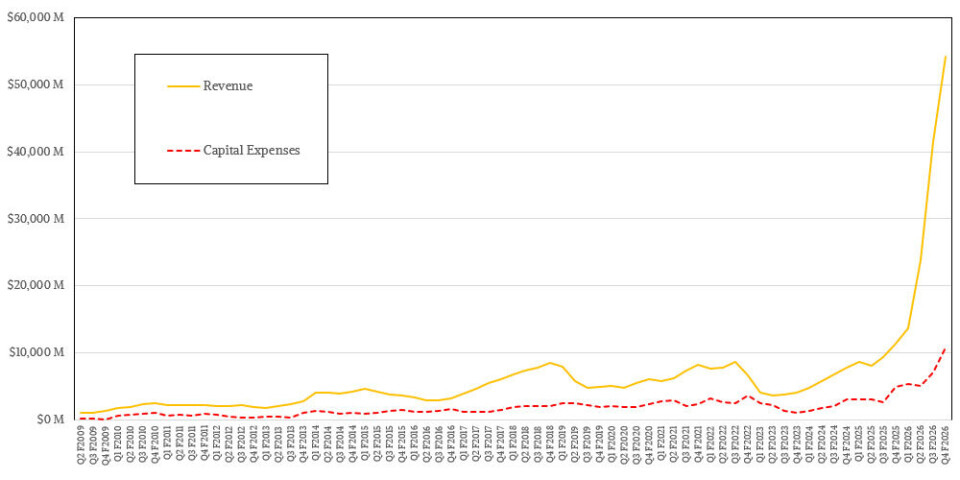
They’re learning, like OPEC nations with oil.
The memory business has always been plagued by boom-bust cycles, and none of the DRAM and flash vendors wants to create an oversupply situation. Not when insane demand and supply shortages are driving up prices – and profits – sky high. Even if Micron, Samsung, and SK Hynix could build and ramp a foundry in a year, they might choose not to because memory prices per unit capacity just keep rising. They are all trying to do the least work for the maximum revenue and the lowest possible cost, and there has never been such a shiny golden hour in the history of IT.
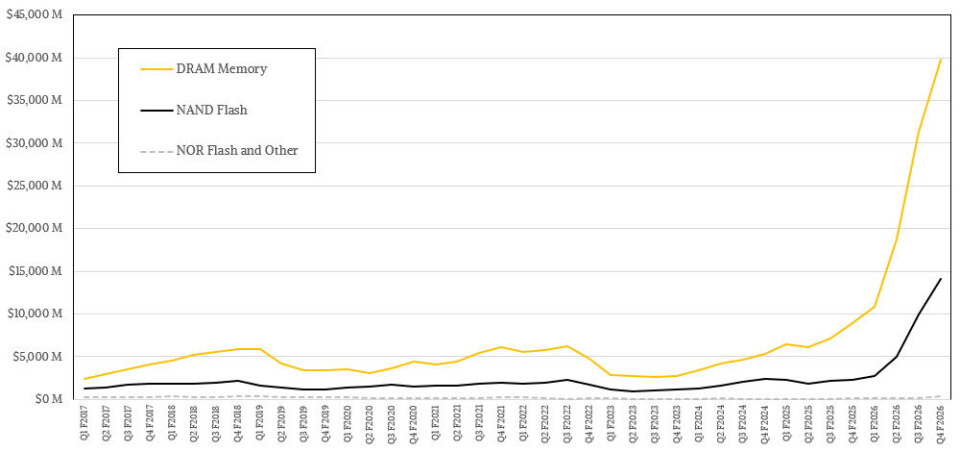
The DRAM business, which includes various kinds of memory chips including low-power LPDDR that is being increasingly used in some AI server systems, high capacity server memory based on regular DRAM, and “normal” DRAM for PCs, tablets, and smartphones. The DRAM business rose by 4.4X to $39.77 billion in the quarter, and despite HBM’s best intentions with rising prices, DRAM was not Micron’s fastest growing product line. Flash non-volatile storage was, with sales up 6.2X to $14.1 billion.
If capacity were not a constraint – meaning, if Micron could drop in working foundries in a few quarters rather than several years – it would still take many years for the flash business to catch up to the DRAM business. That said, for a dollar of capex, NAND flash memory foundries are easier and cheaper to add than DRAM foundries, and given the demand, I expect for Micron to build out this business as fast as is practical. The difficulty of bringing clean room DRAM foundries online – and the higher expense – is why we expect Micron to move slower here in terms of bits shipped.
NEXTPLATFORM AD
No matter what, Micron’s chief technology officer, Scott DeBoer, told Wall Street analysts that the company is two generations ahead of ChangXin Memory Technologies (CXMT), China’s up and coming indigenous memory maker, and you can bet that it will make sure it stays two generations ahead to keep its customers from moving to Chinese memory. CXMT just went public on the Shanghai Stock Exchange in July, raising $8.6 billion. Which is a pittance compared to the kind of profits its rivals are now enjoying. But you can bet that China is dead serious about supplying its own memory and trying to sell it globally. It is only a matter of time.
But for now, Micron is rolling in it.
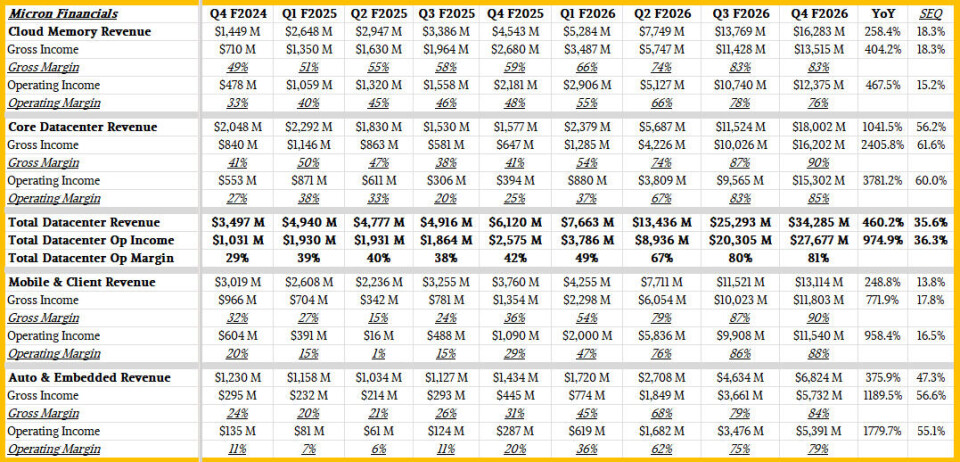
The Cloud Memory business unit, which is dominated by HBM memory, is not as large or as profitable as the Core Datacenter business unit, which is where regular DRAM and flash are stashed. But make no mistake. At this point, both are growing crazy fast and are incredibly profitable.
In fiscal Q4, the Cloud Memory business had sales of $16.28 billion, up 3.6X year on year and up 18.3 percent sequentially. Gross income was 83 percent of sales ($13.52 billion) and operating income was 76 percent of sales ($12.38 billion). Gross income grew by 5X and net income grew by 4.7X year on year. To say that Micron has extraordinary pricing power is a massive understatement. We would love to know how much of this growth is higher pricing for HBM and high-end DRAM and how much is increased capacity.
NEXTPLATFORM AD
Mark Murphy, Micron’s chief financial officer, said on the call that DRAM bits shipped rose by a single digit percentage in Q4 and that prices increased in the “high teens percentage range.” With flash, bits shipped rose by 10 percent year on year and prices increased by 30 percent. But again, these are across all products. I think the price increases for HBM, LPDDR, and high-end DRAM for servers were higher than that average and that shipments were also a lot higher than the average. There is no other way to get the kinds of numbers the Micron datacenter business has.
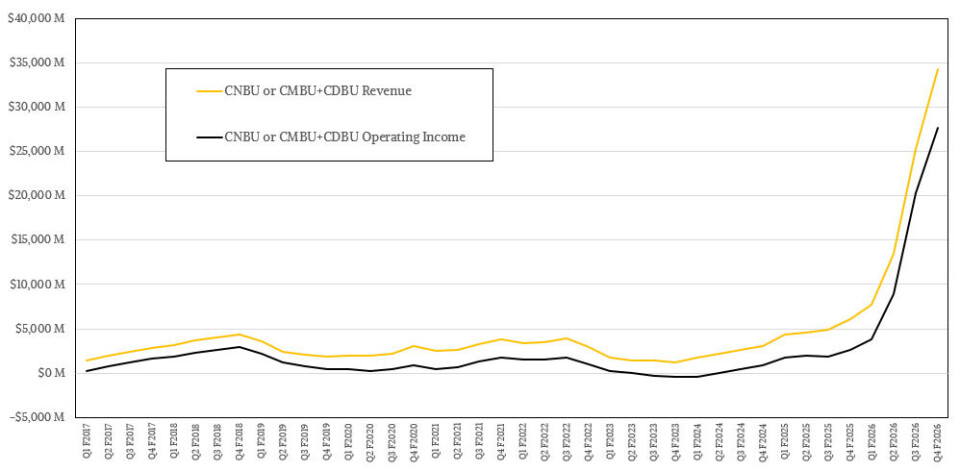
The Core Datacenter business was up 11X year on year to a tad over $18 billion, a testament to how DRAM and flash are core components in AI clusters, whether they are for training, inference, or AI sandboxes executing agentic AI code and tools.
Add them together, and Micron’s datacenter revenue rose by 5.6X to $34.29 billion, which was 35.6 percent sequential growth. The company’s datacenter product operating income rose by 10.7X to $27.68 billion, and represented 81 percent of revenues for the datacenter products as a whole. Amazing.
Excepting that Micron gets revenues and profits that are even higher in its mobile, client, auto, and embedded segments, and that has helped pay for development of the datacenter stuff, I really don’t care much about these. But the data is in the table above for you to peruse.
Basically, as a best friend’s mom used to say when someone was fortunate, Micron has “sat in a tub of butter.” It can do no wrong at the moment, and is just raking in the money with a combine a half acre wide.
Micron no longer gives us data, or even just good hints, about how the HBM, high-end server DRAM, and LPDDR segments of the DRAM space are doing. But I take the data we get and what I see going on in the industry and take a stab at predicting how these key three product segments do in terms of driving sales for Micron. Take a gander:
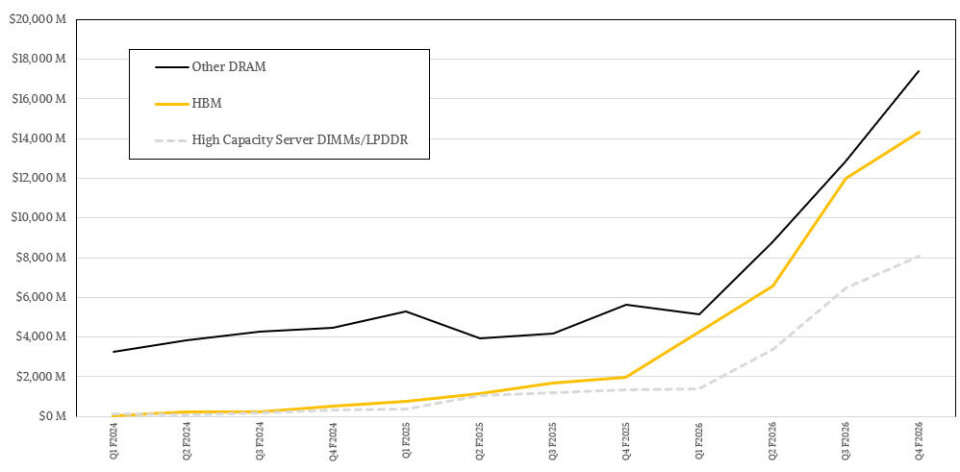
My best guess has HBM memory driving $14.33 billion in fiscal Q4, up 7.6X year on year, with high capacity server DIMMs and LPDDR memory together driving $8.05 billion in sales, up 6.1X compared to Q4 F2025. The rest of the DRAM sold by Micron I estimate to be $17.39 billion, growing at 3.1X year on year.
Going forward in 2027, Micron is going to hike the price of its HBM memory to get its profit profile in line with regular DRAM. Sanjay Mehrotra, Micron’s chief executive officer, said on the call that Micron has "completed agreements for the vast majority of our calendar 2027 HBM bit supply with significant price increases year over year, narrowing the gross margin gap with conventional DRAM."
The HBM4 ramp, Mehrotra added, is proceeding apace and the company has a “strong roadmap for future HBM products,” calling out the work the company is doing with Nvidia for the industry’s first custom-HBM4E implementation, NVHBM, which will be adopted in next generation of GPUs and NVLink Fusion platforms from Big Green.
In general, Mehrotra said that memory and flash will be under tighter constraints in calendar 2027 and 2028 than they were in calendar 2026 – sorry, folks, move along, nothing to see here. This calendar year, Micron is growing DRAM bits shipped by the mid-20s percent range, and in calendar 2027 and 2028, it will only grow in the low 20s percent. With flash, it flips, just as we hinted at above. Flash capacity shipped in calendar 2026 was in the low 20s percent range, and in calendar 2027 and 2028, it will be in the mid-20s percent range. Again, it is easier and cheaper to expand flash manufacturing than it is to expand DRAM capacity, and expanding HBM capacity is harder and harder because increasingly taller DRAM stacks running at higher speeds have a higher chance of being a manufacturing dud.
Micron did say it would expand its capex in fiscal 2027, and that this extra spending would aim to increase DRAM output. It will have to do that as it moves into HBM4E and HBM5, which are going to burn through DRAM because of dud stacks faster than HBM4 and HBM3E did. (With higher DRAM speeds and higher stacks, the yields necessarily go down. And will keep getting worse.)
And just for fun, here is the Micron HBM market forecast from June, which was not updated in the September quarter:
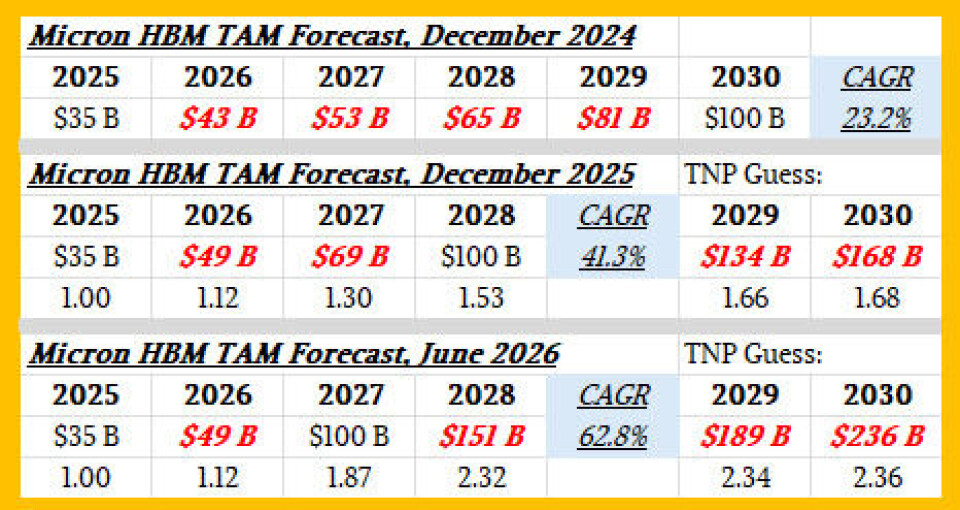
Crazy, isn’t it? Micron wanted to get rich, like all companies want to, but this GenAI boom has made all the memory and flash makers richer than they ever imagined.
To secure supplies of memory and flash, Micron’s customers have shelled out $32 billion on prepayments, which is why that cash pile is so high. The company has inked 26 supplier agreements that cover around 35 percent of its revenues between now and fiscal 2030, and Mehrotra said that it will eventually have agreements that represent around half of sales. Micron has $150 billion in remaining performance obligations – what is colloquially called revenue backlog – and this only represents deals with fixed price floors and committed volumes. There are presumably customers who have deals without fixed pricing and without committed volumes, but it is hard to imagine why given this environment.
As for guidance, Micron only talked about Q1 F2027, and said sales were expected to be $61.5 billion, plus or minus $1.5 billion. That is 13 percent sequential growth, which is not huge by comparisons to other quarters. But it is huge year on year, up 4.5X compared to the $13.64 billion Micron brought in for Q1 F2025.
Which brings me to my final point: A twelve-high HBM stack probably weighs somewhere around a quarter gram and costs maybe $500 to $600, depending on the customer and the volumes. At that weight, you need about 125 stacks to get a troy ounce of HBM4. That is a cost of $62,500 to $75,000 per troy ounce. Gold is trading at $4,176 per troy ounce as this story goes to press, which makes an HBM4 stack worth 15X to 18X that of gold.
Strange new world.
[](https://www.facebook.com/sharer.php?u=https%3A%2F%2Fwww.nextplatform.com%2Fstore%2F2026%2F10%2F02%2Fmicrons-numbers-show-why-hbm4-memory-is-worth-15x-its-weight-in-gold%2F5300701) [](https://twitter.com/intent/tweet?url=https%3A%2F%2Fwww.nextplatform.com%2Fstore%2F2026%2F10%2F02%2Fmicrons-numbers-show-why-hbm4-memory-is-worth-15x-its-weight-in-gold%2F5300701) [](https://www.linkedin.com/sharing/share-offsite/?url=https%3A%2F%2Fwww.nextplatform.com%2Fstore%2F2026%2F10%2F02%2Fmicrons-numbers-show-why-hbm4-memory-is-worth-15x-its-weight-in-gold%2F5300701) [](https://bsky.app/intent/compose?text=Micron%E2%80%99s%20Numbers%20Show%20Why%20HBM4%20Memory%20Is%20Worth%2015X%20Its%20Weight%20In%20Gold%0Ahttps%3A%2F%2Fwww.nextplatform.com%2Fstore%2F2026%2F10%2F02%2Fmicrons-numbers-show-why-hbm4-memory-is-worth-15x-its-weight-in-gold%2F5300701) [](https://www.reddit.com/submit?url=https%3A%2F%2Fwww.nextplatform.com%2Fstore%2F2026%2F10%2F02%2Fmicrons-numbers-show-why-hbm4-memory-is-worth-15x-its-weight-in-gold%2F5300701&title=Micron%E2%80%99s%20Numbers%20Show%20Why%20HBM4%20Memory%20Is%20Worth%2015X%20Its%20Weight%20In%20Gold) [](https://api.whatsapp.com/send?text=Micron%E2%80%99s%20Numbers%20Show%20Why%20HBM4%20Memory%20Is%20Worth%2015X%20Its%20Weight%20In%20Gold%0Ahttps%3A%2F%2Fwww.nextplatform.com%2Fstore%2F2026%2F10%2F02%2Fmicrons-numbers-show-why-hbm4-memory-is-worth-15x-its-weight-in-gold%2F5300701)
NEXTPLATFORM AD
 Micron’s Numbers Show Why HBM4 Memory Is Worth 15X Its Weight In Gold October 2, 2026
compute Optimization Is The Key Challenge For Quantum Computing September 30, 2026
AI Nvidia Wraps Security Layer Around Agentic AI To Stop Rogue Behavior September 30, 2026
ai  AMD Buys World Labs For $8.2 Billion To Get AI Model Cred September 29, 2026
COMPUTE  IonQ: There Is One CPU To Rule Error Correction Decoding September 25, 2026
 Improving Quantum Error Correction By Meshing Surface Code With IBM’s Heavy-Hex Architecture September 23, 2026
 Vector Search Is Now A Data Type, But The Money Math Has Not Gone Away September 22, 2026
 SPONSORED Sovereign AI Overcomes Compliance Challenges And Feeds Innovation September 22, 2026
COMPUTE Accelerated Server Sales Are Themselves Accelerating September 21, 2026
CONNECT The GenAI Boom Accelerates And Transforms Ethernet Switching September 20, 2026
 Bull Beats Out HPE For Next-Gen Lumi AI Supercomputer September 17, 2026
 Infleqtion And Nvidia Reduce Physical-to-Logical Qubit Ratio in Quantum Computers September 16, 2026
 How To Smash The Memory Wall Plaguing High Performance Systems September 16, 2026
 SPONSORED POST Operationalize AI At Scale With HPE And Nvidia September 15, 2026
 CLOUD Despite Hefty Capital Investments, The Cloud Starts Paying Off For Oracle September 14, 2026
 CONNECT Broadcom Rides Rocketing Trend For Custom AI Accelerators September 10, 2026
 Startup d-Matrix Will Pair Its Raptor Memory-Based XPU To Nvidia Rackscale Iron September 10, 2026
 HPE Sees No Customer Pushback On Rising Datacenter Equipment Costs September 8, 2026
COMPUTE  Dell Says AI Will Drive 75 Percent Of Datacenter Demand By 2030 September 8, 2026
Nvidia Expands Its Open Source AI Presence With $12.9 Billion Hugging Face Buy September 3, 2026
Optics Still Driving Marvell’s AI Business More Than Custom Chips September 2, 2026
CLOUD  VMware Intros Private AI Cloud, AI Factory As Workloads Shift To On-Prem September 1, 2026
In The Long Run, Nvidia NVSwitch Is The InfiniBand Of Scale Up AI Networks August 31, 2026
COMPUTE Peeling Apart That Supposed $120 Billion Chip Deal Google Inked With Marvell August 27, 2026
 COMPUTE The Network Is More Of Nvidia’s Computer Than It Ever Was At Sun August 27, 2026
 STORE You Probably Forget How Cheap Memory Used To Be – And Is Not So Now August 25, 2026
 COMPUTE IBM Pushes System Design To Reach Ultra-Cold Temperatures For Quantum August 19, 2026
 COMPUTE Cerebras Overclocks WSE-3 Waferscale Engine To Boost Inference Oomph In “Nexus” CS-4 August 19, 2026