




Lo Gran Mar

Today would have been Om Malik’s 60th birthday. To celebrate, his friends booked a cozy Arts and Crafts heritage space on Market Street and will spend the day reminiscing about Om and rejoicing in his life. There is a lot on display and a lot to celebrate, as Om broke the mold in many respects.
Om’s life wasn't easy to distill; he collected rare pens, sending friends to Japan on secret pen-finding missions in service of his obsession. He only drank excellent coffee, making you go out of your way for a meeting because he wouldn’t do Philz. He wore selvage denim and Brunello Cucinelli and eventually interviewed the man himself about craft. He was obsessed with watches, perfume, and tea. His reading glasses were Maison Bonnet.
Om lived as an antidote to the velocity of late-stage capitalism. In his book Psychopolitics, Byung-Chul Han describes an era in which we are compelled to constantly refine and optimize ourselves, essentially turning humans into widgets in the Rube Goldberg machine of the free market. We gravitate toward whatever is quick and convenient, converging on the average. This results in a commodification and subsequent enshittification of life—a “progressive degradation” according to Om.
You can spot this efficiency motive in everything we do since the Industrial Revolution, accelerated by software, even in our philanthropy. Fashionable effective altruism brings our quantification fetish to charitable giving. But a life well-lived cannot be summed up in a QALY; it is a sensibility, in other, more cliched words, “a taste.”
Om had this sensibility, and it wasn’t just material; his writing was peppered with literary and philosophical references, hearkening to his deep curiosity and associative intelligence. Particularly striking pieces are “We Are Living in Pinocchio’s World”, which is as deep a cut as it gets—it opens with a rare Montblanc pen dedicated to Carlo Collodi, the creator of Pinocchio, and ends the way much of his later writing ended, in the hubris of present-day Silicon Valley—and his analysis of Virgil’s Aeneid as propaganda for an empire-building Augustus in “The Myth, the Mythos and the Man.”
Someone, please publish Om’s final essays as a book. They are bangers.
His “Mythos” essay is particularly salient as we enter a more oligarchic era of technological advancement, in which some of us have taken it upon ourselves, by virtue of our CS or ML degrees, to unleash untold, unpredictable forces upon the rest of us, in the name of progress, sure, but also in the name of making money. Profit is easily legible, discernible. Philanthropy, humanism, valuing the human soul, whatever that means, these are harder to account for, relegated to a figurative line item under “goodwill” on a balance sheet.
Om was a version of what writer and investor Tina He calls “the last humanist.” Entrepreneurs, CEOs, bankers, and venture capitalists have market-driven scorecards whose results are easy to measure and acknowledge. Om inhabited that world, too, but his humanism demanded a broader measure. Humanists are fundamentally storytellers whose bottom line is Aristotle’s concept of eudaimonia: human flourishing. Unlike, say, EBITA, it’s fuzzy.
They are romantic, like Lord Byron, who argued in the House of Lords against making frame-breaking punishable by death. Byron empathized with the Luddites, who, watching their livelihoods crushed by the march of profit progress, decided to fight back. And when faced with the inevitability of technology, humanists hope that innovations will be more like the printing press than the stocking frame, unlocking creativity rather than destroying human value.
They care about inefficiencies, like bespoke pen nibs, mechanical watches, and old Leica cameras, because meaning is not always efficient. When effectiveness becomes our only measure, we strip out meaning. But meaning and stories make life worth it: “If we have our own why in life, we shall get along with almost any how,” to quote Nietzsche, another Om fave.
As Om wrote:
“Pinocchio becomes real, becomes human, only after he accepts obligation. Collodi is saying that it is important to have self-governance. It is necessary to choose the difficult truth over the easy satisfying one. That doesn’t jibe with everything the attention economy is selling, dopamine hits delivered so frequently that it becomes hard to distinguish stimulation from autonomy.”
Unless we make a concerted effort to cultivate and fund them1, these humanists are a dying breed, partly because real, hard-won cultural capital has depreciated in the internet age, passed up for symbolic capital and cheap dopamine. In the slop era, it seems futile to care about stories and the materials and craft behind what you’ve made.
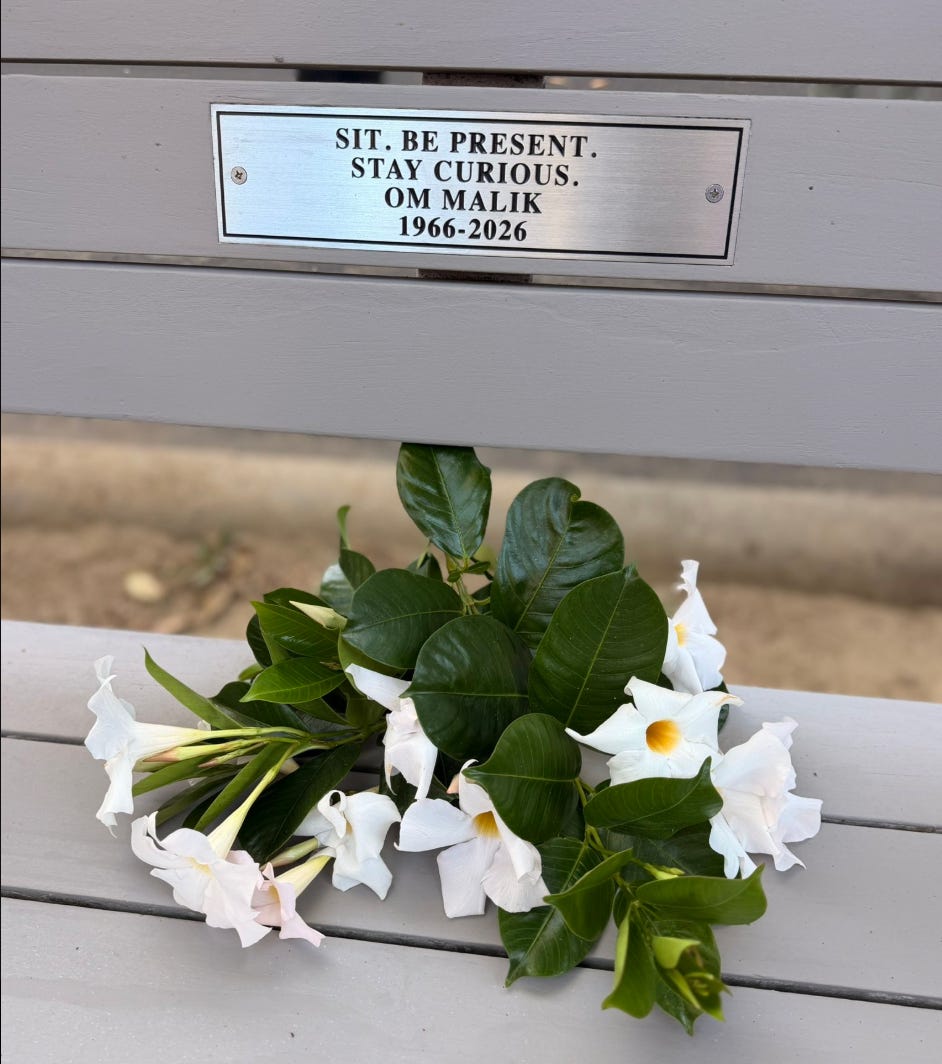
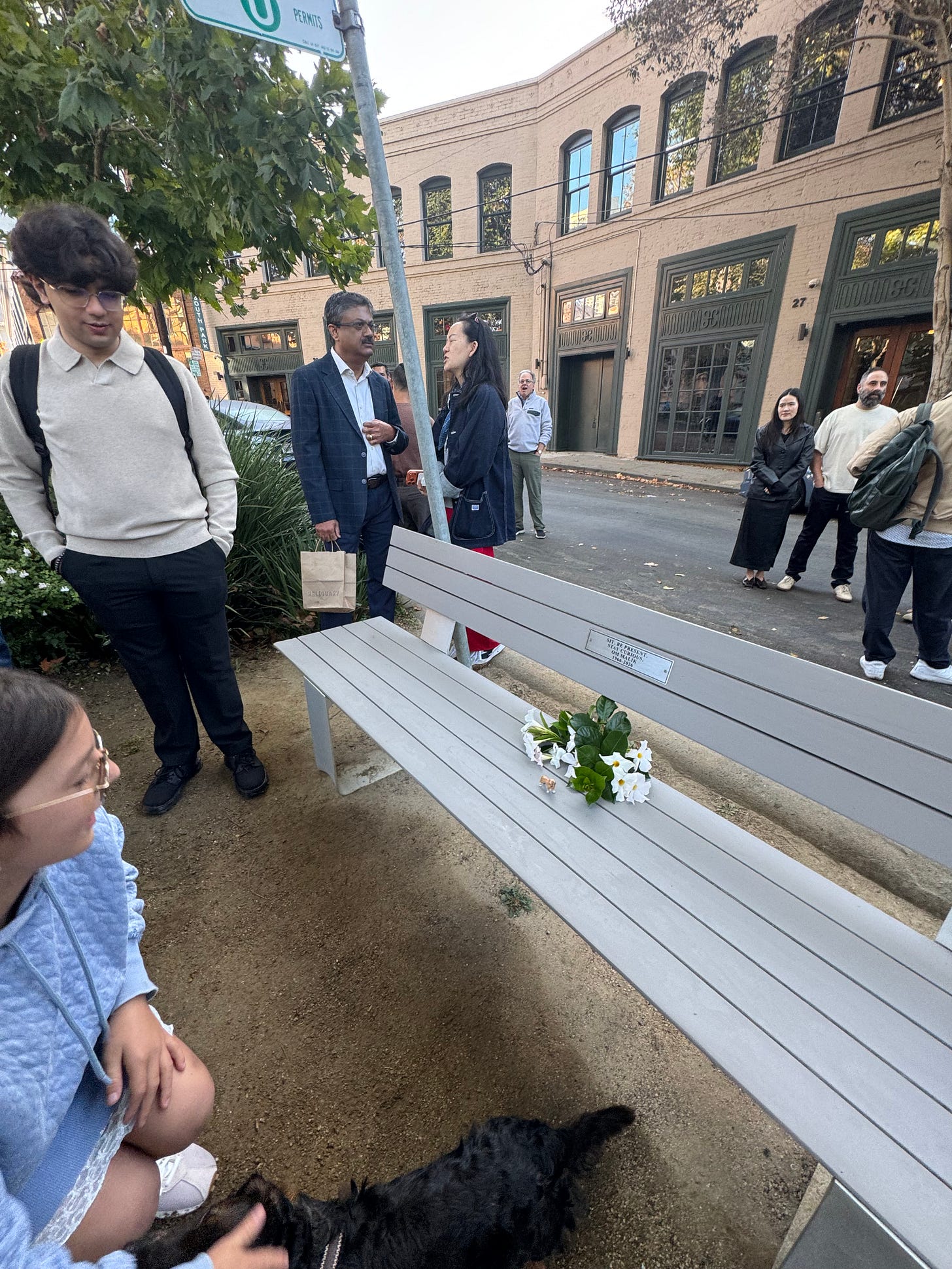
But you can see the importance of actually caring, of putting in the time and effort to make meaning, in the sheer number and extent of lives Om impacted, and in how many people who loved him have stepped up to imbue his Omfest memorial with reciprocal meaning. More than 250 people are signed up on Luma to attend today. And as of this morning, a new park bench with Om’s name on it stands in South Park, a place where he often took meetings, engaging in deep conversations about power, technology, and the common good. “Sit. Be present. Stay curious.”
It is my hope that this bench will serve as a venue for new conversations, ones we desperately need to be having now, whether you’ve taken a side or stayed on the sidelines in the AI boom. Because your voice and story are important and, like Om’s, are unpredictable, idiosyncratic, and, in ways AI could never, irreplacable.

Photos via Matt Mullenweg and Audrey Kim
I am told Om’s family has set up a foundation that will do this very thing.