

Medicine Nobel awarded for brain ‘switch’ that controls neurons with light: live updates
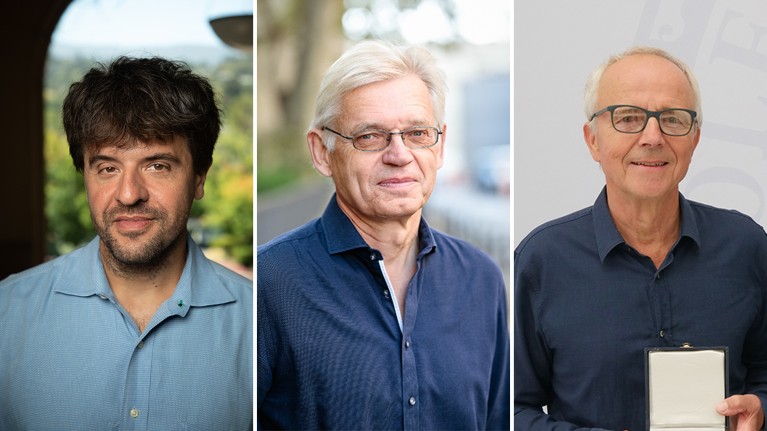
Left to right: Karl Deisseroth, Peter Hegemann and Georg Nagel were awarded the 2026 Nobel prize in medicine for their work on optogenetics.Credit: L-R Stanford Medicine, Humbold-Universität zu Berlin/Philipp Plum, Robert Emmerich/Universität Würzburg
After being on many scientists’ shortlists for years, optogenetics — a technology that allows researchers to control the brain’s neurons with pulses of light — has been recognized by the 2026 Nobel Prize in Physiology or Medicine. The technique has transformed how neuroscientists study the brain, offering them a way to test cause and effect.
The winners are Karl Deisseroth at Stanford University in California, Peter Hegemann at Humboldt University of Berlin, and Georg Nagel at the University of Würzburg in Germany. They share the prize of 12 million Swedish kronor (US$1.2 million).
Deisseroth said that, as a night owl, he had been working late before he received the call from the Nobel committee. “It was a complete surprise,” he told a press conference held by Stanford University today. “I was lying down, just starting to drift off to sleep, and my phone rang at my bedside,” he said. “There were about 30 seconds where I had trouble forming words … but \[it’s\] very exciting and overwhelming, and just delightful.”
 Can you name the women who have won a science Nobel prize?
A switch neuroscientists dreamt of
Neuroscientists’ aim is to unpick the brain’s many roles: how it governs feelings, behaviours and bodily functions. To understand how the brain works and how its cells mediate different behaviours, scientists require an approach that can perturb the system with high precision.
“Optogenetics provides opportunities for mapping the brain in a way that we could once only dream of,” said Per Svenningsson, chair of the Nobel Committee for Physiology or Medicine, in the press release announcing the prize.
Working together in the early 2000s, Hegemann and Nagel discovered a light-sensitive protein called channelrhodopsin1,2 in the alga Chlamydomonas reinhardtii, which is able to swim towards a light source. In response to blue light, the protein opens to allow charged molecules to flood into cells, creating a tiny electrical charge.
In later work, Deisseroth and his colleagues inserted3 the gene encoding channelrhodopsin into neurons of rodents, and found that it could cause the cells to fire and communicate with other neurons. The technology — a light-controlled ‘switch’ that allowed neuroscientists to alter specific cell types in the neural circuits of living brains — soon came to be known as optogenetics. It revolutionized neuroscience.
“We use light to turn on or off individual cells, even or types of cell or connections from one part of the brain to another. We can turn those on and off with millisecond precision in real time during behaviour, during cognition, and that allows us to see what actually matters for brain function and to start to map function and dysfunction precisely,” said Deisseroth. “It’s a real confluence of engineering and medicine.”
Illuminating the brain
The prizewinners’ work “fundamentally changed how we conduct neuroscience” and has “influenced fields far beyond it in biology, and opened new therapeutic possibilities,” says neuroscientist Rui Costa, who is president and chief executive of the Allen Institute in Seattle, Washington. “I first met Karl 23 years ago, and he was already thinking deeply about how to control the activity of specific neurons to understand and alter behaviour. Karl’s commitment not only to discovery, but also to sharing tools and reagents at scale, was equally transformative,” says Costa.
 How to win a Nobel prize: what kind of scientist scoops medals?
The discovery and application of channelrhodopsin has led to a diverse ‘optogenetic toolkit’ that allows scientists in different fields to harness cellular activity with light.
Optogenetics has had a great impact on basic science, says Alexander Gottschalk, a neuroscientist at Goethe University Frankfurt in Germany. “It’s such an easy way, a very precise way, to define which cells should become responsive,” says Gottschalk. “Many people in the field have expected \[this\] for several rounds of Nobels already, but it took until now.”
Into the clinic
Insights provided by optogenetic tools have helped researchers to better understand brain function in health and diseases including depression, schizophrenia, Parkinson’s and Alzheimer’s.
There are also efforts to directly apply optogenetics to treat a form of blindness. In trials, it has been used to partially restore vision in people with a genetic disease called retinitis pigmentosa, which causes a gradual death of the light-sensitive cells in the retina. Four biotechnology companies have ongoing trials of optogenetic technologies for retinitis pigmentosa. One of the firms, Nanoscope Therapeutics in Dallas, Texas, is seeking approval from the US Food and Drug Administration for its approach.
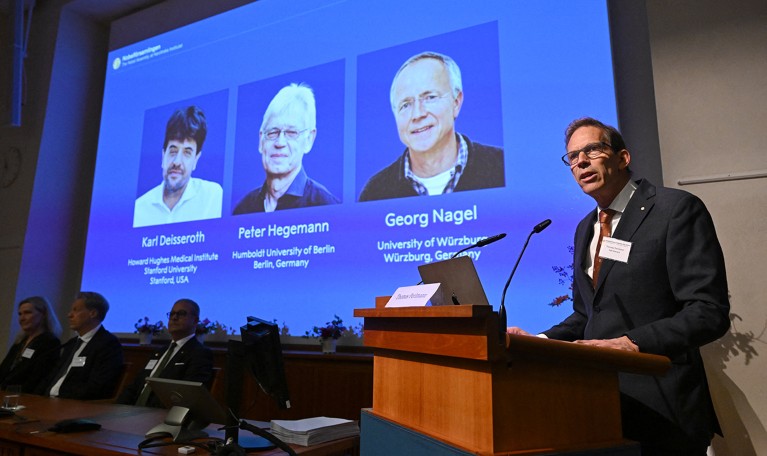
Karl Deisseroth, Peter Hegemann and Georg Nagel have won the 2026 Nobel Prize in Medicine or Physiology for their discoveries in optogenetics, announced by Nobel Committee secretary-general Thomas Perlmann (right).Credit: Jonathan Nackstrand/AFP via Getty
Enjoying our latest content?
Log in or create an account to continue- Access the most recent journalism from Nature's award-winning team
- Explore the latest features & opinion covering groundbreaking research
-
 Restoring vision with optogenetics
-
 Ion channel in the spotlight
-
 How to win a Nobel prize: what kind of scientist scoops medals?
- Implanted device enables responsive bladder control
- Optogenetics: 10 years after ChR2 in neurons—views from the community
-
 Will AI ever win its own Nobel? Some predict a prize-worthy science discovery soon
-
 Can you name the women who have won a science Nobel prize?
- Neuroscience
- Physiology
- Neuroscience
- Physiology
-
 How to respond to hate speech without fuelling it further News Q&A 02 OCT 26
-
 ‘Vibe coding’ makes the dictionary: AI terms recognized by Merriam-Webster News 01 OCT 26
-
 An amygdala to anterior hypothalamic circuit gates stress sensitivity Article 30 SEP 26
-
 ‘What took them so long?’ This year’s medicine Nobel winner is overdue News 05 OCT 26
-
 Old hearts age backwards: transplanted organs adjust to host’s biological age News 28 SEP 26
-
 GLP-1 drugs fail to help some people lose weight — scientists are on a quest for answers News 24 SEP 26
- #### Proteomics Specialist Build the science that shapes the future of human health. Application closing date: 08 November 2026 Join a place where ambitious science thrives... Milan (IT) Human Technopole
- #### Tenure-Track Professor/Associate Professor/Assistant Professor The University of Hong Kong We are seeking a motivated Tenure-Track Professor/Associate Professor/Assistant Professor to join our Department of Pha... Hong Kong (HK) The University of Hong Kong
- #### Global Recruitment for Faculty and Researchers at Anhui Normal University Anhui Normal University sincerely invites outstanding researchers and academics worldwide to join its faculty. Wuhu, Anhui (CN) Anhui Normal University
- #### Scientific Project Manager Human Technopole is hiring a Scientific Project Manager who will act as the operational lead of the European project PRE-CVD. Milan (IT) Human Technopole
- #### Miguel Servet Researcher Position
Access through your institution
or
doi: https://doi.org/10.1038/d41586-026-03091-2
Additional reporting by Anne Pichon.
References
1. Nagel, G. et al. Science 296, 2395–2398 (2002). Article PubMed Google Scholar 2. Nagel, G. et al. Proc. Natl Acad. Sci. USA 100, 13940–13945 (2003). Article PubMed Google Scholar 3. Boyden, E. S., Zhang, F., Bamberg, E., Nagel, G. & Deisseroth, K. Nature Neurosci. 8, 1263–1268 (2005). Article PubMed Google Scholar
